


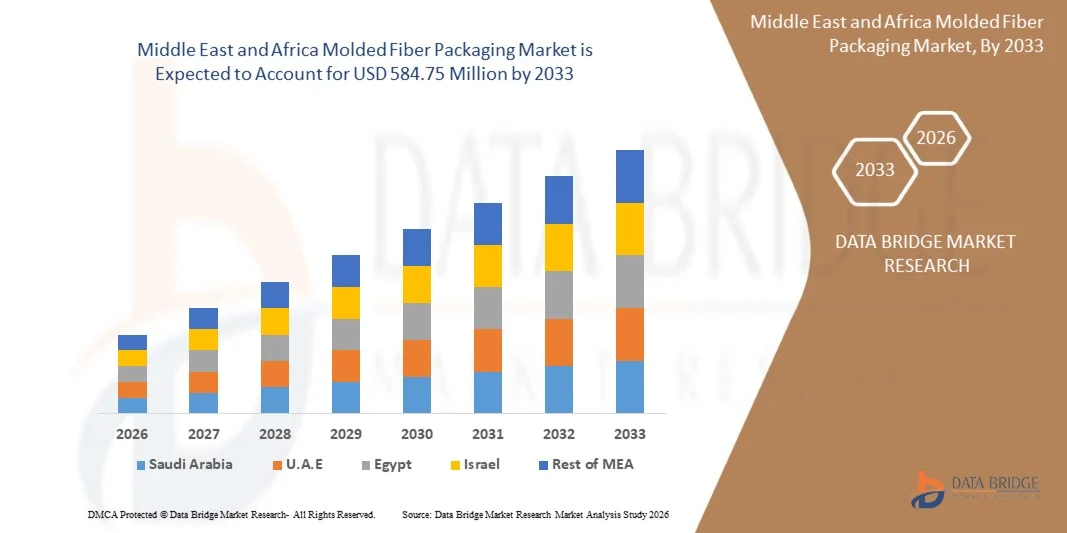
Middle East and Africa Molded Fiber Packaging Market Size
- The Middle East and Africa Molded Fiber Packaging Market size was valued at USD 401.86 million in 2025 and is projected to reach USD 584.75 million by 2033, growing at a CAGR of 4.80% during the forecast period.
- The market expansion is primarily driven by increasing environmental awareness and the rising adoption of sustainable and eco-friendly packaging solutions across food & beverage, electronics, and consumer goods sectors.
- Additionally, stringent government regulations promoting the use of biodegradable materials, along with growing consumer preference for recyclable and compostable packaging, are accelerating the adoption of molded fiber packaging solutions, thereby significantly fueling the market’s growth.
Middle East and Africa Molded Fiber Packaging Market Analysis
- Molded fiber packaging, offering sustainable and biodegradable alternatives to conventional packaging, is becoming increasingly vital across food & beverage, electronics, and consumer goods sectors in both residential and commercial applications due to its eco-friendliness, cost-effectiveness, and versatility.
- The rising adoption of molded fiber packaging is primarily driven by increasing environmental awareness, stringent government regulations on single-use plastics, and growing consumer preference for recyclable and compostable packaging solutions.
- U.A.E. dominated the Middle East and Africa Molded Fiber Packaging Market with the largest revenue share of 35.2% in 2025, supported by strong initiatives promoting sustainable packaging, high manufacturing activity in the food processing sector, and the presence of major packaging companies investing in molded fiber innovations.
- Saudi Arabia is expected to be the fastest-growing region in the Middle East and Africa Molded Fiber Packaging Market during the forecast period due to rapid urbanization, increasing demand for packaged foods, and rising adoption of eco-friendly packaging solutions.
- The thick-wall segment dominated the market with the largest revenue share of 41.5% in 2025, driven by its superior durability, impact resistance, and suitability for heavy or fragile products such as electronics and packaged beverages.
Report Scope and Middle East and Africa Molded Fiber Packaging Market Segmentation
|
Attributes |
Molded Fiber Packaging Key Market Insights |
|
Segments Covered |
|
|
Countries Covered |
Middle East and Africa
|
|
Key Market Players |
|
|
Market Opportunities |
|
|
Value Added Data Infosets |
In addition to the insights on market scenarios such as market value, growth rate, segmentation, geographical coverage, and major players, the market reports curated by the Data Bridge Market Research also include import export analysis, production capacity overview, production consumption analysis, price trend analysis, climate change scenario, supply chain analysis, value chain analysis, raw material/consumables overview, vendor selection criteria, PESTLE Analysis, Porter Analysis, and regulatory framework. |
Middle East and Africa Molded Fiber Packaging Market Trends
“Advancements in Sustainable and Smart Packaging Solutions”
- A significant and accelerating trend in the Middle East and Africa Molded Fiber Packaging Market is the adoption of innovative, eco-friendly, and smart packaging solutions that combine sustainability with functional design, enhancing product protection and consumer convenience.
- For instance, companies such as Huhtamaki and Smurfit Kappa are developing molded fiber trays and containers that are fully biodegradable yet durable, suitable for sensitive products such as fresh produce, electronics, and beverages.
- Smart packaging integration allows features such as QR codes, NFC tags, or embedded sensors to provide product information, track freshness, or monitor storage conditions. For example, some molded fiber food containers now include freshness indicators or temperature-sensitive labels that inform consumers about the quality of perishable goods.
- These innovations facilitate centralized tracking and quality control throughout the supply chain, reducing waste and improving inventory management for manufacturers and retailers.
- The trend towards more functional, sustainable, and intelligent packaging is fundamentally reshaping consumer expectations for eco-friendly products. Companies such as Eco-Pak and GreenPack are developing molded fiber solutions with embedded tracking and freshness-monitoring capabilities to meet these evolving demands.
- The demand for molded fiber packaging with integrated sustainability and smart functionality is growing rapidly across food & beverage, consumer goods, and electronics sectors, as both consumers and businesses increasingly prioritize environmentally responsible and technologically enhanced packaging solutions.
Middle East and Africa Molded Fiber Packaging Market Dynamics
Driver
“Growing Demand Driven by Environmental Awareness and Regulatory Support”
- The increasing focus on sustainability among consumers and businesses, coupled with stricter government regulations on single-use plastics and non-biodegradable packaging, is a significant driver for the heightened demand for molded fiber packaging.
- For instance, in 2025, the UAE government launched initiatives to phase out non-recyclable plastics in food and retail packaging, encouraging manufacturers to adopt biodegradable alternatives. Such strategies by key authorities are expected to accelerate the adoption of molded fiber packaging across the Middle East and Africa during the forecast period.
- As consumers and businesses become more conscious of environmental impact, molded fiber packaging offers eco-friendly solutions that are recyclable, compostable, and biodegradable, providing a compelling alternative to traditional plastic and Styrofoam packaging.
- Furthermore, the rising demand for sustainable packaging in food & beverage, consumer goods, and electronics sectors is making molded fiber solutions a preferred choice, offering durability, protective qualities, and alignment with corporate sustainability goals.
- The versatility of molded fiber packaging for various applications, combined with its compatibility with branding and labeling requirements, is propelling adoption in both residential and commercial supply chains. Increasing awareness campaigns and eco-conscious consumer behavior further contribute to market growth.
Restraint/Challenge
“High Production Costs and Limited Manufacturing Infrastructure”
- The relatively higher production cost of molded fiber packaging compared to conventional plastic alternatives poses a significant challenge to broader market adoption, particularly in price-sensitive regions within the Middle East and Africa.
- For instance, the cost of raw materials, specialized machinery, and energy-intensive processes can make molded fiber products more expensive for small- and medium-sized enterprises.
- Additionally, the limited availability of manufacturing facilities and technological expertise in some regions can hinder rapid scale-up and distribution, restricting market penetration.
- Addressing these challenges through investment in cost-efficient production technologies, expansion of regional manufacturing capacity, and development of public-private partnerships to support sustainable packaging initiatives is crucial for fostering market growth.
- While awareness of environmental benefits is rising, price sensitivity and infrastructure constraints remain key barriers to adoption, particularly for smaller companies and developing markets within the region.
- Overcoming these challenges through technological innovation, economies of scale, and government incentives will be vital for sustained growth in the molded fiber packaging market.
Middle East and Africa Molded Fiber Packaging Market Scope
The molded fiber packaging market is segmented on the basis of the type, source, product and end user.
• By Type
On the basis of type, the Middle East and Africa Molded Fiber Packaging Market is segmented into thick-wall, transfer molded, thermoformed fiber, and processed pulp. The thick-wall segment dominated the market with the largest revenue share of 41.5% in 2025, driven by its superior durability, impact resistance, and suitability for heavy or fragile products such as electronics and packaged beverages. Thick-wall molded fiber packaging is preferred by manufacturers seeking reliable protection during storage and transportation while maintaining eco-friendly credentials.
The transfer molded segment is expected to witness the fastest CAGR of 19.8% from 2026 to 2033, fueled by growing demand in food service and takeaway industries. Transfer molded packaging offers design flexibility, lightweight properties, and quick production capabilities, making it increasingly popular among commercial and industrial users requiring customized, sustainable packaging solutions.
• By Source
On the basis of source, the Middle East and Africa Molded Fiber Packaging Market is segmented into wood pulp and non-wood pulp. The wood pulp segment dominated the market with the largest revenue share of 62.3% in 2025, owing to its availability, biodegradability, and superior molding properties. Wood pulp-based packaging is widely adopted across food & beverage and consumer goods industries for trays, clamshells, and boxes.
The non-wood pulp segment is expected to witness the fastest CAGR of 21.1% from 2026 to 2033, driven by the rising use of agricultural residues, bagasse, and bamboo as sustainable alternatives to traditional wood pulp. Non-wood pulp packaging offers eco-friendly solutions with lower environmental impact, attracting manufacturers and consumers seeking circular economy-friendly products.
• By Product
On the basis of product, the Middle East and Africa Molded Fiber Packaging Market is segmented into trays, clamshell containers, boxes, end caps, and others. The trays segment dominated the market with the largest revenue share of 39.7% in 2025, primarily due to its widespread use in the food & beverage sector for bakery, dairy, and fresh produce packaging. Trays provide structural integrity, maintain product freshness, and support sustainability goals.
The clamshell container segment is expected to witness the fastest CAGR of 20.5% from 2026 to 2033, driven by increasing demand in the takeaway, ready-to-eat meals, and fast-food sectors. Clamshells are valued for their convenience, tamper-evident design, and compatibility with retail branding requirements, making them a preferred choice for modern food packaging solutions.
• By End User
On the basis of end user, the Middle East and Africa Molded Fiber Packaging Market is segmented into food & beverage, electronics, personal care, healthcare, and others. The food & beverage segment dominated the market with the largest revenue share of 51.2% in 2025, fueled by rising consumption of packaged and takeaway foods, along with stringent food safety regulations requiring hygienic and protective packaging solutions.
The electronics segment is expected to witness the fastest CAGR of 22.3% from 2026 to 2033, driven by increasing shipments of delicate consumer electronics, smartphones, and home appliances across the region. Molded fiber packaging provides protective cushioning, impact resistance, and sustainable alternatives to foam or plastic inserts, supporting the growing demand for environmentally responsible electronics packaging.
Middle East and Africa Molded Fiber Packaging Market Regional Analysis
- U.A.E. dominated the Middle East and Africa Molded Fiber Packaging Market with the largest revenue share of 35.2% in 2025, driven by rising demand for sustainable and eco-friendly packaging solutions across food & beverage, consumer goods, and electronics sectors.
- Manufacturers and consumers in the region increasingly prioritize biodegradable, recyclable, and compostable packaging to meet environmental regulations and sustainability goals, boosting the adoption of molded fiber packaging.
- This widespread uptake is further supported by government initiatives promoting plastic alternatives, growing industrial and retail activity, and increasing awareness of environmentally responsible practices among consumers and businesses. As a result, molded fiber packaging is becoming the preferred choice for protecting products while aligning with the region’s sustainability objectives, establishing it as a key packaging solution across both residential and commercial supply chains.
Saudi Arabia Molded Fiber Packaging Market Insight
The Saudi Arabia molded fiber packaging market captured the largest revenue share of 41% in 2025, driven by rapid growth in the food & beverage, consumer goods, and e-commerce sectors. Increasing government initiatives promoting sustainable packaging and reducing single-use plastics are encouraging manufacturers to adopt eco-friendly molded fiber solutions. Rising urbanization, growing retail and hospitality industries, and the expansion of takeaway and food delivery services are further fueling demand. Additionally, investments by local and international packaging companies in innovative molded fiber products are strengthening adoption across commercial and industrial supply chains.
U.A.E. Molded Fiber Packaging Market Insight
The U.A.E. molded fiber packaging market is projected to expand at a significant CAGR during the forecast period, driven by high consumer awareness regarding environmental sustainability and government regulations restricting non-biodegradable packaging. The country’s booming retail, food service, and logistics sectors are major contributors to market growth. Manufacturers are increasingly adopting molded fiber trays, clamshells, and boxes that combine durability with eco-friendliness. Additionally, the UAE’s position as a regional trade hub facilitates rapid distribution of sustainable packaging solutions across the Middle East.
South Africa Molded Fiber Packaging Market Insight
The South Africa market is expected to grow at a considerable CAGR, fueled by the increasing adoption of environmentally responsible packaging across food & beverage, personal care, and healthcare sectors. Growing urban populations, rising disposable incomes, and government initiatives promoting recycling and sustainable materials are supporting market expansion. Local manufacturers are investing in cost-effective molded fiber technologies to meet rising demand, while retailers and food service providers are prioritizing biodegradable and recyclable packaging solutions to align with consumer preferences and sustainability goals.
Egypt Molded Fiber Packaging Market Insight
The Egypt molded fiber packaging market is gaining momentum due to rapid growth in packaged foods, e-commerce, and retail sectors. Government regulations aimed at reducing plastic waste, coupled with increasing awareness among consumers and businesses about environmental impact, are driving the adoption of molded fiber packaging solutions. Manufacturers are increasingly using trays, clamshells, and boxes to provide product protection while meeting sustainability requirements. The market is witnessing strong adoption in both commercial and residential applications, particularly in food service, retail, and logistics industries.
Middle East and Africa Molded Fiber Packaging Market Share
The Molded Fiber Packaging industry is primarily led by well-established companies, including:
- Huhtamaki (Finland)
- Tetra Pak (Switzerland)
- Smurfit Kappa (Ireland)
- Berry Global (U.S.)
- International Paper (U.S.)
- Eco-Pak (South Africa)
- WestRock (U.S.)
- GreenPack (U.A.E.)
- Futamura (Japan)
- Biopak (Australia)
- Stora Enso (Finland)
- Mondi Group (Austria)
- Huhtamaki PPL (India)
- Cascades (Canada)
- DS Smith (U.K.)
- Evergreen Packaging (U.S.)
- Sonoco Products (U.S.)
- Beijing Huaduo Packaging (China)
- Packaging Corporation of Africa (South Africa)
- Oji Holdings (Japan)
What are the Recent Developments in Middle East and Africa Molded Fiber Packaging Market?
- In April 2024, Huhtamaki, a global leader in sustainable packaging solutions, launched a strategic initiative in Saudi Arabia to expand its molded fiber product portfolio for food service and consumer goods sectors. The initiative focuses on introducing durable, biodegradable trays and clamshells that meet local regulatory requirements while promoting eco-friendly practices. By leveraging its global expertise and advanced manufacturing capabilities, Huhtamaki is addressing regional sustainability challenges and strengthening its presence in the rapidly growing Middle East and Africa molded fiber packaging market.
- In March 2024, Smurfit Kappa introduced an innovative line of molded fiber packaging solutions in the U.A.E., designed specifically for fresh produce and perishable goods. The new packaging combines durability with compostable materials, enhancing product protection and shelf life. This development underscores Smurfit Kappa’s commitment to delivering sustainable, high-performance packaging that meets the evolving needs of food retailers and manufacturers in the region.
- In March 2024, Eco-Pak, a leading sustainable packaging company, successfully deployed a large-scale molded fiber packaging solution for a major food delivery and e-commerce operator in South Africa. The project aims to reduce plastic waste while providing durable, hygienic packaging for deliveries. This initiative highlights the growing significance of environmentally responsible packaging in urban logistics and the company’s role in promoting circular economy practices across the region.
- In February 2024, GreenPack announced a strategic partnership with a leading grocery and retail chain in Egypt to roll out molded fiber clamshells and trays for fresh food products. This collaboration is designed to improve sustainability, reduce single-use plastic dependency, and streamline packaging operations for the retailer. The initiative reflects GreenPack’s focus on innovation and operational efficiency while promoting eco-friendly packaging adoption in the Middle East and Africa.
- In January 2024, Tetra Pak unveiled a new range of thermoformed molded fiber trays and boxes at the Gulfood Manufacturing Expo 2024 in the UAE. The innovative products combine strength, lightweight design, and full biodegradability, enabling food processors and manufacturers to enhance product safety and sustainability. This launch emphasizes Tetra Pak’s dedication to integrating advanced, environmentally responsible solutions into packaging systems, catering to both commercial and retail sectors across the region.

- Interactive Data Analysis Dashboard
- Company Analysis Dashboard for high growth potential opportunities
- Research Analyst Access for customization & queries
- Competitor Analysis with Interactive dashboard
- Latest News, Updates & Trend analysis
- Harness the Power of Benchmark Analysis for Comprehensive Competitor Tracking
Middle East And Africa Molded Fiber Packaging Market, Supply Chain Analysis and Ecosystem Framework
To support market growth and help clients navigate the impact of geopolitical shifts, DBMR has integrated in-depth supply chain analysis into its Middle East And Africa Molded Fiber Packaging Market research reports. This addition empowers clients to respond effectively to global changes affecting their industries. The supply chain analysis section includes detailed insights such as Middle East And Africa Molded Fiber Packaging Market consumption and production by country, price trend analysis, the impact of tariffs and geopolitical developments, and import and export trends by country and HSN code. It also highlights major suppliers with data on production capacity and company profiles, as well as key importers and exporters. In addition to research, DBMR offers specialized supply chain consulting services backed by over a decade of experience, providing solutions like supplier discovery, supplier risk assessment, price trend analysis, impact evaluation of inflation and trade route changes, and comprehensive market trend analysis.
Data collection and base year analysis are done using data collection modules with large sample sizes. The stage includes obtaining market information or related data through various sources and strategies. It includes examining and planning all the data acquired from the past in advance. It likewise envelops the examination of information inconsistencies seen across different information sources. The market data is analysed and estimated using market statistical and coherent models. Also, market share analysis and key trend analysis are the major success factors in the market report. To know more, please request an analyst call or drop down your inquiry.
The key research methodology used by DBMR research team is data triangulation which involves data mining, analysis of the impact of data variables on the market and primary (industry expert) validation. Data models include Vendor Positioning Grid, Market Time Line Analysis, Market Overview and Guide, Company Positioning Grid, Patent Analysis, Pricing Analysis, Company Market Share Analysis, Standards of Measurement, Global versus Regional and Vendor Share Analysis. To know more about the research methodology, drop in an inquiry to speak to our industry experts.
Data Bridge Market Research is a leader in advanced formative research. We take pride in servicing our existing and new customers with data and analysis that match and suits their goal. The report can be customized to include price trend analysis of target brands understanding the market for additional countries (ask for the list of countries), clinical trial results data, literature review, refurbished market and product base analysis. Market analysis of target competitors can be analyzed from technology-based analysis to market portfolio strategies. We can add as many competitors that you require data about in the format and data style you are looking for. Our team of analysts can also provide you data in crude raw excel files pivot tables (Fact book) or can assist you in creating presentations from the data sets available in the report.













