


Middle East and Africa Molded Fibreglass Reinforced Plastic (FRP) Grating Market Overview
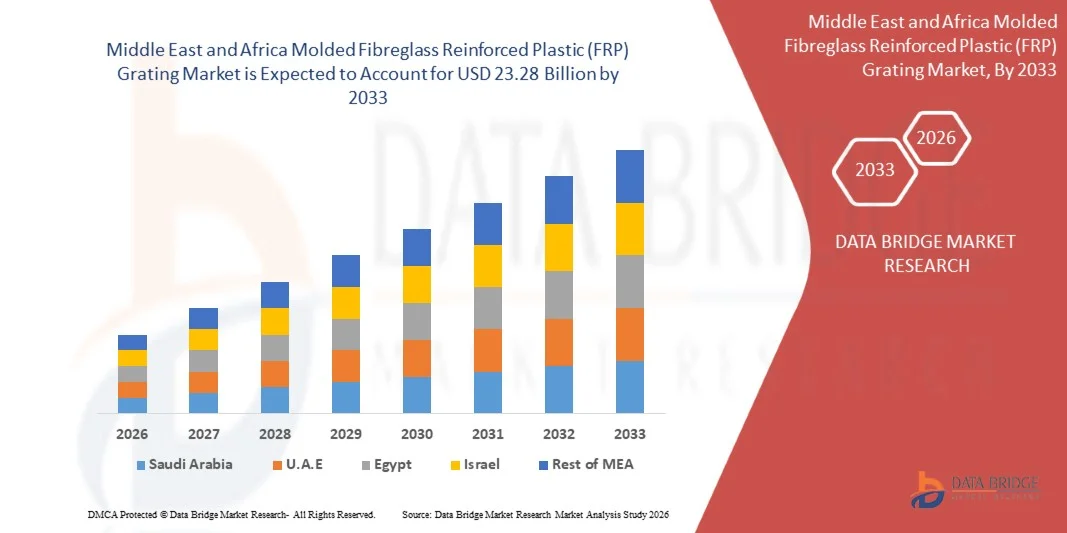
The Middle East and Africa molded fibreglass reinforced plastic (FRP) grating market was valued at USD 14.72 billion in 2025 and is projected to reach USD 23.28 billion by 2033, growing at a CAGR of 5.90% from 2026 to 2033. The market is witnessing steady expansion driven by increasing demand for corrosion-resistant, lightweight, and high-strength materials across oil & gas, marine, chemical processing, and industrial infrastructure applications.
The growing emphasis on industrial safety standards, combined with rising investments in offshore oil platforms, desalination plants, and wastewater treatment facilities, is significantly boosting the adoption of FRP gratings in the region. Their superior durability in harsh environmental conditions, such as high humidity, salinity, and extreme temperatures, makes them a preferred alternative to traditional steel gratings. In addition, ongoing industrial diversification initiatives across Gulf Cooperation Council countries and infrastructure modernization projects in Africa are further accelerating market growth.
Key Market Trends & Insights
- Saudi Arabia molded fibreglass reinforced plastic (FRP) grating market captured the largest revenue share of approximately 41.2% in the Middle East and Africa region in 2025, driven by massive investments in oil refineries, offshore drilling platforms, petrochemical complexes, and mega infrastructure projects under Vision 2030.
- U.A.E. molded fibreglass reinforced plastic (FRP) grating market is expected to witness the fastest growth rate from 2026 to 2033, capturing approximately 28.6% market share in 2025 within the Middle East and Africa region. Growth is driven by rapid industrial diversification, expansion of smart city initiatives, and rising marine infrastructure development.
- The Polyester segment held the largest market revenue share of approximately 38.5% in 2025, driven by its wide usage in industrial flooring, structural support systems, and corrosion-resistant platforms across oil & gas and construction sectors. Polyester FRP gratings are widely preferred due to their cost-effectiveness, ease of fabrication, and balanced mechanical strength. Their adoption is particularly strong in desalination plants and offshore facilities in Saudi Arabia and UAE. In addition, rising infrastructure development in emerging African economies is further supporting steady demand for polyester-based composites.
- The Vinyl Ester segment is projected to register the fastest growth at a CAGR of 7.6% from 2026 to 2033, supported by superior resistance to acids, alkalis, and harsh chemical environments. These properties make it highly suitable for petrochemical plants, marine structures, and wastewater treatment facilities. Increasing deployment in high-corrosion zones such as offshore drilling platforms in the Persian Gulf is accelerating adoption. Furthermore, growing emphasis on lifecycle cost reduction in industrial infrastructure is driving preference for high-performance resin systems.
- The Flat Strip segment held the largest market revenue share of approximately 22.9% in 2025, driven by its extensive use in walkway systems, industrial platforms, and structural reinforcement applications. Flat strips provide high flexibility in modular construction and are widely used in custom FRP grating assemblies. Their ease of installation and compatibility with multiple industrial designs further enhances adoption. In addition, demand from oil refineries and chemical processing plants is significantly contributing to segment growth.
- The Trench Covers segment is projected to grow at the fastest CAGR of 8.1% from 2026 to 2033, driven by increasing demand for safe drainage systems in industrial and urban infrastructure. These covers are widely used in oil refineries, airports, and wastewater treatment facilities to ensure corrosion-free and load-bearing drainage protection. Rising investments in smart city infrastructure projects across the Middle East are further boosting demand. In addition, their non-slip and non-conductive properties make them highly suitable for high-risk industrial environments.
- The 31–50 mm segment held the largest market revenue share of approximately 41.2% in 2025, supported by its optimal balance between strength, weight, and load-bearing capacity. This range is extensively used in industrial walkways, offshore platforms, and maintenance access systems. It is particularly preferred in oil & gas installations across GCC countries due to its durability in harsh environmental conditions. Moreover, its versatility across multiple industrial applications makes it the most widely adopted specification globally.
- The Above 50 mm segment is projected to register the fastest growth at a CAGR of 7.9% from 2026 to 2033, driven by increasing demand for heavy-duty infrastructure in mining, marine docks, and large-scale industrial projects. These gratings are designed for high load-bearing applications where structural strength is critical. Expansion of deep-water port infrastructure in Africa and the Middle East is further accelerating adoption. In addition, rising industrialization in resource-rich African nations is boosting demand for heavy-duty FRP systems.
- The Compression Molding segment held the largest market revenue share of approximately 44.6% in 2025, driven by its high production efficiency, cost-effectiveness, and ability to produce uniform high-strength components. This method is widely used for large-scale FRP grating manufacturing in industrial applications. It also supports consistent quality control, making it highly suitable for oil & gas and construction sectors. In addition, strong adoption by major manufacturers in the Middle East is reinforcing its dominance.
- The Vacuum Molding segment is projected to register the fastest growth at a CAGR of 8.4% from 2026 to 2033, supported by demand for lightweight, high-strength, and precision-engineered composite structures. This technology enables improved resin distribution and enhanced structural integrity of FRP products. It is increasingly used in offshore platforms, marine applications, and aerospace-grade structural components. Growing focus on advanced manufacturing technologies in the UAE and Saudi Arabia is further accelerating adoption.
- The Walkways segment held the largest market revenue share of approximately 35.8% in 2025, driven by extensive deployment in oil & gas refineries, chemical plants, and industrial facilities. Walkways require high corrosion resistance and anti-slip properties, making FRP gratings an ideal solution. Their use significantly enhances workplace safety in hazardous environments. Increasing offshore exploration activities in the Gulf region further support segment dominance.
- The Platforms segment is projected to grow at the fastest CAGR of 7.8% from 2026 to 2033, supported by rising industrial expansion and offshore infrastructure development. Platforms are widely used in drilling rigs, maintenance areas, and processing units where structural durability is critical. Expansion of petrochemical complexes and renewable energy installations is further driving demand. In addition, ongoing modernization of industrial facilities in Africa is contributing to growth.
- The Oil & Gas segment held the largest market revenue share of approximately 29.4% in 2025, driven by extensive use of FRP gratings in offshore rigs, refineries, and drilling platforms. The segment benefits from continuous investments in upstream and downstream oil infrastructure across Saudi Arabia, UAE, and Nigeria. FRP gratings are preferred due to their corrosion resistance and long service life in harsh environments. Increasing safety regulations in hazardous industrial zones further support adoption.
- The Marine segment is projected to register the fastest growth at a CAGR of 8.6% from 2026 to 2033, supported by rising port expansion projects, shipbuilding activities, and offshore infrastructure development. FRP gratings are increasingly used in docks, ship decks, and coastal facilities due to their resistance to saltwater corrosion. Growth in global maritime trade and logistics infrastructure in Africa is further strengthening demand. In addition, expansion of offshore renewable energy projects is creating new application opportunities.
Market Size & Forecast
- Market Value (2025): USD 14.72 Billion
- Expected Market Value (2033): USD 23.28 Billion
- Forecast CAGR (2026–2033): 5.90%
- Leading Region in 2025: North America
- Fastest Growing Region: Asia-Pacific
Report Scope and Middle East and Africa Molded Fibreglass Reinforced Plastic (FRP) Grating Market Segmentation
|
Attributes |
Middle East and Africa Molded Fibreglass Reinforced Plastic (FRP) Grating Key Market Insights |
|
Segments Covered |
|
|
Countries Covered |
Middle East and Africa
|
|
Key Market Players |
• Saudi Arabian Amiantit Company (Saudi Arabia) |
|
Market Opportunities |
• Expansion Of Oil & Gas Infrastructure Projects |
|
Value Added Data Infosets |
In addition to the insights on market scenarios such as market value, growth rate, segmentation, geographical coverage, and major players, the market reports curated by the Data Bridge Market Research also include import export analysis, production capacity overview, production consumption analysis, price trend analysis, climate change scenario, supply chain analysis, value chain analysis, raw material/consumables overview, vendor selection criteria, PESTLE Analysis, Porter Analysis, and regulatory framework. |
Middle East and Africa Molded Fibreglass Reinforced Plastic (FRP) Grating Market Trends
Trend: Growth In Oil & Gas Expansion And Industrial Corrosion Resistant Infrastructure Adoption
Increasing demand for durable, lightweight, and high-strength structural materials across oil & gas, marine, chemical processing, and power generation industries is accelerating the adoption of molded fibreglass reinforced plastic (FRP) gratings in the Middle East and Africa. Conventional steel gratings face rapid corrosion in offshore platforms, desalination plants, and petrochemical environments, particularly in high salinity and high humidity conditions common across GCC coastal regions.
In offshore oil installations in Saudi Arabia and the UAE, FRP gratings are increasingly used for walkways, platforms, and maintenance decks to reduce corrosion-related maintenance costs and improve worker safety in hazardous environments. In industrial wastewater treatment facilities across South Africa and Egypt, FRP systems are replacing metallic structures to improve durability and reduce lifecycle replacement costs. In addition, large-scale refinery expansions in the Middle East, including capacity upgrades in Saudi Aramco facilities, are integrating corrosion-resistant composite materials to enhance operational efficiency and reduce downtime associated with structural degradation. The increasing deployment of desalination infrastructure in the Gulf region is further strengthening demand for FRP gratings due to their resistance to saltwater exposure and chemical corrosion.
Global Molded Fibreglass Reinforced Plastic (FRP) Grating Market Dynamics
Key Market Driver: Rising Investments In Oil & Gas, Marine, And Industrial Infrastructure Development
The Middle East and Africa region is witnessing strong capital investments in oil & gas exploration, petrochemical expansion, and marine infrastructure, driving demand for high-performance corrosion-resistant materials such as FRP gratings. Governments in Saudi Arabia, UAE, and Qatar are actively expanding downstream and upstream oil operations to diversify energy output and strengthen industrial capacity, increasing the need for safe and durable platform materials.
Industrial facilities in offshore drilling sites across the Persian Gulf and West African oil fields such as Nigeria’s Niger Delta are increasingly adopting FRP gratings to improve operational safety and reduce long-term maintenance costs associated with steel corrosion. In addition, desalination plants in Saudi Arabia and the UAE, which collectively account for a significant share of global desalinated water production, are deploying FRP structures to withstand continuous saltwater exposure. Large-scale industrial zones such as NEOM in Saudi Arabia and Suez Canal Economic Zone in Egypt are also contributing to rising adoption of advanced composite materials for infrastructure development.
Key Restraint/Challenge: High Initial Cost And Limited Awareness In Emerging African Markets
Despite strong performance advantages, the adoption of molded FRP gratings is constrained by relatively high initial installation costs compared to conventional steel and aluminum alternatives. Small and mid-sized industrial operators often prefer traditional materials due to lower upfront investment requirements, even though FRP offers lower lifecycle costs.
In several African economies, limited awareness regarding advanced composite materials and their long-term durability benefits restricts market penetration. Supply chain limitations and dependence on imports for high-grade FRP materials further increase procurement costs in remote industrial regions. In addition, lack of standardized installation expertise and limited technical workforce training slows adoption across construction and industrial sectors.
Cost benchmarking indicates that FRP grating systems can be approximately 20–40% higher in initial cost than galvanized steel alternatives, although lifecycle maintenance costs are significantly lower in corrosive environments such as offshore oil platforms and chemical processing plants.
Key Market Opportunity: Expansion Of Industrial Safety Regulations And Large-Scale Infrastructure Modernization
Growing emphasis on industrial safety standards and modernization of infrastructure across Middle East and African economies is creating strong opportunities for FRP grating manufacturers. Governments are increasingly enforcing stricter workplace safety regulations in high-risk sectors such as oil & gas, mining, and chemical processing, encouraging the use of non-corrosive and non-conductive materials in industrial flooring and platforms.
In Saudi Vision 2030 and UAE industrial diversification programs, large-scale infrastructure development projects are integrating advanced composite materials to improve operational safety and efficiency. Mining operations in South Africa and copper extraction projects in Zambia are increasingly adopting FRP gratings due to their resistance to chemical exposure and heavy mechanical load conditions.
In addition, rapid expansion of renewable energy infrastructure, including solar farms in the UAE and Morocco, is creating new application opportunities for FRP materials in maintenance walkways and structural support systems. Pilot installations in Gulf industrial zones have demonstrated maintenance cost reductions of nearly 25–30% over steel-based systems in corrosive operating environments, highlighting strong long-term economic benefits.
Middle East and Africa Molded Fibreglass Reinforced Plastic (FRP) Grating Market Scope
The market is segmented on the basis of type, product type, grating height, technology, application, and end-user.
• By Type
On the basis of type, the molded fibreglass reinforced plastic (FRP) grating market is segmented into Polyester, Vinyl Ester, Phenolic, Epoxy, Polyurethanes, and Others. The Polyester segment held the largest market revenue share of approximately 38.5% in 2025, driven by its wide usage in industrial flooring, structural support systems, and corrosion-resistant platforms across oil & gas and construction sectors. Polyester FRP gratings are widely preferred due to their cost-effectiveness, ease of fabrication, and balanced mechanical strength. Their adoption is particularly strong in desalination plants and offshore facilities in Saudi Arabia and UAE. In addition, rising infrastructure development in emerging African economies is further supporting steady demand for polyester-based composites.
The Vinyl Ester segment is projected to register the fastest growth at a CAGR of 7.6% from 2026 to 2033, supported by superior resistance to acids, alkalis, and harsh chemical environments. These properties make it highly suitable for petrochemical plants, marine structures, and wastewater treatment facilities. Increasing deployment in high-corrosion zones such as offshore drilling platforms in the Persian Gulf is accelerating adoption. Furthermore, growing emphasis on lifecycle cost reduction in industrial infrastructure is driving preference for high-performance resin systems.
• By Product Type
On the basis of product type, the market is segmented into Angles, Square, Flat Strip, I Beams, U Channel, Round Tube, Wide Flange Beams, Trench Covers, Solid Rods, Fluted Tubes/Ladder Rung, Kick Plate/Toe Plate, and Others. The Flat Strip segment held the largest market revenue share of approximately 22.9% in 2025, driven by its extensive use in walkway systems, industrial platforms, and structural reinforcement applications. Flat strips provide high flexibility in modular construction and are widely used in custom FRP grating assemblies. Their ease of installation and compatibility with multiple industrial designs further enhances adoption. In addition, demand from oil refineries and chemical processing plants is significantly contributing to segment growth.
The Trench Covers segment is projected to grow at the fastest CAGR of 8.1% from 2026 to 2033, driven by increasing demand for safe drainage systems in industrial and urban infrastructure. These covers are widely used in oil refineries, airports, and wastewater treatment facilities to ensure corrosion-free and load-bearing drainage protection. Rising investments in smart city infrastructure projects across the Middle East are further boosting demand. In addition, their non-slip and non-conductive properties make them highly suitable for high-risk industrial environments.
• By Grating Height
On the basis of grating height, the market is segmented into 10–30 mm, 31–50 mm, and Above 50 mm. The 31–50 mm segment held the largest market revenue share of approximately 41.2% in 2025, supported by its optimal balance between strength, weight, and load-bearing capacity. This range is extensively used in industrial walkways, offshore platforms, and maintenance access systems. It is particularly preferred in oil & gas installations across GCC countries due to its durability in harsh environmental conditions. Moreover, its versatility across multiple industrial applications makes it the most widely adopted specification globally.
The Above 50 mm segment is projected to register the fastest growth at a CAGR of 7.9% from 2026 to 2033, driven by increasing demand for heavy-duty infrastructure in mining, marine docks, and large-scale industrial projects. These gratings are designed for high load-bearing applications where structural strength is critical. Expansion of deep-water port infrastructure in Africa and the Middle East is further accelerating adoption. In addition, rising industrialization in resource-rich African nations is boosting demand for heavy-duty FRP systems.
• By Technology
On the basis of technology, the market is segmented into Compression Molding, Cold Press Molding, Vacuum Molding, Foam Molding, and Others. The Compression Molding segment held the largest market revenue share of approximately 44.6% in 2025, driven by its high production efficiency, cost-effectiveness, and ability to produce uniform high-strength components. This method is widely used for large-scale FRP grating manufacturing in industrial applications. It also supports consistent quality control, making it highly suitable for oil & gas and construction sectors. In addition, strong adoption by major manufacturers in the Middle East is reinforcing its dominance.
The Vacuum Molding segment is projected to register the fastest growth at a CAGR of 8.4% from 2026 to 2033, supported by demand for lightweight, high-strength, and precision-engineered composite structures. This technology enables improved resin distribution and enhanced structural integrity of FRP products. It is increasingly used in offshore platforms, marine applications, and aerospace-grade structural components. Growing focus on advanced manufacturing technologies in the UAE and Saudi Arabia is further accelerating adoption.
• By Application
On the basis of application, the market is segmented into Stair Treads, Walkways, Platforms, Docks, Hand Rails, Walls, and Others. The Walkways segment held the largest market revenue share of approximately 35.8% in 2025, driven by extensive deployment in oil & gas refineries, chemical plants, and industrial facilities. Walkways require high corrosion resistance and anti-slip properties, making FRP gratings an ideal solution. Their use significantly enhances workplace safety in hazardous environments. Increasing offshore exploration activities in the Gulf region further support segment dominance.
The Platforms segment is projected to grow at the fastest CAGR of 7.8% from 2026 to 2033, supported by rising industrial expansion and offshore infrastructure development. Platforms are widely used in drilling rigs, maintenance areas, and processing units where structural durability is critical. Expansion of petrochemical complexes and renewable energy installations is further driving demand. In addition, ongoing modernization of industrial facilities in Africa is contributing to growth.
• By End-User
On the basis of end-user, the market is segmented into Petrochemicals, Pulp & Paper, Building & Construction, Food & Beverages, Mining, Pharmaceutical, Oil & Gas, Electrical & Electronics, Water Management, Marine, Defence, Sports & Leisure, and Others. The Oil & Gas segment held the largest market revenue share of approximately 29.4% in 2025, driven by extensive use of FRP gratings in offshore rigs, refineries, and drilling platforms. The segment benefits from continuous investments in upstream and downstream oil infrastructure across Saudi Arabia, UAE, and Nigeria. FRP gratings are preferred due to their corrosion resistance and long service life in harsh environments. Increasing safety regulations in hazardous industrial zones further support adoption.
The Marine segment is projected to register the fastest growth at a CAGR of 8.6% from 2026 to 2033, supported by rising port expansion projects, shipbuilding activities, and offshore infrastructure development. FRP gratings are increasingly used in docks, ship decks, and coastal facilities due to their resistance to saltwater corrosion. Growth in global maritime trade and logistics infrastructure in Africa is further strengthening demand. In addition, expansion of offshore renewable energy projects is creating new application opportunities.
Middle East and Africa Molded Fibreglass Reinforced Plastic (FRP) Grating Market Regional Analysis
Saudi Arabia Molded Fibreglass Reinforced Plastic (FRP) Grating Market Insight
Saudi Arabia molded fibreglass reinforced plastic (FRP) grating market captured the largest revenue share of approximately 41.2% in the Middle East and Africa region in 2025, driven by massive investments in oil refineries, offshore drilling platforms, petrochemical complexes, and mega infrastructure projects under Vision 2030. The country’s strong focus on industrial safety and operational efficiency is accelerating the replacement of conventional steel gratings with corrosion-resistant FRP solutions. Large-scale refinery expansions and industrial city developments are significantly boosting demand for durable walkway and platform materials. In addition, expanding desalination capacity and continuous offshore exploration activities are strengthening long-term market growth
U.A.E. Molded Fibreglass Reinforced Plastic (FRP) Grating Market Insight
The U.A.E. molded fibreglass reinforced plastic (FRP) grating market is expected to witness the fastest growth rate from 2026 to 2033, capturing approximately 28.6% market share in 2025 within the Middle East and Africa region. Growth is driven by rapid industrial diversification, expansion of smart city initiatives, and rising marine infrastructure development. The country’s strong investment in offshore oil facilities, ports, and coastal construction projects is significantly increasing FRP adoption due to high corrosion resistance and long service life. Major logistics hubs and industrial zones are increasingly integrating composite materials to enhance operational safety and reduce maintenance costs. Sustainability-focused construction practices and modern urban development projects are further accelerating market penetration.
Middle East and Africa Molded Fibreglass Reinforced Plastic (FRP) Grating Market Share
The Middle East and Africa Molded Fibreglass Reinforced Plastic (FRP) Grating industry is primarily led by well-established companies, including:
• Saudi Arabian Amiantit Company (Saudi Arabia)
• Zamil Industrial Investment Company (Saudi Arabia)
• Saudi Fiberglass Factory (Saudi Arabia)
• National Factory for Fiberglass Industries (Saudi Arabia)
• Future Pipe Industries (U.A.E.)
• Fiberx Group (U.A.E.)
• Glass Reinforced Plastic LLC (U.A.E.)
• Oman Fibre Glass Products (Oman)
• Al Kobaisi Group (Bahrain)
• Qatar Plastic Products Company (Qatar)
• Egyptian Fiberglass Factory (Egypt)
• Advanced Fiberglass Industries (Egypt)

- Interactive Data Analysis Dashboard
- Company Analysis Dashboard for high growth potential opportunities
- Research Analyst Access for customization & queries
- Competitor Analysis with Interactive dashboard
- Latest News, Updates & Trend analysis
- Harness the Power of Benchmark Analysis for Comprehensive Competitor Tracking
Middle East And Africa Molded Frp Grating Market, Supply Chain Analysis and Ecosystem Framework
To support market growth and help clients navigate the impact of geopolitical shifts, DBMR has integrated in-depth supply chain analysis into its Middle East And Africa Molded Frp Grating Market research reports. This addition empowers clients to respond effectively to global changes affecting their industries. The supply chain analysis section includes detailed insights such as Middle East And Africa Molded Frp Grating Market consumption and production by country, price trend analysis, the impact of tariffs and geopolitical developments, and import and export trends by country and HSN code. It also highlights major suppliers with data on production capacity and company profiles, as well as key importers and exporters. In addition to research, DBMR offers specialized supply chain consulting services backed by over a decade of experience, providing solutions like supplier discovery, supplier risk assessment, price trend analysis, impact evaluation of inflation and trade route changes, and comprehensive market trend analysis.
Data collection and base year analysis are done using data collection modules with large sample sizes. The stage includes obtaining market information or related data through various sources and strategies. It includes examining and planning all the data acquired from the past in advance. It likewise envelops the examination of information inconsistencies seen across different information sources. The market data is analysed and estimated using market statistical and coherent models. Also, market share analysis and key trend analysis are the major success factors in the market report. To know more, please request an analyst call or drop down your inquiry.
The key research methodology used by DBMR research team is data triangulation which involves data mining, analysis of the impact of data variables on the market and primary (industry expert) validation. Data models include Vendor Positioning Grid, Market Time Line Analysis, Market Overview and Guide, Company Positioning Grid, Patent Analysis, Pricing Analysis, Company Market Share Analysis, Standards of Measurement, Global versus Regional and Vendor Share Analysis. To know more about the research methodology, drop in an inquiry to speak to our industry experts.
Data Bridge Market Research is a leader in advanced formative research. We take pride in servicing our existing and new customers with data and analysis that match and suits their goal. The report can be customized to include price trend analysis of target brands understanding the market for additional countries (ask for the list of countries), clinical trial results data, literature review, refurbished market and product base analysis. Market analysis of target competitors can be analyzed from technology-based analysis to market portfolio strategies. We can add as many competitors that you require data about in the format and data style you are looking for. Our team of analysts can also provide you data in crude raw excel files pivot tables (Fact book) or can assist you in creating presentations from the data sets available in the report.













