


What is the Middle East and Africa Mycotoxin Binders Market Size and Overview ?
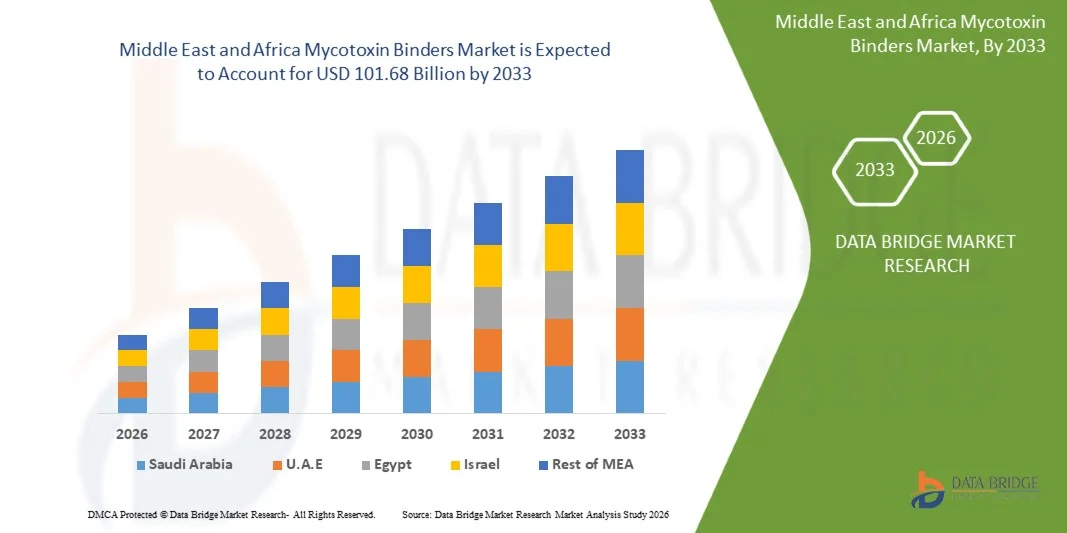
As per Data Bridge Market Research Analysis the Middle East and Africa mycotoxin binders market was valued at USD 54.13 billion in 2025 and is projected to reach USD 101.68 billion by 2033, growing at a CAGR of 8.20% from 2026 to 2033. The global mycotoxin binders market is experiencing consistent growth driven by increasing awareness regarding animal feed safety, rising concerns over mycotoxin contamination in livestock feed, and growing demand for high-quality animal nutrition solutions. Mycotoxin binders are widely adopted in the animal feed industry to reduce the harmful effects of toxins such as aflatoxins, ochratoxins, and other fungal contaminants, helping improve animal health, productivity, and feed efficiency.
The increasing prevalence of fungal contamination in grains and feed ingredients, combined with stricter regulations on feed quality and food safety, is compelling livestock producers, feed manufacturers, and animal nutrition companies to adopt advanced mycotoxin management solutions. Natural and advanced binder technologies, including clay-based, yeast-derived, and enzyme-based solutions, are gaining popularity as they provide effective toxin mitigation while supporting sustainable animal production. Growing demand for poultry, dairy, and livestock products, along with increasing investments in animal health and nutrition, is further accelerating the adoption of mycotoxin binders globally.
Market Size & Forecast
- Middle East and Africa Market Value (2025): USD 54.13 Billion
- Expected Market Value (2033): USD 101.68 Billion
- Forecast CAGR (2026–2033): 8.20%
- Leading Region in 2025: Saudi Arabia
- Fastest Growing Region: U.A.E.
What are the Major Takeaways of Middle East and Africa Mycotoxin Binders Market ?
- Saudi Arabia dominated the Middle East and Africa mycotoxin binders market with the largest revenue share of 33.84% in 2025, supported by the country’s expanding livestock and poultry production, increasing focus on animal feed safety, and rising adoption of advanced feed additives to reduce mycotoxin contamination risks. Government initiatives to strengthen food security, along with investments in modern animal nutrition practices, are further driving demand for mycotoxin binders across livestock and aquaculture sectors.
- The dry segment dominated the market with a 67.84% share in 2025, owing to its longer shelf life, ease of transportation, simple storage requirements, and compatibility with commercial feed manufacturing processes.
- A.E. is expected to be the fastest-growing country in the Middle East and Africa mycotoxin binders market, registering a CAGR of 7.2% from 2026 to 2033, fueled by rising demand for high-quality animal protein, increasing livestock farming activities, growing adoption of commercial feed solutions, and investments in advanced animal nutrition technologies.
- Organic mycotoxin binders are the fastest-growing segment by nature, projected to register a CAGR of 7.0%, supported by increasing preference for natural feed additives, growing awareness regarding sustainable livestock production, and rising demand for effective solutions that enhance animal performance while minimizing chemical dependency.
Report Scope and Middle East and Africa Mycotoxin Binders Market Segmentation
|
Attributes |
Mycotoxin Binders Key Market Insights |
|
Segments Covered |
|
|
Countries Covered |
Middle East and Africa
|
|
Key Market Players |
|
|
Market Opportunities |
|
|
Value Added Data Infosets |
In addition to the insights on market scenarios such as market value, growth rate, segmentation, geographical coverage, and major players, the market reports curated by the Data Bridge Market Research also include in-depth expert analysis, geographically represented company-wise production and capacity, network layouts of distributors and partners, detailed and updated price trend analysis and deficit analysis of supply chain and demand. |
What is the Key Trend in the Middle East and Africa Mycotoxin Binders Market ?
Trend: Growth in Livestock Feed Safety and Advanced Animal Nutrition Solutions
The Middle East and Africa Mycotoxin Binders market is witnessing increasing adoption of advanced feed additive solutions as livestock producers focus on improving animal health, feed efficiency, and productivity. Poultry, dairy, and aquaculture producers are increasingly incorporating mycotoxin binders into feed formulations to reduce the negative impact of contaminants such as aflatoxins, ochratoxins, and fumonisins. The rising demand for safe animal-derived food products, expansion of commercial feed manufacturing, and increasing awareness about feed quality management are supporting market growth. Countries such as Saudi Arabia and the U.A.E. are investing in modern livestock production systems and food security initiatives, encouraging the adoption of scientifically developed animal nutrition products.
Middle East and Africa Mycotoxin Binders Market Dynamics
Key Market Driver: Increasing Livestock Production and Demand for High-Quality Animal Feed
The expansion of poultry, dairy, and aquaculture industries across the Middle East and Africa is a major factor driving demand for mycotoxin binders. Feed contamination caused by fungal toxins can reduce animal growth performance, immunity, fertility, and feed conversion efficiency, creating the need for preventive feed management solutions. Saudi Arabia’s focus on strengthening domestic food production and reducing dependency on imported animal products has increased investments in poultry and livestock farming, driving the use of feed additives. Similarly, the growth of commercial aquaculture projects in countries such as Egypt and the U.A.E. is creating additional demand for mycotoxin control solutions to maintain aquatic animal health and productivity. The increasing adoption of compound feed and commercial feed mills is also supporting market expansion, as manufacturers integrate mycotoxin binders into feed formulations to comply with animal health and food safety requirements.
Key Restraint/Challenge: Limited Awareness and High Cost of Advanced Mycotoxin Management Solutions
A key challenge for the Middle East and Africa Mycotoxin Binders market is limited awareness among small-scale livestock farmers regarding the economic impact of mycotoxin contamination and the benefits of preventive feed solutions. Many producers continue to rely on traditional feed management practices, restricting adoption rates in developing markets. In addition, premium mycotoxin binders containing advanced organic components, enzymes, or multifunctional formulations involve higher costs compared with conventional feed additives. Small and medium-sized farms often face challenges in adopting these solutions due to budget constraints. Variations in feed quality standards, storage conditions, and climatic factors such as high humidity and temperature in several African and Middle Eastern regions further increase the complexity of mycotoxin control. For instance, the hot and humid climatic conditions in parts of Africa contribute to higher risks of fungal growth during grain storage, increasing the need for effective mycotoxin mitigation strategies while also raising operational costs for feed producers.
Key Market Opportunity: Rising Adoption of Organic and Multi-Functional Mycotoxin Binders
The growing preference for natural and sustainable animal nutrition solutions presents a significant opportunity for mycotoxin binder manufacturers. Organic binders, including yeast-based products, microbial-derived solutions, and plant-based formulations, are gaining attention due to their ability to support gut health, immunity, and animal performance beyond traditional toxin adsorption. The increasing demand for antibiotic-free animal production is encouraging livestock producers to explore alternative feed additives that enhance animal resilience and productivity. In addition, advancements in biotechnology are enabling the development of multifunctional mycotoxin binders that combine adsorption, detoxification, and gut health benefits.
The expansion of precision livestock farming and improved feed monitoring technologies is expected to further support market growth by enabling targeted use of mycotoxin management solutions across poultry, livestock, and aquaculture operations in the Middle East and Africa region.
How is the Middle East and Africa Mycotoxin Binders Market Segmented ?
The Middle East and Africa Mycotoxin Binders market is segmented on the basis of product type, nature, type of animal, and form.
- By Product Type
On the basis of product type, the Middle East and Africa Mycotoxin Binders market is segmented into Adsorbents and Denaturants. The Adsorbents segment dominated the market with a 63.25% share in 2025, owing to their widespread adoption in poultry, livestock, and aquaculture feed formulations due to their high toxin-binding efficiency, cost-effectiveness, and proven ability to reduce the negative effects of mycotoxin contamination. Adsorbent-based solutions such as clay minerals, bentonite, and activated compounds are extensively used by feed manufacturers across the region to improve animal health, feed quality, and productivity. Increasing awareness regarding feed safety, rising commercial livestock production, and growing demand for high-performance animal nutrition products are further supporting segment dominance.
The Denaturants segment is projected to register the fastest growth at a CAGR of 7.1% from 2026 to 2033, driven by increasing demand for advanced mycotoxin management solutions that can chemically modify or neutralize toxin activity. Growing adoption of multifunctional feed additives, rising focus on preventive animal health management, and increasing investments in research and development of biological detoxification technologies are accelerating segment growth. The rising preference for advanced solutions beyond traditional adsorption mechanisms is expected to create new opportunities for denaturant-based products in the Middle East and Africa livestock industry.
- By Nature
On the basis of nature, the Middle East and Africa mycotoxin binders market is segmented into Organic and Inorganic. The Inorganic segment dominated the market with a 58.46% share in 2025, supported by extensive use of mineral-based binders due to their affordability, availability, and strong adsorption properties against major mycotoxins. Inorganic solutions, including clay-based materials and mineral compounds, are widely incorporated into poultry and livestock feeds across emerging markets where cost-effective feed safety solutions are highly preferred. Increasing feed production, expansion of commercial farms, and growing concerns regarding contamination risks are strengthening adoption.
The organic segment is expected to witness the fastest CAGR of 7.3% from 2026 to 2033, driven by increasing demand for natural, sustainable, and multifunctional feed additives. Organic mycotoxin binders, including yeast derivatives, microbial-based products, and plant-based formulations, are gaining traction due to their ability to support gut health, immunity, and animal performance. Growing preference for antibiotic-free animal production, improved awareness among farmers, and rising adoption of advanced animal nutrition strategies are expected to accelerate organic segment expansion across the region.
- By Type of Animal
On the basis of animal type, the Middle East and Africa mycotoxin binders market is segmented into companion animals, livestock, and aquatic Animals. The Livestock segment dominated the market with a 55.72% share in 2025, driven by increasing demand for poultry, cattle, and dairy production and the need to maintain animal productivity under changing climatic and feed quality conditions. Mycotoxin contamination significantly affects growth performance, immunity, and feed conversion efficiency in livestock, encouraging farmers and feed manufacturers to adopt preventive feed solutions. Expanding commercial farming activities in countries such as Saudi Arabia, Egypt, and South Africa are further supporting segment growth.
The aquatic animals segment is projected to register the fastest CAGR of 7.5% from 2026 to 2033, fueled by rapid expansion of aquaculture production and increasing adoption of formulated feeds for fish and shrimp farming. Growing awareness about the impact of mycotoxins on aquatic animal growth, survival rates, and feed utilization is encouraging aquaculture producers to integrate mycotoxin management solutions. Investments in sustainable aquaculture practices and rising seafood consumption across Middle East and African markets are expected to further drive demand.
- By Form
On the basis of form, the Middle East and Africa mycotoxin binders market is segmented into Dry and Liquid. The Dry segment dominated the market with a 67.84% share in 2025, owing to its longer shelf life, ease of transportation, simple storage requirements, and compatibility with commercial feed manufacturing processes. Dry mycotoxin binders are widely preferred by feed mills and livestock producers due to their easy blending capabilities and cost advantages. Increasing adoption of compound feed production and rising investments in animal nutrition infrastructure are reinforcing the dominance of dry formulations.
The liquid segment is expected to witness the fastest CAGR of 7.0% from 2026 to 2033, supported by growing demand for convenient and precise application methods in modern livestock production systems. Liquid formulations enable uniform distribution, easy dosing, and integration with automated feeding systems, making them attractive for advanced farming operations. Increasing adoption of precision livestock farming technologies, rising demand for efficient feed management solutions, and growing focus on improving animal performance are expected to accelerate liquid segment growth in the Middle East and Africa market.
Which Region Holds the Largest Share of the Middle East and Africa Mycotoxin Binders Market ?
The Middle East mycotoxin binders market is witnessing steady growth, driven by increasing livestock production, rising demand for animal protein, and growing awareness regarding animal feed safety and quality management. The region is experiencing higher adoption of advanced feed additives as livestock producers and feed manufacturers focus on reducing the impact of mycotoxin contamination and improving animal health and productivity. Government initiatives supporting food security, expansion of commercial poultry and dairy farming, and investments in modern animal nutrition technologies are further supporting market development across the region. Increasing adoption of scientifically formulated feed solutions and growing emphasis on sustainable livestock production are expected to strengthen demand for mycotoxin binders in the Middle East.
Saudi Arabia Mycotoxin Binders Market Insight
Saudi Arabia dominated the Middle East and Africa Mycotoxin Binders market and accounted for the largest revenue share of 33.84% in 2025, supported by expanding livestock and poultry production, increasing focus on animal feed safety, and rising adoption of advanced feed additives to reduce mycotoxin contamination risks. Government initiatives to strengthen food security, improve domestic animal production, and enhance feed quality standards are driving demand for mycotoxin binders across livestock and aquaculture sectors. In addition, increasing investments in modern farming practices, commercial feed production, and animal nutrition solutions are further contributing to market growth in Saudi Arabia.
U.A.E. Mycotoxin Binders Market Insight
The U.A.E. Mycotoxin Binders market is expected to be the fastest-growing market in the Middle East and Africa region, registering a CAGR of 7.2% from 2026 to 2033, fueled by rising demand for high-quality animal protein, increasing livestock farming activities, and growing adoption of commercial feed solutions. The country’s focus on improving food security, enhancing animal health standards, and investing in advanced animal nutrition technologies is accelerating the use of mycotoxin binders. Furthermore, growing awareness regarding feed safety, expansion of poultry and dairy production, and increasing adoption of innovative feed additives are creating new opportunities for market participants in the U.A.E.
Which are the Top Companies in Middle East and Africa Mycotoxin Binders Market ?
The mycotoxin binders industry is primarily led by well-established companies, including:
- BASF SE (Germany)
- Bayer AG (Germany)
- DSM-Firmenich (Netherlands/Switzerland)
- Cargill, Incorporated (U.S.)
- Alltech (U.S.)
- Kemin Industries, Inc. (U.S.)
- Novus International, Inc. (U.S.)
- Biomin GmbH (Austria)
- EW Nutrition GmbH (Germany)
- Olmix Group (France)
- Perstorp Holding AB (Sweden)
- Impextraco N.V. (Belgium)
- Bentoli, Inc. (U.S.)
- Amlan International (U.S.)
- Clariant AG (Switzerland)
- Impextraco N.V. (Belgium)
- Micron Bio-Systems Ltd. (U.K.)
- Vetoquinol S.A. (France)
- Phileo by Lesaffre (France)
- Lallemand Inc. (Canada)
- Chr. Hansen Holding A/S (Denmark)
- Adisseo (China)
- Zhengzhou Mico Biotech Co., Ltd. (China)
- Angel Yeast Co., Ltd. (China)
- Shandong Longchang Animal Health Product Co., Ltd. (China)
- Koudijs Animal Nutrition B.V. (Netherlands)
- Bentoli AgriNutrition (U.S.)
- Feed Additives Group (Netherlands)
- Vetagro S.p.A. (Italy)
- Trouw Nutrition (Netherlands)
- Dostofarm GmbH (Germany)
What are Latest Developments in Middle East and Africa Mycotoxin Binders Market ?
- In March 2021, DSM-Firmenich expanded its animal nutrition solutions portfolio by strengthening its focus on mycotoxin risk management technologies, including advanced feed additive solutions designed to improve livestock performance and feed safety. The company’s initiatives focused on addressing increasing global concerns regarding mycotoxin contamination in animal feed, driven by changing climate conditions, grain quality challenges, and rising demand for sustainable livestock production solutions
- In May 2022, Kemin Industries highlighted advancements in its mycotoxin management solutions portfolio through continued development of integrated feed protection technologies. The company focused on improving animal health outcomes by combining toxin binding approaches with broader feed safety strategies, supporting poultry, livestock, and aquaculture producers in managing risks associated with multiple mycotoxins
- In February 2023, Olmix Group introduced developments in its animal nutrition portfolio focused on natural and sustainable mycotoxin management solutions. The company emphasized the use of algae-based and mineral-based technologies to support animal resilience against feed contamination challenges, aligning with the growing industry shift toward natural feed additives and improved gut health solutions
- In March 2023, the global feed mycotoxin binders and modifiers market was highlighted as a rapidly expanding segment, with major industry participants including Cargill, BASF, ADM, Biomin, Kemin Industries, and Alltech continuing investments in product innovation and mycotoxin mitigation technologies. The market growth was attributed to increasing livestock production, rising feed safety concerns, and growing adoption of advanced toxin-binding solutions
- In September 2023, Novus International continued strengthening its animal nutrition portfolio with research-driven feed additive solutions targeting improved animal performance and feed quality. The company’s innovation efforts reflected the increasing demand for multifunctional mycotoxin management products capable of supporting immunity, digestion, and productivity in livestock operations
- In April 2024, Biomin advanced its mycotoxin management technology platform with solutions incorporating enzymatic biotransformation approaches, including products designed to address challenging mycotoxins such as zearalenone (ZEN). These technologies focused on complementing traditional adsorption methods by using targeted detoxification mechanisms to improve protection against complex mycotoxin threats in animal feed
- In December 2024, Alltech released findings from its harvest analysis activities highlighting continued global risks from mycotoxin contamination in grains and forages. The report emphasized the importance of proactive mycotoxin management strategies as climate variability and changing crop conditions increased contamination risks across feed ingredients, supporting continued demand for advanced mycotoxin binders
- In October 2025, Alltech announced the launch of its next-generation mycotoxin binders, Mycosorb A+ Evo and Mycosorb Evo, designed to provide enhanced mycotoxin-binding efficiency and broader-spectrum protection against multiple toxin challenges. The new solutions were developed to improve livestock health and performance by addressing mycotoxins such as deoxynivalenol (DON), fusaric acid, and Penicillium-derived toxins, representing a major advancement in feed safety technologies

- Interactive Data Analysis Dashboard
- Company Analysis Dashboard for high growth potential opportunities
- Research Analyst Access for customization & queries
- Competitor Analysis with Interactive dashboard
- Latest News, Updates & Trend analysis
- Harness the Power of Benchmark Analysis for Comprehensive Competitor Tracking
Middle East And Africa Mycotoxin Binders Market, Supply Chain Analysis and Ecosystem Framework
To support market growth and help clients navigate the impact of geopolitical shifts, DBMR has integrated in-depth supply chain analysis into its Middle East And Africa Mycotoxin Binders Market research reports. This addition empowers clients to respond effectively to global changes affecting their industries. The supply chain analysis section includes detailed insights such as Middle East And Africa Mycotoxin Binders Market consumption and production by country, price trend analysis, the impact of tariffs and geopolitical developments, and import and export trends by country and HSN code. It also highlights major suppliers with data on production capacity and company profiles, as well as key importers and exporters. In addition to research, DBMR offers specialized supply chain consulting services backed by over a decade of experience, providing solutions like supplier discovery, supplier risk assessment, price trend analysis, impact evaluation of inflation and trade route changes, and comprehensive market trend analysis.
Data collection and base year analysis are done using data collection modules with large sample sizes. The stage includes obtaining market information or related data through various sources and strategies. It includes examining and planning all the data acquired from the past in advance. It likewise envelops the examination of information inconsistencies seen across different information sources. The market data is analysed and estimated using market statistical and coherent models. Also, market share analysis and key trend analysis are the major success factors in the market report. To know more, please request an analyst call or drop down your inquiry.
The key research methodology used by DBMR research team is data triangulation which involves data mining, analysis of the impact of data variables on the market and primary (industry expert) validation. Data models include Vendor Positioning Grid, Market Time Line Analysis, Market Overview and Guide, Company Positioning Grid, Patent Analysis, Pricing Analysis, Company Market Share Analysis, Standards of Measurement, Global versus Regional and Vendor Share Analysis. To know more about the research methodology, drop in an inquiry to speak to our industry experts.
Data Bridge Market Research is a leader in advanced formative research. We take pride in servicing our existing and new customers with data and analysis that match and suits their goal. The report can be customized to include price trend analysis of target brands understanding the market for additional countries (ask for the list of countries), clinical trial results data, literature review, refurbished market and product base analysis. Market analysis of target competitors can be analyzed from technology-based analysis to market portfolio strategies. We can add as many competitors that you require data about in the format and data style you are looking for. Our team of analysts can also provide you data in crude raw excel files pivot tables (Fact book) or can assist you in creating presentations from the data sets available in the report.













