Middle East and Africa Non-Stick Cookware Market Size
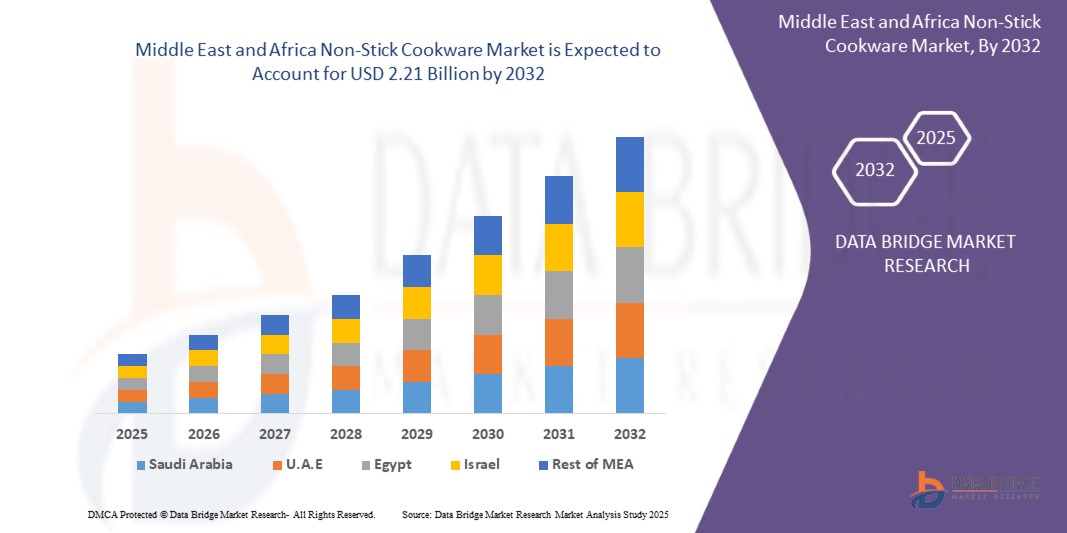
- The Middle East and Africa non-stick cookware market size was valued at USD 1.60 billion in 2024 and is expected to reach USD 2.21 billion by 2032, at a CAGR of 4.10% during the forecast period
- The market growth is largely fuelled by the rising preference for convenient cooking solutions, expanding urban middle-class population, and the growing popularity of modern kitchens across urban households in Gulf Cooperation Council (GCC) countries and South Africa
- In addition, increased consumer awareness regarding the health benefits of non-stick cookware, such as reduced oil usage and easy cleaning, is positively influencing purchasing decisions and driving product adoption across both residential and commercial segments
Middle East and Africa Non-Stick Cookware Market Analysis
- Increasing demand for time-saving cooking products, coupled with a shift toward healthier food preparation methods with minimal oil usage, is encouraging the adoption of non-stick cookware
- Growth in the hospitality and tourism industry, especially in the United Arab Emirates and Saudi Arabia, is further supporting market expansion due to rising demand from commercial food service establishments
- Saudi Arabia is expected to dominate the Middle East and Africa non-stick cookware market, driven by a growing demand for premium kitchenware, rising disposable incomes, and a shift toward modern culinary practices
- Israel is expected to witness the highest compound annual growth rate (CAGR) in the Middle East and Africa non-stick cookware market due to increasing consumer awareness of health-conscious cooking, strong technology adoption, and rising interest in premium kitchenware.
- The Teflon coated segment dominated the market with the largest revenue share in 2024, driven by its widespread availability, affordability, and effective non-stick performance. Consumers across urban households prefer Teflon cookware for its ease of cleaning and quick-cooking features. The segment continues to lead due to its strong brand recall and compatibility with standard heat sources
Report Scope and Middle East and Africa Non-Stick Cookware Market Segmentation
|
Attributes |
Middle East and Africa Non-Stick Cookware Key Market Insights |
|
Segments Covered |
|
|
Countries Covered |
Middle East and Africa
|
|
Key Market Players |
|
|
Market Opportunities |
|
|
Value Added Data Infosets |
In addition to the insights on market scenarios such as market value, growth rate, segmentation, geographical coverage, and major players, the market reports curated by the Data Bridge Market Research also include in-depth expert analysis, pricing analysis, brand share analysis, consumer survey, demography analysis, supply chain analysis, value chain analysis, raw material/consumables overview, vendor selection criteria, PESTLE Analysis, Porter Analysis, and regulatory framework. |
Middle East and Africa Non-Stick Cookware Market Trends
“Rising Demand for Ceramic-Coated Non-Stick Cookware”
- Consumers are increasingly seeking PTFE- and PFOA-free ceramic-coated cookware due to growing concerns over traditional non-stick coatings and their potential health hazards; this shift is especially visible in urban households prioritizing safe and eco-conscious cooking practices
- Ceramic cookware is perceived as a cleaner and greener option, offering sustainability benefits such as reduced emissions during production and safer disposal, which appeals to environmentally aware consumers in markets such as the United Arab Emirates and South Africa
- With excellent heat resistance and even heat distribution, ceramic-coated pans support cooking styles common in the region, such as high-temperature frying and sautéing, making them both practical and culturally compatible
- Retailers and e-commerce platforms are increasingly promoting ceramic options through online sales campaigns and in-store promotions, further boosting their visibility and accessibility across the region
- In 2023, regional brands such as Royalford and international players such as Prestige launched affordable ceramic cookware ranges in the GCC and North Africa, expanding consumer choices and accelerating market penetration
Middle East and Africa Non-Stick Cookware Market Dynamics
Driver
“Increasing Urbanization and the Rise of Modern Kitchens”
- Rapid urbanization across the region is reshaping consumer lifestyles, with growing demand for space-efficient, easy-to-use kitchen products that fit into compact urban homes and modern apartments in cities such as Dubai, Riyadh, and Nairobis
- The rising number of nuclear families and working professionals is driving preference for cookware that reduces time and effort, such as non-stick pans which require less oil and are easy to clean, enhancing daily convenience
- As modular kitchens become more common in middle-class and upper-income households, consumers are actively replacing traditional cookware with non-stick options that align with their aesthetic and functional expectations
- Social media influence and cooking trends introduced via television, online tutorials, and influencers are further encouraging younger consumers to adopt advanced cookware that supports efficient and hygienic cooking
- For instance, the increase in modern residential construction projects in Saudi Arabia and the UAE has created a surge in demand for contemporary kitchenware, with non-stick cookware positioned as an essential component of the modern culinary setup
Restraint/Challenge
“Counterfeit and Low-Quality Product Penetration”
- The market is challenged by the presence of counterfeit cookware that mimics branded products but lacks safety and quality standards, leading to faster wear and potentially hazardous chemical leaching at high temperatures
- These low-cost products are often distributed through unregulated retail channels in regions with limited consumer protection enforcement, making it difficult for buyers to differentiate between genuine and fake offerings
- The prevalence of substandard non-stick cookware negatively affects customer trust and satisfaction, resulting in hesitancy to repurchase even from reputable brands, thereby harming overall market reputation
- Established brands face pricing pressures from these imitation products, making it harder to sustain margins while still investing in innovation and quality compliance, especially in price-sensitive markets
- For instance, local markets in parts of East and West Africa frequently stock unbranded cookware with unreliable coatings, contributing to consumer complaints and increasing calls for stricter import and quality control regulations
Middle East and Africa Non-Stick Cookware Market Scope
The market is segmented on the basis of material, product, coating layer, price range, application, and distribution channel.
• By Material
On the basis of material, the Middle East and Africa non-stick cookware market is segmented into Teflon coated, anodized aluminium coated, ceramic coated, enameled iron coating, and others. The Teflon coated segment dominated the market with the largest revenue share in 2024, driven by its widespread availability, affordability, and effective non-stick performance. Consumers across urban households prefer Teflon cookware for its ease of cleaning and quick-cooking features. The segment continues to lead due to its strong brand recall and compatibility with standard heat sources.
The ceramic coated segment is expected to witness the fastest growth rate from 2025 to 2032, fueled by increasing consumer preference for toxin-free and eco-friendly options. Ceramic coatings are favored for their aesthetic appeal, thermal efficiency, and safety benefits, especially among health-conscious consumers. This trend is further supported by rising demand in the premium cookware category across the Gulf Cooperation Council countries.
• By Product
On the basis of product, the market is segmented into pan, pot, bakeware, pressure cooker, skillet, square grill, trays, breakfast sets, Dutch oven, oven containers, loaf tin, sandwich toaster, wok, wok turner, egg poacher, cast iron skillet, cast aluminum Dutch oven, whisk, spoon, soup ladle, and others. The pan segment accounted for the largest market share in 2024, primarily due to its essential role in daily cooking routines across households. Its versatility, combined with the availability of various sizes and coatings, makes it a kitchen staple.
The skillet and grill segment is expected to witness the fastest growth rate from 2025 to 2032, supported by the increasing popularity of international cuisines and interest in home grilling. These products are also gaining traction in commercial kitchens and quick-service restaurants, where durability and performance are key decision factors.
• By Coating Layer
Based on coating layer, the market is categorized into single layer, double layer, and triple layer. The double layer segment held the leading market share in 2024, offering a balanced combination of affordability and durability, which appeals to mid-income households. Double-coated cookware resists wear better than single-layer variants and supports medium-intensity cooking.
The triple layer segment is expected to witness the fastest growth rate from 2025 to 2032, as consumers increasingly seek longer-lasting non-stick properties. The growth is further supported by rising disposable incomes and the increasing availability of premium triple-layer products in supermarkets and specialty kitchenware stores.
• By Price Range
On the basis of price range, the market is divided into economy, mid-range, and luxury. The mid-range segment dominated the market in 2024, driven by the strong preference for quality products at reasonable prices among middle-income consumers. This segment benefits from a wide array of branded products offering reliable performance and style.
The luxury segment is expected to witness the fastest growth rate from 2025 to 2032, driven by high-income groups in regions such as the United Arab Emirates and Saudi Arabia who seek designer kitchenware with advanced features. Increased gifting during festive seasons and weddings also contributes to the premium product demand.
• By Application
In terms of application, the market is segmented into household and commercial. The household segment led the market in 2024, supported by growing urbanization and lifestyle shifts that emphasize home cooking and convenience. This segment has witnessed a spike in demand for easy-to-clean, time-saving cookware solutions.
The commercial segment is expected to witness the fastest growth rate from 2025 to 2032, particularly with the expansion of the food service industry, including hotels, cafes, and catering services. Durability, bulk availability, and heat resistance are key purchasing factors for commercial buyers.
• By Distribution Channel
By distribution channel, the market is classified into online and offline. The offline segment accounted for the highest revenue in 2024, owing to the presence of a wide range of products across physical retail outlets, supermarkets, and specialty stores. In-store product inspection and instant availability enhance offline sales appeal.
The online segment is expected to witness the fastest growth rate from 2025 to 2032, propelled by increasing internet penetration, ease of doorstep delivery, and regular promotional campaigns by e-commerce platforms. Consumers in urban centers are increasingly purchasing cookware via online platforms due to the variety and convenience offered.
Middle East and Africa Non-Stick Cookware Market Regional Analysis
- Saudi Arabia is expected to dominate the Middle East and Africa non-stick cookware market, driven by a growing demand for premium kitchenware, rising disposable incomes, and a shift toward modern culinary practices
- The country’s expanding urban population and increasing awareness of healthy cooking techniques are fueling the adoption of non-stick cookware
- Moreover, the influence of Western lifestyles and the growth of organized retail formats continue to enhance market accessibility and consumer preference
Israel Non-Stick Cookware Market Insight
Israel is expected to witness the fastest growth rate from 2025 to 2032, due to a rising focus on health-conscious cooking, technological advancements in kitchen appliances, and an increase in home-cooking trends. The country's well-developed retail infrastructure and strong presence of international cookware brands are facilitating the rapid penetration of innovative and eco-friendly non-stick products. In addition, the growing popularity of online shopping platforms is further supporting market expansion across both urban and suburban regions.
Middle East and Africa Non-Stick Cookware Market Share
The Middle East and Africa Non-Stick Cookware industry is primarily led by well-established companies, including:
- Royalford – Western International Group (U.A.E.)
- HomeBox – Landmark Group (U.A.E.)
- Jashanmal Home (U.A.E.)
- Al-Futtaim IKEA (U.A.E.)
- Carrefour – Majid Al Futtaim Retail (U.A.E.)
- NOON – Noon AD Holdings (U.A.E.)
- LuLu Hypermarket – LuLu Group International (U.A.E.)
- KORKMAZ (Turkey)
- Tabco Emirates (U.A.E.)
- Tramontina Middle East (U.A.E.)
Latest Developments in Middle East and Africa Non-Stick Cookware Market
- In February 2022, Spectrum Brands Holdings, Inc. expanded its cookware portfolio by acquiring the cookware business of Tristar Products Inc. This strategic acquisition aims to strengthen Spectrum’s position as a key global consumer goods manufacturer. The move is expected to enhance its competitive edge in the non-stick cookware segment and broaden its market reach across international markets
- In November 2021, Wonderchef Home Appliances entered a strategic partnership with Sixth Sense Ventures, securing an investment of USD 20.15 million. The funding is set to boost the company’s digital footprint, distribution infrastructure, and manufacturing capabilities. The initiative will especially benefit Wonderchef’s extensive non-stick cookware line in India, enhancing brand visibility and product accessibility
- In March 2021, American Securities acquired Conair Hospitality in a strategic financial move to reinforce its market presence. The acquisition is expected to influence the non-stick cookware market as Conair undergoes structural and strategic changes. These developments may impact product availability, competitive pricing, and innovation across cookware offerings under the new ownership
- In January 2021, All-Clad launched seven new ceramic cookware series aimed at expanding its product portfolio with a focus on affordability and quality. This development targets a wider consumer base by offering versatile, health-conscious cookware solutions. The launch supports the brand’s long-term growth strategy and reinforces its presence in the competitive non-stick cookware landscape

- Interactive Data Analysis Dashboard
- Company Analysis Dashboard for high growth potential opportunities
- Research Analyst Access for customization & queries
- Competitor Analysis with Interactive dashboard
- Latest News, Updates & Trend analysis
- Harness the Power of Benchmark Analysis for Comprehensive Competitor Tracking
Data collection and base year analysis are done using data collection modules with large sample sizes. The stage includes obtaining market information or related data through various sources and strategies. It includes examining and planning all the data acquired from the past in advance. It likewise envelops the examination of information inconsistencies seen across different information sources. The market data is analysed and estimated using market statistical and coherent models. Also, market share analysis and key trend analysis are the major success factors in the market report. To know more, please request an analyst call or drop down your inquiry.
The key research methodology used by DBMR research team is data triangulation which involves data mining, analysis of the impact of data variables on the market and primary (industry expert) validation. Data models include Vendor Positioning Grid, Market Time Line Analysis, Market Overview and Guide, Company Positioning Grid, Patent Analysis, Pricing Analysis, Company Market Share Analysis, Standards of Measurement, Global versus Regional and Vendor Share Analysis. To know more about the research methodology, drop in an inquiry to speak to our industry experts.
Data Bridge Market Research is a leader in advanced formative research. We take pride in servicing our existing and new customers with data and analysis that match and suits their goal. The report can be customized to include price trend analysis of target brands understanding the market for additional countries (ask for the list of countries), clinical trial results data, literature review, refurbished market and product base analysis. Market analysis of target competitors can be analyzed from technology-based analysis to market portfolio strategies. We can add as many competitors that you require data about in the format and data style you are looking for. Our team of analysts can also provide you data in crude raw excel files pivot tables (Fact book) or can assist you in creating presentations from the data sets available in the report.