


Middle East and Africa Olive Oil Market Size
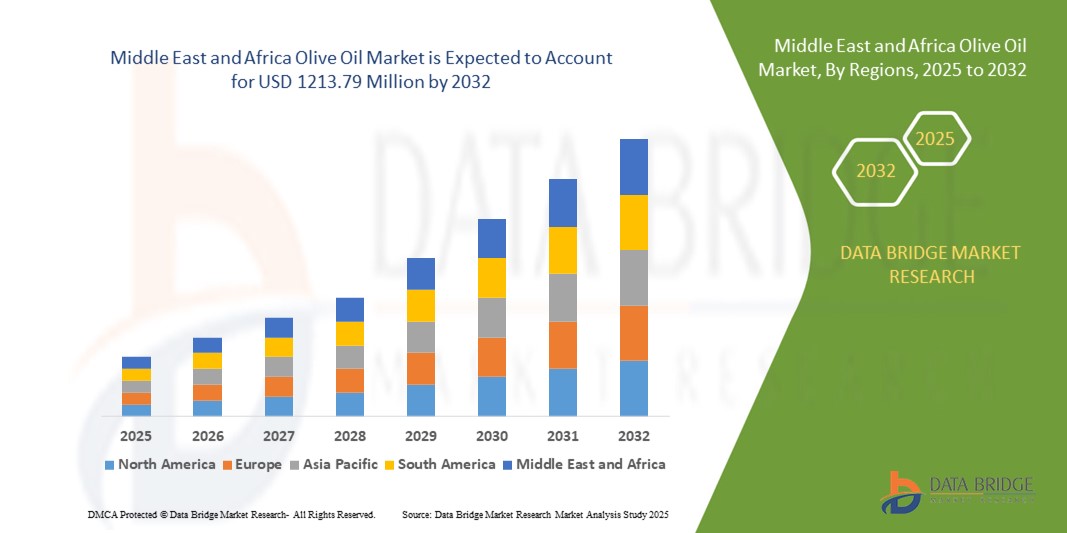
- The Middle East and Africa olive oil market size was valued at USD 834.17 million in 2024 and is expected to reach USD 1213.79 million by 2032, at a CAGR of 4.8% during the forecast period
- The market growth is primarily driven by increasing consumer awareness of olive oil’s health benefits, such as its high antioxidant content and heart-healthy properties, along with growing demand for premium and natural food products
- Rising adoption of Mediterranean diets, coupled with growing applications in cosmetics and pharmaceuticals, is further propelling the demand for olive oil across both retail and industrial channels
Middle East and Africa Olive Oil Market Analysis
- The olive oil market in the Middle East and Africa is experiencing robust growth due to increasing consumer preference for healthy cooking oils and natural ingredients in food, cosmetics, and personal care products
- Growing demand for premium olive oil types, such as extra virgin and virgin olive oil, is encouraging manufacturers to innovate with high-quality, organic, and sustainably sourced products
- South Africa dominates the Middle East and Africa olive oil market with the largest revenue share of 35.6% in 2024, driven by a well-established food and beverage industry and increasing consumer preference for healthy and premium cooking oils
- Saudi Arabia is expected to be the fastest-growing country in the olive oil market during the forecast period, fueled by rising disposable incomes, rapid urbanization, and growing awareness of olive oil’s health and culinary benefits
- The extra virgin olive oil segment dominated the largest market revenue share of 38.5% in 2024, driven by its superior quality, rich flavor, and high nutritional value, making it a preferred choice for health-conscious consumers and culinary applications
Report Scope and Middle East and Africa Olive Oil Market Segmentation
|
Attributes |
Middle East and Africa Olive Oil Key Market Insights |
|
Segments Covered |
|
|
Countries Covered |
Middle East and Africa
|
|
Key Market Players |
|
|
Market Opportunities |
|
|
Value Added Data Infosets |
In addition to the insights on market scenarios such as market value, growth rate, segmentation, geographical coverage, and major players, the market reports curated by the Data Bridge Market Research also include in-depth expert analysis, pricing analysis, brand share analysis, consumer survey, demography analysis, supply chain analysis, value chain analysis, raw material/consumables overview, vendor selection criteria, PESTLE Analysis, Porter Analysis, and regulatory framework. |
Middle East and Africa Olive Oil Market Trends
Increasing Adoption of Health-Conscious and Sustainable Products
- The Middle East and Africa olive oil market is experiencing a notable trend toward the adoption of health-conscious and sustainable products
- Consumers are increasingly seeking olive oils, particularly extra virgin and organic varieties, due to their high content of monounsaturated fats, antioxidants, and anti-inflammatory properties, which are linked to health benefits such as reduced risk of heart disease and improved cholesterol levels
- Advanced extraction methods, such as cold-pressing and cold-extraction, are gaining popularity as they preserve the nutritional quality and flavor of olive oil, appealing to health-focused consumers
- For instance, companies such as Znaidi Food Industries in Tunisia have introduced premium extra virgin olive oil brands, such as “Maria Bonomo,” extracted from Chetoui olives, emphasizing quality and sustainability
- This trend is enhancing the appeal of olive oil for both culinary and non-culinary applications, including cosmetics and personal care, making it more attractive to health-conscious consumers and environmentally aware buyers
- Sustainable farming practices, supported by initiatives such as the European Bank for Reconstruction and Development’s funding for olive oil production in Tunisia and Morocco, are further driving the market by promoting eco-friendly production methods
Middle East and Africa Olive Oil Market Dynamics
Driver
Rising Demand for Healthy Cooking Oils and Mediterranean Cuisine
- Increasing consumer awareness of the health benefits of olive oil, such as its monounsaturated fat content and antioxidant properties, is a major driver for the Middle East and Africa olive oil market
- The growing popularity of Mediterranean cuisine, which heavily features olive oil, is boosting demand, particularly in urban areas and among younger demographics
- Government initiatives in countries such as Turkey, where olive oil production increased by 32% in 2021, are supporting sustainable olive agriculture, further fueling market growth
- The expansion of applications beyond food and beverages, such as in cosmetics, personal care, and pharmaceuticals, is also driving demand, with South Africa leading due to its increasing use of olive oil in beauty products
- The rise of e-commerce and non-store-based distribution channels is making olive oil more accessible, particularly in Saudi Arabia, the fastest-growing market, where disposable incomes and health awareness are rising
Restraint/Challenge
High Production Costs and Adulteration Concerns
- The high cost of producing premium olive oils, particularly extra virgin and organic variants, due to labor-intensive processes and the need for advanced extraction technologies, poses a significant barrier to market growth, especially in cost-sensitive emerging markets
- Integrating sustainable and organic farming practices can further increase production costs, limiting adoption among smaller producers
- Adulteration and mislabeling of olive oil, particularly in markets such as Turkey, where fraudulent practices have been reported, raise concerns about product authenticity and quality, potentially eroding consumer trust
- The fragmented regulatory landscape across Middle Eastern and African countries regarding quality standards and labeling complicates compliance for producers and distributors
- These challenges may hinder market expansion, particularly in regions with high price sensitivity or limited awareness of olive oil’s benefits
Middle East and Africa Olive Oil market Scope
The market is segmented on the basis of type, flavor, extraction method, application, and distribution channel.
- By Type
On the basis of type, the Middle East and Africa olive oil market is segmented into Virgin Olive Oil, Pomace Olive Oil, Refined Olive Oil, Common Olive Oil, Extra Virgin Olive Oil, and Lite/Light Olive Oil. The Extra Virgin Olive Oil segment dominated the largest market revenue share of 38.5% in 2024, driven by its superior quality, rich flavor, and high nutritional value, making it a preferred choice for health-conscious consumers and culinary applications. Its production from the first cold pressing of olives ensures minimal processing, preserving antioxidants and monounsaturated fats.
The Lite/Light Olive Oil segment is expected to witness the fastest growth rate from 2025 to 2032, driven by increasing consumer preference for low-calorie and heart-healthy cooking oils. Its milder flavor and versatility in cooking appeal to a broader consumer base, particularly in emerging markets with rising health awareness.
- By Flavor
On the basis of flavor, the Middle East and Africa olive oil market is segmented into Full-Bodied & Earthy, Fruity & Peppery, Fruity & Herby, and Mild & Buttery. The Fruity & Herby segment dominated with a 34.6% market share in 2024, attributed to its popularity in Mediterranean cuisine and growing consumer preference for seafood dishes, which pair well with this flavor profile. The segment’s appeal is further enhanced by increasing awareness of its health benefits and versatility in culinary applications.
The Mild & Buttery segment is anticipated to experience the fastest growth from 2025 to 2032, driven by its smooth taste and suitability for diverse cooking styles, including baking and light sautéing. Its appeal to consumers seeking subtle flavors for everyday use is expected to boost demand.
- By Extraction Method
On the basis of extraction method, the Middle East and Africa olive oil market is segmented into First-Press, Cold-Pressed, and Cold-Extracted. The Cold-Extracted segment held the largest market share of 48.7% in 2024, driven by its association with high-quality extra virgin olive oil, which retains maximum nutritional value and flavor due to minimal heat exposure during extraction. This method’s ability to prevent lifestyle-related disorders such as obesity further supports its dominance.
The Cold-Pressed segment is expected to grow significantly from 2025 to 2032, as advancements in extraction technologies improve yield and quality, appealing to health-conscious consumers and premium brands. Its eco-friendly and nutrient-preserving process aligns with the growing demand for sustainable products.
- By Application
The market is application On the basis of flavor, the Middle East and Africa olive oil market is segmented into Food and Beverages, Pharmaceutical, Cosmetic and Personal Care, Aromatherapy, and Others. The Food and Beverages segment accounted for the largest market revenue share of 65.2% in 2024, fueled by the widespread adoption of olive oil in Mediterranean cuisine, growing consumer awareness of its health benefits, and increasing use in household cooking and commercial food production.
The Cosmetic and Personal Care segment is projected to witness robust growth from 2025 to 2032, driven by olive oil’s moisturizing and antioxidant properties, which are increasingly incorporated into skincare and haircare products. The rising demand for natural and organic beauty products is expected to further accelerate this segment’s growth.
- By Distribution Channel
On the basis of distribution channel, the Middle East and Africa olive oil market is segmented into Store Based and Non-Store Based. The Store Based segment dominated with a 70.8% market share in 2024, driven by consumer preference for purchasing olive oil through supermarkets, hypermarkets, and specialty stores, where product quality and authenticity can be physically verified.
The Non-Store Based segment is expected to experience the fastest growth from 2025 to 2032, propelled by the rise of online retailing, which offers convenience, competitive pricing, and a wide range of products. The expansion of e-commerce platforms enables olive oil producers to reach a broader consumer base, including those in remote areas.
Middle East and Africa Olive Oil Market Regional Analysis
- South Africa dominates the Middle East and Africa olive oil market with the largest revenue share of 35.6% in 2024, driven by a well-established food and beverage industry and increasing consumer preference for healthy and premium cooking oils
- Growth is driven by increasing consumer awareness of olive oil's health benefits, such as its high monounsaturated fat content and antioxidant properties, alongside the rising popularity of Mediterranean cuisine
- Consumers prioritize olive oil for its nutritional value, versatility in cooking, and applications in cosmetics and personal care. Advancements in extraction technologies, such as cold-pressed and cold-extracted methods, enhance product quality, further boosting demand in both household and industrial applications
Saudi Arabia Olive Oil Market Insight
Saudi Arabia is expected to witness the fastest growth rate in the Middle East and Africa olive oil market, driven by rising consumer awareness of health benefits and increasing demand for high-quality olive oil in culinary and personal care applications. Rapid urbanization, growing disposable incomes, and a shift toward healthier cooking oils boost market penetration. The popularity of Mediterranean cuisine and government initiatives promoting sustainable and healthy food options further accelerate adoption. Both store-based and non-store-based distribution channels are expanding, with a notable rise in online sales catering to convenience-driven consumers.
Middle East and Africa Olive Oil Market Share
The olive oil industry is primarily led by well-established companies, including:
- Cargill, Incorporated (U.S.)
- Deoleo (Spain)
- Del Monte Foods, Inc. (U.S.)
- Gallo Worldwide (U.S.)
- BORGES INTERNATIONAL GROUP, S.L.U. (Spain)
- SOVENA (Portugal)
- Sun Grove Foods Inc. (U.S.)
- EU Olive Oil Ltd (U.K.)
- Artajo oil (Spain)
- SALOV GROUP (Italy)
- Aceites Sandúa (Spain)
- Tucan Olive Oil Company LTD (U.K.)
- Domenico Manca S.p.a. (Italy)
- Les huiles d'olive Lahmar (Tunisia)
- GRAMPIANS OLIVE CO. (Australia)
- Victorian Olive Groves (Australia)
- Gourmet Foods Inc. (U.S.)
- JAENCOOP GROUP (Spain)
- ΜΙΝΕRVΑ (Greece)
What are the Recent Developments in Middle East and Africa Olive Oil Market?
- In June 2025, Jordan’s Ministry of Agriculture launched a comprehensive campaign to modernize the olive oil sector, emphasizing quality enhancement, sustainability, and public awareness. Led by the Plant Protection and Phytosanitary Directorate, the initiative includes deploying low-residue pesticides, sticky traps, and farmer training to combat pests such as the olive fruit fly. The campaign promotes integrated pest management, good agricultural practices, and aims to produce high-quality, pesticide-free olive oil that meets international standards. This strategic effort supports Jordan’s economic modernization goals and preserves its agricultural heritage
- In March 2025, Tunisian startup Bioheat, founded by engineer Yassine Khelifi, unveiled an innovative solution to transform olive pomace—a byproduct of oil extraction—into clean energy briquettes. These cylindrical briquettes offer a sustainable alternative to firewood, helping reduce deforestation and carbon emissions. Developed over four years, Bioheat’s technology produces low-moisture fuel that burns efficiently. This initiative not only tackles waste management but also supports Tunisia’s shift toward a circular economy in its olive sector, aligning with environmental and energy goals in a country heavily reliant on imported fuel
- In February 2025, Tunisia’s olive oil sector saw a major boost thanks to a bumper harvest, driving a sharp rise in exports. The country exported 115,200 tons in Q1 2025—an 85.3% increase year-on-year. While bulk shipments dominated at 90.6%, packaged exports slightly declined to 9.4%, reflecting shifting market dynamics. Despite global price drops, Tunisia’s strong production and strategic diversification into new markets underscore its resilience and growing influence in the international olive oil trade
- In May 2024, Turkey’s table olive exports are projected to hit a record USD250 million, fueled by rising global demand and robust production. The country exported 64,000 metric tons since October 2024, marking a 33% increase in volume and 26.5% in value over the previous year. With Germany and Iraq as top importers, Turkey is advancing toward its goal of 100,000 tons exported. This growth reflects the strength of Turkey’s broader olive sector, suggesting promising potential for olive oil exports as well
- In February 2022, Turkish olive oil producer Kristal Oil launched a new product line called “Kristal Anatolia”, featuring extra-virgin and Riviera olive oils. Packaged in 1- and 2-liter green PET bottles, these oils were introduced at budget-friendly prices to increase accessibility, especially in discount markets where Kristal products were previously unavailable. The initiative reflects Kristal’s commitment to meeting consumer demand while maintaining quality. With over 80 years of experience, Kristal continues to uphold high standards in production, certified by international food safety organizations

- Interactive Data Analysis Dashboard
- Company Analysis Dashboard for high growth potential opportunities
- Research Analyst Access for customization & queries
- Competitor Analysis with Interactive dashboard
- Latest News, Updates & Trend analysis
- Harness the Power of Benchmark Analysis for Comprehensive Competitor Tracking
Middle East And Africa Olive Oil Market, Supply Chain Analysis and Ecosystem Framework
To support market growth and help clients navigate the impact of geopolitical shifts, DBMR has integrated in-depth supply chain analysis into its Middle East And Africa Olive Oil Market research reports. This addition empowers clients to respond effectively to global changes affecting their industries. The supply chain analysis section includes detailed insights such as Middle East And Africa Olive Oil Market consumption and production by country, price trend analysis, the impact of tariffs and geopolitical developments, and import and export trends by country and HSN code. It also highlights major suppliers with data on production capacity and company profiles, as well as key importers and exporters. In addition to research, DBMR offers specialized supply chain consulting services backed by over a decade of experience, providing solutions like supplier discovery, supplier risk assessment, price trend analysis, impact evaluation of inflation and trade route changes, and comprehensive market trend analysis.
Data collection and base year analysis are done using data collection modules with large sample sizes. The stage includes obtaining market information or related data through various sources and strategies. It includes examining and planning all the data acquired from the past in advance. It likewise envelops the examination of information inconsistencies seen across different information sources. The market data is analysed and estimated using market statistical and coherent models. Also, market share analysis and key trend analysis are the major success factors in the market report. To know more, please request an analyst call or drop down your inquiry.
The key research methodology used by DBMR research team is data triangulation which involves data mining, analysis of the impact of data variables on the market and primary (industry expert) validation. Data models include Vendor Positioning Grid, Market Time Line Analysis, Market Overview and Guide, Company Positioning Grid, Patent Analysis, Pricing Analysis, Company Market Share Analysis, Standards of Measurement, Global versus Regional and Vendor Share Analysis. To know more about the research methodology, drop in an inquiry to speak to our industry experts.
Data Bridge Market Research is a leader in advanced formative research. We take pride in servicing our existing and new customers with data and analysis that match and suits their goal. The report can be customized to include price trend analysis of target brands understanding the market for additional countries (ask for the list of countries), clinical trial results data, literature review, refurbished market and product base analysis. Market analysis of target competitors can be analyzed from technology-based analysis to market portfolio strategies. We can add as many competitors that you require data about in the format and data style you are looking for. Our team of analysts can also provide you data in crude raw excel files pivot tables (Fact book) or can assist you in creating presentations from the data sets available in the report.













