


What is the Middle East and Africa Omega-3 for Food Application Market Size and Growth Rate?
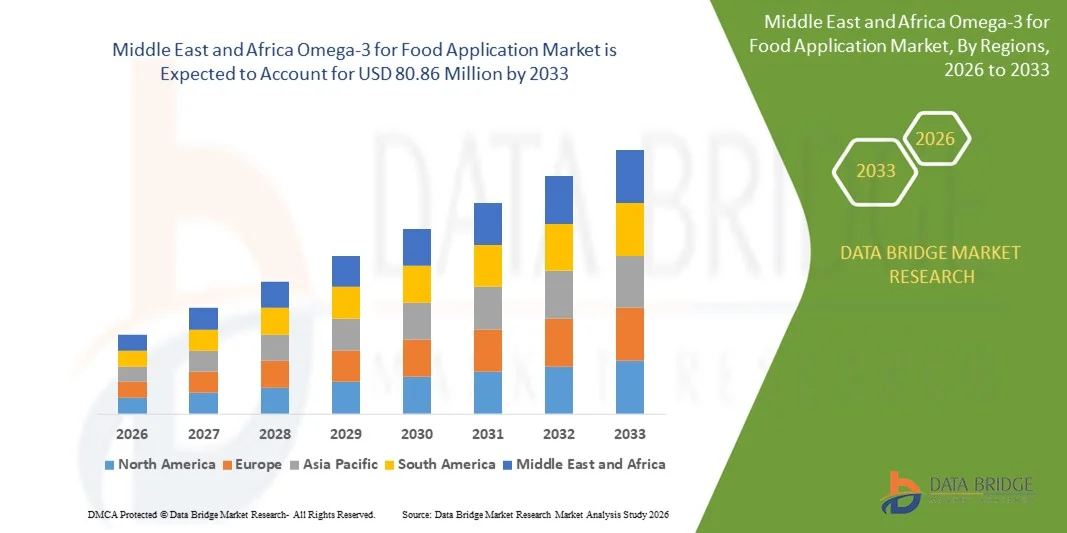
- As per Data Bridge Market Research Analysis the Middle East and Africa Omega-3 for food application market size was valued at USD 43.26 million in 2025 and is expected to reach USD 80.86 million by 2033, at a CAGR of 8.0% during the forecast period
- Increasing consumer demand for functional, fortified, and health-focused foods is driving growth in the Omega-3 for food applications market. Rising awareness of heart health, cognitive support, and anti-inflammatory benefits of Omega-3 fatty acids is encouraging manufacturers to incorporate these ingredients into bakery, dairy, beverages, and snack products
- The growing preference for natural and organic food products, combined with concerns over sugar consumption, obesity, and diabetes, is further accelerating the adoption of Omega-3-fortified foods. Functional benefits such as anti-inflammatory, cardioprotective, and brain health support are strengthening market appeal Middle East and Africaly
Market Size & Forecast
- Global Market Value (2025): USD 43.26 million
- Expected Market Value (2033): USD 80.86 million
- Forecast CAGR (2026–2033): 8.0%
What are the Major Takeaways of Omega-3 for Food Application Market?
- Rising consumer health consciousness, increasing disposable incomes, and evolving dietary preferences are key factors positively impacting the Omega-3 for Food Applications market. In addition, product innovations and new formulation strategies present lucrative opportunities for market participants
- High cost of Omega-3 ingredients compared to conventional alternatives, coupled with the presence of cheaper artificial fortification options, may hinder growth. Limited consumer awareness in emerging regions about the health benefits of Omega-3 is projected to challenge widespread adoption
- Despite challenges, ongoing R&D, product diversification, and marketing initiatives are expected to sustain long-term growth in the Middle East and Africa Omega-3 for Food Applications market
- Saudi Arabia dominated the Middle East and Africa Omega-3 for Food Application market with a 41.2% revenue share in 2025, supported by rising consumer awareness of heart health, brain development, and preventive nutrition in key countries such as Saudi Arabia, South Africa, and Egypt
- South Africa is projected to register the fastest CAGR of 9.64% from 2026 to 2033, fueled by increasing awareness of heart health, cognitive function, and dietary supplementation. Omega-3-enriched beverages, dairy products, and fortified snacks are gaining traction
- The DHA segment dominated the market with a revenue share of 51.6% in 2025, supported by its extensive use in infant formula, fortified dairy, brain-health beverages, and nutritional supplements
Report Scope and Omega-3 for Food Application Market Segmentation
|
Attributes |
Omega-3 for Food Application Key Market Insights |
|
Segments Covered |
|
|
Countries Covered |
Middle East and Africa
|
|
Key Market Players |
|
|
Market Opportunities |
|
|
Value Added Data Infosets |
|
What is the Key Trend in the Omega-3 for Food Application Market?
Rising Demand for Nutrient-Enriched and Multi-Omega-3 Food Ingredients
- The Omega-3 for Food Application market is witnessing significant growth toward nutrient-enriched, multifunctional, and clean-label formulations, including blends with plant-based oils, algae extracts, and dietary fibers to improve nutritional value, taste, and functional benefits
- Manufacturers are developing multi-purpose Omega-3 solutions that support heart health, cognitive function, anti-inflammatory properties, and broader applications in bakery, dairy, beverages, and infant nutrition products
- Consumers are increasingly seeking natural, safe, and functional Omega-3 ingredients over synthetic alternatives, driving adoption across food, beverages, and nutraceutical categories.
- For instance, companies such as DSM, BASF, Croda, ADM, and Aker BioMarine have expanded their Omega-3 product portfolios by introducing microencapsulated, powdered, and blended oils suitable for fortified foods and beverages
- Growing awareness of cardiovascular health, infant nutrition, and clean-label consumption is accelerating Middle East and Africa market adoption
- As consumer focus on health, functionality, and natural ingredients intensifies, Omega-3 for Food Applications are expected to remain central to product innovation across the food and nutraceutical industries
What are the Key Drivers of Omega-3 for Food Application Market?
- Rising demand for functional, plant- and marine-based Omega-3 ingredients is driving strong adoption of Omega-3 for Food Applications Middle East and Africaly
- For instance, in 2025, DSM, BASF, and Croda expanded microencapsulated and powdered Omega-3 products for fortified dairy, beverages, and infant nutrition applications
- Growing awareness of heart health, infant brain development, anti-inflammatory benefits, and cognitive support is boosting demand across the U.S., Middle East and Africa, and Middle East and Africa
- Advancements in microencapsulation, extraction, and blending techniques have improved stability, taste masking, and application versatility in a wide range of foods
- Rising preference for organic, non-GMO, and clean-label food products further supports market expansion, driven by health-conscious and environmentally aware consumers
- With continuous R&D, new product launches, collaborations, and expanded Middle East and Africa distribution, the Omega-3 for Food Application market is expected to maintain strong growth during the forecast period
Which Factor is Challenging the Growth of the Omega-3 for Food Application Market?
- High extraction, purification, and stabilization costs associated with marine and plant-based Omega-3 oils limit affordability in price-sensitive regions
- For instance, during 2024–2025, fluctuations in fish oil and algae production, raw material availability, and energy costs impacted manufacturing volumes for several companies
- Strict regulatory requirements for novel food approvals, food safety, and labeling compliance add operational complexities
- Limited consumer awareness in emerging markets about Omega-3 benefits, including cardiovascular, cognitive, and infant nutrition support, restricts adoption
- Competition from cheaper alternatives such as flaxseed oil, chia oil, and other plant-based oils exerts pressure on pricing and differentiation
- Companies are addressing these challenges by focusing on cost-efficient extraction, stable formulations, regulatory alignment, and consumer education to expand adoption of high-quality Omega-3 for Food Applications Middle East and Africaly
How is the Omega-3 for Food Application Market Segmented?
The market is segmented on the basis of type, source, form, applications, and function.
- By Type
The Omega-3 for Food Application market is segmented into Alpha-Linolenic Acid (ALA), Eicosapentaenoic Acid (EPA), Docosahexaenoic Acid (DHA), and EPA+DHA. The DHA segment dominated the market with a revenue share of 51.6% in 2025, supported by its extensive use in infant formula, fortified dairy, brain-health beverages, and nutritional supplements. DHA is widely preferred due to its proven benefits for cognitive development, eye health, and neurological support. Its high stability in microencapsulated formats and compatibility with bakery, beverage, and powdered formulations further expands industrial adoption.
The EPA+DHA segment is projected to grow at the fastest CAGR from 2026 to 2033, driven by growing demand for synergistic blends in heart-health functional foods, sports nutrition, and anti-inflammatory formulations. Increasing awareness of preventive nutrition, rising cardiovascular disease incidence, and product innovation from marine- and algae-based sources will continue to accelerate demand across Middle East and Africa markets.
- By Source
The Omega-3 for Food Application market is segmented into Marine-Based, Algae-Based, and Plant-Based. The Marine-Based segment held the largest share of 58.3% in 2025, driven by strong availability of fish oil, krill oil, and concentrated marine triglycerides used in fortified beverages, dairy, spreads, and dietary supplements. Marine-based Omega-3s remain the most established source due to high EPA and DHA content and wide regulatory acceptance across Middle East and Africa food industries.
The Algae-Based segment is expected to register the fastest CAGR from 2026 to 2033, fueled by rising preference for plant-origin, sustainable, non-GMO, and vegan alternatives suitable for infant formula, functional beverages, clean-label foods, and premium nutritional products. Increasing investments in microalgae fermentation, cost-efficient production, and environmental sustainability further strengthen adoption across the U.S., Middle East and Africa, and Middle East and Africa.
- By Form
The market is segmented into Oil and Powder forms. The Oil segment dominated the market with a 67.2% revenue share in 2025, attributed to its high utilization in fortified beverages, dairy products, infant formula, and culinary applications. Oils offer superior absorption, high purity levels, and broader applicability across traditional food systems. Marine and algae-based Omega-3 oils remain the industry standard for EPA and DHA fortification, particularly in premium food and nutraceutical categories.
The Powder segment is projected to grow at the fastest CAGR from 2026 to 2033, supported by increasing adoption in baked goods, gummies, confectionery, dry mixes, meal replacements, and powdered beverages. Powdered Omega-3 offers better stability, taste masking, longer shelf life, and easy blending, making it ideal for large-scale industrial usage and plant-based food manufacturers.
- By Applications
The Omega-3 for Food Application market is segmented into Functional Food, Confectionery & Chocolate Products, Sports Nutrition, Dietary Supplements, Infant Formula, and Others. The Functional Food segment led the market with a revenue share of 36.4% in 2025, driven by rising demand for heart-health foods, brain-boosting beverages, fortified dairy alternatives, spreads, cereals, and health bars. Increasing consumer preference for preventive and lifestyle-based nutrition supports continuous expansion.
The Sports Nutrition segment is projected to grow at the fastest CAGR from 2026 to 2033, owing to growing interest in anti-inflammatory benefits, muscle recovery, endurance improvement, and joint-health support. Rising consumption of Omega-3-infused protein powders, gels, hydration drinks, and performance foods is fueling rapid growth across North America, Middle East and Africa, and Middle East and Africa.
- By Function
The market is segmented into Food Fortification, Bone & Joint Health, Skin Health, Hair Health, Nails Health, and Others. The Food Fortification segment dominated the market with a 44.8% revenue share in 2025, supported by rising incorporation of Omega-3 in dairy products, beverages, bakery items, infant formula, cereals, and nutritional snacks. Increasing government focus on nutritional enhancement, clean-label formulations, and preventive health fuels widespread industrial adoption.
The Skin Health segment is projected to grow at the fastest CAGR from 2026 to 2033, driven by rising demand for beauty-from-within products, anti-aging functional foods, collagen blends, and dermatologically supported nutrition. The role of Omega-3 in hydration, inflammation reduction, and skin barrier repair accelerates integration in fortified snacks, beverages, and functional confectionery.
Which Region Holds the Largest Share of the Omega-3 for Food Application Market?
- Saudi Arabia dominated the Middle East and Africa Omega-3 for Food Application market with a 41.2% revenue share in 2025, supported by rising consumer awareness of heart health, brain development, and preventive nutrition in key countries such as Saudi Arabia, South Africa, and Egypt
- Strong adoption of fortified foods, dietary supplements, functional beverages, and infant nutrition drives Omega-3 inclusion in dairy products, cereals, health bars, and sports nutrition formulations
- Rising disposable incomes, urbanization, and expansion of organized retail and e-commerce channels continue to accelerate adoption across diverse food categories
U.A.E. Omega-3 for Food Application Market Insight
The U.A.E. demonstrates steady growth due to strong demand for premium fortified foods, functional beverages, and infant nutrition. High disposable incomes, urban lifestyles, and growing interest in preventive health are driving Omega-3 integration in dairy drinks, nutritional bars, and ready-to-drink beverages. Ongoing product innovation in taste, stability, and bioavailability is supporting widespread market penetration.
South Africa Omega-3 for Food Application Market Insight
South Africa is projected to register the fastest CAGR of 9.64% from 2026 to 2033, fueled by increasing awareness of heart health, cognitive function, and dietary supplementation. Omega-3-enriched beverages, dairy products, and fortified snacks are gaining traction. Expansion of e-commerce platforms, retail availability, and consumer focus on natural and clean-label ingredients support rapid adoption across urban and semi-urban regions.
Egypt Omega-3 for Food Application Market Insight
Egypt contributes significantly to regional growth, driven by rising interest in functional nutrition, infant formula, and fortified foods. Growing health consciousness, demand for cognitive and cardiovascular support, and adoption of dietary supplements are encouraging higher Omega-3 consumption. Manufacturers are emphasizing plant-based and algae-derived EPA and DHA solutions, improved taste profiles, and compliance with food safety and quality standards to expand market reach.
Which are the Top Companies in Omega-3 for Food Application Market?
The Omega-3 for food application industry is primarily led by well-established companies, including:
- DSM (Netherlands)
- BASF SE (Germany)
- Croda International Plc (U.K.)
- Aker BioMarine (Norway)
- ADM (Archer Daniels Midland Company) (U.S.)
- Cellana Inc. (U.S.)
- HUTAI Biopharm Resource Co. Ltd (China)
- AlaskOmega (U.S.)
- KinOmega Biopharm Inc. (U.S.)
- Pharma Marine AS (Norway)
- GC Rieber VivoMega AS (Norway)
- Sanmark LLC (U.S.)
- Arjuna Natural Pvt Ltd (India)
- ConnOils LLC (U.S.)
- Kingdomway Nutrition, Inc. (China)
- Polaris Inc. (U.S.)
- Biosearch Life (Spain)
What are the Recent Developments in Middle East and Africa Omega-3 for Food Application Market?
- In March 2025, Natac introduced its Omega-3 Star product, manufactured using premium-quality fish oil and formulated for applications across food, nutraceutical, and pet nutrition industries. This launch strengthens the company’s position in the expanding omega-3 solutions market
- In October 2023, dsm-firmenich launched life’s OMEGA O3020 in the North American market, presenting the first single-source algal omega-3 that matches the natural EPA-to-DHA ratio of standard fish oil while offering superior efficacy. This product is expected to accelerate the adoption of plant-based omega-3 alternatives
- In May 2023, Nuseed Middle East and Africa introduced its Nuseed Nutriterra plant-based oil enriched with omega-3, designed specifically to meet the evolving needs of the human nutrition and dietary supplement sectors. This innovation enhances the availability of sustainable, non-marine omega-3 sources
- In March 2023, Epax invested USD 40 million in molecular distillation technologies aimed at improving the production and purity of highly concentrated omega-3 ingredients. This investment underscores the company’s commitment to advancing high-quality omega-3 solutions
- In October 2022, Nature’s Bounty launched a new Plant-Based Omega-3 dietary supplement formulated with 1,000 mg of vegetarian algae oil to support heart, joint, and skin health. This product introduction highlights the growing consumer demand for clean-label and vegan omega-3 options

- Interactive Data Analysis Dashboard
- Company Analysis Dashboard for high growth potential opportunities
- Research Analyst Access for customization & queries
- Competitor Analysis with Interactive dashboard
- Latest News, Updates & Trend analysis
- Harness the Power of Benchmark Analysis for Comprehensive Competitor Tracking
Middle East And Africa Omega 3 For Food Application Market, Supply Chain Analysis and Ecosystem Framework
To support market growth and help clients navigate the impact of geopolitical shifts, DBMR has integrated in-depth supply chain analysis into its Middle East And Africa Omega 3 For Food Application Market research reports. This addition empowers clients to respond effectively to global changes affecting their industries. The supply chain analysis section includes detailed insights such as Middle East And Africa Omega 3 For Food Application Market consumption and production by country, price trend analysis, the impact of tariffs and geopolitical developments, and import and export trends by country and HSN code. It also highlights major suppliers with data on production capacity and company profiles, as well as key importers and exporters. In addition to research, DBMR offers specialized supply chain consulting services backed by over a decade of experience, providing solutions like supplier discovery, supplier risk assessment, price trend analysis, impact evaluation of inflation and trade route changes, and comprehensive market trend analysis.
Data collection and base year analysis are done using data collection modules with large sample sizes. The stage includes obtaining market information or related data through various sources and strategies. It includes examining and planning all the data acquired from the past in advance. It likewise envelops the examination of information inconsistencies seen across different information sources. The market data is analysed and estimated using market statistical and coherent models. Also, market share analysis and key trend analysis are the major success factors in the market report. To know more, please request an analyst call or drop down your inquiry.
The key research methodology used by DBMR research team is data triangulation which involves data mining, analysis of the impact of data variables on the market and primary (industry expert) validation. Data models include Vendor Positioning Grid, Market Time Line Analysis, Market Overview and Guide, Company Positioning Grid, Patent Analysis, Pricing Analysis, Company Market Share Analysis, Standards of Measurement, Global versus Regional and Vendor Share Analysis. To know more about the research methodology, drop in an inquiry to speak to our industry experts.
Data Bridge Market Research is a leader in advanced formative research. We take pride in servicing our existing and new customers with data and analysis that match and suits their goal. The report can be customized to include price trend analysis of target brands understanding the market for additional countries (ask for the list of countries), clinical trial results data, literature review, refurbished market and product base analysis. Market analysis of target competitors can be analyzed from technology-based analysis to market portfolio strategies. We can add as many competitors that you require data about in the format and data style you are looking for. Our team of analysts can also provide you data in crude raw excel files pivot tables (Fact book) or can assist you in creating presentations from the data sets available in the report.













