


Pre-shipment Inspection Market Size
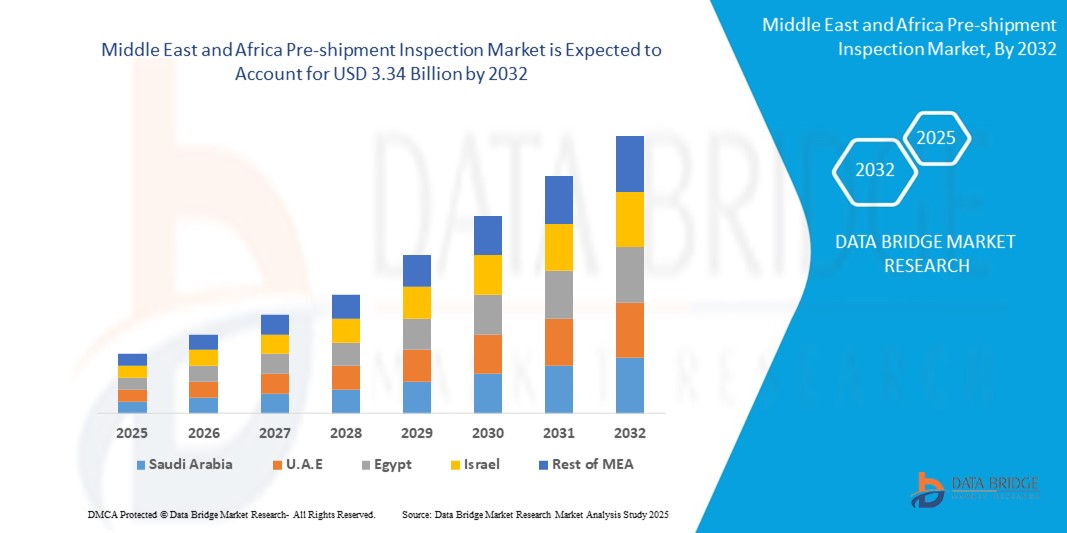
- The Middle East and Africa Pre-shipment Inspection Market size was valued at USD 1.9 billion in 2024 and is expected to reach USD 3.34 billion by 2032, at a CAGR of 8.4% during the forecast period
- This growth is driven by factors such as the rising import-export activities, stricter compliance regulations, and increasing demand for quality control across diverse industries.
Pre-shipment Inspection Market Analysis
- Pre-shipment inspection is the type of inspection done before shipment of goods. These processes can be done at different stages before shipment such as checking of goods, documentation and packaging, and quality control or consistency of goods.
- The pre-shipment process has been carried out for declining the risk of poor quality and non-compliance goods, minimizing product recalls and reducing cost.
- Saudi Arabia is expected to dominate the Pre-shipment Inspections market due to its growing non-oil exports, strict regulatory frameworks, and increased focus on product quality and compliance
- U.A.E. is expected to be the fastest growing region in the Pre-shipment Inspection Market during the forecast period due to expanding trade volume, logistics infrastructure, and strict import-export quality regulations
- In-House segment is expected to dominate the market with a market share of 51.27% due to cost-efficiency, faster turnaround times, and better control over internal quality assurance processes.
Report Scope and Pre-shipment Inspection Market Segmentation
|
Attributes |
Pre-shipment Inspection Key Market Insights |
|
Segments Covered |
|
|
Countries Covered |
Middle East and Africa
|
|
Key Market Players |
|
|
Market Opportunities |
|
|
Value Added Data Infosets |
In addition to the insights on market scenarios such as market value, growth rate, segmentation, geographical coverage, and major players, the market reports curated by the Data Bridge Market Research also include import export analysis, production capacity overview, production consumption analysis, price trend analysis, climate change scenario, supply chain analysis, value chain analysis, raw material/consumables overview, vendor selection criteria, PESTLE Analysis, Porter Analysis, and regulatory framework. |
Pre-shipment Inspection Market Trends
“Increasing Use of PSI for Regulatory Compliance and Anti-Counterfeit Measures”
- With rising concerns around counterfeit goods and substandard imports, more MEA governments are enforcing strict compliance through pre-shipment inspections. Regulatory bodies in countries like Egypt, Saudi Arabia, and South Africa are mandating PSI to ensure imported goods meet national and international standards
- This trend is particularly strong in sectors like pharmaceuticals, food products, electronics, and construction materials. PSI helps prevent the entry of unsafe or non-compliant goods, reducing public health risks and economic loss. Importers are also using PSI to meet certification requirements and ease customs clearance. The process not only adds a layer of security but also boosts consumer trust in product quality. For businesses, this ensures smoother market entry and avoids costly delays or rejections. As more countries introduce trade compliance frameworks, PSI becomes an essential tool in regulatory enforcement
- For instance, In April 2025, the Food and Drug Authority updated its rules to require PSI for all imported health supplements. A supplier in Jordan partnered with a PSI agency to certify batch quality and labeling. The inspection allowed faster entry at Saudi ports without additional checks. This proactive compliance helped the company expand its distribution quickly. It reflects the growing role of PSI in regulatory assurance
Pre-shipment Inspection Market Dynamics
Driver
“Growth in Cross-Border Trade and Import Volumes”
- As countries across the Middle East and Africa expand their international trade relationships, the volume of goods crossing borders is increasing significantly. Nations like the UAE, Kenya, and Nigeria are strengthening their trade ties with Asia, Europe, and the Americas. This rise in imports—from electronics and machinery to food and medical supplies—requires robust inspection protocols to ensure compliance with quality, safety, and labeling standards.
- Pre-shipment inspection acts as the first line of defense against defective or misdeclared goods. It also helps importers avoid penalties, returns, or rejected shipments at destination ports. The complexity of dealing with multiple regulatory frameworks makes PSI even more critical in cross-border transactions. Governments are also promoting PSI to protect consumers and domestic markets from subpar or counterfeit products. This consistent trade growth fuels the demand for reliable, third-party inspection services. As international commerce continues to rise, PSI will remain a critical component of trade facilitation in MEA.
For instance,
- In January 2025, a South African importer of home appliances increased trade with Chinese suppliers. To meet customs and safety standards, the company partnered with a PSI firm to inspect each shipment before departure. The inspections ensured the goods met energy efficiency and voltage norms. This prevented costly delays and boosted customer trust. The importer now includes PSI in all cross-border deals.
Opportunity
“Expansion of Manufacturing and Export Hubs”
- As African nations ramp up industrialization and diversify their economies, more local manufacturing hubs are emerging, especially in countries like Kenya, Nigeria, and Ethiopia. These regions are producing goods such as textiles, machinery, food products, and electronics for export, prompting a growing need for pre-shipment inspection services. Since many of these products are headed to Europe and Asia, compliance with international quality standards is essential. Governments are also supporting this growth with export promotion schemes, making PSI a key requirement. Local exporters increasingly recognize the value of third-party verification to build trust with Middle-East & Africa buyers.
- The growing number of free trade zones and special economic areas also boosts cross-border movement of goods, increasing inspection demand. Furthermore, digitalization and logistics upgrades are making it easier to implement inspection systems. This creates a large and expanding opportunity for PSI companies to establish a presence in underserved African markets. As manufacturing continues to grow, PSI services will become a vital part of the value chain.
For instance,
- In March 2025, a garment manufacturer in Ethiopia started exporting to European retailers and needed to meet EU safety standards. To avoid delays at customs and ensure buyer satisfaction, the company hired a PSI provider to inspect each shipment. The inspections helped verify fabric quality and labeling accuracy. As a result, the company built a strong reputation for quality. This showcases how PSI supports Africa's export ambitions.
Restraint/Challenge
“High Cost and Limited Access for Small Importers and Exporters”
- Pre-shipment inspections, while crucial for quality assurance, often come with significant costs—especially for small and medium-sized businesses. In many parts of MEA, smaller importers and exporters operate on tight budgets and may find the fees for third-party inspections too high. This can discourage them from entering international trade or push them to bypass formal inspection processes, risking penalties or shipment rejections.
- Additionally, access to accredited PSI agencies in remote or underserved areas is often limited, making it harder for businesses outside urban centers to comply. This imbalance can stifle trade growth among smaller market players and reinforce dominance by larger corporations that can afford consistent inspections. For PSI providers, this means slower market penetration in rural and low-income regions. Unless more affordable or subsidized PSI models are introduced, the market’s reach may remain uneven. This cost barrier continues to be a roadblock in democratizing quality assurance across the region.
For instance,
- In April 2025, a small textile exporter in Tanzania faced delays because they couldn’t afford pre-shipment inspection fees for a European order. The shipment was held at port due to missing compliance documentation. Unable to meet PSI requirements, the exporter lost the deal. This incident shows how inspection costs can limit trade for small businesses. Access to low-cost PSI is needed for inclusivity.
Pre-shipment Inspection Market Scope
The market is segmented on the basis sourcing type, EXIM and application.
|
Segmentation |
Sub-Segmentation |
|
Sourcing type |
|
|
EXIM |
|
|
Application |
|
In 2025, the In-House is projected to dominate the market with a largest share in segment
In 2025, the In-House segment is projected to dominate the Middle East and Africa pre-shipment inspection market with the largest share of 51.27%. This is mainly due to companies seeking greater control over inspection processes, faster turnaround times, and cost-efficiency. Businesses with established internal quality assurance teams prefer managing inspections in-house to maintain consistency and respond quickly to compliance needs. Additionally, the rise of localized production and warehousing in MEA supports in-house setups. The trend reflects a growing preference for internalized quality checks over outsourcing, particularly in sectors like manufacturing, logistics, and retail.
The Outsourced is expected to account for the largest share during the forecast period in market
The Outsourced segment is expected to account for the largest share of 46.21% in the pre-shipment inspection market during the forecast period. This growth is driven by companies aiming to leverage third-party expertise for unbiased, standardized, and Middle-East & Africa recognized inspection processes. Many businesses, especially SMEs and exporters dealing with international markets, prefer outsourcing to ensure compliance with varying regional regulations. Outsourced services reduce internal resource burdens and provide access to specialized skills and technology. The rising complexity of Middle-East & Africa trade and regulatory frameworks continues to make outsourced PSI a preferred and scalable solution across industries.
Pre-shipment Inspection Market Regional Analysis
“Saudi Arabia Holds the Largest Share in the Pre-shipment Inspection Market”
- Saudi Arabia holds the largest share in the pre-shipment inspection market due to its strategic position as a major trade hub in the Middle East. The country’s robust import and export activities, especially in industries like oil, chemicals, automotive, and consumer goods, drive the demand for efficient and reliable pre-shipment inspection services.
- Additionally, Saudi Arabia's regulatory requirements, designed to ensure product quality and safety, mandate rigorous inspections for goods entering the country. The Kingdom’s growing focus on infrastructure development and international trade agreements further boosts the demand for pre-shipment inspections. As the largest economy in the region, Saudi Arabia is expected to continue dominating the market, attracting both local and international PSI providers.
“U.A.E. is Projected to Register the Highest CAGR in the Pre-shipment Inspection Market”
- The U.A.E. is projected to register the highest compound annual growth rate (CAGR) in the pre-shipment inspection market due to its strategic role as a Middle-East & Africa trade and logistics hub. The country’s advanced infrastructure, including world-class ports and airports, facilitates rapid growth in international trade, driving the demand for pre-shipment inspection services.
- Additionally, U.A.E.'s strong regulatory frameworks for imports, particularly in sectors like electronics, pharmaceuticals, and food, make inspections an essential part of the trade process. The country's continuous economic diversification and increasing investments in infrastructure further fuel the need for reliable inspection services. As a result, U.A.E. is witnessing a surge in both demand for PSI services and market expansion opportunities for service providers.
Pre-shipment Inspection Market Share
The market competitive landscape provides details by competitor. Details included are company overview, company financials, revenue generated, market potential, investment in research and development, new market initiatives, presence, production sites and facilities, production capacities, company strengths and weaknesses, product launch, product width and breadth, application dominance. The above data points provided are only related to the companies' focus related to market.
The Major Market Leaders Operating in the Market Are:
- AIM Control Group,
- ALS Limited,
- Applus+,
- Asia Quality Focus,
- AsiaInspection,
- Bureau Veritas,
- Cayley Aerospace,
- CIS Commodity Inspection Services,
- Cotecna
- Inspection SA,
- Eurofins Scientific,
- Guangdong Inspection,
- Intertek Group plc,
- TÜV Nord Group,
- TÜV Rheinland,
- TUV SUD,
- DNV GL AS,
Latest Developments in Middle East and Africa Pre-shipment Inspection Market
- In June 2024, Applus+ carried out a pre-shipment inspection for Middle East Food Solutions Company (MEFSCO) in Saudi Arabia. This inspection was essential for getting export approval for goods being shipped to Iraq, as it led to the issuance of a Certificate of Conformity. Applus+ is officially recognized by Iraq’s standards authority to carry out such certifications. This step ensures that exported goods meet quality and safety rules, helping Saudi exporters maintain smooth and compliant trade with Iraq.
- CIS expanded its services in June 2024 by teaming up with QIMA, a Middle-East & Africa expert in quality control and compliance. This partnership boosts CIS’s ability to carry out thorough inspections, especially for agricultural products, across the Middle East and Africa. By combining CIS’s local experience with QIMA’s Middle-East & Africa tech and network, the alliance aims to provide faster, more reliable inspections that support growing trade demands in the region.
- On February 5, 2025, Intertek opened a new regional headquarters in Riyadh, Saudi Arabia, showing its dedication to expanding in the Middle East. This new office allows Intertek to offer direct support and inspection services for large projects, including energy and infrastructure developments. The Riyadh hub helps Intertek respond better to local needs while reinforcing its presence and capacity to handle pre-shipment inspections in the region.
- In October 2024, TÜV Rheinland launched new certification services for electronic and electrical products, with a focus on environmentally friendly and smart technologies. These services include testing for lighting systems and advanced user interfaces, helping companies shift toward greener operations. By rolling out these services in the MEA region, TÜV Rheinland is meeting rising demands for safe, sustainable, and innovative product inspections.
- In June 2024, India’s trade authority approved QIMA (formerly AsiaInspection) to expand its operations to several countries, including many in Africa and the Middle East. This expansion allows QIMA to support more businesses with pre-shipment inspections, ensuring their exports meet international quality and safety standards. It strengthens QIMA’s role in the Middle-East & Africa trade system, particularly in helping MEA companies access new markets with confidence.

- Interactive Data Analysis Dashboard
- Company Analysis Dashboard for high growth potential opportunities
- Research Analyst Access for customization & queries
- Competitor Analysis with Interactive dashboard
- Latest News, Updates & Trend analysis
- Harness the Power of Benchmark Analysis for Comprehensive Competitor Tracking
Middle East And Africa Pre Shipment Inspection Market, Supply Chain Analysis and Ecosystem Framework
To support market growth and help clients navigate the impact of geopolitical shifts, DBMR has integrated in-depth supply chain analysis into its Middle East And Africa Pre Shipment Inspection Market research reports. This addition empowers clients to respond effectively to global changes affecting their industries. The supply chain analysis section includes detailed insights such as Middle East And Africa Pre Shipment Inspection Market consumption and production by country, price trend analysis, the impact of tariffs and geopolitical developments, and import and export trends by country and HSN code. It also highlights major suppliers with data on production capacity and company profiles, as well as key importers and exporters. In addition to research, DBMR offers specialized supply chain consulting services backed by over a decade of experience, providing solutions like supplier discovery, supplier risk assessment, price trend analysis, impact evaluation of inflation and trade route changes, and comprehensive market trend analysis.
Data collection and base year analysis are done using data collection modules with large sample sizes. The stage includes obtaining market information or related data through various sources and strategies. It includes examining and planning all the data acquired from the past in advance. It likewise envelops the examination of information inconsistencies seen across different information sources. The market data is analysed and estimated using market statistical and coherent models. Also, market share analysis and key trend analysis are the major success factors in the market report. To know more, please request an analyst call or drop down your inquiry.
The key research methodology used by DBMR research team is data triangulation which involves data mining, analysis of the impact of data variables on the market and primary (industry expert) validation. Data models include Vendor Positioning Grid, Market Time Line Analysis, Market Overview and Guide, Company Positioning Grid, Patent Analysis, Pricing Analysis, Company Market Share Analysis, Standards of Measurement, Global versus Regional and Vendor Share Analysis. To know more about the research methodology, drop in an inquiry to speak to our industry experts.
Data Bridge Market Research is a leader in advanced formative research. We take pride in servicing our existing and new customers with data and analysis that match and suits their goal. The report can be customized to include price trend analysis of target brands understanding the market for additional countries (ask for the list of countries), clinical trial results data, literature review, refurbished market and product base analysis. Market analysis of target competitors can be analyzed from technology-based analysis to market portfolio strategies. We can add as many competitors that you require data about in the format and data style you are looking for. Our team of analysts can also provide you data in crude raw excel files pivot tables (Fact book) or can assist you in creating presentations from the data sets available in the report.













