


Middle East and Africa Protein Hydrolysates Market Size
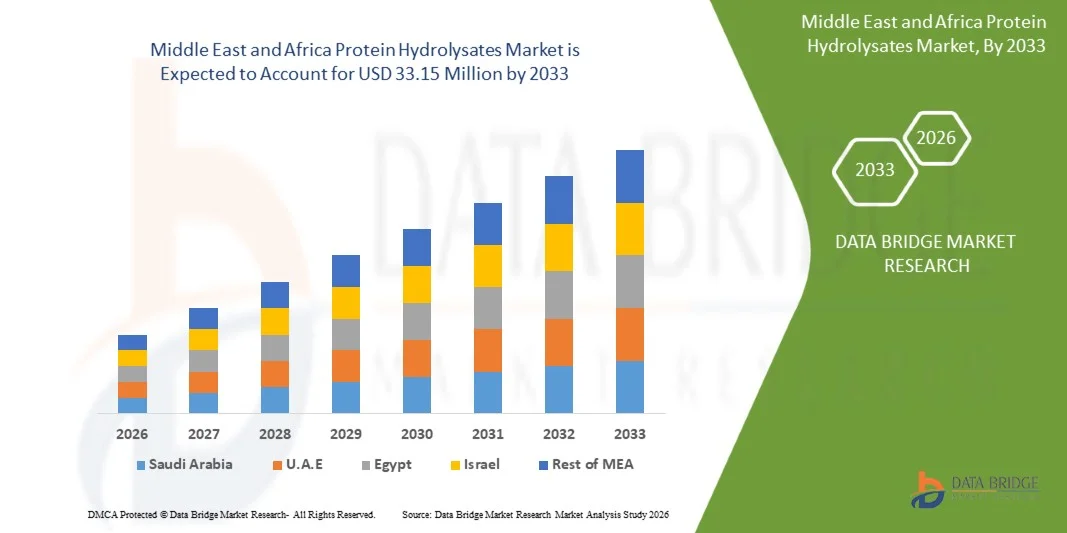
- The Middle East and Africa Protein Hydrolysates Market size was valued at USD 26.17 million in 2025 and is expected to reach USD 33.15 million by 2033, at a CAGR of 3.0% during the forecast period
- The market growth is largely fueled by the increasing demand for high-quality, easily digestible protein ingredients across infant nutrition, clinical nutrition, and sports nutrition sectors, driven by rising health awareness and nutritional requirements
- Furthermore, the growing preference for functional and bioactive protein ingredients with enhanced absorption and targeted health benefits is positioning protein hydrolysates as a key component in advanced nutritional formulations. These combined factors are accelerating the adoption of protein hydrolysates, thereby significantly boosting overall market growth
Middle East and Africa Protein Hydrolysates Market Analysis
- Protein hydrolysates are pre-digested proteins produced through enzymatic or chemical hydrolysis, resulting in smaller peptides and amino acids that enable faster absorption and improved bioavailability. These ingredients are widely used in food, beverage, pharmaceutical, and animal feed applications to enhance nutritional value and functional performance
- The rising demand for protein hydrolysates is primarily driven by increasing consumer focus on health and wellness, expanding applications in medical and sports nutrition, and growing utilization in animal feed to improve digestibility and growth efficiency
- U.A.E. dominated the Middle East and Africa Protein Hydrolysates Market in 2025, due to strong demand for premium nutritional products, increasing health awareness, and growing consumption of sports and clinical nutrition across urban populations
- Saudi Arabia is expected to be the fastest growing country in the Middle East and Africa Protein Hydrolysates Market during the forecast period due to increasing demand for nutritional supplements, rising investments in food processing, and growing focus on health and fitness
- Animals segment dominated the market with a market share of 52.9% in 2025, due to extensive use of dairy, meat, and marine-derived proteins in clinical, infant, and performance nutrition products. Animal-based hydrolysates offer superior amino acid profiles and high bioavailability, making them highly suitable for medical-grade formulations. Established supply chains and strong industrial processing capabilities further reinforce their market leadership
Report Scope and Middle East and Africa Protein Hydrolysates Market Segmentation
|
Attributes |
Protein Hydrolysates Key Market Insights |
|
Segments Covered |
|
|
Countries Covered |
Middle East and Africa
|
|
Key Market Players |
|
|
Market Opportunities |
|
|
Value Added Data Infosets |
In addition to the insights on market scenarios such as market value, growth rate, segmentation, geographical coverage, and major players, the market reports curated by the Data Bridge Market Research also include in-depth expert analysis, pricing analysis, brand share analysis, consumer survey, demography analysis, supply chain analysis, value chain analysis, raw material/consumables overview, vendor selection criteria, PESTLE Analysis, Porter Analysis, and regulatory framework. |
Middle East and Africa Protein Hydrolysates Market Trends
“Rising Demand for Functional and Easily Digestible Protein Ingredients”
- A significant trend in the Middle East and Africa Protein Hydrolysates Market is the increasing demand for functional protein ingredients that offer enhanced digestibility and rapid absorption, driven by growing health awareness and the need for efficient nutrient delivery across diverse consumer groups. This trend is strengthening the role of protein hydrolysates in specialized nutrition segments such as infant, clinical, and sports nutrition
- For instance, Arla Foods Ingredients offers whey protein hydrolysates designed for infant nutrition and medical applications, supporting faster digestion and reduced allergenic potential. Such products enhance nutritional efficiency and meet strict regulatory requirements in sensitive applications
- The use of protein hydrolysates in sports nutrition is expanding as athletes and fitness consumers increasingly prefer proteins that support faster muscle recovery and improved performance. This is positioning hydrolyzed proteins as essential components in post-workout formulations and performance supplements
- The food and beverage industry is incorporating hydrolyzed proteins into functional foods to enhance nutritional value while maintaining product quality and taste. This is contributing to broader adoption across mainstream consumer products beyond specialized nutrition
- Healthcare applications are witnessing increased use of protein hydrolysates in clinical nutrition to support patients with compromised digestion and metabolic conditions. This trend is improving patient outcomes through more efficient nutrient absorption
- The market is experiencing sustained growth as manufacturers continue to innovate and expand applications of hydrolyzed proteins across multiple sectors. This growing demand is reinforcing the transition toward advanced, functional, and performance-oriented protein ingredients globally
Middle East and Africa Protein Hydrolysates Market Dynamics
Driver
“Increasing Utilization in Clinical and Sports Nutrition”
- The increasing use of protein hydrolysates in clinical and sports nutrition is driving market growth due to their superior absorption rate and ability to deliver essential amino acids quickly to the body. These characteristics make them highly suitable for medical patients and athletes requiring rapid nutritional support
- For instance, Kerry Group Plc develops hydrolyzed protein solutions used in medical nutrition and sports performance products, enabling faster recovery and improved muscle synthesis. These formulations support both therapeutic and performance-focused applications across markets
- The rising prevalence of chronic diseases and aging populations is increasing demand for easily digestible nutritional solutions in clinical settings. Protein hydrolysates play a crucial role in addressing malnutrition and supporting recovery in patients with specific dietary needs
- The expanding fitness and wellness industry is fueling demand for advanced protein supplements that enhance endurance, strength, and recovery. This is encouraging manufacturers to develop specialized hydrolysate-based formulations targeting performance optimization
- The continuous growth of clinical and sports nutrition sectors is reinforcing this driver as demand for efficient, high-quality protein solutions increases. This is positioning protein hydrolysates as key ingredients supporting health, recovery, and performance enhancement
Restraint/Challenge
“High Production Cost and Processing Complexity”
- The Middle East and Africa Protein Hydrolysates Market faces challenges due to the high production costs and complex processing techniques required to produce high-quality hydrolyzed proteins. These processes involve specialized enzymes, controlled conditions, and advanced technologies, increasing overall manufacturing expenses
- For instance, Cargill, Incorporated utilizes advanced enzymatic hydrolysis processes that require precise control and significant investment in technology and infrastructure. These requirements raise production costs and create barriers for small and medium-sized manufacturers
- Maintaining consistent product quality and functional properties requires strict quality control measures throughout the hydrolysis process. These additional steps increase operational complexity and extend production timelines
- The need for high-quality raw materials such as premium dairy, marine, or plant proteins further contributes to cost pressures across the supply chain. Fluctuations in raw material availability can also impact pricing stability
- These combined factors continue to restrict wider adoption in price-sensitive markets and create pressure on manufacturers to innovate cost-effective production methods while maintaining product quality
Middle East and Africa Protein Hydrolysates Market Scope
The market is segmented on the basis of type, source, form, process, and application.
• By Type
On the basis of type, the Middle East and Africa Protein Hydrolysates Market is segmented into milk, meat, marine, plant, eggs, and others. The milk segment dominated the largest market revenue share in 2025, driven by the strong utilization of whey and casein hydrolysates in infant formula and clinical nutrition applications. Milk-based hydrolysates are widely preferred due to their high digestibility, rapid absorption, and established safety profile in medical formulations. The segment also benefits from well-developed dairy processing infrastructure and consistent raw material availability across major producing regions. Increasing demand for hypoallergenic protein solutions further strengthens the dominance of milk-derived hydrolysates in therapeutic nutrition.
The plant segment is anticipated to witness the fastest growth rate from 2026 to 2033, supported by rising vegan adoption and clean-label dietary preferences. Plant-based hydrolysates derived from soy, pea, and wheat are gaining traction due to sustainability and lower allergenic risks compared to animal-based sources. Expanding investment in plant protein innovation is improving taste, solubility, and functional performance of hydrolysates. Food manufacturers are increasingly incorporating plant hydrolysates into sports nutrition and fortified foods. The shift toward environmentally sustainable protein sources continues to accelerate this segment’s expansion.
• By Source
On the basis of source, the Middle East and Africa Protein Hydrolysates Market is segmented into animals, plants, and microbes. The animals segment dominated the largest market revenue share of 52.9% in 2025, driven by extensive use of dairy, meat, and marine-derived proteins in clinical, infant, and performance nutrition products. Animal-based hydrolysates offer superior amino acid profiles and high bioavailability, making them highly suitable for medical-grade formulations. Established supply chains and strong industrial processing capabilities further reinforce their market leadership. Growing demand for functional proteins in healthcare nutrition continues to support this dominance.
The microbes segment is expected to witness the fastest growth rate from 2026 to 2033, driven by advancements in fermentation and biotechnology-based protein production. Microbial hydrolysates are gaining attention for their scalability, consistency, and reduced dependency on agricultural inputs. Increasing focus on sustainable and controlled production systems is encouraging manufacturers to adopt microbial sources. These proteins also offer potential for customized amino acid profiling through engineered fermentation processes. Rising innovation in bio-based ingredients continues to accelerate microbial segment growth.
On the basis of form, the Middle East and Africa Protein Hydrolysates Market is segmented into liquid and powder. The powder segment dominated the largest market revenue share in 2025, driven by its longer shelf life, ease of transportation, and widespread use in dietary supplements and sports nutrition. Powdered hydrolysates are highly stable and can be easily incorporated into various food and beverage formulations. Manufacturers prefer powder form due to cost efficiency in storage and large-scale distribution. The segment also benefits from strong demand in clinical nutrition products requiring precise dosage control.
The liquid segment is anticipated to witness the fastest growth rate from 2026 to 2033, supported by rising demand in medical and ready-to-use nutrition formulations. Liquid hydrolysates offer faster absorption and easier administration, particularly in hospital and elderly care settings. Increasing preference for convenient nutritional delivery formats is driving adoption in clinical applications. Technological improvements in stabilization and packaging are enhancing product shelf life and usability. Growing focus on patient-centric nutrition solutions continues to support this segment’s expansion.
• By Process
On the basis of process, the Middle East and Africa Protein Hydrolysates Market is segmented into enzymatic hydrolysis and acid hydrolysis. The enzymatic hydrolysis segment dominated the largest market revenue share in 2025, driven by its ability to produce high-quality, bioactive peptides with minimal nutritional degradation. Enzymatic processing is widely preferred in infant nutrition and clinical applications due to its controlled and selective breakdown of proteins. It also ensures better taste profiles and reduced bitterness compared to chemical methods. Increasing demand for premium and functional protein ingredients continues to reinforce this segment’s dominance.
The enzymatic hydrolysis segment is also expected to witness the fastest growth rate from 2026 to 2033, driven by advancements in enzyme engineering and process optimization technologies. Manufacturers are increasingly shifting toward enzymatic methods due to their environmental safety and efficiency advantages. Improved enzyme specificity enables tailored peptide production for targeted health benefits. Rising regulatory preference for clean and non-chemical processing methods further supports adoption. Continuous innovation in bioprocessing is accelerating the expansion of enzymatic hydrolysis.
• By Application
On the basis of application, the Middle East and Africa Protein Hydrolysates Market is segmented into animal feed, infant nutrition, clinical nutrition, sports nutrition, dietary supplements, and others. The animal feed segment dominated the largest market revenue share in 2025, driven by the increasing use of hydrolyzed proteins to enhance digestibility and nutrient absorption in livestock and aquaculture. Protein hydrolysates improve feed efficiency and support animal growth performance, making them widely adopted in commercial farming systems. Strong demand from poultry and aquaculture industries further strengthens this segment. Cost-effective formulation benefits also contribute to its market leadership.
The sports nutrition segment is anticipated to witness the fastest growth rate from 2026 to 2033, driven by rising fitness awareness and demand for high-performance dietary supplements. Protein hydrolysates are increasingly used in sports formulations due to their rapid absorption and muscle recovery benefits. Growing participation in fitness activities and strength training is expanding consumer demand for advanced protein products. Manufacturers are focusing on flavored and easily digestible hydrolysate-based supplements. The rising global sports and wellness culture continues to accelerate this segment’s growth.
Middle East and Africa Protein Hydrolysates Market Regional Analysis
- U.A.E. dominated the Middle East and Africa Protein Hydrolysates Market with the largest revenue share in 2025, driven by strong demand for premium nutritional products, increasing health awareness, and growing consumption of sports and clinical nutrition across urban populations
- The demand for protein hydrolysates is supported by expanding food and beverage sector, rising imports of high-quality protein ingredients, and increasing presence of global companies such as Kerry Group Plc and Cargill, Incorporated offering advanced nutritional solutions tailored to regional dietary needs
- The presence of advanced retail infrastructure, growing adoption of functional foods, and strong focus on health and wellness trends reinforce the U.A.E. leadership position in the Middle East and Africa market
Saudi Arabia Middle East and Africa Protein Hydrolysates Market Insight
Saudi Arabia is projected to record the fastest CAGR in the Middle East and Africa Protein Hydrolysates Market from 2026 to 2033, supported by increasing demand for nutritional supplements, rising investments in food processing, and growing focus on health and fitness. The country is witnessing expanding use of protein hydrolysates in sports nutrition, clinical applications, and fortified food products. Government initiatives promoting local food production and diversification are accelerating market growth. Collaborations with global companies such as Archer Daniels Midland Company and Ingredion Incorporated are strengthening supply chains and product availability. These developments position Saudi Arabia as the fastest-growing market for protein hydrolysates in the region.
South Africa Middle East and Africa Protein Hydrolysates Market Insight
South Africa is expected to witness steady growth between 2026 and 2033, driven by increasing demand for affordable protein-enriched food products and expanding applications in animal feed and dietary supplements. Rising investments in food processing and agriculture sectors are supporting consistent demand for protein hydrolysates. The growing awareness of nutrition and improved access to functional food products is encouraging market expansion. Industry participants are strengthening capabilities through collaborations with companies such as Roquette Frères and Tereos Group. Continued focus on nutrition, food security, and industrial development is contributing to stable long-term growth in South Africa’s Middle East and Africa Protein Hydrolysates Market.
Middle East and Africa Protein Hydrolysates Market Share
The protein hydrolysates industry is primarily led by well-established companies, including:
- Titan Biotech Limited (India)
- BRF Ingredients (Brazil)
- Eco Agri (Cambodia)
- Bioibérica (Spain)
- Kemin Industries, Inc. (U.S.)
- Janatha Fish Meal & Oil Products. (India)
- Bio-marine Ingredients Ireland Ltd. (Ireland)
- ZXCHEM U.S. INC (U.S.)
- Nutrifish (Tunisia)
- Sampi, A. Costantino & C. S.P.A (Italy)
- CRESCENT BIOTECH (India)
- Interra International (U.S.)
- Tessenderlo Group (Belgium)
- Cargill, Incorporated (U.S.)
- Kerry Group Plc (Ireland)
Latest Developments in Middle East and Africa Protein Hydrolysates Market
- In October 2025, ZXCHEM GROUP introduced Biotide Proteins as a newly established subsidiary focused on advancing animal and plant-based protein solutions. The initiative was aimed at addressing the changing needs of the global nutrition, food, and supplement sectors. Biotide Proteins was developed to offer customized functional protein ingredients, including fully hydrolyzed variants such as pea protein and brown rice protein. This launch reinforced the company’s focus on innovation and expansion within the specialized protein ingredients market
- In March 2024, Novus International, Inc. completed the acquisition of BioResource International, Inc. (BRI), a U.S.-based enzyme company renowned for its protein feed solutions. This strategic move granted Novus full ownership of BRI’s product portfolio, intellectual property, and facilities, significantly expanding its capabilities in protein hydrolysates and enzyme technologies for animal nutrition. The acquisition strengthens Novus’s innovation pipeline, enhances its supply chain control, and supports its long-term goals in functional proteins and gut health. It also builds on a longstanding partnership between the two companies, dating back to 2008
- In June 2022, Kerry Group plc acquired a €38 million manufacturing facility in KwaZulu-Natal, South Africa, dedicated to the production of protein hydrolysates for animal feed applications. This strategic investment significantly boosts Kerry’s manufacturing capacity and strengthens its distribution network across the African continent. The facility supports Kerry’s commitment to sustainable nutrition and addresses the rising demand for high-quality, digestible protein ingredients in the region’s expanding livestock and aquaculture sectors
- In July 2021, Symrise AG, through its Diana Aqua division, partnered with SMAG® Smart Agriculture to develop a customized mobile app aimed at digitalizing agronomic activities related to the production of protein hydrolysates. Built on SMAG’s Agreo platform, the app enables Symrise’s global network of agronomists and producers to collect, structure, and coordinate agro-data in real time. This digital solution enhances traceability, supply chain transparency, and sustainability, aligning with growing market demands for responsible sourcing and data accuracy in the animal feed industry. The app was piloted in France and Chile ahead of a global rollout
- In August 2020, Bioiberica S.A.U. partnered with Vetnostrum to expand into the Taiwanese market, introducing its protein hydrolysate-based animal feed products, including Palbio® 380. This collaboration marked a strategic step in Bioiberica’s Asia-Pacific expansion, aiming to meet the region’s growing demand for high-quality, sustainable feed ingredients. The partnership leverages Vetnostrum’s local distribution expertise and Bioiberica’s innovation in functional proteins to enhance animal nutrition and health across Taiwan’s livestock and aquaculture sector

- Interactive Data Analysis Dashboard
- Company Analysis Dashboard for high growth potential opportunities
- Research Analyst Access for customization & queries
- Competitor Analysis with Interactive dashboard
- Latest News, Updates & Trend analysis
- Harness the Power of Benchmark Analysis for Comprehensive Competitor Tracking
Middle East And Africa Protein Hydrolysates Market, Supply Chain Analysis and Ecosystem Framework
To support market growth and help clients navigate the impact of geopolitical shifts, DBMR has integrated in-depth supply chain analysis into its Middle East And Africa Protein Hydrolysates Market research reports. This addition empowers clients to respond effectively to global changes affecting their industries. The supply chain analysis section includes detailed insights such as Middle East And Africa Protein Hydrolysates Market consumption and production by country, price trend analysis, the impact of tariffs and geopolitical developments, and import and export trends by country and HSN code. It also highlights major suppliers with data on production capacity and company profiles, as well as key importers and exporters. In addition to research, DBMR offers specialized supply chain consulting services backed by over a decade of experience, providing solutions like supplier discovery, supplier risk assessment, price trend analysis, impact evaluation of inflation and trade route changes, and comprehensive market trend analysis.
Data collection and base year analysis are done using data collection modules with large sample sizes. The stage includes obtaining market information or related data through various sources and strategies. It includes examining and planning all the data acquired from the past in advance. It likewise envelops the examination of information inconsistencies seen across different information sources. The market data is analysed and estimated using market statistical and coherent models. Also, market share analysis and key trend analysis are the major success factors in the market report. To know more, please request an analyst call or drop down your inquiry.
The key research methodology used by DBMR research team is data triangulation which involves data mining, analysis of the impact of data variables on the market and primary (industry expert) validation. Data models include Vendor Positioning Grid, Market Time Line Analysis, Market Overview and Guide, Company Positioning Grid, Patent Analysis, Pricing Analysis, Company Market Share Analysis, Standards of Measurement, Global versus Regional and Vendor Share Analysis. To know more about the research methodology, drop in an inquiry to speak to our industry experts.
Data Bridge Market Research is a leader in advanced formative research. We take pride in servicing our existing and new customers with data and analysis that match and suits their goal. The report can be customized to include price trend analysis of target brands understanding the market for additional countries (ask for the list of countries), clinical trial results data, literature review, refurbished market and product base analysis. Market analysis of target competitors can be analyzed from technology-based analysis to market portfolio strategies. We can add as many competitors that you require data about in the format and data style you are looking for. Our team of analysts can also provide you data in crude raw excel files pivot tables (Fact book) or can assist you in creating presentations from the data sets available in the report.













