


Middle East and Africa Recycled Plastic Market Size
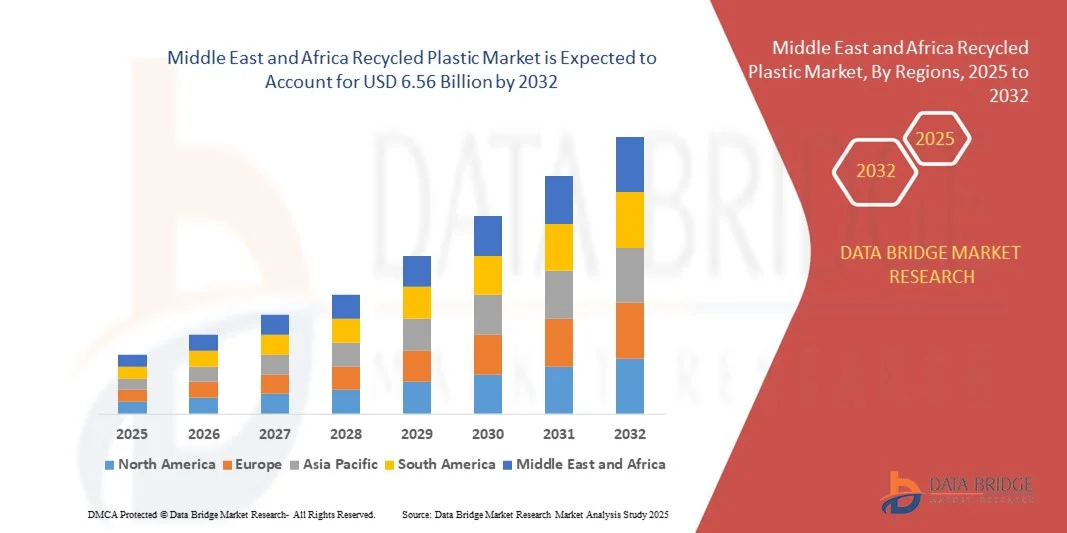
- The Middle East and Africa Recycled Plastic Market size was valued at USD 3.93 billion in 2024 and is projected to reach USD 6.56 billion by 2032, growing at a CAGR of 6.60% during the forecast period
- Market growth is primarily driven by increasing environmental concerns, government regulations promoting sustainable practices, and the rising demand for cost-effective, eco-friendly materials across industries such as packaging, construction, and automotive
- In addition, growing awareness of plastic pollution, coupled with advancements in recycling technologies and infrastructure, is encouraging manufacturers to adopt recycled plastics, further accelerating the region’s shift toward a circular economy
Middle East and Africa Recycled Plastic Market Analysis
- Recycled plastics, derived from post-consumer and post-industrial waste, are becoming essential materials across industries in the Middle East and Africa due to their cost-effectiveness, reduced environmental footprint, and compatibility with sustainability goals in packaging, construction, and automotive sectors
- The surging demand for recycled plastics is primarily fueled by increasing environmental awareness, strict government regulations on plastic waste, and a growing push toward circular economy practices across emerging markets
- U.A.E. dominated the Middle East and Africa Recycled Plastic Market with the largest revenue share of 37% in 2024, driven by well-established recycling infrastructure, active government initiatives, and strong participation from both local manufacturers and multinational companies in promoting sustainable materials
- Saudi Arabia Council (GCC) countries are expected to be the fastest growing region in the Middle East and Africa Recycled Plastic Market during the forecast period, due to rising industrial activity, growing consumer awareness, and investments in green technologies
- The Polyethylene Terephthalate segment dominated the market with the largest revenue share of 38.5% in 2024, driven by its widespread use in packaging applications such as beverage bottles and food containers, thanks to its excellent recyclability and strong mechanical properties.
Report Scope and Middle East and Africa Recycled Plastic Market Segmentation
|
Attributes |
Recycled Plastic Key Market Insights |
|
Segments Covered |
|
|
Countries Covered |
Middle East and Africa
|
|
Key Market Players |
|
|
Market Opportunities |
|
|
Value Added Data Infosets |
In addition to the insights on market scenarios such as market value, growth rate, segmentation, geographical coverage, and major players, the market reports curated by the Data Bridge Market Research also include import export analysis, production capacity overview, production consumption analysis, price trend analysis, climate change scenario, supply chain analysis, value chain analysis, raw material/consumables overview, vendor selection criteria, PESTLE Analysis, Porter Analysis, and regulatory framework. |
Middle East and Africa Recycled Plastic Market Trends
Technological Advancements in Sorting and Recycling Infrastructure
- A significant and accelerating trend in the Middle East and Africa Recycled Plastic Market is the rapid evolution and deployment of advanced recycling technologies, including AI-powered sorting systems, robotic automation, and chemical recycling processes. These innovations are dramatically improving the efficiency, quality, and scalability of plastic recycling across the region.
- For Instance, AI-driven optical sorters are now being implemented in several large-scale recycling facilities in South Africa and the U.A.E., enabling precise separation of plastic types, colors, and contamination levels. This leads to higher purity in recycled outputs, making them more suitable for use in packaging, construction, and automotive applications.
- Chemical recycling technologies, such as pyrolysis and depolymerization, are also gaining traction. These processes allow hard-to-recycle plastics like multilayer films and contaminated packaging to be broken down into their original monomers or fuels, expanding the range of plastics that can be effectively reused.
- Automation and machine learning systems are being integrated into material recovery facilities (MRFs) to optimize operations and reduce labor dependency. For instance, robotic arms using AI can identify and sort plastics at high speeds with greater accuracy than traditional manual sorting methods.
- The integration of smart monitoring and real-time data analytics further enhances the efficiency of recycling plants by predicting maintenance needs, minimizing downtime, and improving throughput. Countries like Egypt and Kenya are beginning to adopt such digital tools to modernize their waste management infrastructure.
- This technological transformation is redefining the capabilities of the recycling industry in the region, positioning it to meet increasing demand for high-quality recycled plastics. As a result, both governments and private players are investing heavily in upgrading recycling systems to align with global sustainability goals and regional circular economy initiatives.
Middle East and Africa Recycled Plastic Market Dynamics
Driver
Growing Need Due to Sustainability Mandates and Industrial Demand
-
The increasing emphasis on environmental sustainability, combined with growing industrial demand across sectors like packaging, construction, and automotive, is significantly driving the growth of the Middle East and Africa Recycled Plastic Market.
- For instance, in May 2024, SABIC launched a new line of certified circular polymers produced through advanced recycling technologies in Saudi Arabia, reinforcing the region’s shift toward sustainable materials. Initiatives such as this by key players are expected to boost the market during the forecast period.
- As governments in the region implement stricter regulations on plastic waste and encourage circular economy models, industries are actively seeking recycled plastic alternatives to meet compliance and reduce environmental impact.
- The use of recycled plastics in packaging is rising, especially in the FMCG sector, where companies are under pressure from both regulators and consumers to reduce their carbon footprint and plastic waste. Similarly, the construction industry is adopting recycled plastic products for insulation, piping, and paneling due to their durability and lower cost.
- Rising oil prices and increasing consumer preference for eco-friendly products are also making recycled plastics an economically attractive option. Additionally, infrastructure development and urbanization across countries like the U.A.E., Kenya, and Egypt are fueling demand for sustainable materials, accelerating market growth.
Restraint/Challenge
Limited Recycling Infrastructure and Quality Inconsistencies
- One of the primary challenges in the Middle East and Africa Recycled Plastic Market is the underdeveloped recycling infrastructure in several parts of the region. Many countries still lack comprehensive waste collection systems, formal recycling networks, and access to modern processing technologies.
- For instance, while South Africa and the U.A.E. have made progress in establishing recycling frameworks, many Sub-Saharan countries still rely heavily on informal collection, leading to inefficiencies, contamination issues, and low recycling rates.
- Inconsistent quality and limited availability of high-grade recycled plastics also pose barriers to adoption, especially in industries like food packaging or automotive, which require stringent quality standards.
- Addressing these challenges requires coordinated investment in recycling facilities, standardized regulations across countries, and public-private partnerships to build efficient waste management systems.
- Furthermore, public awareness about the benefits of recycling remains low in many parts of the region. Consumer education campaigns and government incentives for recycled product usage will be critical to improving adoption rates and ensuring long-term market sustainability.
Middle East and Africa Recycled Plastic Market Scope
The recycled plastic market is segmented on the basis of type, source and industry.
- By Type
On the basis of type, the Middle East and Africa Recycled Plastic Market is segmented into Polyethylene Terephthalate (PET), Polyethylene (PE), Polypropylene (PP), Polyvinyl Chloride (PVC), Polystyrene (PS), and Others. The Polyethylene Terephthalate segment dominated the market with the largest revenue share of 38.5% in 2024, driven by its widespread use in packaging applications such as beverage bottles and food containers, thanks to its excellent recyclability and strong mechanical properties. PET’s versatility and demand in the beverage and food industry, especially with increasing regulations encouraging recycling, significantly contribute to its dominance.
The Polypropylene segment is anticipated to witness the fastest growth rate of 22.1% from 2025 to 2032, fueled by its expanding applications in automotive, textiles, and packaging sectors. PP’s lightweight nature, chemical resistance, and improving recycling technologies are encouraging greater adoption in emerging markets across the Middle East and Africa.
- By Source
On the basis of source, the market is segmented into Bottles, Bags, Films, Fibers, Foams, and Others. Bottles segment led the market with a 40.7% share in 2024, primarily due to the high volume of PET bottles collected from beverage and water industries for recycling. Bottles offer relatively cleaner and easier-to-process feedstock compared to other sources, making them highly preferred in recycled plastic manufacturing.
The Films segment is expected to record the fastest CAGR of 23.4% during the forecast period, driven by growing recycling initiatives in packaging films used in retail, agriculture, and industrial sectors. Despite challenges in recycling multilayer films, advancements in sorting and chemical recycling are unlocking the potential of this segment, particularly in rapidly urbanizing markets with increasing plastic consumption.
- By Industry
On the basis of industry, the Middle East and Africa Recycled Plastic Market is segmented into Packaging, Building and Construction, Textile, Automotive, Electrical and Electronics, Household Goods, Agriculture, Healthcare, and Others. The Packaging segment accounted for the largest market share of 42.8% in 2024, reflecting the high demand for sustainable packaging solutions amid stringent environmental regulations and rising consumer preference for eco-friendly products. Recycled plastics are extensively used in bottles, containers, and flexible packaging materials.
the Building and Construction segment is expected to witness the fastest CAGR of 21.5% from 2025 to 2032, propelled by increased infrastructure development and the adoption of recycled plastics in piping, insulation, and panels. The durability and cost-efficiency of recycled plastics make them attractive alternatives in construction, especially in emerging economies focused on sustainable urbanization.
Middle East and Africa Recycled Plastic Market Regional Analysis
- Middle East and Africa dominated the Recycled Plastic Market with the largest revenue share of 37% in 2024, driven by increasing regulatory focus on sustainability and growing investments in recycling infrastructure across key economies such as the U.A.E., South Africa, and Egypt.
- Consumers and industries in the region are increasingly adopting recycled plastics due to rising environmental awareness, cost advantages over virgin plastics, and the expanding applications of recycled materials in packaging, construction, and automotive sectors.
- This robust market growth is supported by government initiatives promoting circular economy models, improved waste management systems, and the entry of global players investing in advanced recycling technologies. The combination of urbanization, industrialization, and sustainability mandates is establishing recycled plastics as a critical component in reducing plastic waste and driving sustainable development across the region.
U.A.E. Recycled Plastic Market Insight
The U.A.E. recycled plastic market is anticipated to grow at a noteworthy CAGR, driven by strong governmental focus on sustainability, including ambitious zero-waste and circular economy goals. The country's advanced infrastructure and strategic investment in recycling plants create favorable conditions for market expansion. High demand from packaging, construction, and automotive industries, combined with a strong regulatory framework for plastic waste management, continues to encourage the use of recycled plastics. The U.A.E.’s role as a regional trade and logistics hub also enhances its market prominence.
South Africa Recycled Plastic Market Insight
South Africa’s recycled plastic market is expected to expand at a considerable CAGR throughout the forecast period, supported by growing industrial demand and increasing environmental regulations. The country has made significant strides in formalizing its recycling ecosystem, with improvements in collection, sorting, and processing infrastructure. Rising awareness among consumers and businesses about the benefits of recycled plastics is fostering adoption, particularly in packaging and building sectors. South Africa’s strong manufacturing base and sustainability initiatives position it as a leader in the African recycled plastics market.
Middle East and Africa Recycled Plastic Market Share
The Recycled Plastic industry is primarily led by well-established companies, including:
- BASF (Germany)
- SABIC (Saudi Arabia)
- Dow Inc. (U.S.)
- DuPont de Nemours, Inc. (U.S.)
- Evonik Industries AG (Germany)
- Sumitomo Chemical Co., Ltd (Japan)
- Arkema (France)
- Celanese Corporation (U.S.)
- Eastman Chemical Company (U.S.)
- Chevron Phillips Chemical Co., LLC (U.S.)
- Lotte Chemical Corporation (South Korea)
- Exxon Mobil Corporation (U.S.)
- Formosa Plastics Corporation (Taiwan)
- Covestro AG (Germany)
- Toray Industries, Inc. (Japan)
- Mitsui & Co. Plastics Ltd. (Japan)
- TEIJIN LIMITED (Japan)
- INEOS Group (U.K. / Switzerland)
- Eni S.p.A. (Italy)
- LG Chem (South Korea)
- LANXESS AG (Germany)
- CHIMEI Corporation (Taiwan)
- Huntsman International LLC (U.S.)
- LyondellBasell Industries Holdings B.V. (Netherlands)
What are the Recent Developments in Middle East and Africa Recycled Plastic Market?
- In April 2023, BASF, a global chemical industry leader, launched a new recycled plastic production facility in the U.A.E., aimed at increasing the supply of high-quality recycled polyethylene terephthalate (rPET) for packaging applications. This initiative demonstrates BASF’s commitment to supporting the circular economy in the Middle East and Africa by providing sustainable material solutions tailored to regional market demands. The facility leverages advanced recycling technologies to enhance product quality while reducing environmental impact, reinforcing BASF’s leadership in the growing recycled plastics market.
- In March 2023, SABIC announced the expansion of its recycling operations in Saudi Arabia with the launch of a state-of-the-art mechanical recycling plant focused on polypropylene and polyethylene waste. This move is part of SABIC’s broader sustainability strategy to increase recycled content in its product portfolio. By addressing regional plastic waste challenges, SABIC aims to promote sustainable manufacturing practices and support the growing demand for recycled plastics across industries such as packaging, construction, and automotive in the Middle East and Africa.
- In March 2023, Dow Inc. successfully collaborated with regional governments and waste management companies in South Africa to implement an advanced plastic waste collection and sorting program. This initiative enhances the availability of quality recycled plastics by improving feedstock supply for recycling plants. Dow’s involvement underscores its commitment to developing local recycling infrastructure and supporting sustainable plastic reuse, contributing to the growth and maturity of the Middle East and Africa recycled plastic market.
- In February 2023, Covestro AG, a global leader in high-performance polymers, announced a partnership with leading packaging manufacturers in Egypt to develop recycled plastic solutions aimed at reducing virgin plastic consumption in the food and beverage sector. This collaboration focuses on integrating recycled materials into high-quality packaging products, meeting growing consumer demand for environmentally responsible options. Covestro’s efforts highlight the increasing adoption of recycled plastics in emerging markets within the region.
- In January 2023, Eastman Chemical Company introduced its innovative chemical recycling technology to the U.A.E. market, enabling the conversion of hard-to-recycle plastic waste into high-value recycled polymers. This cutting-edge process addresses regional recycling challenges by expanding the range of plastics that can be effectively recycled. Eastman’s technology deployment is a significant step towards closing the recycling loop in the Middle East and Africa, supporting the region’s sustainable development goals and driving growth in the recycled plastics industry.

- Interactive Data Analysis Dashboard
- Company Analysis Dashboard for high growth potential opportunities
- Research Analyst Access for customization & queries
- Competitor Analysis with Interactive dashboard
- Latest News, Updates & Trend analysis
- Harness the Power of Benchmark Analysis for Comprehensive Competitor Tracking
Middle East And Africa Recycled Plastic Market, Supply Chain Analysis and Ecosystem Framework
To support market growth and help clients navigate the impact of geopolitical shifts, DBMR has integrated in-depth supply chain analysis into its Middle East And Africa Recycled Plastic Market research reports. This addition empowers clients to respond effectively to global changes affecting their industries. The supply chain analysis section includes detailed insights such as Middle East And Africa Recycled Plastic Market consumption and production by country, price trend analysis, the impact of tariffs and geopolitical developments, and import and export trends by country and HSN code. It also highlights major suppliers with data on production capacity and company profiles, as well as key importers and exporters. In addition to research, DBMR offers specialized supply chain consulting services backed by over a decade of experience, providing solutions like supplier discovery, supplier risk assessment, price trend analysis, impact evaluation of inflation and trade route changes, and comprehensive market trend analysis.
Data collection and base year analysis are done using data collection modules with large sample sizes. The stage includes obtaining market information or related data through various sources and strategies. It includes examining and planning all the data acquired from the past in advance. It likewise envelops the examination of information inconsistencies seen across different information sources. The market data is analysed and estimated using market statistical and coherent models. Also, market share analysis and key trend analysis are the major success factors in the market report. To know more, please request an analyst call or drop down your inquiry.
The key research methodology used by DBMR research team is data triangulation which involves data mining, analysis of the impact of data variables on the market and primary (industry expert) validation. Data models include Vendor Positioning Grid, Market Time Line Analysis, Market Overview and Guide, Company Positioning Grid, Patent Analysis, Pricing Analysis, Company Market Share Analysis, Standards of Measurement, Global versus Regional and Vendor Share Analysis. To know more about the research methodology, drop in an inquiry to speak to our industry experts.
Data Bridge Market Research is a leader in advanced formative research. We take pride in servicing our existing and new customers with data and analysis that match and suits their goal. The report can be customized to include price trend analysis of target brands understanding the market for additional countries (ask for the list of countries), clinical trial results data, literature review, refurbished market and product base analysis. Market analysis of target competitors can be analyzed from technology-based analysis to market portfolio strategies. We can add as many competitors that you require data about in the format and data style you are looking for. Our team of analysts can also provide you data in crude raw excel files pivot tables (Fact book) or can assist you in creating presentations from the data sets available in the report.













