


Middle East and Africa Respiratory Masks Market Size
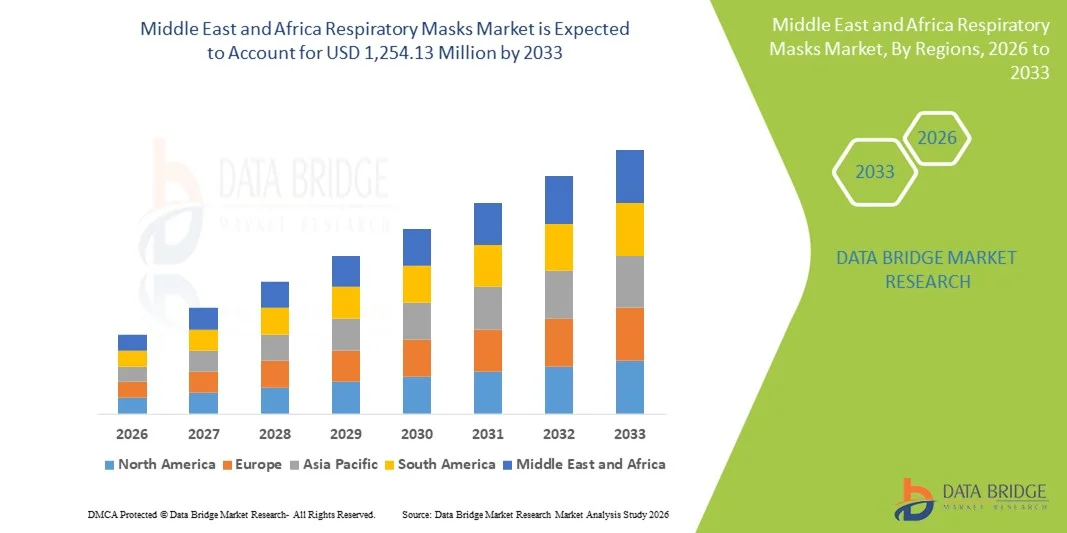
- The Middle East and Africa respiratory masks market size was valued at USD 735.39 million in 2025 and is expected to reach USD 1,254.13 million by 2033, at a CAGR of 6.9% during the forecast period
- The market growth is primarily driven by increasing awareness of occupational health and safety, rising prevalence of respiratory diseases, and stricter regulatory standards across healthcare, industrial, and construction sectors in the region
- Furthermore, growing preparedness for infectious disease outbreaks, expanding healthcare infrastructure, and rising demand for effective personal protective equipment are positioning respiratory masks as essential safety solutions, thereby significantly accelerating the overall market growth
Middle East and Africa Respiratory Masks Market Analysis
- Respiratory masks, designed to protect users from airborne particles, pollutants, and infectious agents, are increasingly critical across healthcare, industrial, military, and public settings in the Middle East and Africa, supported by rising safety awareness and regulatory compliance requirements
- The market demand is primarily driven by increasing exposure to dust and pollutants, higher incidence of respiratory conditions, and growing adoption of personal protective equipment across medical, industrial, and public safety applications
- Saudi Arabia dominated the Middle East and Africa respiratory masks market with an estimated share of 28.7% in 2025, supported by robust healthcare infrastructure, strong defense and oil & gas sectors, and stringent occupational safety norms, resulting in high demand across medical, industrial, and military applications
- Nigeria is expected to be the fastest growing country during the forecast period, projected to register the highest CAGR, driven by its expanding healthcare system, large population base, rising industrial activity, and increasing government-led public health and safety initiatives
- Common Grade Surgical Masks segment dominated the market with a share of 46.2% in 2025, driven by widespread usage across hospitals and clinics, public settings, and public safety service organizations owing to their affordability and broad regulatory acceptance
Report Scope and Middle East and Africa Respiratory Masks Market Segmentation
|
Attributes |
Middle East and Africa Respiratory Masks Key Market Insights |
|
Segments Covered |
|
|
Countries Covered |
Middle East and Africa
|
|
Key Market Players |
|
|
Market Opportunities |
|
|
Value Added Data Infosets |
In addition to the insights on market scenarios such as market value, growth rate, segmentation, geographical coverage, and major players, the market reports curated by the Data Bridge Market Research also include in-depth expert analysis, patient epidemiology, pipeline analysis, pricing analysis, and regulatory framework |
Middle East and Africa Respiratory Masks Market Trends
Rising Adoption of Advanced Filtration and Comfort Features
- A significant and accelerating trend in the Middle East and Africa respiratory masks market is the development of advanced filtration technologies combined with ergonomic designs for enhanced comfort and prolonged usage. This integration is improving user compliance and protection efficiency
- For instance, the 3M Aura 9300+ series incorporates high-efficiency particulate filters with a low breathing resistance design, allowing users to wear the mask comfortably for extended periods in industrial and healthcare settings. Similarly, Honeywell H801 respirators provide adjustable nose clips and soft sealing edges for better fit and reduced discomfort
- Advanced mask technologies include multi-layer filtration, antibacterial coatings, and improved airflow channels, which collectively enhance protection against airborne pollutants, pathogens, and allergens. For instance, Moldex 9000 series masks feature an optimized exhalation valve to reduce heat buildup and moisture accumulation during prolonged use
- The seamless combination of protective efficiency and comfort facilitates broader adoption across multiple applications, including healthcare, public safety, and industrial environments. Users can now utilize a single high-performance mask across varied settings without compromising safety or comfort
- This trend towards more efficient, comfortable, and user-friendly respiratory masks is reshaping expectations for personal protective equipment. Consequently, companies such as Kimberly-Clark are developing ergonomic masks with features like enhanced filtration layers and adjustable straps to increase user compliance
- The demand for respiratory masks that offer advanced protection while maintaining comfort is growing rapidly across both healthcare and industrial sectors, as consumers and organizations increasingly prioritize health, safety, and usability
- Smart design innovations, such as transparent masks for easier communication in healthcare and educational settings, are gaining popularity, enhancing both functionality and acceptance. For instance, ClearMask models allow patients and workers to see facial expressions while maintaining protection
Middle East and Africa Respiratory Masks Market Dynamics
Driver
Increasing Health Awareness and Stringent Safety Regulations
- The rising awareness of respiratory diseases, occupational hazards, and infectious outbreaks, coupled with strict safety regulations across healthcare, industrial, and public sectors, is a significant driver for the heightened demand for respiratory masks
- For instance, in March 2025, 3M Middle East launched a campaign to promote proper respirator usage in hospitals and construction sites, highlighting multi-layer filtration and compliance with regional safety standards. Such initiatives by key companies are expected to propel the market growth during the forecast period
- As consumers and organizations prioritize preventive health measures, respiratory masks provide effective protection against dust, allergens, and airborne pathogens, making them essential safety equipment across medical, industrial, and public applications
- Furthermore, regulatory frameworks mandating the use of masks in healthcare facilities, construction sites, and industrial workplaces are accelerating adoption, ensuring compliance with occupational safety standards
- The availability of masks that cater to both reusable and disposable needs, combined with ergonomic designs, further enhances user acceptance, increasing penetration across hospitals, public safety organizations, and industrial workplaces
- Growing government-led initiatives, including public awareness campaigns and subsidies for PPE procurement, are boosting adoption rates, particularly in high-risk occupational sectors. For instance, the UAE Ministry of Health promoted mask usage in hospitals and public areas in 2025
- Rising industrialization and expansion of sectors such as oil & gas, manufacturing, and construction are increasing the need for respiratory protection, creating a strong institutional demand for high-quality masks across workplaces
Restraint/Challenge
Supply Chain Constraints and Cost Barriers
- Challenges such as inconsistent supply of raw materials, production delays, and fluctuating costs of high-quality filtration fabrics pose a significant hurdle to market expansion in the Middle East and Africa
- For instance, disruptions in polypropylene and melt-blown fabric availability in 2025 led to temporary shortages of FFP and surgical masks in certain markets, affecting healthcare and industrial sectors’ ability to procure adequate protective equipment
- Addressing these supply chain constraints through diversified sourcing, localized production, and strategic stockpiling is critical to maintaining consistent market growth and ensuring timely availability of respiratory masks
- Additionally, the higher cost of advanced masks compared to basic non-medical grade masks can hinder adoption among price-sensitive users and smaller organizations, particularly in developing economies across Africa
- While disposable and reusable masks are increasingly available, the perceived premium for high-filtration or ergonomic designs may limit uptake. Overcoming these challenges through cost-effective manufacturing, government incentives, and awareness campaigns will be crucial for sustained growth
- Limited consumer knowledge and training on proper mask usage can reduce effectiveness, particularly in public and industrial sectors, posing a challenge for maximizing protection benefits. For instance, improper fit or handling of surgical masks can compromise filtration efficiency
- Competition from low-cost, locally manufactured masks that may not meet regulatory standards can affect market growth, as price-sensitive buyers may prioritize affordability over quality, impacting the adoption of certified high-performance masks
Middle East and Africa Respiratory Masks Market Scope
The market is segmented on the basis of type, usability, age, material, application, end user, and distribution channels.
- By Type
On the basis of type, the Middle East and Africa respiratory masks market is segmented into FFP, common grade surgical masks, non-medical grade respiratory masks, and other. The Common Grade Surgical Masks segment dominated the market with a share of 46.2% in 2025, driven by their widespread adoption across hospitals, clinics, and public safety organizations. Their affordability, regulatory acceptance, and proven protection against pathogens make them a preferred choice in both medical and public settings. Healthcare facilities rely heavily on surgical masks for everyday protection of staff and patients, while government-mandated usage in public spaces further strengthens their market position. Additionally, the compatibility of surgical masks with disposable and reusable designs increases adoption among varied end users. Companies producing certified surgical masks focus on comfort, breathability, and ergonomic designs, which enhance user compliance and boost market dominance. The extensive distribution network through hospitals, online pharmacies, and retail channels ensures consistent availability across the region.
The FFP segment is anticipated to witness the fastest growth with a CAGR of 14.5% from 2026 to 2033, fueled by increasing industrial and public health awareness. FFP masks provide higher filtration efficiency against fine dust, pollutants, and viral particles, making them essential for oil & gas, manufacturing, and construction workers. The rising prevalence of occupational safety regulations in Saudi Arabia, UAE, and Nigeria is driving institutional demand for FFP masks. Additionally, growing adoption in public areas during infectious outbreaks has expanded the consumer base beyond industrial users. Technological advancements, such as ergonomic designs and multi-layer filters, enhance user comfort, increasing compliance even during prolonged usage. Increasing partnerships between mask manufacturers and large-scale industrial companies further accelerates market penetration for FFP types.
- By Usability
On the basis of usability, the market is segmented into reusable and disposable masks. The Disposable segment dominated the market with a share of 63% in 2025, driven by its convenience, cost-effectiveness, and widespread use across hospitals, public spaces, and industrial workplaces. Disposable masks eliminate the need for cleaning or maintenance, making them suitable for high-volume applications and short-term use. Regulatory compliance for single-use masks in healthcare settings ensures consistent demand across medical facilities. Additionally, disposable masks are favored for public safety campaigns and temporary workforce protection in industries like construction and oil & gas. The ability to distribute masks easily through online pharmacies, retail, and direct tenders further enhances their dominance. Manufacturers continue to improve comfort, breathability, and filtration efficiency to increase adoption among both healthcare professionals and general consumers.
The Reusable segment is expected to witness the fastest growth with a CAGR of 12% during the forecast period, driven by environmental concerns and cost-efficiency for long-term use. Reusable masks with replaceable filters are gaining traction among industrial workers, hospitals, and environmentally conscious consumers. Countries like UAE and South Africa are adopting policies to encourage sustainable PPE practices, which further accelerates reusable mask adoption. Technological enhancements, such as improved fit, antibacterial coatings, and ergonomic designs, make reusable masks suitable for prolonged wear. Institutional buyers, including hospitals and oil & gas companies, prefer reusable options for their long-term cost benefits. Awareness campaigns on proper cleaning and usage also contribute to the increasing uptake of reusable respiratory masks.
- By Age
On the basis of age, the market is segmented into pediatric and adult masks. The Adult segment dominated with a market share of 78% in 2025, due to the larger working-age population exposed to industrial pollutants, occupational hazards, and public health risks. Adults are primary users in hospitals, manufacturing companies, construction sites, and public safety organizations. Adult masks are also required in public spaces to meet government mandates for respiratory protection during disease outbreaks. Manufacturers focus on ergonomic designs and adjustable fittings to accommodate diverse adult populations across different countries. Large-scale procurement by corporate, industrial, and healthcare organizations ensures consistent demand in the adult segment.
The Pediatric segment is expected to witness the fastest growth with a CAGR of 13% from 2026 to 2033, fueled by rising awareness among parents and educational institutions about protecting children from airborne diseases and pollutants. Pediatric masks are increasingly used in schools, pediatric healthcare facilities, and public campaigns. Technological innovations, such as smaller sizes, softer materials, and fun designs, enhance comfort and compliance among children. Countries like Saudi Arabia, UAE, and Nigeria are witnessing a growing emphasis on child safety programs, which further boosts pediatric mask adoption. Online and retail channels focusing on parents also contribute to this segment’s growth.
- By Material
On the basis of material, the market is segmented into Polypropylene (PP), polyurethane, polyester, cotton, and others. The Polypropylene (PP) segment dominated with a market share of around 55% in 2025, due to its high filtration efficiency, affordability, and wide applicability across disposable and surgical masks. PP is the primary material used in medical-grade masks and FFP types, making it essential in hospitals, clinics, and industrial settings. Its lightweight and breathable properties improve user comfort, boosting compliance for prolonged usage. Manufacturers prefer PP for ease of mass production, ensuring cost-effective supply to large-scale institutional buyers. Regulatory approvals for PP-based masks further strengthen its dominance in the Middle East and Africa region.
The Cotton segment is expected to witness the fastest growth with a CAGR of 11.5% during the forecast period, driven by the rising demand for reusable and comfortable masks for daily use. Cotton masks are popular among public users and in homecare settings due to their softness and skin-friendliness. Innovations like multi-layered cotton masks with replaceable filters enhance protection without compromising comfort. Environmental awareness and preference for sustainable materials further boost cotton mask adoption. Retail and online pharmacy channels targeting consumers directly support market penetration in urban areas across the region.
- By Application
On the basis of application, the market is segmented into military, industrial, public, medical, and others. The Medical segment dominated with a market share of 41% in 2025, driven by high adoption in hospitals, clinics, and healthcare facilities to protect staff and patients from infectious diseases. Regulatory mandates and government healthcare guidelines ensure a continuous demand for medical masks. Medical masks also include both disposable and reusable options, catering to diverse institutional requirements. Manufacturers focus on ergonomic and high-filtration designs for extended wear in medical settings. The prevalence of respiratory diseases and pandemic preparedness programs further reinforces the medical segment’s dominance.
The Industrial segment is expected to witness the fastest growth with a CAGR of 13% from 2026 to 2033, fueled by the expanding oil & gas, manufacturing, and construction sectors across Saudi Arabia, UAE, and Nigeria. Industrial masks protect workers from dust, chemical exposure, and airborne pollutants, ensuring compliance with occupational safety standards. Rising industrialization and infrastructure development projects drive bulk procurement of industrial-grade masks. Technological advancements in filtration and durability make these masks more efficient and comfortable for prolonged industrial use. Safety awareness programs and regulatory enforcement further accelerate market adoption in the industrial sector.
- By End User
On the basis of end user, the market is segmented into hospitals and clinics, homecare setting, public safety service organizations, oil & gas companies, manufacturing companies, construction companies, and others. The Hospitals and Clinics segment dominated with a market share of 38% in 2025, driven by the high demand for respiratory protection in patient care and healthcare operations. Hospitals procure large volumes of medical and surgical masks to ensure safety for staff, patients, and visitors, particularly in high-risk departments such as ICUs and emergency rooms. Regulatory compliance and infection control protocols mandate mask usage, sustaining consistent demand in the healthcare sector. Disposable and FFP masks are particularly preferred for medical applications due to their high filtration efficiency and ease of disposal. Furthermore, hospitals also adopt ergonomic designs to improve comfort during long shifts, enhancing staff compliance. The strong distribution network through direct tenders and specialized medical suppliers ensures continuous supply and availability across the region.
The Oil & Gas Companies segment is expected to witness the fastest growth with a CAGR of 14% from 2026 to 2033, driven by stringent occupational safety regulations and increasing industrial activities in Saudi Arabia, UAE, and Nigeria. Workers in oil & gas facilities are exposed to dust, chemical fumes, and airborne contaminants, creating high institutional demand for industrial-grade FFP and surgical masks. Companies are investing in high-filtration, reusable masks with ergonomic features to ensure prolonged safety and comfort for employees. Industrial safety audits and compliance requirements further accelerate mask adoption. Partnerships between mask manufacturers and oil & gas corporations enable bulk procurement, driving faster penetration of advanced respiratory masks in this sector. Additionally, growing awareness of worker health and safety initiatives enhances uptake in large-scale industrial operations.
- By Distribution Channels
On the basis of distribution channels, the market is segmented into direct tenders, retail, online pharmacies, and others. The Direct Tenders segment dominated with a market share of 44% in 2025, driven by bulk procurement by hospitals, industrial companies, and government organizations. Direct tenders allow institutions to source high-quality medical, industrial, and FFP masks at competitive prices while ensuring compliance with regional safety regulations. Large-scale procurement contracts also guarantee timely delivery of masks for continuous operations in healthcare and industrial settings. Companies supplying through direct tenders often provide additional services such as customized packaging, training on proper usage, and after-sales support, which strengthens market dominance. Regulatory requirements and government initiatives to maintain stockpiles of PPE further contribute to the segment’s leadership.
The Online Pharmacies segment is expected to witness the fastest growth with a CAGR of 15% during the forecast period, fueled by increasing e-commerce adoption, convenience, and growing health awareness among consumers in urban areas. Online platforms allow individuals and small organizations to purchase surgical, FFP, and reusable masks directly, often with home delivery and subscription options. The COVID-19 pandemic accelerated online mask purchases, and the trend continues as consumers prefer contactless procurement methods. Additionally, online platforms often offer detailed product information, customer reviews, and access to certified masks, enhancing consumer confidence. Increasing internet penetration and smartphone usage across Saudi Arabia, UAE, and Nigeria further support rapid growth of online distribution channels in the region.
Middle East and Africa Respiratory Masks Market Regional Analysis
- Saudi Arabia dominated the Middle East and Africa respiratory masks market with an estimated share of 28.7% in 2025, supported by robust healthcare infrastructure, strong defense and oil & gas sectors, and stringent occupational safety norms, resulting in high demand across medical, industrial, and military applications
- Consumers and organizations in the region prioritize high-quality respiratory protection due to increased awareness of occupational hazards, air pollution, and the prevalence of infectious diseases, leading to higher adoption of surgical, FFP, and reusable masks
- This widespread adoption is further supported by stringent government safety regulations, strong industrial and healthcare sectors, and rising investments in occupational and public health, establishing respiratory masks as essential protective equipment across medical, industrial, and public applications
The Saudi Arabia Respiratory Masks Market Insight
The Saudi Arabia respiratory masks market captured the largest revenue share of 28.7% in 2025 within the Middle East and Africa region, fueled by rising awareness of occupational health, industrial safety, and infection control. Consumers and organizations are increasingly prioritizing protection against airborne pollutants, dust, and pathogens, driving demand for surgical, FFP, and reusable masks. The strong presence of healthcare infrastructure, coupled with stringent workplace safety regulations in industrial and construction sectors, further propels market growth. Moreover, government initiatives promoting PPE usage in hospitals and public spaces are significantly contributing to market expansion. The growing trend of industrialization and large-scale construction projects is also increasing institutional procurement of high-quality respiratory masks.
UAE Respiratory Masks Market Insight
The UAE respiratory masks market is projected to grow at a substantial CAGR throughout the forecast period, primarily driven by robust healthcare spending, rapid urbanization, and heightened public health awareness. The increasing prevalence of respiratory diseases and occupational exposure to pollutants is fostering widespread adoption of high-filtration masks across medical, industrial, and public applications. Consumers in the UAE are drawn to masks offering comfort, ergonomic designs, and compliance with international safety standards. The market is also witnessing growth across hospitals, oil & gas facilities, and public safety organizations, with disposable and reusable masks being adopted extensively. Additionally, the integration of respiratory protection programs in corporate and government sectors ensures steady demand and expansion.
Nigeria Respiratory Masks Market Insight
The Nigeria respiratory masks market is expected to witness the fastest CAGR during the forecast period due to rising industrialization, a large population base, and increasing awareness of personal protective equipment. The growing adoption of masks in healthcare, industrial, and public safety sectors is driven by government initiatives and regulatory enforcement for occupational health and safety. Consumers and organizations are increasingly seeking affordable, reliable masks, including surgical and non-medical grade types, to reduce exposure to pollutants and pathogens. Expansion of retail and online pharmacy channels is enhancing accessibility, while large-scale procurement by hospitals, industrial firms, and public safety agencies further propels market growth. Technological advancements, such as improved filtration and ergonomic designs, are also contributing to rising demand.
South Africa Respiratory Masks Market Insight
The South Africa respiratory masks market is gaining momentum due to increasing awareness of respiratory illnesses, workplace safety compliance, and government-led health campaigns. Hospitals, clinics, and industrial companies are adopting high-quality surgical and FFP masks to protect employees and patients from airborne contaminants. The integration of ergonomic designs and reusable options is enhancing user comfort and compliance, particularly among industrial workers. Public adoption in urban areas is also rising, supported by retail and online pharmacy distribution channels. Additionally, the focus on sustainable PPE solutions, such as reusable cotton masks, is attracting environmentally conscious consumers. Corporate initiatives promoting safety and health awareness are further fueling market growth.
Middle East and Africa Respiratory Masks Market Share
The Middle East and Africa Respiratory Masks industry is primarily led by well-established companies, including:
- Fine Hygienic Holding (Jordan)
- Honeywell International Inc. (U.S.)
- 3M (U.S.)
- MSA Safety Incorporated (U.S.)
- Kimberly Clark Professional (U.S.)
- Ansell Limited (Australia)
- DuPont de Nemours, Inc. (U.S.)
- Cardinal Health, Inc. (U.S.)
- Bullard (U.S.)
- Delta Plus Group (France)
- Uvex Safety Group (Germany)
- Drägerwerk AG & Co. KGaA (Germany)
- Avon Technologies plc (U.K.)
- Alpha Pro Tech, Ltd. (Canada)
- Prestige Ameritech (U.S.)
- Cambridge Mask Co. (U.K.)
- Makrite Industries Inc. (U.S.)
- Fido Masks Co., Ltd. (China)
- Intech Safety Pvt. Ltd. (India)
- GVS Group (Italy)
What are the Recent Developments in Middle East and Africa Respiratory Masks Market?
- In December 2025, a LinkedIn industry outlook highlighted that Middle East and Africa N95 respirator mask market demand is set to expand sharply through increased health security concerns, urbanization, and industrial activity marking a renewed focus on respiratory protection solutions across healthcare and industrial sectors in the region
- In March 2025, industry figures reported that the global medical mask market including respiratory and surgical masks widely used in the Middle East and Africa was projected to grow significantly due to heightened healthcare demand, infection control measures, and rising awareness of respiratory protection needs worldwide, reflecting strong regional activity in mask adoption and production
- In September 2024, UNICEF issued a health emergency supply note related to Middle East respiratory syndrome (MERS) outlining procurement and availability of PPE including respiratory protection and masks — through its supply division to support outbreak response and infection prevention across affected countries, highlighting international support mechanisms for respiratory protective equipment in the region
- In August 2023, Germany donated 5 million protective surgical masks to Jordan’s Ministry of Health through the World Health Organization (WHO) office, reinforcing support for COVID‑19 response efforts and helping protect healthcare workers and communities from respiratory infections as part of collaborative global health assistance
- In June 2022, half a million medical face masks were donated to the Palestinian Ministry of Health by the Swedish Organisation for Aid (SWEDO), and were distributed across hospitals and health centers in West Bank cities, villages, and refugee camps to support ongoing healthcare needs and respiratory protection efforts amid public health demands

- Interactive Data Analysis Dashboard
- Company Analysis Dashboard for high growth potential opportunities
- Research Analyst Access for customization & queries
- Competitor Analysis with Interactive dashboard
- Latest News, Updates & Trend analysis
- Harness the Power of Benchmark Analysis for Comprehensive Competitor Tracking
Data collection and base year analysis are done using data collection modules with large sample sizes. The stage includes obtaining market information or related data through various sources and strategies. It includes examining and planning all the data acquired from the past in advance. It likewise envelops the examination of information inconsistencies seen across different information sources. The market data is analysed and estimated using market statistical and coherent models. Also, market share analysis and key trend analysis are the major success factors in the market report. To know more, please request an analyst call or drop down your inquiry.
The key research methodology used by DBMR research team is data triangulation which involves data mining, analysis of the impact of data variables on the market and primary (industry expert) validation. Data models include Vendor Positioning Grid, Market Time Line Analysis, Market Overview and Guide, Company Positioning Grid, Patent Analysis, Pricing Analysis, Company Market Share Analysis, Standards of Measurement, Global versus Regional and Vendor Share Analysis. To know more about the research methodology, drop in an inquiry to speak to our industry experts.
Data Bridge Market Research is a leader in advanced formative research. We take pride in servicing our existing and new customers with data and analysis that match and suits their goal. The report can be customized to include price trend analysis of target brands understanding the market for additional countries (ask for the list of countries), clinical trial results data, literature review, refurbished market and product base analysis. Market analysis of target competitors can be analyzed from technology-based analysis to market portfolio strategies. We can add as many competitors that you require data about in the format and data style you are looking for. Our team of analysts can also provide you data in crude raw excel files pivot tables (Fact book) or can assist you in creating presentations from the data sets available in the report.













