


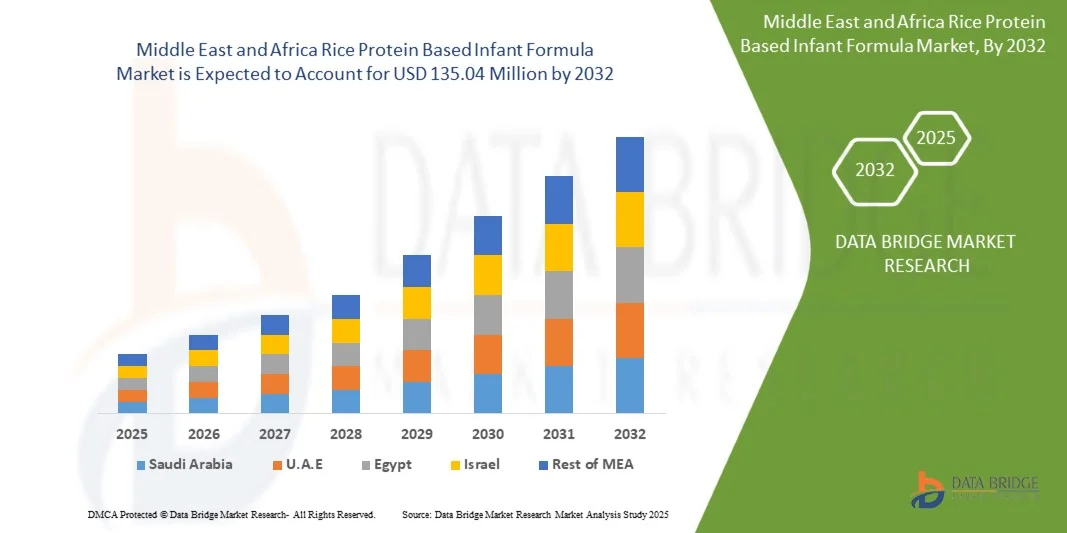
Middle East and Africa Rice Protein Based Infant Formula Market Size
- The Middle East and Africa rice protein based infant formula market size was valued at USD 74.04 million in 2024 and is expected to reach USD 135.04 million by 2032, at a CAGR of 7.80% during the forecast period
- The market growth is largely fuelled by the increasing prevalence of lactose intolerance and cow’s milk allergy among infants, rising consumer preference for plant-based and hypoallergenic nutrition, and growing awareness about the benefits of rice protein as a gentle alternative for infant digestion
- Rising adoption of organic and clean-label infant formulas, along with advancements in formulation technology to enhance taste and nutritional profile, further supports market expansion
Middle East and Africa Rice Protein Based Infant Formula Market Analysis
- The rice protein based infant formula market is witnessing steady growth, driven by the rising prevalence of lactose intolerance and cow’s milk allergy among infants, which is increasing demand for plant-based and hypoallergenic nutrition options
- Growing consumer awareness about the benefits of rice protein, including its digestibility and low allergenic potential, is further boosting market adoption
- Saudi Arabia accounted for the largest revenue share in the Middle East and Africa in 2024, driven by growing awareness of infant nutrition, dietary allergies, and the benefits of plant-based alternatives
- South Africa is expected to witness the highest compound annual growth rate (CAGR) in the Middle East and Africa rice protein based infant formula market due to increasing urbanization, expanding healthcare awareness among parents, rising adoption of specialty and non-GMO infant formulas, growth of modern retail and e-commerce channels, and government initiatives supporting infant nutrition
- The Formulated segment held the largest market revenue share in 2024, driven by the increasing demand for ready-to-feed, nutritionally balanced rice protein formulas. These products provide convenience for caregivers while ensuring consistent nutrient intake, making them highly preferred in infant nutrition
Report Scope and Middle East and Africa Rice Protein Based Infant Formula Market Segmentation
|
Attributes |
Middle East and Africa Rice Protein Based Infant Formula Key Market Insights |
|
Segments Covered |
|
|
Countries Covered |
Middle East and Africa
|
|
Key Market Players |
|
|
Market Opportunities |
|
|
Value Added Data Infosets |
In addition to the insights on market scenarios such as market value, growth rate, segmentation, geographical coverage, and major players, the market reports curated by the Data Bridge Market Research also include in-depth expert analysis, pricing analysis, brand share analysis, consumer survey, demography analysis, supply chain analysis, value chain analysis, raw material/consumables overview, vendor selection criteria, PESTLE Analysis, Porter Analysis, and regulatory framework. |
Middle East and Africa Rice Protein Based Infant Formula Market Trends
“Rising Adoption of Plant-Based Infant Nutrition”
- The growing preference for rice protein-based infant formulas is transforming the infant nutrition landscape by offering a hypoallergenic, easily digestible alternative to traditional dairy-based formulas. The availability of plant-based options allows caregivers to provide nutrition suited to infants with lactose intolerance or cow’s milk protein allergies, improving infant health outcomes
- Increasing demand for specialized formulas in urban and health-conscious populations is accelerating the adoption of rice protein-based products. These formulas are particularly effective in regions with high awareness of infant nutrition and food sensitivities, helping reduce digestive issues and supporting optimal growth
- The affordability and convenience of ready-to-use rice protein formulas are making them attractive for routine infant feeding, leading to improved dietary management. Caregivers benefit from consistent nutrient intake without complex preparation, ultimately supporting overall infant health and development
- For instance, in 2023, several infant nutrition brands reported higher caregiver satisfaction and reduced incidence of gastrointestinal issues after introducing rice protein-based formulas, demonstrating improved tolerance and feeding adherence
- While rice protein-based formulas are gaining traction, their impact depends on product innovation, taste optimization, and accessibility. Manufacturers must focus on nutritional quality, convenient packaging, and awareness campaigns to fully capitalize on this growing demand
Middle East and Africa Rice Protein Based Infant Formula Market Dynamics
Driver
“Increasing Awareness About Lactose Intolerance And Food Allergies”
- The rise in lactose intolerance and cow’s milk protein allergies among infants is pushing both caregivers and pediatricians to prioritize plant-based alternatives. Rice protein formulas provide a safe and effective solution, prompting strong growth in the market
- Parents are increasingly aware of the long-term health implications of undiagnosed food sensitivities, including digestive issues and poor nutrient absorption. This awareness has led to regular adoption of hypoallergenic formulas, even among small families
- Public health initiatives and pediatric nutrition programs have strengthened awareness about alternative infant nutrition options. Educational campaigns highlighting the benefits of rice protein-based formulas help caregivers make informed feeding choices
- For instance, in 2022, pediatric nutrition guidelines emphasized the use of hypoallergenic and plant-based formulas for infants at risk of allergies, boosting demand for rice protein products in healthcare and retail settings
- While awareness and institutional support are driving the market, there is still a need to enhance availability, ensure affordability, and educate caregivers on proper usage to sustain long-term adoption
Restraint/Challenge
“High Cost Of Specialized Formulas And Limited Accessibility In Certain Regions”
- The high price of rice protein-based infant formulas compared to standard dairy-based formulas makes them less accessible for price-sensitive consumers. This limits widespread usage, particularly in developing regions
- In many areas, there is a lack of awareness and guidance from healthcare professionals about specialized formulas. The absence of proper distribution and information reduces timely adoption and optimal use
- Market penetration is further restricted by supply chain challenges, including inconsistent availability in retail and online channels. Caregivers in remote regions often rely on traditional formulas, which may not suit infants with allergies
- For instance, in 2023, surveys in certain developing countries revealed that over 60% of families with infants at risk of allergies could not access rice protein-based formulas due to high prices and limited distribution
- While product innovation continues, addressing cost and accessibility remains crucial. Market stakeholders must focus on affordable formulations, educational campaigns, and scalable distribution solutions to bridge the gap and unlock long-term market potential
Middle East and Africa Rice Protein Based Infant Formula Market Scope
The market is segmented on the basis of type, product type, form, infant age, and distribution channel.
- By Type
On the basis of type, the market is segmented into Formulated and Unformulated. The Formulated segment held the largest market revenue share in 2024, driven by the increasing demand for ready-to-feed, nutritionally balanced rice protein formulas. These products provide convenience for caregivers while ensuring consistent nutrient intake, making them highly preferred in infant nutrition.
The Unformulated segment is expected to witness the fastest growth rate from 2025 to 2032, due to its flexibility for custom preparation and suitability for infants with specific dietary requirements. Unformulated formulas allow caregivers to adjust concentration and composition, offering personalized feeding solutions.
- By Product Type
On the basis of product type, the market is segmented into Standard Formula, Toddler Formula, Follow-On Formula, and Special Formula. The Standard Formula segment held the largest revenue share in 2024, driven by its wide acceptability and suitability for general infant nutrition needs. These formulas provide balanced nutrition and are widely recommended by healthcare professionals.
The Special Formula segment is expected to witness the fastest growth rate from 2025 to 2032, due to increasing awareness about food allergies, lactose intolerance, and specific dietary requirements. Special formulas cater to infants with unique nutritional needs, enhancing market adoption.
- By Form
Based on form, the market is categorized into Non-GMO and GMO. The Non-GMO segment held the largest share in 2024, driven by growing consumer preference for clean-label, naturally sourced ingredients and perceived health benefits. Non-GMO formulas are trusted for safety and quality, especially in infant nutrition.
The GMO segment is expected to witness the fastest growth rate from 2025 to 2032, owing to its cost-effectiveness and enhanced nutritional fortification options. GMO formulas allow manufacturers to optimize protein content and functional nutrients efficiently.
- By Infant Age
The market is segmented into 0-6 Months, 6-12 Months, and 1-3 Years. The 0-6 Months segment held the largest share in 2024, driven by high demand for early-life nutrition and allergy-sensitive formulas. This age group requires carefully balanced proteins and micronutrients for optimal growth.
The 6-12 Months segment is expected to witness the fastest growth rate from 2025 to 2032, due to increasing awareness of follow-on nutrition and the need for complementary feeding options. Formulas for this age group help bridge nutritional gaps during weaning.
- By Distribution Channel
The market is classified into Store-Based Retailer and Non-Store Retailer. Store-Based Retailer dominated in 2024, due to product availability, trust, and visibility in supermarkets, pharmacies, and specialty stores. Caregivers prefer physical stores for convenient access and expert guidance.
Non-Store Retailer is expected to witness the fastest growth rate from 2025 to 2032, owing to the rapid adoption of e-commerce, online marketplaces, and direct-to-consumer sales models. These channels offer convenience, broader product choices, and competitive pricing.
Middle East and Africa Rice Protein Based Infant Formula Market Regional Analysis
- Saudi Arabia accounted for the largest revenue share in the Middle East and Africa in 2024, driven by growing awareness of infant nutrition, dietary allergies, and the benefits of plant-based alternatives
- Rising disposable incomes, urbanization, and the increasing adoption of hypoallergenic rice protein formulas are supporting broader market adoption
- Government initiatives, improved healthcare guidance, and the availability of high-quality, trusted products are further propelling market growth and encouraging caregiver confidence
South Africa Rice Protein Based Infant Formula Market Insight
The South Africa rice protein based infant formula market is expected to witness the fastest growth rate from 2025 to 2032, fueled by rising awareness of infant allergies, lactose intolerance, and the benefits of plant-based nutrition. Caregivers are increasingly adopting rice protein formulas for improved digestion, immunity, and nutritional support. Urbanization and expanding retail channels are boosting accessibility. The growing availability of specialty and non-GMO rice protein formulas is also contributing to adoption. Increasing health consciousness and disposable incomes further accelerate market growth.
Middle East and Africa Rice Protein Based Infant Formula Market Share
The Middle East and Africa rice protein based infant formula industry is primarily led by well-established companies, including:
- Cilo Cybin (South Africa)
- CannaMed (South Africa)
- Medigrow (South Africa)
- CannAfrica (South Africa)
- PharmaCielo (South Africa)
- Bodhi Khaya (South Africa)
- Sativa Group (South Africa)
- Cannabics Pharmaceuticals (Israel)
- Tikun Olam (Israel)
- Seach Medical Group (Israel)

- Interactive Data Analysis Dashboard
- Company Analysis Dashboard for high growth potential opportunities
- Research Analyst Access for customization & queries
- Competitor Analysis with Interactive dashboard
- Latest News, Updates & Trend analysis
- Harness the Power of Benchmark Analysis for Comprehensive Competitor Tracking
Middle East And Africa Rice Protein Based Infant Formula Market, Supply Chain Analysis and Ecosystem Framework
To support market growth and help clients navigate the impact of geopolitical shifts, DBMR has integrated in-depth supply chain analysis into its Middle East And Africa Rice Protein Based Infant Formula Market research reports. This addition empowers clients to respond effectively to global changes affecting their industries. The supply chain analysis section includes detailed insights such as Middle East And Africa Rice Protein Based Infant Formula Market consumption and production by country, price trend analysis, the impact of tariffs and geopolitical developments, and import and export trends by country and HSN code. It also highlights major suppliers with data on production capacity and company profiles, as well as key importers and exporters. In addition to research, DBMR offers specialized supply chain consulting services backed by over a decade of experience, providing solutions like supplier discovery, supplier risk assessment, price trend analysis, impact evaluation of inflation and trade route changes, and comprehensive market trend analysis.
Data collection and base year analysis are done using data collection modules with large sample sizes. The stage includes obtaining market information or related data through various sources and strategies. It includes examining and planning all the data acquired from the past in advance. It likewise envelops the examination of information inconsistencies seen across different information sources. The market data is analysed and estimated using market statistical and coherent models. Also, market share analysis and key trend analysis are the major success factors in the market report. To know more, please request an analyst call or drop down your inquiry.
The key research methodology used by DBMR research team is data triangulation which involves data mining, analysis of the impact of data variables on the market and primary (industry expert) validation. Data models include Vendor Positioning Grid, Market Time Line Analysis, Market Overview and Guide, Company Positioning Grid, Patent Analysis, Pricing Analysis, Company Market Share Analysis, Standards of Measurement, Global versus Regional and Vendor Share Analysis. To know more about the research methodology, drop in an inquiry to speak to our industry experts.
Data Bridge Market Research is a leader in advanced formative research. We take pride in servicing our existing and new customers with data and analysis that match and suits their goal. The report can be customized to include price trend analysis of target brands understanding the market for additional countries (ask for the list of countries), clinical trial results data, literature review, refurbished market and product base analysis. Market analysis of target competitors can be analyzed from technology-based analysis to market portfolio strategies. We can add as many competitors that you require data about in the format and data style you are looking for. Our team of analysts can also provide you data in crude raw excel files pivot tables (Fact book) or can assist you in creating presentations from the data sets available in the report.













