


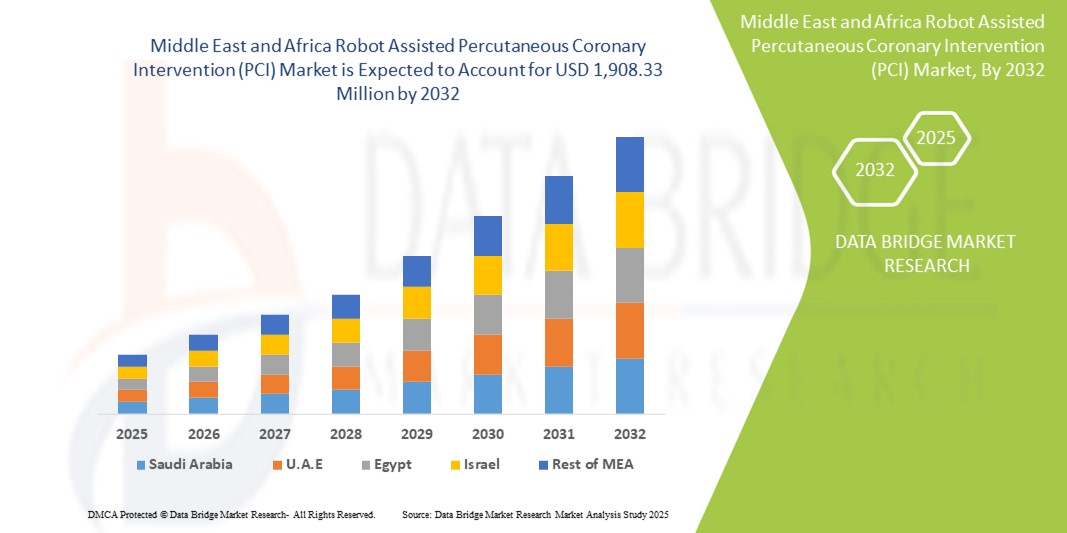
Middle East and Africa Robot Assisted Percutaneous Coronary Intervention (PCI) Market Size
- The Middle East and Africa robot assisted percutaneous coronary intervention (PCI) market size was valued at USD 787.46 million in 2024 and is expected to reach USD 1,908.33 million by 2032, at a CAGR of 11.7% during the forecast period
- The market growth is largely fueled by the rising prevalence of cardiovascular diseases, increasing adoption of minimally invasive procedures, and ongoing technological advancements in robotic-assisted surgical systems across hospitals and cardiac care centers
- Furthermore, growing demand for precision, reduced procedural complications, and enhanced patient outcomes is establishing robot-assisted PCI as a preferred solution in modern interventional cardiology. These converging factors are accelerating the uptake of robotic PCI systems, thereby significantly boosting the industry’s growth
Middle East and Africa Robot Assisted Percutaneous Coronary Intervention (PCI) Market Analysis
- Robot-assisted PCI systems, offering precision-guided and minimally invasive cardiac interventions, are becoming increasingly vital components of modern cardiology practices in both hospitals and specialized cardiac care centers due to their enhanced procedural accuracy, reduced complications, and improved patient outcomes
- The escalating demand for robot-assisted PCI is primarily fueled by the rising prevalence of cardiovascular diseases, growing awareness of minimally invasive treatment benefits, and the adoption of advanced robotic technologies in healthcare facilities
- South Africa dominated the Middle East and Africa robot assisted percutaneous coronary intervention (PCI) market with a revenue share of 45.5% in 2024, characterized by advanced healthcare infrastructure, early adoption of robotic-assisted procedures, and a strong presence of leading medical device suppliers
- Saudi Arabia is expected to be the fastest-growing country in the Middle East and Africa robot assisted percutaneous coronary intervention (PCI) market during the forecast period, driven by increasing healthcare investments, expanding cardiac centers, and rising demand for advanced interventional cardiology procedures
- Robotic systems segment dominated the Middle East and Africa robot assisted percutaneous coronary intervention (PCI) market with a share of 46.5% in 2024, driven by their essential role in performing precise interventions and reducing procedural complications in coronary artery disease treatments
Report Scope and Middle East and Africa Robot Assisted Percutaneous Coronary Intervention (PCI) Market Segmentation
|
Attributes |
Middle East and Africa Robot Assisted Percutaneous Coronary Intervention (PCI) Key Market Insights |
|
Segments Covered |
|
|
Countries Covered |
Middle East and Africa
|
|
Key Market Players |
|
|
Market Opportunities |
|
|
Value Added Data Infosets |
In addition to the insights on market scenarios such as market value, growth rate, segmentation, geographical coverage, and major players, the market reports curated by the Data Bridge Market Research also include in-depth expert analysis, pricing analysis, brand share analysis, consumer survey, demography analysis, supply chain analysis, value chain analysis, raw material/consumables overview, vendor selection criteria, PESTLE Analysis, Porter Analysis, and regulatory framework. |
Middle East and Africa Robot Assisted Percutaneous Coronary Intervention (PCI) Market Trends
Precision and Minimally Invasive Cardiac Interventions
- A significant and accelerating trend in the Middle East and Africa robot-assisted PCI market is the increasing adoption of robotic systems that provide precise and minimally invasive coronary interventions, improving procedural outcomes and reducing complications
- For instance, Corindus Vascular Robotics’ CorPath GRX system enables physicians to remotely control stent placement with high accuracy, reducing radiation exposure for both patients and operators
- Integration with advanced imaging modalities and navigation systems allows robotic PCI platforms to enhance procedural precision, facilitate complex lesion treatment, and provide real-time guidance during interventions
- Robotic-assisted PCI systems are increasingly being incorporated into hospital cardiac suites and specialized cath labs, allowing for streamlined workflows, improved operator ergonomics, and reduced procedural time
- This trend towards more accurate, less invasive, and technology-enabled interventions is fundamentally reshaping interventional cardiology practices in the region
- The demand for robotic-assisted PCI systems is growing rapidly across hospitals and cath labs, as healthcare providers increasingly prioritize precision, safety, and patient outcomes in cardiovascular procedures
Middle East and Africa Robot Assisted Percutaneous Coronary Intervention (PCI) Market Dynamics
Driver
Increasing Prevalence of Cardiovascular Diseases and Technological Adoption
- The rising prevalence of coronary artery disease and other cardiovascular conditions, coupled with the adoption of advanced interventional technologies, is a significant driver for the growing demand for robotic-assisted PCI systems
- For instance, in 2024, Groote Schuur Hospital in South Africa implemented robotic-assisted PCI to enhance treatment accuracy and reduce procedure-related complications
- As healthcare providers focus on improving patient outcomes and reducing procedural risks, robotic systems offer precision, stability, and real-time guidance that traditional manual PCI cannot fully provide
- Furthermore, increasing investments in healthcare infrastructure, cardiac centers, and cath labs are supporting the integration of robotic-assisted systems into clinical practice
- The ability to perform complex interventions with improved safety, combined with operator ergonomics and workflow efficiency, is propelling adoption across hospitals and specialized cardiac facilities in the region
Restraint/Challenge
High Cost and Limited Skilled Workforce
- The high initial cost of robotic-assisted PCI systems and associated instruments poses a significant challenge to broader market penetration, particularly in price-sensitive countries within the region
- For instance, smaller hospitals and clinics in developing MEA countries often cannot justify the investment due to limited procedural volumes or budget constraints
- In addition, the limited availability of trained interventional cardiologists skilled in operating robotic systems can restrict adoption and utilization across healthcare facilities
- Training programs, operator certification, and ongoing skill development are required to maximize system efficiency, which adds to operational costs and time investment
- While technological awareness is increasing, hospitals may hesitate to implement robotic systems until the benefits are fully validated in regional clinical settings
- Addressing these challenges through cost-effective solutions, local training programs, and demonstration of clinical and economic benefits will be crucial for sustainable market growth in the Middle East and Africa
Middle East and Africa Robot Assisted Percutaneous Coronary Intervention (PCI) Market Scope
The market is segmented on the basis of product type, procedure type, application, and end user.
- By Product Type
On the basis of product type, the Middle East and Africa robot assisted percutaneous coronary intervention (PCI) market is segmented into robotic systems, instruments, and accessories. The robotic systems segment dominated the market with the largest revenue share of 46.5% in 2024, driven by their essential role in performing precise, minimally invasive coronary interventions. Robotic systems offer superior accuracy during stent placement, reducing procedural complications and radiation exposure for both patients and operators. Hospitals and cath labs often prioritize robotic systems for complex coronary artery disease cases where precision is critical. These systems also integrate with advanced imaging and navigation tools, enhancing procedural confidence and success rates. The established presence of leading suppliers such as Corindus Vascular Robotics and their regional partnerships further support the adoption of robotic systems across the Middle East and Africa. Strong demand is also fueled by the ability of robotic platforms to improve operator ergonomics and workflow efficiency in cardiac intervention suites.
The instruments segment is expected to witness the fastest growth rate of 15.8% from 2025 to 2032, driven by the increasing need for specialized catheters, guidewires, and supporting tools that complement robotic systems. Instruments enable physicians to perform precise lesion treatment, optimize stent deployment, and enhance procedural safety. Hospitals and cath labs upgrading to robotic PCI often invest in high-quality instruments to ensure optimal system performance. Rising procedural volumes for coronary interventions across Saudi Arabia, UAE, and South Africa are accelerating demand. In addition, instruments are increasingly customized for compatibility with robotic systems, further driving adoption. The ease of handling, reduced procedural risk, and improved outcomes make instruments a critical subsegment in the growing robotic PCI ecosystem.
- By Procedure Type
On the basis of procedure type, the Middle East and Africa robot assisted percutaneous coronary intervention (PCI) market is segmented into robot-assisted procedures and fully automated procedures. The robot-assisted procedures segment dominated with a revenue share of 61% in 2024, as it allows cardiologists to retain manual control while benefiting from robotic precision. This enhances operator confidence and reduces complications. Hospitals prefer these procedures due to proven clinical efficacy and shorter learning curves. Integration with imaging and AI software makes these procedures more effective. Continuous technological improvements sustain their popularity. The combination of manual expertise and robotic assistance keeps this segment dominant.
The fully automated procedures segment is expected to witness the fastest CAGR of 20.2% from 2025 to 2032, driven by advancements in AI, real-time imaging, and robotic navigation. Fully automated PCI can standardize procedures and reduce dependency on operator skill, which is critical in regions with fewer experienced cardiologists. Hospitals adopting this technology aim to improve consistency and reduce complications. Growing investment in robotic research supports innovation. Increasing regulatory approvals for automated systems encourage adoption. Rising awareness of precision and efficiency benefits further accelerates growth.
- By Application
On the basis of application, the Middle East and Africa robot assisted percutaneous coronary intervention (PCI) market is segmented into coronary angioplasty, stent placement, and thrombectomy. The coronary angioplasty segment dominated with 55% market share in 2024, driven by the high prevalence of coronary artery disease and widespread adoption of minimally invasive interventions. Robotic systems provide precise catheter manipulation, reducing procedural complications. Hospitals in the MEA region continue investing in robotic PCI to improve patient outcomes. Integration with imaging and guidance tools further increases procedural accuracy. Cardiologists increasingly prefer robotic-assisted angioplasty over traditional manual methods. Rising procedural volumes support the continued dominance of this segment.
The stent placement segment is expected to witness the fastest growth rate of 19.3% from 2025 to 2032, fueled by the rising incidence of complex lesions requiring accurate stent deployment. Robotic precision minimizes operator fatigue and ensures optimal placement. Hospitals and cath labs are increasingly adopting stent-focused robotic interventions. Technological improvements in stent delivery systems drive growth. Awareness among cardiologists about procedural accuracy benefits supports expansion. Increasing cardiovascular disease prevalence in the region reinforces the fast growth trend.
- By End User
On the basis of end user, the Middle East and Africa robot assisted percutaneous coronary intervention (PCI) market is segmented into hospitals, cath labs, and others. The hospitals segment dominated the market with the largest share in 2024, as hospitals possess advanced infrastructure and higher patient volumes suitable for adopting robotic-assisted systems. Hospitals often serve as primary centers for complex cardiovascular procedures and can justify the investment in robotic platforms due to procedural efficiency and improved patient safety. In addition, hospitals provide training opportunities for interventional cardiologists, enhancing operator adoption of robotic technology. The strong presence of cardiac centers and multi-specialty hospitals in South Africa and UAE supports continued growth. Partnerships between hospitals and device manufacturers also facilitate access to the latest robotic PCI systems. Hospitals benefit from centralized management of procedural workflows and integration with imaging and navigation systems, making them the primary end-user segment.
The cath labs segment is expected to witness the fastest growth rate of 14.5% from 2025 to 2032, driven by their specialized focus on cardiovascular interventions. Cath labs are increasingly upgrading to robotic-assisted PCI to improve procedural precision and reduce operator fatigue. Rising awareness of minimally invasive techniques among cardiologists and hospital administrators encourages investment in robotic technology. Cath labs in private and government healthcare facilities are adopting robotic platforms to enhance procedural outcomes and reduce complications. The ability to perform complex interventions with high accuracy, combined with integration with imaging systems, accelerates adoption. In addition, cath labs benefit from procedural efficiency, enabling higher patient throughput and improved resource utilization, positioning them as the fastest-growing end-user segment in the region.
Middle East and Africa Robot Assisted Percutaneous Coronary Intervention (PCI) Market Regional Analysis
- South Africa dominated the Middle East and Africa robot-assisted PCI market with a revenue share of 45.5% in 2024, characterized by advanced healthcare infrastructure, early adoption of robotic-assisted procedures, and a strong presence of leading medical device suppliers
- Hospitals and cardiac centers in the region highly value the precision, minimally invasive nature, and improved patient outcomes offered by robotic PCI systems, making them the preferred solution for complex cardiovascular procedures
- This widespread adoption is further supported by a well-established network of multi-specialty hospitals, growing procedural volumes, and increasing investments in interventional cardiology, establishing robotic-assisted PCI as a favored solution in South Africa’s healthcare ecosystem
The South Africa Robot-Assisted PCI Market Insight
The South Africa robot assisted percutaneous coronary intervention (PCI) market captured the largest revenue share of 45.5% in 2024, fueled by advanced healthcare infrastructure and the early adoption of robotic-assisted interventions. Hospitals and specialized cardiac centers increasingly prioritize precision, minimally invasive procedures, and improved patient outcomes. The strong presence of leading medical device suppliers, combined with rising procedural volumes for coronary artery disease interventions, further propels market growth. Moreover, integration with advanced imaging and navigation systems enhances procedural efficiency and safety. Public and private healthcare initiatives aimed at improving cardiovascular care are also driving adoption. This establishes South Africa as the key hub for robotic PCI in the Middle East and Africa region.
Saudi Arabia Robot-Assisted PCI Market Insight
The Saudi Arabia robot assisted percutaneous coronary intervention (PCI) market is projected to grow at the fastest CAGR during the forecast period, driven by expanding cardiac care facilities, increasing prevalence of cardiovascular diseases, and government investments in advanced healthcare technologies. Hospitals and cath labs are increasingly adopting robotic-assisted systems to improve procedural accuracy and patient safety. The emphasis on minimally invasive procedures and modern interventional cardiology techniques supports strong market expansion. Awareness campaigns and clinical demonstrations are encouraging wider acceptance among healthcare providers. Moreover, rising private healthcare investments are enabling hospitals to implement state-of-the-art robotic systems. The demand for precision-guided coronary interventions continues to stimulate growth.
United Arab Emirates (UAE) Robot-Assisted PCI Market Insight
The UAE robot assisted percutaneous coronary intervention (PCI) market is witnessing substantial growth due to modernization of hospitals, growing cardiac procedure volumes, and the adoption of advanced robotic platforms. Healthcare facilities are increasingly focused on improving procedural outcomes while reducing operator fatigue and patient risk. Integration with imaging technologies and training programs for interventional cardiologists further supports adoption. Government initiatives promoting high-quality cardiac care and medical tourism are additional growth drivers. The country’s well-developed healthcare infrastructure allows rapid implementation of robotic-assisted systems. These factors collectively position the UAE as a rapidly expanding market for robotic PCI in the region.
Egypt Robot-Assisted PCI Market Insight
The Egypt robot assisted percutaneous coronary intervention (PCI) market is expected to expand steadily during the forecast period, driven by increasing awareness of minimally invasive cardiac interventions and improvements in hospital infrastructure. Public and private hospitals are gradually adopting robotic-assisted systems to enhance procedural accuracy and reduce complications. Investments in healthcare modernization and training for cardiologists support market growth. Rising cardiovascular disease prevalence and increasing patient demand for advanced interventions contribute to adoption. Regional partnerships with medical device manufacturers are facilitating technology transfer and system availability. The focus on improving interventional cardiology outcomes is central to market expansion.
Nigeria Robot-Assisted PCI Market Insight
The Nigeria robot assisted percutaneous coronary intervention (PCI) market is gaining momentum as hospitals and specialized cardiac centers invest in modern interventional cardiology technologies. The demand for precision-guided, minimally invasive coronary procedures is rising with increasing awareness among healthcare providers and patients. Government initiatives to improve healthcare access and quality are promoting adoption. Integration with imaging systems and training programs enhances operator confidence and procedural efficiency. Despite challenges such as high system costs, rising procedural volumes and private healthcare growth support market development. Nigeria represents an emerging market with strong potential for robotic PCI growth.
Middle East and Africa Robot Assisted Percutaneous Coronary Intervention (PCI) Market Share
The Middle East and Africa Robot Assisted Percutaneous Coronary Intervention (PCI) industry is primarily led by well-established companies, including:
- Robocath, Inc. (France)
- meerecompany Inc. (South Korea)
- Stryker (U.S.)
- Medtronic (Ireland)
- Intuitive Surgical Operations, Inc (U.S.)
- Zimmer Biomet (U.S.)
- Smith+Nephew (U.K.)
- Asensus Surgical US, Inc. (U.S.)
- THINK Surgical, Inc. (U.S.)
- Auris Health, Inc. (U.S.)
- CMR Surgical Ltd (U.K.)
- Medtech Life Pvt. Ltd (India)
- Koninklijke Philips N.V., (Netherlands)
- Siemens Healthineers AG (Germany)
- Boston Scientific Corporation (U.S.)
- Biotronik (Germany)
- Wits Donald Gordon Medical Centre (South Africa)
What are the Recent Developments in Middle East and Africa Robot Assisted Percutaneous Coronary Intervention (PCI) Market?
- In July 2025, King Faisal Specialist Hospital and Research Centre (KFSHRC) in Riyadh, Saudi Arabia, successfully performed the world's first implantation of two artificial pumps for biventricular support (BiVAD-HMIII) using robotic technology. This groundbreaking procedure, led by Prof. Feras Khaliel, treated a patient with advanced heart failure
- In January 2025, the King Faisal Specialist Hospital and Research Centre (KFSHRC) in Riyadh, Saudi Arabia, performed the world's first robotic-assisted implantation of an artificial heart pump, the HeartMate 3, developed by Abbott
- In January 2025, At Arab Health 2025, Philips unveiled healthcare innovations focusing on diagnostic solutions, hospital patient monitoring, precision care, and informatics. These industry-leading solutions, including cloud-based data management, advanced visualization, automation, and AI, aim to reduce administrative burdens, optimize workflows, and empower clinicians with insights to enhance experiences and improve patient outcomes
- In May 2023, Siemens Healthineers announced the discontinuation of its CorPath GRX robotic system, which was widely used for robot-assisted PCI. This decision was a setback for the global market, including the Middle East and Africa, as the CorPath GRX was one of the leading robotic platforms in the field. The move highlights the challenges faced by manufacturers in achieving widespread adoption and commercial success for these expensive systems, despite their clear benefits in reducing radiation exposure and enhancing procedural precision
- In July 2022, Robocath's Joint Venture, Cathbot, Concludes First Clinical Study in China to Evaluate Robotic PCI Safety and Efficacy. Cathbot, a joint venture between Robocath and a Chinese partner, completed its first clinical study in China to assess the safety and efficacy of robotic-assisted PCI. This milestone signifies Robocath's commitment to expanding its presence in the Asian market, which may have implications for future expansion into the Middle East and Africa

- Interactive Data Analysis Dashboard
- Company Analysis Dashboard for high growth potential opportunities
- Research Analyst Access for customization & queries
- Competitor Analysis with Interactive dashboard
- Latest News, Updates & Trend analysis
- Harness the Power of Benchmark Analysis for Comprehensive Competitor Tracking
Data collection and base year analysis are done using data collection modules with large sample sizes. The stage includes obtaining market information or related data through various sources and strategies. It includes examining and planning all the data acquired from the past in advance. It likewise envelops the examination of information inconsistencies seen across different information sources. The market data is analysed and estimated using market statistical and coherent models. Also, market share analysis and key trend analysis are the major success factors in the market report. To know more, please request an analyst call or drop down your inquiry.
The key research methodology used by DBMR research team is data triangulation which involves data mining, analysis of the impact of data variables on the market and primary (industry expert) validation. Data models include Vendor Positioning Grid, Market Time Line Analysis, Market Overview and Guide, Company Positioning Grid, Patent Analysis, Pricing Analysis, Company Market Share Analysis, Standards of Measurement, Global versus Regional and Vendor Share Analysis. To know more about the research methodology, drop in an inquiry to speak to our industry experts.
Data Bridge Market Research is a leader in advanced formative research. We take pride in servicing our existing and new customers with data and analysis that match and suits their goal. The report can be customized to include price trend analysis of target brands understanding the market for additional countries (ask for the list of countries), clinical trial results data, literature review, refurbished market and product base analysis. Market analysis of target competitors can be analyzed from technology-based analysis to market portfolio strategies. We can add as many competitors that you require data about in the format and data style you are looking for. Our team of analysts can also provide you data in crude raw excel files pivot tables (Fact book) or can assist you in creating presentations from the data sets available in the report.













