Slewing Bearings Market Overview
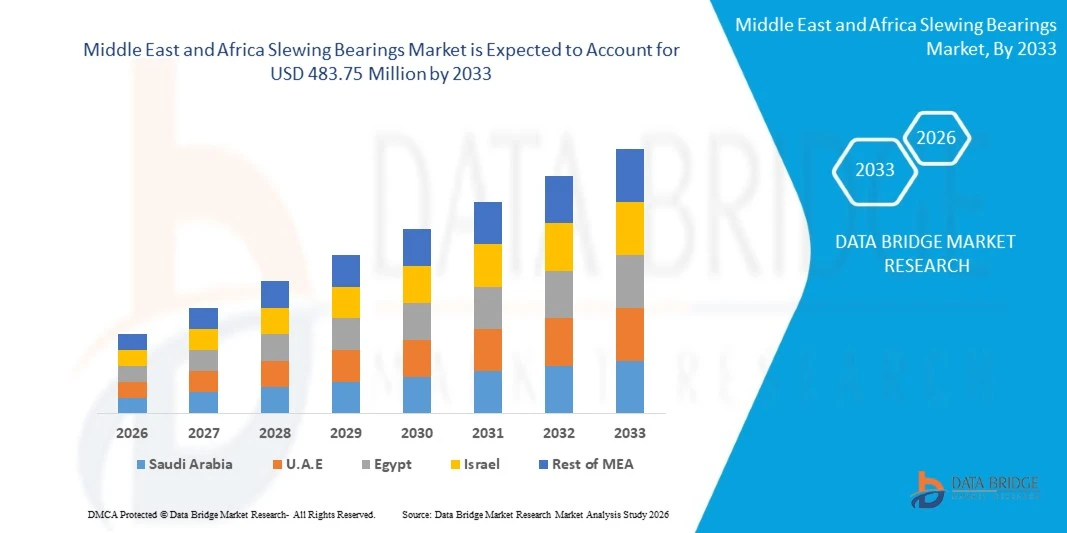
The Middle East & Africa slewing bearings market was valued at USD 265.20 million in 2025 and is projected to reach USD 483.75 million by 2033, growing at a CAGR of 12.77% from 2026 to 2033. The increasing demand for heavy construction machinery, expanding infrastructure development, and rising investments in renewable energy projects are supporting market growth. Slewing bearings are widely used in cranes, excavators, mining equipment, wind turbines, and industrial machinery to enable smooth rotational movement while supporting heavy axial, radial, and moment loads. Growing demand for durable and high-performance components across construction, mining, manufacturing, and material-handling applications is further contributing to market expansion.
Furthermore, increasing investments in wind energy installations, industrial automation, and large-scale infrastructure projects are creating opportunities for slewing bearing manufacturers. Advancements in bearing materials, sealing technologies, lubrication systems, and precision engineering are improving load-bearing capacity, operational reliability, and service life. The growing adoption of predictive maintenance and the need to reduce equipment downtime are also encouraging demand for advanced bearing solutions. The expansion of construction equipment manufacturing, mining activities, and renewable energy infrastructure is expected to support the growth of the Middle East & Africa Slewing Bearings Market during the forecast period.
Market Size & Forecast
- Middle East & Africa Market Value (2025): USD 265.20 million
- Expected Market Value (2033): USD 483.75 million
- Forecast CAGR (2026–2033): 12.77%
- Leading state in 2025: GCC
- Fastest Growing state: Egyp
Key Market Trends & Insights
- GCC dominated the Middle East & Africa slewing bearings market with the largest revenue share of 59.00% in 2025, supported by its extensive manufacturing base, rapid infrastructure development, and strong demand for construction and mining equipment. The country's large-scale investments in transportation networks, urban development, industrial facilities, and renewable energy projects are driving the use of slewing bearings in cranes, excavators, heavy machinery, and wind turbines. In addition, China's established bearing manufacturing industry, advanced production capabilities, and expanding industrial automation sector are strengthening market demand.
- The ball slewing bearings segment dominated the market with a 50.73% share in 2025, owing to its low friction, smooth rotational performance, high precision, and suitability for applications requiring reliable load handling. These bearings are widely used in construction machinery, industrial equipment, material-handling systems, and renewable energy installations, supporting efficient rotational movement and operational reliability.
- Egypt is expected to be the fastest-growing region in the Middle East & Africa slewing bearings market, registering a CAGR of 13.76% during 2026–2033. Growth is supported by increasing investments in infrastructure development, expanding mining activities, rising demand for construction equipment, and growing renewable energy installations. The need for reliable heavy machinery and durable rotational components is creating additional opportunities for slewing bearing manufacturers across the state.
- The internal gear segment dominated the market with a 46.54% share in 2025, driven by its compact design, efficient torque transmission, and suitability for applications requiring controlled rotational movement. Internal gear slewing bearings are used in cranes, excavators, industrial machinery, and material-handling equipment, where protected gear arrangements and reliable operating performance are important.
- The non-flanged segment dominated the market with a 64.94% share in 2025, owing to its straightforward design, structural versatility, and suitability for a wide range of industrial and heavy equipment applications. These bearings can be integrated into machinery designs according to specific mounting requirements, supporting their use in construction equipment, industrial systems, and other applications requiring reliable rotational movement.
- The heavy-duty segment dominated the market with a 36.85% share in 2025, supported by increasing demand for bearings capable of withstanding high loads, mechanical stress, and demanding operating conditions. Heavy-duty slewing bearings are widely used in mining machinery, cranes, excavators, and large construction equipment, where durability, load-bearing capacity, and operational reliability are essential for maintaining equipment performance and reducing downtime.
Report Scope and Slewing Bearings Market Segmentation
|
Attributes |
Slewing Bearings Key Market Insights |
|
Segments Covered |
|
|
Countries Covered |
Middle East & Africa
|
|
Key Market Players |
|
|
Market Opportunities |
|
|
Value Added Data Infosets |
In addition to the insights on market scenarios such as market value, growth rate, segmentation, geographical coverage, and major players, the market reports curated by the Data Bridge Market Research also include in-depth expert analysis, geographically represented company-wise production and capacity, network layouts of distributors and partners, detailed and updated price trend analysis and deficit analysis of supply chain and demand. |
Slewing Bearings Market Trends
Trend: Growing Demand for High-Capacity Bearings and Advanced Gear Technologies
The Middle East & Africa slewing bearings market is increasingly focusing on high-load-capacity bearing designs, improved rotational precision, and enhanced durability to meet the requirements of construction equipment, mining machinery, industrial automation, and renewable energy applications. Manufacturers are developing advanced slewing bearing solutions with improved sealing systems, optimized gear configurations, and durable materials to support reliable operation under demanding conditions. The expansion of wind energy installations and large-scale infrastructure projects is further increasing demand for bearings used in turbine yaw and pitch systems, cranes, excavators, and heavy machinery. In addition, improvements in bearing testing, condition monitoring, and lubrication technologies are supporting equipment reliability and reducing maintenance requirements.
For instance,
- In July 2025, WafangDian Bearing Group (ZWZ) announced the development of an ultra-large slewing bearing designed for 4,000-ton all-terrain cranes. The product addressed the requirements of heavy lifting applications and highlighted advances in bearing design, materials, and precision manufacturing.
- In October 2025, thyssenkrupp rothe erde and Shanghai Electric Wind Power Group signed a joint development agreement for a Pitch Bearing Unit (PBU). The collaboration focused on developing high-performance wind turbine components to support next-generation turbine designs and upgrades to existing wind power installations.
- In July 2026, NSK and Cosmo Eco Power reported progress in field testing bearing lubrication condition-monitoring technology for wind turbines. The initiative aimed to improve maintenance efficiency, support early detection of bearing condition changes, and enhance wind turbine operational reliability.
Overall, these developments highlight the growing importance of product innovation, high-load performance, and condition monitoring in the Middle East & Africa slewing bearings market. Increasing demand for large construction machinery, advanced wind turbines, and reliable industrial equipment is encouraging manufacturers to improve bearing capacity, durability, and maintenance performance. Continued technological development and collaboration between bearing manufacturers and equipment producers are expected to support market growth during the forecast period.
Middle East & Africa Slewing Bearings Market Dynamics
Key Market Driver: Expanding Infrastructure Development and Renewable Energy Investments
The Middle East & Africa slewing bearings market is witnessing growth driven by increasing infrastructure development, expanding construction activities, and rising investments in renewable energy projects. Slewing bearings are essential components in cranes, excavators, mining machinery, material-handling equipment, and wind turbines, where they enable smooth rotational movement and support heavy axial, radial, and moment loads. The growing demand for high-performance construction equipment and large-scale industrial machinery is encouraging manufacturers to develop durable, precision-engineered bearing solutions. In addition, the expansion of onshore and offshore wind energy installations is increasing demand for slewing bearings used in turbine yaw and pitch systems. Advancements in bearing materials, sealing technologies, and lubrication systems are further improving operational reliability, load-bearing capacity, and service life.
For instance,
- In July 2025, WafangDian Bearing Group (ZWZ) announced the development of an ultra-large slewing bearing designed for 4,000-ton all-terrain cranes, highlighting advancements in heavy-duty lifting equipment and bearing manufacturing capabilities.
- In October 2025, thyssenkrupp Rothe Erde and Shanghai Electric Wind Power Group signed a joint development agreement for a Pitch Bearing Unit (PBU). The modular design aims to simplify transportation, support turbine upgrades, and improve the performance of wind energy systems.
- In February 2026, Luoyang LYC Bearing Group's independently developed wind turbine main bearings supported the commissioning and grid connection of a 20 MW offshore wind turbine in Fujian, China, demonstrating progress in large-scale wind power bearing technology.
- In July 2026, NSK and Cosmo Eco Power reported progress in field testing bearing lubrication condition-monitoring technology on wind turbines, supporting efforts to improve equipment uptime and maintenance efficiency.
Overall, these developments highlight the growing importance of technological innovation in the Middle East & Africa slewing bearings market. Increasing demand for high-load-capacity bearings, modular wind turbine components, and intelligent monitoring solutions is encouraging manufacturers to improve product performance and reliability. Continued investment in engineering, material development, and predictive maintenance technologies is expected to support market development during the forecast period.
Key Restraint/Challenge: High Manufacturing Costs, Raw Material Price Volatility, and Technical Performance Requirements
The Middle East & Africa slewing bearings market faces challenges associated with high manufacturing costs, fluctuations in raw material prices, and the technical complexity of producing large, high-precision bearing components. Slewing bearings require specialized materials, precision machining, heat treatment, gear manufacturing, and stringent quality control to ensure reliable performance under heavy loads and demanding operating conditions. Changes in the prices of alloy steel and other manufacturing inputs can increase production expenses and affect profit margins. In addition, maintaining dimensional accuracy, load-bearing capacity, sealing performance, and fatigue resistance presents technical challenges for manufacturers serving construction, mining, industrial machinery, and renewable energy applications.
For instance,
- In March 2026, domestic steel prices in India reportedly increased by 18–25% over three months, following the extension of safeguard duties on steel imports. Rising steel prices can increase raw material procurement costs for slewing bearing manufacturers, putting pressure on production expenses and profit margins.
- In June 2026, S&P Middle East & Africa reported that U.S. tariffs on imported steel and aluminum had increased input costs for some downstream manufacturers. The report noted that the U.S. producer price index for iron and steel rose 10.4% between April 2025 and April 2026, while the steel mill products index increased 13.3%. Such cost increases can create additional challenges for bearing manufacturers that rely on steel for high-strength components.
Overall, these challenges can affect production efficiency, pricing competitiveness, and profitability in the Middle East & Africa slewing bearings market. Manufacturers must focus on process optimization, material efficiency, advanced quality-control systems, and improved bearing designs to manage costs while maintaining product reliability. Strengthening supply chain resilience and investing in manufacturing technologies will remain important for addressing technical and operational challenges during the forecast period.
Key Market Opportunity: Growing Renewable Energy Investments and Advanced Bearing Technology
The Middle East & Africa slewing bearings market is gaining opportunities from increasing investments in renewable energy, particularly wind power, along with rising demand for advanced rotational components in construction machinery, mining equipment, and industrial automation. Manufacturers are focusing on developing high-load-capacity bearings, improved sealing systems, advanced lubrication solutions, and precision-engineered components to enhance equipment reliability and service life. The expansion of offshore wind projects and the development of larger wind turbines are creating demand for specialized slewing bearings used in blade pitch and nacelle yaw systems. In addition, innovations in bearing testing, condition monitoring, and predictive maintenance are creating opportunities to improve operational performance and reduce equipment downtime.
For instance,
- In October 2025, thyssenkrupp rothe erde and Shanghai Electric Wind Power Group signed a joint development agreement for a Pitch Bearing Unit (PBU). The modular solution integrates the pitch bearing, blade drive system, and hub to simplify transportation, support turbine upgrades, and improve the performance of wind energy installations.
- In October 2025, Schaeffler, Lindø Offshore Renewables Center (LORC), and R&D Test Systems commissioned a high-capacity wind turbine bearing test facility in Denmark. The facility supports the testing and validation of rotor bearing arrangements for next-generation wind turbines, including large-capacity offshore systems, creating opportunities for advanced bearing development.
- In March 2026, SKF announced an agreement to acquire G-Tech Instruments, a specialist in condition-monitoring and measurement technology. The acquisition is intended to strengthen SKF's digital reliability solutions and predictive-maintenance capabilities, supporting improved equipment performance and reduced downtime across heavy industry and energy applications.
Overall, these developments highlight opportunities arising from renewable energy expansion, bearing design innovation, and advanced maintenance technologies in the Middle East & Africa slewing bearings market. Continued investment in modular bearing systems, high-load-capacity products, and condition-monitoring solutions is expected to help manufacturers address the evolving requirements of wind energy, construction, mining, and industrial equipment applications during the forecast period.
Middle East & Africa Slewing Bearings Market Scope
The Middle East & Africa slewing bearings market is segmented into ten notable segments based on product type, mounting configuration, load capacity, sealing type, application, distribution channel, gear configuration, material, manufacturing process, and end user industry.
- By product type
On the basis of product type, the Middle East & Africa slewing bearings market is segmented into ball slewing bearings, roller slewing bearings, ball and roller combination slewing bearings, wire race slewing bearings, thin section slewing bearings, segmental slewing bearings, customized slewing bearings. In 2025, the ball slewing bearings segment is expected to dominate the Middle East & Africa slewing bearings market with a market share of 50.73% due to its low friction, smooth rotational movement, high precision, and widespread use in construction machinery, industrial equipment, and renewable energy applications.
The wire race slewing bearings segment is projected to register the fastest CAGR of 17.72% from 2026 to 2033, owing to its high load-bearing capacity, superior rigidity, and suitability for heavy-duty applications in construction machinery, mining equipment, cranes, and wind turbines operating under demanding conditions.
- By mounting configuration
On the basis of mounting configuration, the Middle East & Africa slewing bearings market is segmented into flanged, non-flanged, integral mounting, split. In 2025, the non-flanged segment is expected to dominate the Middle East & Africa slewing bearings market with a share of 64.94% due to its simple mounting design, cost-effectiveness, structural versatility, and suitability for integration into various construction equipment, industrial machinery, and heavy-duty applications.
The flanged segment is projected to register the fastest CAGR of 13.05% from 2026 to 2033, owing to its enhanced structural stability, secure equipment integration, improved load distribution, and suitability for heavy-duty construction machinery, industrial equipment, and applications requiring reliable rotational performance.
- By load capacity
On the basis of load capacity, the Middle East & Africa slewing bearings market is segmented into light duty, medium duty, heavy duty, ultra-heavy duty. In 2025, the heavy-duty segment is expected to dominate the Middle East & Africa slewing bearings market with a market share of 36.85%, owing to its high load-bearing capacity, structural strength, and durability under demanding operating conditions. Heavy-duty slewing bearings are widely used in construction machinery, mining equipment, cranes, material-handling systems, and wind turbines, where reliable rotation and the ability to withstand substantial axial, radial, and tilting moment loads are essential.
The medium duty segment is expected to experience the fastest CAGR of 12.79% from 2026 to 2033, owing to increasing demand for compact, lightweight, and cost-effective slewing bearings across industrial automation, robotics, medical equipment, and material-handling applications. The growing adoption of automated machinery and precision equipment is driving the need for bearings that provide smooth rotational movement, reliable performance, and efficient space utilization under lower load conditions.
- By sealing type
On the basis of sealing type, the Middle East & Africa slewing bearings market is segmented into single seal, double seal, contact seal, non-contact seal, high-performance sealed. In 2025, the double seal segment is expected to dominate the Middle East & Africa slewing bearings market with a market share of 32.83%, owing to its enhanced ability to prevent the entry of dust, moisture, dirt, and other contaminants into bearing assemblies. Double-seal configurations provide improved protection for internal components, support effective lubricant retention, and reduce wear under demanding operating conditions.
The non-contact seal segment is expected to experience the fastest CAGR of 13.80% from 2026 to 2033, owing to its low-friction design, reduced wear, and suitability for applications requiring efficient rotational performance. Non-contact seals minimize direct contact between sealing components, helping reduce frictional losses and maintenance requirements while supporting smooth bearing operation. Their growing adoption in industrial automation, robotics, wind energy equipment, and precision machinery is driven by the need for improved energy efficiency, operational reliability, and extended service life.
- By application
On the basis of application, the Middle East & Africa slewing bearings market is segmented into construction equipment, mining equipment, wind energy, industrial machinery & automation, marine & offshore equipment, agriculture & forestry equipment, railway equipment, medical equipment, aerospace & defense equipment, amusement equipment, port equipment, solar energy equipment, automotive & transportation, power transmission, material handling & logistics, others. In 2025, the construction equipment segment is expected to dominate the Middle East & Africa slewing bearings market with a market share of 40.99% owing to the extensive use of slewing bearings in excavators, cranes, drilling equipment, concrete pumps, and other heavy construction machinery. These bearings enable smooth rotational movement, support heavy axial and radial loads, and provide stability during lifting, digging, and material-handling operations. Increasing investments in infrastructure development, urbanization, road construction, and commercial building projects are further driving demand for construction equipment.
The industrial machinery & automation segment is expected to experience the fastest CAGR of 18.07% from 2026 to 2033, owing to the increasing adoption of industrial automation, robotics, precision manufacturing, and advanced material-handling systems. Slewing bearings enable controlled rotational movement, high positioning accuracy, and reliable load distribution in automated production equipment, robotic systems, and industrial machinery.
- By distribution channel
On the basis of distribution channel, the Middle East & Africa slewing bearings market is segmented into OEM, aftermarket, direct sales, system integrators / equipment manufacturers, industrial dealers. In 2025, the OEM segment is expected to dominate the Middle East & Africa slewing bearings market with a market share of 50.61%, owing to the high demand for slewing bearings as original components in newly manufactured construction equipment, mining machinery, wind turbines, industrial automation systems, and material-handling equipment. OEMs prioritize application-specific bearing designs, dimensional accuracy, load-bearing capacity, durability, and compatibility with equipment specifications to ensure reliable performance and operational safety.
The OEM segment is expected to experience the fastest CAGR of 10.12% from 2026 to 2033, owing to the increasing integration of slewing bearings into newly manufactured construction equipment, mining machinery, wind turbines, and industrial automation systems. Growing investments in infrastructure development, renewable energy installations, and advanced manufacturing are driving demand for high-performance bearing components directly from original equipment manufacturers.
- By gear configuration
On the basis of gear configuration, the Middle East & Africa slewing bearings market is segmented into external gear, internal gear, gearless. In 2025, the internal gear segment is expected to dominate the Middle East & Africa slewing bearings market with a market share of 46.54% due to the extensive use of non-dairy creamers in instant coffee, tea premixes, and ready-to-prepare beverage formulations. These manufacturers rely on non-dairy creamers to deliver consistent whiteness, creaminess, smooth texture, and product stability across high-volume production.
The gearless segment is expected to experience the fastest CAGR of 15.24% from 2026 to 2033, owing to the growing popularity of customized specialty beverages, increasing expansion of bubble tea outlets, and rising consumer demand for innovative drink options. Non-dairy creamers are used in milk tea, bubble tea, specialty coffee, and other blended beverages to provide creamy texture, smooth mouthfeel, and consistent product quality.
- By material
On the basis of material, the Middle East & Africa slewing bearings market is segmented into carbon steel, alloy steel, stainless steel, hardened steel, corrosion-resistant materials, special. In 2025, the alloy steel segment is expected to dominate the Middle East & Africa slewing bearings market with a market share of 44.66%, owing to its high strength, excellent load-bearing capacity, wear resistance, and durability under demanding operating conditions. Alloy steel slewing bearings are widely used in construction machinery, mining equipment, cranes, wind turbines, and industrial machinery, where components must withstand heavy loads, repeated rotational movement, and mechanical stress.
The stainless-steel segment is expected to experience the fastest CAGR of 15.33% from 2026 to 2033, owing to its superior corrosion resistance, durability, and suitability for applications exposed to moisture, chemicals, saltwater, and harsh environmental conditions. Stainless steel slewing bearings are increasingly preferred in marine and offshore equipment, food processing machinery, medical equipment, renewable energy systems, and specialized industrial applications where resistance to corrosion and contamination is essential.
- By manufacturing process
On the basis of manufacturing process, the Middle East & Africa slewing bearings market is segmented into forged, rolled ring, machined, precision ground, heat treated. In 2025, the rolled ring segment is expected to dominate the Middle East & Africa slewing bearings market with a market share of 41.88%, owing to its superior structural integrity, material strength, and suitability for manufacturing large-diameter bearing rings. The rolled ring manufacturing process supports uniform grain structure, improved mechanical properties, and reliable performance under heavy loads and repeated rotational stress. These characteristics make rolled ring slewing bearings suitable for construction equipment, mining machinery, cranes, wind turbines, and other heavy-duty industrial applications.
The precision ground segment is expected to experience the fastest CAGR of 13.65% from 2026 to 2033, owing to the increasing demand for high-accuracy slewing bearings with superior dimensional tolerances, smooth rotational movement, and improved operational reliability. Precision grinding enhances surface finish, geometric accuracy, and contact consistency, making these bearings suitable for industrial automation, robotics, medical equipment, aerospace systems, and advanced manufacturing machinery. The growing adoption of automated production systems and precision-engineered equipment is further driving demand for bearings that minimize vibration, improve positioning accuracy, and support consistent performance.
- By end user industry
On the basis of end user industry, the Middle East & Africa slewing bearings market is segmented into construction, mining, renewable energy, industrial manufacturing, marine & offshore, agriculture & forestry, railway, aerospace & defense, healthcare, material handling & logistics, ports & harbors, amusement & recreation, energy & utilities, automotive & transportation, power transmission, others. In 2025, the Construction segment is expected to dominate the Middle East & Africa slewing bearings market with a market share of 37.45%, owing to the extensive use of slewing bearings in excavators, cranes, drilling equipment, concrete pumps, and other heavy construction machinery. These bearings facilitate smooth rotational movement, support substantial axial and radial loads, and provide stability during lifting, digging, and material-handling operations. Increasing investments in infrastructure development, urbanization, road construction, and commercial building projects are further driving demand for construction equipment and associated bearing components.
The renewable energy segment is expected to experience the fastest CAGR of 19.02% from 2026 to 2033, owing to increasing demand for precision-engineered slewing bearings in medical imaging systems, diagnostic equipment, surgical devices, and patient positioning systems. These bearings support smooth rotational movement, precise positioning, low vibration, and reliable operation, which are essential for equipment such as computed tomography (CT) scanners and advanced diagnostic platforms.
Middle East & Africa Slewing Bearings Market Regional Analysis
The GCC dominated the Middle East & Africa slewing bearings market and accounted for the largest revenue share of 59.00% in 2025, driven by increasing investments in infrastructure development, construction projects, mining activities, and industrial expansion. Major investments in commercial buildings, transportation networks, ports, and large-scale urban development projects across Saudi Arabia and the United Arab Emirates are supporting demand for slewing bearings used in cranes, excavators, and material-handling equipment. .
Moreover, Egypt is projected to register the highest CAGR of 13.76% during 2026–2033, driven by increasing investments in infrastructure development, construction projects, industrial modernization, and renewable energy installations. The expansion of transportation networks, urban development initiatives, and commercial construction is increasing demand for cranes, excavators, and heavy machinery that rely on slewing bearings. In addition, investments in industrial facilities, port infrastructure, and mining activities are supporting the adoption of durable, high-load-capacity bearing solutions. Growing interest in wind and solar energy projects, along with the modernization of manufacturing operations, is expected to create further growth opportunities for slewing bearing suppliers in Egypt during the forecast period.
GCC Slewing Bearings Market Insight
The GCC slewing bearings market is driven by increasing investments in infrastructure development, construction, industrial expansion, and energy projects across Saudi Arabia, the United Arab Emirates, and other Gulf countries. Large-scale urban developments, transportation networks, port modernization, and commercial construction are supporting demand for slewing bearings used in cranes, excavators, and material-handling equipment. In addition, investments in renewable energy, particularly solar and wind power, are creating opportunities for advanced bearing solutions. Growing industrial diversification, equipment modernization, and demand for reliable, high-load-capacity components are expected to support market growth across the GCC during the forecast period.
Egypt Slewing Bearings Market Insight
The Egypt slewing bearings market is expected to witness growth driven by increasing investments in infrastructure development, construction, industrial modernization, and renewable energy projects. Expanding transportation networks, port facilities, and urban development initiatives are supporting demand for cranes, excavators, and material-handling equipment that require reliable slewing bearings. In addition, growing investments in manufacturing facilities and mining activities are creating opportunities for high-load-capacity bearing solutions. The country's focus on wind and solar energy development, alongside industrial equipment modernization, is expected to further support market expansion during the forecast period.
South Africa Slewing Bearings Market Insight
The South Africa slewing bearings market is driven by growing investments in mining, infrastructure development, construction, and industrial manufacturing. The country's established mining sector is supporting demand for slewing bearings used in excavators, drilling equipment, cranes, and material-handling systems. Ongoing transportation infrastructure projects and urban development activities are further contributing to market expansion. In addition, increasing investments in renewable energy, particularly wind power, are creating opportunities for advanced bearing solutions. The adoption of industrial automation and demand for durable, high-load-capacity components are expected to support market growth across South Africa.
Middle East & Africa Slewing Bearings Market Share
The Middle East & Africa slewing bearings industry is primarily led by well-established companies, including:
- thyssenkrupp rothe erde (Germany)
- SKF Group (Sweden)
- Schaeffler AG (Germany)
- The Timken Company (U.S.)
- NSK Ltd. (Japan)
- NTN Corporation (Japan)
- Liebherr Group (Switzerland)
- IMO Group (Germany)
- Rollix (Defontaine Group) (France)
- Rotek Incorporated (U.S.)
- Antex Corporation (U.S.)
- La Leonessa S.p.A. (Italy)
- WafangDian Bearing Group (ZWZ) (China)
- Xuzhou Helin Slewing Bearing Co., Ltd. (China)
- Zhejiang Tianma Bearing Group Co., Ltd. (China)
- Luoyang LYC Bearing Co., Ltd. (China)
- Kaydon Bearings (U.S.)
- Silverthin Bearing Group (U.S.)
- Fenghe Slewing Bearing Co., Ltd. (China)
- Xuzhou Wanda Slewing Bearing Co., Ltd. (XZWD) (China)
- Luoyang Longda Bearing Co., Ltd. (LDB) (China)
- PSL, a.s. (Czech Republic)
- Universal Industrial Products, Inc. (UIPI) (U.S.)
- Maanshan Fangyuan Precision Machinery Co., Ltd. (China)
Latest Developments in Middle East & Africa Slewing Bearings Market
- In October 2025, Rothe Erde and Shanghai Electric Wind Power Group signed a joint development agreement for a Pitch Bearing Unit (PBU) at China Wind Power 2025. The collaboration focuses on modular, high-performance wind turbine components, supporting easier upgrades and improved reliability.
- In October 2025, Schaeffler and the Lindø Offshore Renewables Center (LORC), with R&D Test Systems, commissioned a high-capacity wind turbine rotor-bearing test facility in Denmark. The facility supports testing and validation of next-generation wind turbine bearing systems.
- In March 2026, SKF announced an agreement to acquire G-Tech Instruments, a specialist in condition-monitoring and measurement technology. The acquisition is intended to strengthen SKF’s digital reliability and predictive-maintenance capabilities for industrial equipment, including applications in heavy industry and energy.
- In March 2026, Timken acquired the assets and related businesses of Bijur Delimon International, a manufacturer of automated lubrication systems. The acquisition expands Timken’s lubrication capabilities for industries such as mining, rail, and power generation, which also use heavy-duty bearing systems.
- In May 2026, NSK signed a memorandum of understanding with Delta Electronics to collaborate on robotics technology, including actuator development, system integration, prototyping, and potential commercialization. The collaboration reflects growing demand for precision motion components in automated manufacturing and robotics.

- Interactive Data Analysis Dashboard
- Company Analysis Dashboard for high growth potential opportunities
- Research Analyst Access for customization & queries
- Competitor Analysis with Interactive dashboard
- Latest News, Updates & Trend analysis
- Harness the Power of Benchmark Analysis for Comprehensive Competitor Tracking
Middle East And Africa Slewing Bearings Market, Supply Chain Analysis and Ecosystem Framework
To support market growth and help clients navigate the impact of geopolitical shifts, DBMR has integrated in-depth supply chain analysis into its Middle East And Africa Slewing Bearings Market research reports. This addition empowers clients to respond effectively to global changes affecting their industries. The supply chain analysis section includes detailed insights such as Middle East And Africa Slewing Bearings Market consumption and production by country, price trend analysis, the impact of tariffs and geopolitical developments, and import and export trends by country and HSN code. It also highlights major suppliers with data on production capacity and company profiles, as well as key importers and exporters. In addition to research, DBMR offers specialized supply chain consulting services backed by over a decade of experience, providing solutions like supplier discovery, supplier risk assessment, price trend analysis, impact evaluation of inflation and trade route changes, and comprehensive market trend analysis.
Data collection and base year analysis are done using data collection modules with large sample sizes. The stage includes obtaining market information or related data through various sources and strategies. It includes examining and planning all the data acquired from the past in advance. It likewise envelops the examination of information inconsistencies seen across different information sources. The market data is analysed and estimated using market statistical and coherent models. Also, market share analysis and key trend analysis are the major success factors in the market report. To know more, please request an analyst call or drop down your inquiry.
The key research methodology used by DBMR research team is data triangulation which involves data mining, analysis of the impact of data variables on the market and primary (industry expert) validation. Data models include Vendor Positioning Grid, Market Time Line Analysis, Market Overview and Guide, Company Positioning Grid, Patent Analysis, Pricing Analysis, Company Market Share Analysis, Standards of Measurement, Global versus Regional and Vendor Share Analysis. To know more about the research methodology, drop in an inquiry to speak to our industry experts.
Data Bridge Market Research is a leader in advanced formative research. We take pride in servicing our existing and new customers with data and analysis that match and suits their goal. The report can be customized to include price trend analysis of target brands understanding the market for additional countries (ask for the list of countries), clinical trial results data, literature review, refurbished market and product base analysis. Market analysis of target competitors can be analyzed from technology-based analysis to market portfolio strategies. We can add as many competitors that you require data about in the format and data style you are looking for. Our team of analysts can also provide you data in crude raw excel files pivot tables (Fact book) or can assist you in creating presentations from the data sets available in the report.