


Middle East and Africa Sperm Separation Devices Market Overview
The Middle East and Africa sperm separation devices market was valued at USD 24.33 million in 2025 and is projected to reach USD 51.77 million by 2033, growing at a CAGR of 9.90% from 2026 to 2033. The market is witnessing steady growth driven by increasing demand for advanced assisted reproductive technologies (ART), rising infertility rates, and growing awareness of fertility preservation solutions across specialized fertility clinics and hospitals in the region.
The expanding adoption of in-vitro fertilization (IVF) procedures, coupled with improvements in clinical laboratory infrastructure and rising investments in reproductive healthcare services, is accelerating the use of sperm separation devices. Technologies such as density gradient centrifugation and microfluidic-based sperm sorting are gaining traction due to their ability to improve sperm quality selection, enhance fertilization outcomes, and support more efficient and standardized ART procedures across Middle East and Africa healthcare systems.
Key Market Trends & Insights
- Egypt dominated the Middle East and Africa sperm separation devices market with the largest revenue share of 27.6% in 2025, supported by a high concentration of fertility clinics, growing IVF adoption, and relatively advanced reproductive healthcare infrastructure compared to neighboring countries.
- The Centrifugation Devices segment led the market with a 56.8% share in 2025, driven by widespread clinical adoption, cost-effectiveness, and strong reliability in standard IVF laboratory workflows across Egypt, Saudi Arabia, and South Africa
- United Arab Emirates is expected to be the fastest-growing country at a strong CAGR of 8.3 from 2026 to 2033, fueled by rapid expansion of fertility centers, high medical tourism inflow, and continuous investment in advanced reproductive technologies.
- Centrifugation-Free Devices are the fastest-growing devices type, projected to register a CAGR of 7.9%, reflecting the surge in demand for immersive, interactive driver training environments.
- The Sperm Washing Media segment dominated the media category with a 38.5% revenue share in 2025, led by its essential role in removing seminal plasma and improving sperm motility for IVF procedures.
- Electrophoresis accounted for 49.6% of the market, preferred by its widespread use in conventional sperm separation and DNA integrity assessment processes.
- The Forensics segment is the fastest-growing application category, with a CAGR of 7.6%, driven by increasing use of sperm separation technologies in criminal investigations and DNA analysis
Market Size & Forecast
- Global Market Value (2025): USD 24.33 Million
- Expected Market Value (2033): USD 51.77 Million
- Forecast CAGR (2026–2033): 9.90%
- Leading Country in 2025: Egypt
- Fastest Growing Country: United Arab Emirates
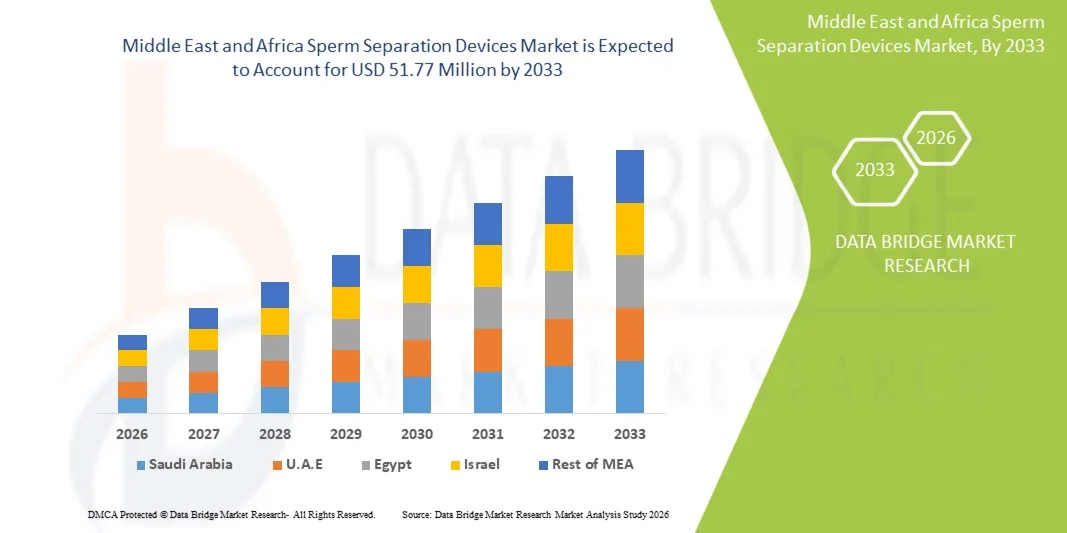
Report Scope and Middle East and Africa Sperm Separation Devices Market Segmentation
|
Attributes |
Middle East and Africa Sperm Separation Devices Key Market Insights |
|
Segments Covered |
|
|
Countries Covered |
Middle East and Africa · Saudi Arabia · U.A.E. · South Africa · Egypt · Israel · Rest of Middle East and Africa |
|
Key Market Players |
· Vitrolife Group (Sweden) · CooperSurgical Inc. (U.S.) · Hamilton Thorne Ltd. (U.S.) · Cook (U.S.) · FUJIFILM Irvine Scientific, Inc. (U.S.) · Thermo Fisher Scientific Inc. (U.S.) · Merck KGaA (Germany) · Esco Medical Technologies (Singapore) · Nidacon International AB (Sweden) · IVFtech ApS (Denmark) · Gynemed GmbH & Co. KG (Germany) · Kitazato Corporation (Japan) · Genea Biomedx Pty Ltd (Australia) · Cryo Bio System (France) · Rocket Medical plc (U.K.) · Medical Supply Company Ltd (U.K.) · Sage Media (U.S.) · MidAtlantic Diagnostics (U.S.) · Parallabs Ltd (U.K.) · OvaScience (U.S.) |
|
Market Opportunities |
· Growing adoption of microfluidics-based sperm selection technologies in IVF clinics · Increasing integration of AI-driven semen analysis and automated sperm processing systems · Rising investment in fertility preservation services |
|
Value Added Data Infosets |
In addition to the insights on market scenarios such as market value, growth rate, segmentation, geographical coverage, and major players, the market reports curated by the Data Bridge Market Research also include in-depth expert analysis, patient epidemiology, pipeline analysis, pricing analysis, and regulatory framework. |
Middle East and Africa Sperm Separation Devices Market Trends
Trend: Rising Adoption of Advanced Sperm Selection Technologies in IVF Procedures
Fertility clinics across the Middle East and Africa are increasingly adopting advanced sperm separation technologies such as density gradient centrifugation and microfluidic sorting to improve IVF outcomes and embryo quality. The integration of automated laboratory systems and precision-based sperm selection techniques is enhancing procedural efficiency, reducing manual errors, and improving clinical success rates in assisted reproductive treatments. Continuous advancements in reproductive biotechnology are also supporting the shift toward standardized and high-accuracy sperm processing workflows in fertility laboratories and hospitals. For instance, IVF centers in Saudi Arabia and United Arab Emirates are deploying microfluidic-based sperm sorting systems to improve fertilization success rates and reduce DNA fragmentation risks in clinical practice.
Middle East and Africa Sperm Separation Devices Market Dynamics
Key Market Driver: Rising Infertility Rates and Expanding IVF Treatment Adoption
The increasing prevalence of infertility cases across Middle East and Africa is significantly driving demand for sperm separation devices used in assisted reproductive technologies. Growing awareness of fertility treatments, coupled with expanding access to IVF services in private and public healthcare systems, is encouraging wider adoption of advanced sperm preparation techniques. Governments and healthcare providers are also investing in specialized fertility centers to address reproductive health challenges, further accelerating market growth. For instance, fertility clinics in Egypt and South Africa are increasingly utilizing density gradient centrifugation systems to enhance sperm quality selection in routine IVF procedures.
Key Restraint/Challenge: High Cost of Advanced Sperm Processing Technologies and Limited Access
A major restraint in the Middle East and Africa sperm separation devices market is the high cost of advanced technologies such as microfluidic sorting systems and automated closed sperm preparation platforms. Limited healthcare funding and uneven distribution of advanced fertility infrastructure across several countries restrict widespread adoption, particularly in low-income and rural regions. In addition, dependence on imported equipment and high maintenance expenses further increase the overall treatment cost, limiting accessibility for smaller clinics and diagnostic laboratories. For instance, fertility centers in Nigeria and Kenya often continue relying on conventional manual sperm preparation methods due to budget constraints and limited access to advanced laboratory infrastructure.
Key Market Opportunity: Expansion of Fertility Tourism and Technology-Driven Reproductive Care
The growing trend of fertility tourism and increasing investment in advanced reproductive healthcare infrastructure present significant opportunities for market expansion in the region. Countries with well-developed healthcare systems are attracting patients from neighboring nations, driving demand for high-performance sperm separation devices. In addition, the integration of digital laboratory systems and AI-supported reproductive technologies is expected to enhance treatment efficiency and diagnostic accuracy. For instance, United Arab Emirates and Israel are expanding fertility treatment capabilities with advanced IVF laboratories equipped with automated sperm sorting systems to support international fertility patients
Middle East and Africa Sperm Separation Devices Market Scope
The Middle East and Africa sperm separation devices market is segmented on the basis of devices, media, assisted devices, technology, application, end user, and distribution channel.
- By Devices
On the basis of devices, the Middle East and Africa sperm separation devices market is segmented into centrifugation devices and centrifugation-free devices. The Centrifugation Devices segment dominated the market with a 56.8% share in 2025, owing to widespread clinical adoption, cost-effectiveness, and strong reliability in standard IVF laboratory workflows across Egypt, Saudi Arabia, and South Africa. These systems are extensively used for density gradient and swim-up techniques in sperm preparation. Their established clinical protocols and compatibility with existing laboratory infrastructure further support their dominance. High reproducibility and ease of use make them the preferred choice in both public and private fertility centers. Continuous improvements in automation and closed-system centrifugation are further enhancing safety and efficiency. However, concerns related to oxidative stress during processing slightly limit advanced clinical preference.
The Centrifugation-Free Devices segment is projected to register the fastest growth at a CAGR of 7.9% from 2026 to 2033, driven by increasing demand for microfluidic-based sperm sorting and DNA-integrity-focused selection methods. These systems minimize mechanical stress on sperm cells, improving fertilization outcomes and embryo quality. Rising adoption in advanced IVF centers in United Arab Emirates and Israel is significantly supporting growth. Continuous innovation in lab-on-chip technologies is improving accuracy and scalability. Increasing focus on reducing laboratory contamination risks is also accelerating adoption. However, high equipment costs and limited availability in smaller clinics restrict widespread penetration.
- By Media
On the basis of media, the market is segmented into sperm washing media, sperm processing media, sperm freezing media, and other media. The Sperm Washing Media segment dominated the market with a 38.5% share in 2025, driven by its essential role in removing seminal plasma and improving sperm motility for IVF procedures. It is widely used across fertility clinics in Egypt, Saudi Arabia, and South Africa due to its cost-effectiveness and compatibility with standard laboratory protocols. Strong clinical reliability and ease of storage further strengthen its adoption. Continuous formulation improvements are enhancing sperm survival rates and fertilization efficiency. High procedural frequency in IVF cycles also supports sustained demand. However, limited differentiation across product offerings slightly restricts innovation-driven growth.
The Sperm Processing Media segment is expected to grow at the fastest rate with a CAGR of 7.4% from 2026 to 2033, driven by increasing use in advanced assisted reproductive techniques requiring enhanced sperm selection precision. These media types are optimized for improving sperm function, capacitation, and fertilization potential. Rising IVF success rate expectations are encouraging adoption in premium fertility centers across United Arab Emirates and Israel. Continuous R&D in bioactive and antioxidant-enriched formulations is further boosting performance. Growing preference for customized media solutions in ART procedures is also supporting expansion. However, higher costs compared to conventional washing media may limit adoption in cost-sensitive markets.
- By Assisted Devices
On the basis of assisted devices, the market is segmented into imaging systems, incubators, cabinets, and others. The Incubators segment dominated the market with a 44.2% share in 2025, owing to its critical role in maintaining controlled temperature, humidity, and gas conditions for sperm viability during IVF procedures. These systems are widely deployed in fertility clinics and IVF laboratories across Egypt, Saudi Arabia, and South Africa. High precision environmental control improves sperm survival and fertilization outcomes. Continuous integration with digital monitoring systems enhances operational efficiency. Their essential role in all ART workflows ensures consistent demand. However, high maintenance requirements and calibration needs can increase operational costs.
The Imaging Systems segment is projected to register the fastest growth at a CAGR of 8.2% from 2026 to 2033, driven by increasing demand for high-resolution sperm analysis and real-time morphological assessment. Advanced imaging supports better sperm selection accuracy, improving IVF success rates. Growing adoption of AI-powered imaging tools in United Arab Emirates and Israel is accelerating market expansion. Integration with digital laboratory systems enhances workflow automation and data accuracy. Increasing use in forensic and diagnostic applications is also supporting demand. However, high capital investment requirements may limit adoption in smaller laboratories.
- By Technology
On the basis of technology, the market is segmented into electrophoresis, dielectrophoresis, and on-chip technologies. The Electrophoresis segment dominated the market with a 49.6% share in 2025, driven by its widespread use in conventional sperm separation and DNA integrity assessment processes. It is highly established across IVF laboratories in Egypt, Saudi Arabia, and South Africa due to its proven reliability and affordability. Strong compatibility with existing laboratory systems supports its continued dominance. It is widely used in both clinical and research applications. Continuous improvements in separation efficiency are enhancing procedural outcomes. However, limitations in selectivity compared to microfluidic systems restrict advanced adoption.
The On-Chip Technology segment is expected to grow at the fastest rate with a CAGR of 8.5% from 2026 to 2033, driven by increasing adoption of microfluidic lab-on-chip platforms for high-precision sperm selection. These systems reduce manual handling and improve sperm quality selection accuracy. Rapid adoption in technologically advanced fertility centers in United Arab Emirates and Israel is significantly driving growth. Integration with AI-enabled analysis systems further enhances efficiency. Growing demand for minimally invasive and highly controlled processing methods supports expansion. However, high development costs and limited clinical standardization remain key challenges.
- By Application
On the basis of application, the market is segmented into fertility, diagnostics, forensics, and others. The Fertility segment dominated the market with a 63.7% share in 2025, driven by the high volume of IVF procedures and increasing infertility rates across Egypt, Saudi Arabia, and South Africa. Sperm separation devices are extensively used to improve fertilization outcomes and embryo quality. Rising awareness of assisted reproductive technologies is further strengthening demand. Continuous expansion of fertility clinics is supporting segment growth. Strong government and private sector investments in reproductive healthcare also contribute to dominance. However, affordability constraints in low-income countries limit broader accessibility.
The Forensics segment is expected to grow at the fastest rate with a CAGR of 7.6% from 2026 to 2033, driven by increasing use of sperm separation technologies in criminal investigations and DNA analysis. Law enforcement agencies in countries such as United Arab Emirates and South Africa are adopting advanced forensic laboratory tools. High demand for accurate biological sample separation is supporting adoption. Technological advancements in microfluidic and automated systems are improving forensic accuracy. Growing investment in modern forensic infrastructure is further accelerating growth. However, limited awareness and budget constraints in several countries restrict widespread implementation.
- By End User
On the basis of end user, the market is segmented into hospitals, clinics, cryobanks, surgical centers, research institutes, fertility centers, IVF laboratories, and others. The IVF Laboratories segment dominated the market with a 34.9% share in 2025, driven by high procedural volumes and specialized infrastructure for assisted reproductive technologies across Egypt, Saudi Arabia, and South Africa. These laboratories are central to sperm preparation, selection, and fertilization processes. Strong integration of advanced devices and media supports operational efficiency. Continuous technological upgrades enhance success rates. High dependency on IVF cycles ensures stable demand. However, high setup and operational costs remain a challenge for smaller facilities.
The Cryobanks segment is expected to register the fastest growth at a CAGR of 8.0% from 2026 to 2033, driven by increasing demand for sperm preservation and fertility preservation services. Rising awareness of delayed parenthood and oncology-related fertility preservation is supporting adoption. Countries such as United Arab Emirates and Israel are investing heavily in biobanking infrastructure. Advanced freezing media and automated storage systems are improving sample viability. Growing medical tourism for fertility preservation is also contributing to expansion. However, regulatory variability across countries may slow standardization.
- By Distribution Channel
On the basis of distribution channel, the market is segmented into direct tender, third party distributors, and others. The Third-Party Distributors segment dominated the market with a 58.1% share in 2025, owing to strong regional supply chain networks, established importer relationships, and wider product accessibility across Egypt, Nigeria, and South Africa. These distributors play a key role in supplying advanced sperm separation devices to mid-sized clinics and laboratories. Their strong logistical presence supports timely delivery and after-sales service. Cost advantages and bundled offerings further strengthen adoption. However, dependency on intermediaries can reduce pricing transparency.
The Direct Tender segment is projected to grow at the fastest rate with a CAGR of 7.2% from 2026 to 2033, driven by increasing government procurement for public hospitals and fertility programs. Countries such as Saudi Arabia and United Arab Emirates are expanding centralized healthcare procurement systems. Direct sourcing ensures better pricing control and quality assurance. Growing public investment in reproductive healthcare infrastructure is supporting adoption. Large-scale hospital projects are also contributing to demand. However, lengthy procurement cycles may slow short-term deployment.
Middle East and Africa Sperm Separation Devices Market Regional Analysis
Egypt dominated the Middle East and Africa sperm separation devices market with the largest revenue share of 27.6% in 2025, supported by a high concentration of fertility clinics, growing IVF adoption, and relatively advanced reproductive healthcare infrastructure compared to neighboring countries. The country also benefits from growing awareness of assisted reproductive technologies, increasing availability of specialized fertility centers, and rising adoption of density gradient centrifugation and emerging sperm sorting technologies. Expanding investments in reproductive healthcare services and gradual integration of advanced laboratory systems continue to strengthen Egypt’s leadership position in the regional market.
The Egypt Sperm Separation Devices Market Insight
The Egypt sperm separation devices market is witnessing strong growth supported by a well-established fertility treatment ecosystem, high IVF procedure volumes, and increasing public awareness of reproductive health solutions. The country benefits from a relatively dense network of fertility clinics and diagnostic laboratories compared to other countries in the region, which supports consistent adoption of sperm separation technologies. Rising demand for cost-effective infertility treatments is reinforcing the use of conventional centrifugation-based systems, while gradual adoption of automated sperm processing platforms is improving laboratory efficiency. Furthermore, continuous improvements in clinical infrastructure and growing availability of advanced reproductive media are strengthening Egypt’s position as a key fertility hub in the region.
Saudi Arabia Sperm Separation Devices Market Insight
The Saudi Arabia sperm separation devices market is experiencing robust expansion driven by rising infertility rates, strong government support for healthcare development, and rapid growth in specialized fertility centers. Increasing investment in reproductive medicine infrastructure under national healthcare transformation programs is significantly enhancing access to advanced ART procedures. Fertility clinics are increasingly adopting high-performance sperm selection technologies to improve clinical outcomes and reduce treatment cycles. In addition, growing integration of automated laboratory systems and microfluidic-based sperm sorting technologies is enhancing precision, reducing manual variability, and improving embryo quality, thereby accelerating market growth across the country.
United Arab Emirates Sperm Separation Devices Market Insight
The United Arab Emirates sperm separation devices market is expanding rapidly due to its advanced healthcare infrastructure, strong medical tourism sector, and high adoption of cutting-edge reproductive technologies. The country has emerged as a regional hub for premium fertility treatments, attracting patients from neighboring countries seeking high success-rate IVF procedures. Increasing deployment of microfluidic sperm sorting systems and AI-integrated laboratory platforms is improving accuracy in sperm selection and overall treatment outcomes. Furthermore, continuous investment in state-of-the-art fertility clinics and integration of digital reproductive health solutions are strengthening the UAE’s leadership in advanced ART services within the region.
South Africa Sperm Separation Devices Market Insight
The South Africa sperm separation devices market is growing steadily due to increasing infertility awareness, improving healthcare accessibility, and expanding availability of IVF and reproductive health services. The country has a relatively more developed private fertility sector, which is driving adoption of advanced sperm preparation technologies. Gradual improvements in diagnostic laboratories and increasing use of automated centrifugation systems are enhancing procedural efficiency and reliability. In addition, rising collaborations between healthcare institutions and international fertility technology providers are supporting knowledge transfer and accelerating adoption of modern reproductive techniques
Middle East and Africa Sperm Separation Devices Market Share
The Middle East and Africa sperm separation devices industry is primarily led by well-established companies, including:
- Vitrolife Group (Sweden)
- CooperSurgical Inc. (U.S.)
- Hamilton Thorne Ltd. (U.S.)
- Cook (U.S.)
- FUJIFILM Irvine Scientific, Inc. (U.S.)
- Thermo Fisher Scientific Inc. (U.S.)
- Merck KGaA (Germany)
- Esco Medical Technologies (Singapore)
- Nidacon International AB (Sweden)
- IVFtech ApS (Denmark)
- Gynemed GmbH & Co. KG (Germany)
- Kitazato Corporation (Japan)
- Genea Biomedx Pty Ltd (Australia)
- Cryo Bio System (France)
- Rocket Medical plc (U.K.)
- Medical Supply Company Ltd (U.K.)
- Sage Media (U.S.)
- MidAtlantic Diagnostics (U.S.)
- Parallabs Ltd (U.K.)
- OvaScience (U.S.)
Latest Developments in Middle East and Africa Sperm Separation Devices Market
- In October 2024, Hamilton Thorne announced AI-driven enhancements to its ART laboratory systems, integrating digital imaging and automation tools for improved reproductive decision-making. These upgrades enhance sperm and embryo evaluation workflows in IVF laboratories by improving precision, traceability, and laboratory efficiency. Such AI-enabled systems are increasingly relevant in advanced fertility centers across the Middle East and Africa, where demand for high-accuracy sperm selection and embryo grading is rising
- In August 2023, Memphasys announced a strategic distribution agreement with Vitrolife Japan for its Felix™ sperm separation system, expanding global commercialization of microfluidic sperm selection technology. The Felix system represents a next-generation sperm separation platform designed to improve selection efficiency for IVF and ICSI procedures. The expansion of distribution networks supports broader clinical access to advanced sperm separation technologies, including in fertility clinics serving Middle East and African patients
- In April 2023, the global sperm separation devices market saw continued expansion of microfluidic sperm selection technologies, with increasing adoption across fertility centers for improving ART success rates. Advanced sperm separation systems such as microfluidic chips and density gradient alternatives gained traction due to their ability to reduce oxidative stress and DNA damage in sperm cells. These technologies are increasingly used in IVF laboratories across Middle East and Africa as clinics move toward high-precision reproductive workflows. The trend reflects growing demand for improved fertility treatment outcomes and standardized laboratory procedures
- In April 2022, Fertilis and University of Adelaide researchers developed a novel microfluidic device aimed at simplifying sperm selection for IVF and improving outcomes in male infertility cases. The innovation focuses on enhancing intracytoplasmic sperm injection (ICSI) procedures by improving sperm quality selection in laboratory settings. Such microdevice technologies are influencing next-generation sperm separation approaches used in assisted reproduction globally, including adoption interest in Middle East fertility clinics. The development supports more efficient and less invasive sperm handling techniques
- In June 2021, CooperSurgical expanded global clinical adoption of its ZyMōt™ microfluidic sperm separation device, strengthening its use in IVF laboratories for selecting high-quality motile sperm with reduced DNA fragmentation. The device is widely used in fertility clinics across the Middle East and Africa due to its ability to improve embryo quality and IVF outcomes through microfluidic sperm selection instead of conventional centrifugation methods. The technology supports standardized sperm preparation workflows in ART laboratories and is increasingly integrated into advanced IVF protocols

- Interactive Data Analysis Dashboard
- Company Analysis Dashboard for high growth potential opportunities
- Research Analyst Access for customization & queries
- Competitor Analysis with Interactive dashboard
- Latest News, Updates & Trend analysis
- Harness the Power of Benchmark Analysis for Comprehensive Competitor Tracking
Data collection and base year analysis are done using data collection modules with large sample sizes. The stage includes obtaining market information or related data through various sources and strategies. It includes examining and planning all the data acquired from the past in advance. It likewise envelops the examination of information inconsistencies seen across different information sources. The market data is analysed and estimated using market statistical and coherent models. Also, market share analysis and key trend analysis are the major success factors in the market report. To know more, please request an analyst call or drop down your inquiry.
The key research methodology used by DBMR research team is data triangulation which involves data mining, analysis of the impact of data variables on the market and primary (industry expert) validation. Data models include Vendor Positioning Grid, Market Time Line Analysis, Market Overview and Guide, Company Positioning Grid, Patent Analysis, Pricing Analysis, Company Market Share Analysis, Standards of Measurement, Global versus Regional and Vendor Share Analysis. To know more about the research methodology, drop in an inquiry to speak to our industry experts.
Data Bridge Market Research is a leader in advanced formative research. We take pride in servicing our existing and new customers with data and analysis that match and suits their goal. The report can be customized to include price trend analysis of target brands understanding the market for additional countries (ask for the list of countries), clinical trial results data, literature review, refurbished market and product base analysis. Market analysis of target competitors can be analyzed from technology-based analysis to market portfolio strategies. We can add as many competitors that you require data about in the format and data style you are looking for. Our team of analysts can also provide you data in crude raw excel files pivot tables (Fact book) or can assist you in creating presentations from the data sets available in the report.













