


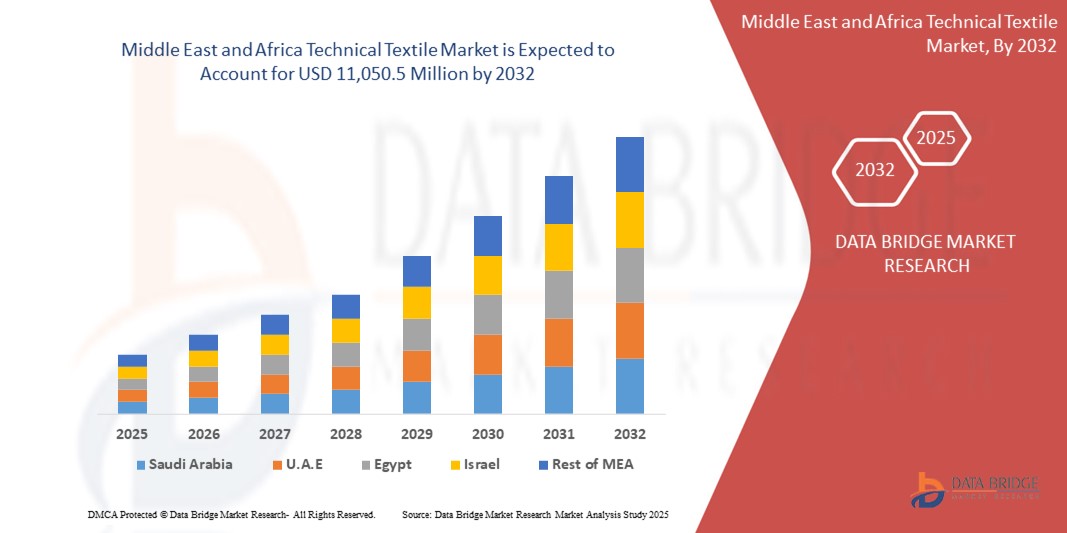
Technical Textile Market Size
- The Middle East and Africa Technical Textile Market size was valued at USD 8,623.8 Million in 2024 and is expected to reach USD 11,050.5 Million by 2032, at a CAGR of4.1% during the forecast period
- This growth is driven by factors such as high demand of fuel-efficient and lightweight transportation vehicles across the globe
Technical Textile Market Analysis
- Technical Textiles are materials and products primarily manufactured for their technical performance and functional properties rather than aesthetic or decorative characteristics. These textiles are used across various industries including automotive, healthcare, construction, agriculture, and defense. They are engineered with specific functionalities such as high strength, durability, resistance to heat and chemicals, and improved safety and efficiency
- The demand for Technical Textiles in the Middle East and Africa region is significantly driven by rapid industrialization, growing infrastructure projects, rising healthcare expenditure, and increased demand from sectors such as automotive and agriculture. Additionally, government initiatives promoting the use of high-performance materials and rising awareness about product efficiency and safety are further propelling market growth
- U.A.E. is expected to dominate the Middle East and Africa Technical Textile market due to its strong investments in infrastructure, healthcare, and defense sectors, along with increasing demand for high-performance textiles in construction (BuildTech), medical (MediTech), and protective clothing (ProTech) applications
- Saudi Arabia is expected to be the fastest growing market in the Middle East and Africa Technical Textile segment during the forecast period. This growth is driven by large-scale investments under the Saudi Vision 2030 initiative, aimed at diversifying the economy beyond oil and strengthening local manufacturing capabilities
- The nonwoven segment is expected to dominate the Middle East and Africa Technical Textile market with a market share of 37.85% in 2025, due to its extensive application in hygiene products, medical textiles, filtration, and automotive components. The segment's growth is fueled by rising demand for disposable medical products, increasing hygiene awareness, and technological advancements in nonwoven production processes
Report Scope and Technical Textile Market Segmentation
|
Attributes |
Technical Textile Key Market Insights |
|
Segments Covered |
|
|
Countries Covered |
Middle East and Africa
|
|
Key Market Players |
|
|
Market Opportunities |
|
|
Value Added Data Infosets |
In addition to the insights on market scenarios such as market value, growth rate, segmentation, geographical coverage, and major players, the market reports curated by the Data Bridge Market Research also include import export analysis, production capacity overview, production consumption analysis, price trend analysis, climate change scenario, supply chain analysis, value chain analysis, raw material/consumables overview, vendor selection criteria, PESTLE Analysis, Porter Analysis, and regulatory framework. |
Technical Textile Market Trends
“Technological Advancements and Diversification Across End-Use Industries”
- One of the prominent trends in the Middle East and Africa Technical Textile Market is the increasing adoption of advanced materials and manufacturing technologies, enabling the production of high-performance textiles tailored to specific industry needs
- Manufacturers are focusing on innovations such as smart textiles, nanotechnology-enhanced fabrics, and sustainable fiber alternatives to meet growing demand from sectors including healthcare, automotive, construction, and defense
- For instance, smart medical textiles with embedded sensors are being developed for patient monitoring in hospitals and home care settings across countries like Japan and South Korea
- Additionally, the diversification of applications—from geotextiles in infrastructure projects to agro-textiles for crop yield optimization—is fueling demand across both developed and emerging economies in the region.
Technical Textile Market Dynamics
Driver
“Expansion of Automotive and Healthcare Industries”
- The growth of the Middle East and Africa Technical Textile market is strongly driven by the expansion of key end-use industries, particularly automotive and healthcare
- • Technical textiles are widely used in automotive interiors, airbags, seatbelts, noise insulation, and lightweight composites, aligning with the EU’s sustainability goals for fuel efficiency and emissions reduction
- • The healthcare sector increasingly relies on medical textiles such as wound care fabrics, surgical gowns, face masks, and antimicrobial textiles, especially in the post-COVID environment
For instance,
- UAE, being largest manufacturer, has significantly increased its consumption of nonwoven and composite technical textiles for vehicle design and passenger safety
- These industry demands are encouraging manufacturers to invest in high-performance, value-added textile technologies across the region.
Opportunity
“Growing Adoption of Smart and Functional Textiles”
- UAE presents significant opportunities in the development and commercialization of smart textiles integrated with sensors, conductive fibers, and phase-change materials
- • The demand is growing in sectors such as defense, sportswear, healthcare, and industrial safety, where wearable technology and real-time data monitoring are becoming critical
- • Saudi Arabia funding initiatives and innovation hubs are supporting R&D for smart textile solutions addressing health monitoring, temperature regulation, and environmental sensing
For instance,
- This evolution is creating new revenue streams for tech-savvy manufacturers and startups entering the high-margin technical textile space.
Restraint/Challenge
“Stringent Environmental Regulations and Raw Material Volatility”
- One of the main challenges facing the Europe Technical Textile market is the complex regulatory landscape governing emissions, material safety, and waste management
- • Strict Qatar regulations on chemicals , along with sustainability targets, require manufacturers to reformulate products, adopt circular economy models, and ensure traceability across the supply chain
- • Additionally, volatility in raw material prices—particularly synthetic polymers and specialty fibers—can impact cost-efficiency and profit margins
For instance,
- The price fluctuations of polyester and aramid fibers due to global supply chain disruptions have increased production costs for protective and industrial textiles in 2023–2024
- These factors increase the compliance burden and operational complexity, especially for SMEs aiming to scale sustainably.
Technical Textile Market Scope
The market is segmented on the basis of material, technology, process and application.
|
Segmentation |
Sub-Segmentation |
|
By Material |
|
|
By Technology |
|
|
By Process |
|
|
By Application |
|
In 2025, the nonwoven segment is projected to dominate the market with the largest share in the process segment.
The nonwoven segment is expected to dominate the Middle East and Africa Technical Textile market with the largest share of 36.9% in 2025, driven by its widespread applications across hygiene, medical, filtration, automotive, and construction sectors. The segment benefits from increasing demand for disposable medical products, growth in population hygiene awareness, and government investments in healthcare infrastructure. Moreover, innovations in spunbond and meltblown technologies are enabling cost-effective and high-performance solutions tailored to regional needs.
The natural fiber is expected to account for the largest share during the forecast period in material market
In 2025, the natural fiber segment is expected to dominate the market with the largest market share of 51.31% due to its eco-friendly characteristics, biodegradability, and increasing consumer and industrial preference for sustainable alternatives to synthetic materials. The rising environmental concerns and government regulations promoting green materials have accelerated the adoption of natural fibers in technical textile applications such as geotextiles, automotive interiors, and building insulation.
Technical Textile Market Regional Analysis
“U.A.E. Holds the Largest Share in the Technical Textile Market”
- U.A.E. is expected to lead the Middle East and Africa Technical Textile Market with a significant share of 31.82% in 2025, driven by its advanced manufacturing capabilities, strategic geographic position, and high investment in smart infrastructure projects
- The country's robust construction, automotive, and aerospace sectors are key consumers of technical textiles, particularly in segments like BuildTech, MobilTech, and ProTech.
- Government-backed initiatives such as Make it in the Emirates and national strategies for innovation and sustainability are supporting the growth of technical textile clusters and attracting foreign direct investment
- In addition, U.A.E.’s alignment with global quality and environmental standards makes it a preferred export hub for high-performance textiles across the MENA region and beyond
“Saudi Arabia is Projected to Register the Highest CAGR in the Technical Textile Market”
- Saudi Arabia is projected to experience the highest CAGR in the Middle East and Africa Technical Textile Market during the forecast period, bolstered by Vision 2030 goals focused on economic diversification and industrial development
- The country is rapidly expanding its construction and infrastructure activities, generating strong demand for GeoTech and BuildTech materials such as geotextiles, insulation fabrics, and composites
- Investments in smart cities, such as NEOM, and the growth of the automotive and protective clothing segments are propelling technical textile consumption
- Additionally, Saudi Arabia’s growing textile manufacturing capacity, backed by public-private partnerships, and investment in education and skills development are positioning it as a future production and innovation hub in the region
Technical Textile Market Share
The market competitive landscape provides details by competitor. Details included are company overview, company financials, revenue generated, market potential, investment in research and development, new market initiatives, global presence, production sites and facilities, production capacities, company strengths and weaknesses, product launch, product width and breadth, application dominance. The above data points provided are only related to the companies' focus related to market.
The Major Market Leaders Operating in the Market Are:
- Archer Daniels Midland Company (U.S.)
- Ingredion Incorporated (U.S.)
- The Scoular Company (U.S.)
- Toray Industries Inc. (Japan)
- Teijin Limited (Japan)
- Asahi Kasei Corporation (Japan)
- Low & Bonar PLC (Singapore)
- SRF Limited (India)
- Freudenberg Group (U.A.E.)
- Koninklijke Ten Cate bv (Netherlands)
- Lenzing (Austria)
- Plastics Low & Bonar (United Kingdom)
- Mitsui Chemicals (Japan)
- Alexium International (United States)
Latest Developments in Middle East and Africa Technical Textile Market
- In October 2024, Lenzing AG introduced a new generation of LENZING™ Lyocell fibers specifically engineered for technical textile applications in Middle East and Africa. These fibers offer enhanced durability, thermal regulation, and moisture management, making them suitable for protective wear, filtration, and automotive textiles. The launch aligns with the company’s focus on sustainability and performance-driven solutions in the Middle East and Africaan technical textiles industry.
- In November 2024, Mitsui Chemicals (Japan) expanded its Middle East and Africaan production facility in the Netherlands to increase output of high-performance polypropylene-based nonwovens used in hygiene and industrial applications. The expansion aims to meet rising demand for lightweight, durable, and environmentally friendly materials across the EU region.
- In August 2024, Low & Bonar (U.K.) launched a new range of advanced geotextiles under its Colback® brand, designed for civil engineering and infrastructure projects across Middle East and Africa. The new products are engineered to offer higher strength, filtration, and durability while meeting EU sustainability standards.
- In July 2024, TenCate Protective Fabrics (Netherlands) collaborated with Middle East and Africaan defense organizations to supply flame-resistant textiles for next-generation military uniforms. The initiative focuses on enhancing safety, mobility, and climate adaptability for armed forces operating in varied environments.
- In June 2024, Alexium International (Australia) introduced its Alexicool® Plus product line in the Middle East and Africaan market. This phase change material (PCM) coating is tailored for technical textiles used in bedding, workwear, and medical applications, supporting thermal comfort and energy efficiency in end-use products.

- Interactive Data Analysis Dashboard
- Company Analysis Dashboard for high growth potential opportunities
- Research Analyst Access for customization & queries
- Competitor Analysis with Interactive dashboard
- Latest News, Updates & Trend analysis
- Harness the Power of Benchmark Analysis for Comprehensive Competitor Tracking
Middle East And Africa Technical Textile Market, Supply Chain Analysis and Ecosystem Framework
To support market growth and help clients navigate the impact of geopolitical shifts, DBMR has integrated in-depth supply chain analysis into its Middle East And Africa Technical Textile Market research reports. This addition empowers clients to respond effectively to global changes affecting their industries. The supply chain analysis section includes detailed insights such as Middle East And Africa Technical Textile Market consumption and production by country, price trend analysis, the impact of tariffs and geopolitical developments, and import and export trends by country and HSN code. It also highlights major suppliers with data on production capacity and company profiles, as well as key importers and exporters. In addition to research, DBMR offers specialized supply chain consulting services backed by over a decade of experience, providing solutions like supplier discovery, supplier risk assessment, price trend analysis, impact evaluation of inflation and trade route changes, and comprehensive market trend analysis.
Data collection and base year analysis are done using data collection modules with large sample sizes. The stage includes obtaining market information or related data through various sources and strategies. It includes examining and planning all the data acquired from the past in advance. It likewise envelops the examination of information inconsistencies seen across different information sources. The market data is analysed and estimated using market statistical and coherent models. Also, market share analysis and key trend analysis are the major success factors in the market report. To know more, please request an analyst call or drop down your inquiry.
The key research methodology used by DBMR research team is data triangulation which involves data mining, analysis of the impact of data variables on the market and primary (industry expert) validation. Data models include Vendor Positioning Grid, Market Time Line Analysis, Market Overview and Guide, Company Positioning Grid, Patent Analysis, Pricing Analysis, Company Market Share Analysis, Standards of Measurement, Global versus Regional and Vendor Share Analysis. To know more about the research methodology, drop in an inquiry to speak to our industry experts.
Data Bridge Market Research is a leader in advanced formative research. We take pride in servicing our existing and new customers with data and analysis that match and suits their goal. The report can be customized to include price trend analysis of target brands understanding the market for additional countries (ask for the list of countries), clinical trial results data, literature review, refurbished market and product base analysis. Market analysis of target competitors can be analyzed from technology-based analysis to market portfolio strategies. We can add as many competitors that you require data about in the format and data style you are looking for. Our team of analysts can also provide you data in crude raw excel files pivot tables (Fact book) or can assist you in creating presentations from the data sets available in the report.













