


Middle East and Africa Underactive Bladder Market Overview
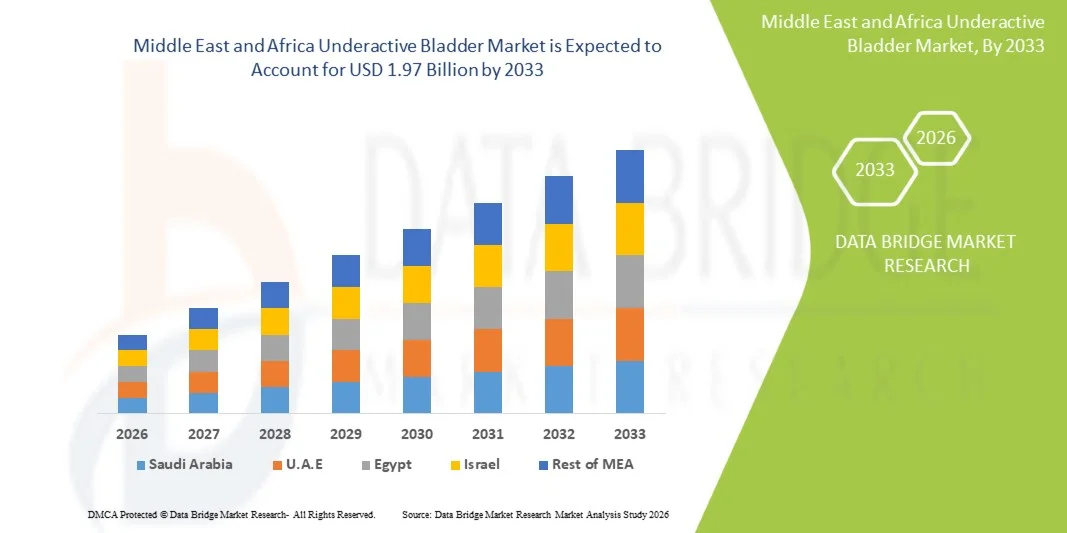
The Middle East and Africa underactive bladder market was valued at USD 1.50 billion in 2025 and is projected to reach USD 1.97 billion by 2033, growing at a CAGR of 3.5% from 2026 to 2033. The market is witnessing steady growth driven by the increasing prevalence of neurogenic and non-neurogenic bladder disorders, rising geriatric population, and growing awareness regarding early diagnosis and treatment of urinary dysfunction conditions across the region.
The growing burden of chronic diseases such as diabetes, Parkinson’s disease, spinal cord injuries, and multiple sclerosis is contributing significantly to the incidence of underactive bladder in Middle Eastern and African countries. In addition, improving healthcare infrastructure, rising healthcare expenditure, and expanding access to urology care are encouraging the adoption of advanced pharmacological therapies, neuromodulation devices, and minimally invasive treatment procedures. Increasing investments in specialty hospitals and rehabilitation centers, along with greater focus on pelvic health and urinary disorder management, are further supporting market expansion across the region.
Key Market Trends & Insights
- Saudi Arabia dominated the Middle East and Africa underactive bladder market with the largest revenue share of 34.28% in 2025, supported by strong healthcare infrastructure development, rising urology care investments, and increasing adoption of advanced urinary disorder treatment solutions.
- The Pharmacotherapy segment led the market with a 46.13% share in 2025, driven by its widespread clinical adoption as the first-line treatment for urinary retention and bladder underactivity.
- South Africa is expected to be the fastest-growing country market at a CAGR of 4.8% from 2026 to 2033, fueled by improving healthcare accessibility, increasing awareness regarding urological disorders, and growing investments in diagnostic and rehabilitation services.
- Stem Cell and Gene Therapies are the fastest-growing type, projected to register a CAGR of 5.4%, reflecting the surge in interest in regenerative medicine approaches for bladder muscle and nerve restoration.
- The Oral segment dominated the route of administration category with a 57.89% revenue share in 2025, led by strong patient preference, ease of administration, and high prescription rates for chronic management of underactive bladder conditions.
- Neurogenic Underactive Bladder accounted for 52.44% of the market, preferred by the high prevalence of neurological disorders such as diabetes-related neuropathy, spinal cord injuries, Parkinson’s disease, and multiple sclerosis.
- The Parenteral segment is the fastest-growing route of administration category, with a CAGR of 5.1%, driven by the increasing use of injectable therapies in severe and hospital-based cases.
Market Size & Forecast
- Global Market Value (2025): USD 1.50 Billion
- Expected Market Value (2033): USD 1.97 Billion
- Forecast CAGR (2026–2033): 3.5%
- Leading Region in 2025: Saudi Arabia
- Fastest Growing Region: South Africa
Report Scope and Middle East and Africa Underactive Bladder Market Segmentation
|
Attributes |
Middle East and Africa Underactive Bladder Key Market Insights |
|
Segments Covered |
|
|
Countries Covered |
Middle East and Africa · Saudi Arabia · U.A.E. · South Africa · Egypt · Israel · Rest of Middle East and Africa |
|
Key Market Players |
· Astellas Pharma Inc. (Japan) · Boston Scientific Corporation (U.S.) · Coloplast Corp (Denmark) · Convatec Group PLC (U.K.) · Cook (U.S.) · Hollister Incorporated (U.S.) · B. Braun SE (Germany) · Medtronic (Ireland) · Teleflex Incorporated (U.S.) · Wellspect HealthCare (Sweden) · Laborie Medical Technologies Corp. (Canada) · Pfizer Inc. (U.S.) · AbbVie Inc. (U.S.) · UroMems (France) · Axonics, Inc. (U.S.) · C. R. Bard, Inc. (U.S.) · Olympus Corporation (Japan) · Fresenius Medical Care AG (Germany) · Cogentix Medical, Inc. (U.S.) · BD (U.S.) |
|
Market Opportunities |
· Growing adoption of sacral neuromodulation and implantable bladder stimulation devices · Increasing clinical research on regenerative medicine and stem cell-based bladder therapies · Expansion of home-based catheterization products and remote urology monitoring solutions |
|
Value Added Data Infosets |
In addition to the insights on market scenarios such as market value, growth rate, segmentation, geographical coverage, and major players, the market reports curated by the Data Bridge Market Research also include in-depth expert analysis, patient epidemiology, pipeline analysis, pricing analysis, and regulatory framework. |
Middle East and Africa Underactive Bladder Market Trends
Trend: Growing Adoption of Advanced Urology Treatment & Awareness Programs
Healthcare providers across Middle Eastern and African countries are increasingly adopting advanced diagnostic and treatment approaches for underactive bladder, supported by rising awareness campaigns and improved access to urology care services. The integration of digital urodynamic testing, minimally invasive procedures, and neuromodulation therapies is improving diagnosis accuracy and patient outcomes. Hospitals and specialty clinics are also focusing on structured bladder rehabilitation programs to address aging-related urinary dysfunction and neurogenic bladder cases, while telemedicine platforms are expanding follow-up care access in remote areas. For instance, Saudi Arabia’s major tertiary hospitals are increasingly implementing neurology-linked urology pathways to improve early diagnosis and long-term bladder management outcomes.
Middle East and Africa Underactive Bladder Market Dynamics
Key Market Driver: Rising Burden of Chronic Neurological and Metabolic Disorders
The increasing prevalence of diabetes, multiple sclerosis, Parkinson’s disease, and spinal cord injuries across Middle East and African countries is significantly driving demand for underactive bladder diagnosis and treatment solutions. These conditions are strongly associated with neurogenic bladder dysfunction, leading to higher patient volumes in urology departments and rehabilitation centers. Expanding healthcare infrastructure and growing investments in specialty care facilities are further supporting early detection and long-term disease management. For instance, South Africa’s public and private healthcare systems are witnessing a rising number of diabetes-related neuropathy cases requiring bladder dysfunction management therapies.
Key Restraint/Challenge: Limited Access to Specialized Urology Care and High Treatment Costs
A major restraint in the Middle East and Africa underactive bladder market is the limited availability of specialized urology services and advanced diagnostic equipment in several low-income and rural regions. High costs associated with neuromodulation devices, long-term pharmacotherapy, and minimally invasive procedures further restrict patient access to optimal treatment options. In addition, shortage of trained urologists and uneven healthcare infrastructure development creates disparities in diagnosis and treatment adoption across countries. For instance, several rural healthcare centers in Nigeria still rely on basic symptomatic treatment due to lack of access to advanced urodynamic testing and specialist consultation services.
Key Market Opportunity: Expansion of Advanced Therapies and Digital Urology Care Solutions
The Middle East and Africa underactive bladder market presents significant growth opportunities through the expansion of advanced treatment modalities such as neuromodulation, regenerative medicine, and minimally invasive surgical procedures. Increasing investment in hospital infrastructure and specialty urology centers is creating a favorable environment for the adoption of innovative bladder dysfunction management solutions. Additionally, the integration of digital health platforms, remote patient monitoring, and AI-assisted diagnostic tools is improving early detection and long-term disease management outcomes across both urban and semi-urban populations. For instance, in the United Arab Emirates, leading healthcare networks are increasingly deploying smart urology clinics that combine digital diagnostics with personalized bladder rehabilitation programs to enhance treatment efficiency and patient compliance.
Middle East and Africa Underactive Bladder Market Scope
The Middle East and Africa underactive bladder market is segmented on the basis of type, route of administration, disease type, and distribution channel.
- By Type
On the basis of type, the Middle East and Africa underactive bladder market is segmented into pharmacotherapy, surgical methods, urethral assist devices, and stem cell and gene therapies. The Pharmacotherapy segment dominated the market with a 46.13% share in 2025, owing to its widespread clinical adoption as the first-line treatment for urinary retention and bladder underactivity. These therapies are widely preferred due to easy availability, established clinical efficacy, and relatively lower treatment cost compared to advanced interventions. Hospitals and clinics frequently prescribe cholinergic agents, alpha-blockers, and combination drug regimens for both neurogenic and non-neurogenic cases. Increasing diagnosis rates of urinary dysfunction are further supporting drug utilization across the region. The segment also benefits from expanding pharmaceutical distribution networks and improving healthcare access in emerging economies.
The Stem Cell and Gene Therapies segment is projected to register the fastest growth at a CAGR of 5.4% from 2026 to 2033, driven by rising interest in regenerative medicine approaches for bladder muscle and nerve restoration. These therapies aim to address the root cause of bladder dysfunction rather than just symptom management. Increasing clinical trials and research collaborations in advanced urology care are supporting segment expansion. Growing investments in biotechnology infrastructure across select Middle Eastern countries are further accelerating adoption. The segment is also gaining traction due to unmet clinical needs in severe neurogenic cases. However, high cost and limited availability currently restrict widespread use.
- By Route of Administration
On the basis of route of administration, the market is segmented into oral, parenteral, and others. The Oral segment dominated the market with a 57.89% share in 2025, driven by strong patient preference, ease of administration, and high prescription rates for chronic management of underactive bladder conditions. Oral medications such as cholinergic stimulants and alpha-adrenergic blockers are widely used as first-line therapy in both hospital and outpatient settings. These drugs offer convenience, better compliance, and lower procedural risk compared to injectable treatments. Expanding pharmacy networks and improved drug availability are further strengthening segment dominance. Continuous introduction of improved oral formulations is also enhancing treatment adherence. The segment benefits from long-term management requirements of chronic urinary dysfunction cases.
The Parenteral segment is expected to witness the fastest growth at a CAGR of 5.1% from 2026 to 2033, driven by increasing use of injectable therapies in severe and hospital-based cases. These treatments are often used when oral medications fail to deliver adequate bladder function improvement. Rising hospitalization rates for neurogenic bladder conditions are supporting demand for injectable drug administration. Advances in drug delivery systems and controlled-release injectable formulations are further improving clinical outcomes. Increasing adoption in specialized urology centers is also contributing to growth. However, higher procedural complexity and cost remain limiting factors.
- By Disease Type
On the basis of disease type, the market is segmented into neurogenic underactive bladder and non-neurogenic underactive bladder. The Neurogenic Underactive Bladder segment dominated the market with a 52.44% share in 2025, owing to the high prevalence of neurological disorders such as diabetes-related neuropathy, spinal cord injuries, Parkinson’s disease, and multiple sclerosis. These conditions significantly impair bladder nerve signaling, leading to higher clinical diagnosis rates. Hospitals across the region are increasingly focusing on neurological-urological integrated care pathways. Growing aging population is also contributing to higher incidence rates. Strong demand for long-term management therapies further strengthens segment dominance. The segment benefits from increased awareness and improved diagnostic capabilities in tertiary care centers.
The Non-Neurogenic Underactive Bladder segment is projected to register the fastest growth at a CAGR of 4.9% from 2026 to 2033, driven by rising cases associated with aging, post-surgical complications, and metabolic disorders. Increasing awareness among patients and physicians is improving detection rates of non-neurological bladder dysfunction. Lifestyle-related risk factors such as obesity and sedentary behavior are also contributing to segment growth. Expanding outpatient urology services are further supporting early diagnosis and treatment. Demand for pharmacological management and rehabilitation therapies is steadily increasing. However, underdiagnosis in rural areas continues to be a challenge.
- By Distribution Channel
On the basis of distribution channel, the market is segmented into hospital pharmacies, retail pharmacies, and others. The Hospital Pharmacy segment dominated the market with a 57.36% share in 2025, owing to high patient inflow in tertiary care hospitals and strong availability of prescription-based therapies. Hospitals remain the primary treatment centers for neurogenic and severe urinary dysfunction cases requiring specialist supervision. Availability of advanced diagnostic and therapeutic infrastructure further supports dominance. Hospital pharmacies also ensure controlled dispensing of high-cost and specialized medications. Increasing hospital-based urology departments across the region is strengthening segment share. The segment benefits from integrated inpatient care and long-term treatment monitoring.
The Retail Pharmacy segment is expected to witness the fastest growth at a CAGR of 5.0% from 2026 to 2033, driven by improving access to prescription drugs and rising outpatient treatment adoption. Increasing availability of chronic urology medications in retail outlets is enhancing patient convenience. Growing awareness of bladder dysfunction management is supporting self-managed treatment approaches under medical guidance. Expansion of pharmacy chains across urban and semi-urban regions is further accelerating growth. Digital prescription services and e-pharmacy platforms are also contributing to market expansion. However, limited availability of specialized drugs in rural areas remains a constraint.
Middle East and Africa Underactive Bladder Market Regional Analysis
Saudi Arabia dominated the Middle East and Africa underactive bladder market with the largest revenue share of 34.28% in 2025, supported by strong healthcare infrastructure development, rising urology care investments, and increasing adoption of advanced urinary disorder treatment solutions. The country is witnessing rising prevalence of diabetes, neurological disorders, and age-related bladder dysfunction, which is significantly driving demand for underactive bladder management therapies. Expanding hospital networks, growing adoption of pharmacotherapy and minimally invasive procedures, and improving access to diagnostic urodynamic testing are further strengthening market penetration. Continuous healthcare modernization under national health transformation initiatives is enhancing specialist care delivery and treatment outcomes. Increasing awareness among patients and physicians regarding early diagnosis is also contributing to higher treatment uptake.
The Saudi Arabia Underactive Bladder Market Insight
The Saudi Arabia underactive bladder market is witnessing strong growth due to rising prevalence of diabetes, neurological disorders, and age-related urinary dysfunction, alongside increasing investments in advanced urology care infrastructure. The country’s rapidly expanding hospital network and government-led healthcare transformation initiatives are driving adoption of pharmacotherapy, neuromodulation, and minimally invasive treatment options. In addition, growing awareness regarding early diagnosis and improved access to specialist urologists are supporting higher treatment uptake. Increasing integration of modern diagnostic tools and long-term bladder management programs is further strengthening market development across tertiary care centers.
South Africa Underactive Bladder Market Insight
The South Africa underactive bladder market is experiencing steady growth, supported by improving healthcare access, rising awareness of urinary tract disorders, and increasing burden of chronic diseases such as diabetes and neurological conditions. The country’s dual public-private healthcare system is expanding diagnostic and treatment capabilities, enabling better identification of bladder dysfunction cases. Growing adoption of pharmacological therapies and rehabilitation-based treatment approaches is contributing to market expansion. Furthermore, increasing investments in specialty clinics and urology departments are enhancing patient care and driving steady market penetration.
United Arab Emirates Underactive Bladder Market Insight
The United Arab Emirates underactive bladder market is expanding steadily due to advanced healthcare infrastructure, high healthcare expenditure, and strong adoption of innovative medical technologies. The presence of world-class hospitals and specialty urology centers is driving early diagnosis and advanced treatment adoption, including neuromodulation and minimally invasive procedures. Increasing awareness among patients and physicians regarding bladder dysfunction management is further supporting market growth. Additionally, integration of digital health solutions and personalized treatment pathways is improving patient outcomes and strengthening the country’s market position.
Egypt Underactive Bladder Market Insight
The Egypt underactive bladder market is growing due to rising population burden of diabetes, limited but improving access to specialized urology care, and increasing healthcare investments. Expanding hospital infrastructure and gradual modernization of diagnostic capabilities are supporting better identification and management of bladder dysfunction cases. Pharmacotherapy remains the primary treatment approach due to cost-effectiveness and accessibility. Furthermore, increasing government and private sector initiatives to strengthen specialty healthcare services are gradually enhancing treatment availability across urban centers.
Middle East and Africa Underactive Bladder Market Share
The Middle East and Africa underactive bladder industry is primarily led by well-established companies, including:
- Astellas Pharma Inc. (Japan)
- Boston Scientific Corporation (U.S.)
- Coloplast Corp (Denmark)
- Convatec Group PLC (U.K.)
- Cook (U.S.)
- Hollister Incorporated (U.S.)
- Braun SE (Germany)
- Medtronic (Ireland)
- Teleflex Incorporated (U.S.)
- Wellspect HealthCare (Sweden)
- Laborie Medical Technologies Corp. (Canada)
- Pfizer Inc. (U.S.)
- AbbVie Inc. (U.S.)
- UroMems (France)
- Axonics, Inc. (U.S.)
- R. Bard, Inc. (U.S.)
- Olympus Corporation (Japan)
- Fresenius Medical Care AG (Germany)
- Cogentix Medical, Inc. (U.S.)
- BD (U.S.)
Latest Developments in Middle East and Africa Underactive Bladder Market
- In September 2025, the Saudi Food and Drug Authority (SFDA) continued strengthening medical device regulatory pathways for advanced urology and neuromodulation technologies, enabling faster introduction of innovative bladder dysfunction management solutions in Saudi hospitals and specialty care centers
- In November 2024, Medtronic launched its InterStim™ X system in India and expanded awareness of advanced neuromodulation therapies across Asia and adjacent emerging healthcare markets, influencing adoption trends in Middle East urology centers managing chronic urinary retention and underactive bladder cases
- In March 2022, a Saudi tertiary care center published clinical evidence showing growing adoption of sacral neuromodulation therapy in Saudi Arabia, highlighting improved outcomes for patients with non-obstructive urinary retention and reinforcing regional acceptance of advanced bladder dysfunction treatments
- In March 2022, Axonics received FDA approval for its recharge-free sacral neuromodulation system, enhancing long-term bladder control therapy options that are increasingly being introduced in UAE and Saudi Arabia private hospital urology departments for underactive bladder and urinary retention management
- In November 2021, Medtronic expanded global adoption of its InterStim™ sacral neuromodulation platform, strengthening treatment options for urinary retention and bladder dysfunction, which are increasingly being adopted in Middle East tertiary care hospitals for refractory neurogenic bladder cases

- Interactive Data Analysis Dashboard
- Company Analysis Dashboard for high growth potential opportunities
- Research Analyst Access for customization & queries
- Competitor Analysis with Interactive dashboard
- Latest News, Updates & Trend analysis
- Harness the Power of Benchmark Analysis for Comprehensive Competitor Tracking
Data collection and base year analysis are done using data collection modules with large sample sizes. The stage includes obtaining market information or related data through various sources and strategies. It includes examining and planning all the data acquired from the past in advance. It likewise envelops the examination of information inconsistencies seen across different information sources. The market data is analysed and estimated using market statistical and coherent models. Also, market share analysis and key trend analysis are the major success factors in the market report. To know more, please request an analyst call or drop down your inquiry.
The key research methodology used by DBMR research team is data triangulation which involves data mining, analysis of the impact of data variables on the market and primary (industry expert) validation. Data models include Vendor Positioning Grid, Market Time Line Analysis, Market Overview and Guide, Company Positioning Grid, Patent Analysis, Pricing Analysis, Company Market Share Analysis, Standards of Measurement, Global versus Regional and Vendor Share Analysis. To know more about the research methodology, drop in an inquiry to speak to our industry experts.
Data Bridge Market Research is a leader in advanced formative research. We take pride in servicing our existing and new customers with data and analysis that match and suits their goal. The report can be customized to include price trend analysis of target brands understanding the market for additional countries (ask for the list of countries), clinical trial results data, literature review, refurbished market and product base analysis. Market analysis of target competitors can be analyzed from technology-based analysis to market portfolio strategies. We can add as many competitors that you require data about in the format and data style you are looking for. Our team of analysts can also provide you data in crude raw excel files pivot tables (Fact book) or can assist you in creating presentations from the data sets available in the report.












