


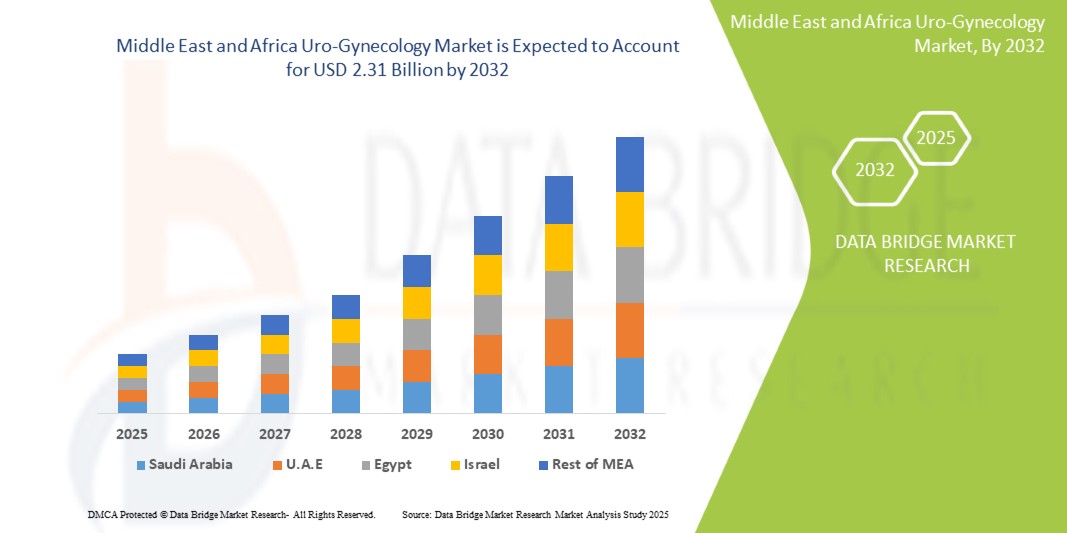
Middle East and Africa Uro-Gynecology Market Size
- The Middle East and Africa Uro-Gynecology Market size was valued at USD 1.34 billion in 2024 and is expected to reach USD 2.31 Billion by 2032, at a CAGR of 7.1% during the forecast period
- The market growth is largely fueled by the rising prevalence of pelvic floor disorders
- Furthermore, growing awareness about female reproductive health issues. These converging factors are accelerating the uptake of uro-gynecology solutions, thereby significantly boosting the industry's growth
Middle East and Africa Uro-Gynecology Market Analysis
- Uro-Gynecology devices and treatments are gaining prominence in Middle East and Africa due to rising awareness, expanding healthcare infrastructure, and increasing demand for advanced pelvic floor disorder management among aging female populations
- The growing emphasis on women’s health, minimally invasive procedures, and government-backed health initiatives is significantly driving the demand for Uro-Gynecology solutions such as vaginal pessaries, mid-urethral slings, and sacral neuromodulation devices. In addition, technological advancements in diagnostic imaging and robotic-assisted surgeries are enhancing procedural accuracy and patient outcomes
- U.A.E is expected to dominate the Middle East and Africa Uro-Gynecology Market, holding the largest revenue share of 21.07% in 2025, attributed to its vast population base, growing prevalence of pelvic organ prolapse (POP) and urinary incontinence (UI), increasing health expenditure, and rapid adoption of innovative medical devices across tier-1 and tier-2 cities
- U.A.E is projected to be the fastest-growing country in the Middle East and Africa Uro-Gynecology Market during the forecast period, driven by improved healthcare accessibility in rural areas, rising female patient awareness through government and NGO outreach programs, increasing penetration of private healthcare providers, and growth in medical tourism focused on gynecological treatments
- The urinary incontinence devices segment is expected to dominate the Middle East and Africa Uro-Gynecology Market, with a market share of 67.91% in 2025, owing to the high prevalence of stress and urge incontinence among the aging female population, growing preference for non-surgical and minimally invasive therapies, and increased product launches from global and regional med-tech players
Report Scope and Middle East and Africa Uro-Gynecology Market Segmentation
|
Attributes |
Middle East and Africa Uro-Gynecology Key Market Insights |
|
Segments Covered |
|
|
Countries Covered |
Middle East and Africa
|
|
Key Market Players |
|
|
Market Opportunities |
|
|
Value Added Data Infosets |
In addition to the insights on market scenarios such as market value, growth rate, segmentation, geographical coverage, and major players, the market reports curated by the Data Bridge Market Research also include import export analysis, production capacity overview, production consumption analysis, price trend analysis, climate change scenario, supply chain analysis, value chain analysis, raw material/consumables overview, vendor selection criteria, PESTLE Analysis, Porter Analysis, and regulatory framework. |
Middle East and Africa Uro-Gynecology Market Trends
Rising Prevalence of Pelvic Floor Disorders
- A major driving force behind the Middle East and Africa Uro-Gynecology Market is the rising prevalence of pelvic floor disorders (PFDs) such as urinary incontinence, pelvic organ prolapse, and fecal incontinence, driven by aging populations, obesity, sedentary lifestyles, and post-childbirth complications. Increased awareness and healthcare access have further elevated the demand for both surgical and non-surgical treatments across regions
- For instance, in October 2023, an article published by the National Library of Medicine highlighted findings from a cross-sectional study in Spain where 55.8% of women experienced urinary incontinence, 14% had symptomatic uterine prolapse, and 10.4% suffered from fecal incontinence. Risk factors included menopause, multiple vaginal deliveries, and instrumental births—emphasizing the growing clinical burden and need for expanded urogynecological care
- In 2025, The Guardian reported that up to 74.5% of elite female powerlifters experienced urinary incontinence during training, yet only 7% sought medical attention. The data links heavy lifting with pelvic floor strain, emphasizing the need for broader awareness, even among young and athletic women traditionally overlooked in PFD studies
- The increasing global prevalence of pelvic floor disorders, supported by robust clinical data and epidemiological insights, is driving the expansion of urogynecology services. Healthcare systems are scaling women’s health programs, while manufacturers innovate diagnostic tools, implants, and minimally invasive devices to meet growing demand. This trend anchors the long-term growth trajectory of the global Middle East and Africa Uro-Gynecology Market
Middle East and Africa Uro-Gynecology Market Dynamics
Driver
Growing Awareness About Female Reproductive Health Issues
- The increasing demand for uro-gynecology solutions is significantly driven by growing global awareness, destigmatization of pelvic health conditions, and improved health literacy among women. Public health initiatives, media exposure, and advocacy by women’s health organizations have made it easier for individuals to seek timely care for issues such as urinary incontinence and pelvic organ prolapse
- For instance, in February 2024, a blog post by the International Federation of Gynecology and Obstetrics (FIGO) revealed that up to 50% of women will experience a pelvic floor disorder in their lifetime, yet stigma and lack of awareness often prevent them from seeking treatment. FIGO emphasized breaking this silence through advocacy and education to empower both patients and healthcare providers
- According to the World Health Organization (WHO), endometriosis affects about 10% (190 million) of reproductive-age women and girls globally, but awareness and education remain limited—especially in low- and middle-income countries. WHO is actively collaborating with stakeholders to improve early diagnosis and expand access to effective treatments, reinforcing the need for global pelvic health education
- According to the Australian Government Department of Health, more than 4.8 million Australians suffer from bladder or bowel control issues. The National Continence Program (NCP) promotes awareness, early intervention, and inclusivity through support services for all age groups—helping individuals lead dignified, confident lives within their communities.
- In India, the National Health Mission (NHM), under the RMNCAH+N strategy, integrates adolescent and reproductive health with maternal care, family planning, and gender equity. This holistic approach aims to improve awareness and normalize treatment-seeking behavior related to pelvic floor disorders
- In the UK, the Bladder & Bowel Community reports 14 million people are affected by related conditions, with 6.5 million facing bowel control issues. Through campaigns like “Just Can’t Wait” and digital support groups, the organization is actively dismantling stigma and empowering individuals to manage their health proactively
- These government-backed awareness campaigns and public health strategies are playing a pivotal role in destigmatizing pelvic floor disorders and promoting early diagnosis and treatment. Countries like Australia, the UK, and India are leading examples of how coordinated efforts between governments, healthcare providers, and advocacy groups can create a more supportive environment for women’s pelvic health, ultimately strengthening the global Middle East and Africa Uro-Gynecology Market
Restraint/Challenge
Stringent Regulatory Framework
- The stringent regulatory frameworks governing the approval and commercialization of urogynecology devices present a significant barrier to global market expansion. Regulatory bodies such as the U.S. FDA and the European Medicines Agency (EMA) require comprehensive clinical trials, rigorous safety assessments, and ongoing post-market surveillance, which delay product launches and increase compliance costs.
- For instance, in February 2025, the European Medicines Agency (EMA) reinforced that under the EU’s Medical Devices Regulation (MDR, EU 2017/745), Class III urogynaecology implants are subject to intensive scrutiny. Requirements include third-party conformity assessments, CE marking, and expert panel evaluations, all of which extend approval timelines and create compliance burdens for manufacturers.
- The regulatory pressures are particularly acute for new entrants and small-to-medium enterprises, which often lack the capital and legal resources to navigate these complex pathways. Evolving safety standards—partly a response to historical controversies around pelvic mesh—further raise the bar for market entry and restrict the availability of novel technologies.
- Although these frameworks are essential for ensuring patient safety, their associated delays, costs, and resource demands significantly hinder the pace of innovation in the global urogynecology market. Without streamlined regulatory pathways or increased support for manufacturers, particularly in emerging economies, access to cutting-edge treatments and medical device solutions will remain uneven and limited across regions.
Middle East and Africa Uro-Gynecology Market Scope
The market is segmented on the basis of product, biomaterial type, material form, indication, end user, and distribution channel.
- By Product
On the basis of product, the Middle East and Africa Uro-Gynecology Market is segmented into urinary incontinence devices, pelvic organ prolapse devices and others. In 2025, the urinary incontinence devices segment will dominate the market with a 67.91% share, driven by increasing cases of incontinence among aging women, rising awareness, improved diagnostic rates, preference for minimally invasive solutions, and technological advancements enhancing product efficacy and patient comfort.
The urinary incontinence devices segment is anticipated to witness the fastest growth rate of 7.0% from 2025 to 2032, fueled by rising geriatric population, growing demand for non-invasive treatment options, increasing healthcare expenditure, greater awareness of women’s health issues, and continuous innovation in device technology.
- By Biomaterial Type
On the basis of biomaterial type, the Middle East and Africa Uro-Gynecology Market is segmented into synthetic biomaterials, natural biomaterials, and others. The synthetic biomaterials segment is expected to hold the largest market revenue share in 2025, driven by high durability, better biocompatibility, cost-effectiveness, ease of manufacturing, and widespread use in uro-gynecological implants and meshes.
The biomaterial type segment is expected to witness the fastest CAGR from 2025 to 2032, driven by rising demand for biocompatible materials, continuous innovation in tissue engineering, increased adoption in uro-gynecological procedures, and growing preference for safer, customizable, and long-lasting implantable solutions across healthcare settings.
- By Material Form
On the basis of material form, the Middle East and Africa Uro-Gynecology Market is segmented into knitted meshes, scaffolds, injectable gels, and others. The knitted meshes segment is expected to hold the largest market revenue share in 2025, driven by their high tensile strength, flexibility, ease of implantation, and widespread use in pelvic floor repair procedures.
The knitted meshes segment is expected to witness the fastest CAGR from 2025 to 2032, driven by increasing adoption in minimally invasive surgeries, advancements in mesh design and materials, growing preference for long-lasting pelvic support solutions, and rising demand for effective treatment of pelvic organ prolapse and incontinence.
- By Indication
On the basis of indication, the Middle East and Africa Uro-Gynecology Market is segmented into urinary incontinence and pelvic organ prolapse. The urinary incontinence segment is expected to hold the largest market revenue share in 2025, driven by its higher global prevalence, increasing awareness among women, expanding elderly population, and rising adoption of advanced treatment and diagnostic solutions.
The urinary incontinence segment is expected to witness the fastest CAGR from 2025 to 2032, driven by growing geriatric population, rising incidence of stress and urge incontinence, improved access to care, increasing acceptance of non-invasive treatments, and continuous advancements in diagnostic tools and therapeutic devices.
- By End-User
On the basis of end-user, the Middle East and Africa Uro-Gynecology Market is segmented into hospitals, ambulatory surgical centers (ASCs), specialty clinics, academic & research institutes, home care settings, and others. The hospitals segment is expected to hold the largest market revenue share in 2025, driven by availability of advanced infrastructure, skilled professionals, high patient footfall, and comprehensive treatment capabilities.
The hospitals segment is expected to witness the fastest CAGR from 2025 to 2032, driven by increasing adoption of advanced uro-gynecological procedures, rising patient preference for multidisciplinary care, expanding healthcare investments, and the availability of specialized surgical units and post-operative care within hospital settings.
- By Distribution Channel
On the basis of distribution channel, the Middle East and Africa Uro-Gynecology Market is segmented into direct tenders, online, retail stores, and others. The direct tenders segment is expected to hold the largest market revenue share in 2025, driven by widespread procurement of urogynecology devices by public and private hospitals through centralized purchasing systems. Large-volume purchases via tenders ensure cost efficiency and standardized product access across institutional healthcare settings. The segment’s dominance is further reinforced by government-backed healthcare schemes, growing hospital chains in emerging markets, and long-term vendor contracts that streamline device supply for pelvic floor disorder treatments.
The online segment is expected to witness the fastest CAGR from 2025 to 2032, propelled by the growing shift toward digital health platforms and e-commerce for medical supplies. Increased patient awareness, convenience in purchasing, and availability of a wide range of pelvic care products—such as pessaries and pelvic floor exercisers—are accelerating online sales. The segment is further supported by the expansion of telemedicine, digital pharmacies, and direct-to-consumer marketing strategies adopted by urogynecology device manufacturers targeting tech-savvy and remote populations.
Middle East and Africa Uro-Gynecology Market Regional Analysis
- Middle East and Africa accounted for a smaller share of the global Middle East and Africa Uro-Gynecology Market in 2024; however, the region is witnessing steady growth, driven by an increasing prevalence of pelvic floor disorders, rising awareness about women’s health, and gradual improvements in healthcare infrastructure
- Consumers and healthcare providers in the region are showing a growing interest in advanced uro-gynecological solutions, particularly minimally invasive surgeries and innovative pelvic floor repair products, due to their effectiveness and reduced recovery times
- This growth is further supported by increasing healthcare investments, government initiatives to enhance women’s health programs, and the rising number of gynecology specialists, establishing a foundation for broader adoption of uro-gynecological treatments across hospitals and specialty clinics
U.A.E Middle East and Africa Uro-Gynecology Market Insight
The U.A.E Middle East and Africa Uro-Gynecology Market accounted for the largest market revenue share in the Middle East and Africa region in 2025, driven by its expansive population base, rising prevalence of pelvic floor disorders, and significant government investment in public healthcare infrastructure. The country’s rapid urbanization, improved health literacy among women, and growing access to specialized gynecological services support widespread adoption of urogynecology treatments. In addition, strong domestic manufacturing capabilities and increased regulatory clarity have fostered a thriving medical device ecosystem.
Saudi Arabia Middle East and Africa Uro-Gynecology Market Insight
The Saudi Arabia Middle East and Africa Uro-Gynecology Market growth is driven by increasing awareness of pelvic floor disorders, government-backed health reforms under Vision 2030, and rising demand for specialized women’s health services. Strategic public–private partnerships and the expansion of high-end private healthcare groups are improving diagnostic and treatment accessibility across the country. Direct investments by global medtech leaders and growing prevalence of conditions such as urinary incontinence and pelvic organ prolapse (affecting 29–41% of Saudi women) are further boosting market uptake. Saudi Arabia’s positioning as a regional healthcare hub is also enhancing international collaboration and fueling infrastructure upgrades in uro-gynecological care .
South Africa Middle East and Africa Uro-Gynecology Market Insight
The South Africa Middle East and Africa Uro-Gynecology Market held a significant share of the Middle East and Africa market in 2025, attributed to its aging female population, increasing awareness of pelvic health disorders, and rising healthcare spending. The country benefits from a relatively well-established reimbursement framework and widespread adoption of minimally invasive and laparoscopic procedures in both public and private sectors. Growing focus on preventive care and early intervention, coupled with the presence of skilled gynecologic surgeons and access to advanced pelvic floor repair technologies, is driving demand. Strategic partnerships with global medtech firms and the expansion of women’s health programs are further enhancing South Africa’s position in the regional uro-gynecology landscape.
Middle East and Africa Uro-Gynecology Market Share
The uro-gynecology industry is primarily led by well-established companies, including:
- Hollister Incorporated (U.S.)
- Integer Holdings Corporation (U.S.)
- Laborie (Canada)
- Convatec Group PLC (U.K.)
- Cooper Surgical, Inc. (U.S.)
- B. Braun SE (Germany)
- Caldera Medical (U.S.)
- PROMEDON (Argentina)
- Betatech Medical (Turkey)
- Bioseal Inc (U.S.)
- pfm medical gmbh (Germany)
- American Medical Systems (Now part of Boston Scientific) (U.S.)
- Bezwada Biomedical, LLC (U.S.)
Latest Developments in Middle East and Africa Uro-Gynecology Market
- In January, Boston Scientific completed its acquisition of Axonics Inc.This significant move has expanded Boston Scientific's Urology and Pelvic Health business by integrating Axonics' cutting-edge sacral neuromodulation (SNM) systems, which are instrumental in treating urinary and bowel dysfunction, directly addressing conditions prevalent in urogynecology
- In February, Boston Scientific implemented management changes and restructuring initiatives that resulted in the creation of a dedicated Urology and Pelvic Health division. This strategic reorganization, which has been in place for some time, underscores Boston Scientific's focused commitment to developing and commercializing products for urinary, pelvic floor, and related women's health conditions, thereby bolstering its impact on the urogynecology field
- In April, Boston Scientific's Urology and Women's Health Division solidified its long-standing marketing alliance with Bladder Health Network, making it exclusive with a four-year agreement back on April 19, 2010. This enduring partnership continues to promote greater access to advanced diagnostic solutions, such as urodynamic testing, for female urinary incontinence and other urinary system problems, which directly supports diagnostic capabilities within the urogynecology market
- In April, Bioseal participated in the HSPA Conference 2024 in Las Vegas, showcasing its innovations and hosting CE-credit educational sessions on sterile processing and quality improvement. This engagement enhanced Bioseal’s industry visibility, strengthened customer education, and positioned the company as a thought leader in sterile processing and single-use surgical solutions
- In March 2023, Bioseal Inc. launched the BioBlue family—a range of single-use surgical instruments designed to reduce cleaning, sterilization labor, and turnaround times in sterile processing.This innovation strengthened Bioseal’s position in the OB/GYN and urogynecology markets by offering cost-effective, sterile, ready-to-use instruments that improve workflow efficiency and reduce infection risk in clinical settings

- Interactive Data Analysis Dashboard
- Company Analysis Dashboard for high growth potential opportunities
- Research Analyst Access for customization & queries
- Competitor Analysis with Interactive dashboard
- Latest News, Updates & Trend analysis
- Harness the Power of Benchmark Analysis for Comprehensive Competitor Tracking
Data collection and base year analysis are done using data collection modules with large sample sizes. The stage includes obtaining market information or related data through various sources and strategies. It includes examining and planning all the data acquired from the past in advance. It likewise envelops the examination of information inconsistencies seen across different information sources. The market data is analysed and estimated using market statistical and coherent models. Also, market share analysis and key trend analysis are the major success factors in the market report. To know more, please request an analyst call or drop down your inquiry.
The key research methodology used by DBMR research team is data triangulation which involves data mining, analysis of the impact of data variables on the market and primary (industry expert) validation. Data models include Vendor Positioning Grid, Market Time Line Analysis, Market Overview and Guide, Company Positioning Grid, Patent Analysis, Pricing Analysis, Company Market Share Analysis, Standards of Measurement, Global versus Regional and Vendor Share Analysis. To know more about the research methodology, drop in an inquiry to speak to our industry experts.
Data Bridge Market Research is a leader in advanced formative research. We take pride in servicing our existing and new customers with data and analysis that match and suits their goal. The report can be customized to include price trend analysis of target brands understanding the market for additional countries (ask for the list of countries), clinical trial results data, literature review, refurbished market and product base analysis. Market analysis of target competitors can be analyzed from technology-based analysis to market portfolio strategies. We can add as many competitors that you require data about in the format and data style you are looking for. Our team of analysts can also provide you data in crude raw excel files pivot tables (Fact book) or can assist you in creating presentations from the data sets available in the report.













