


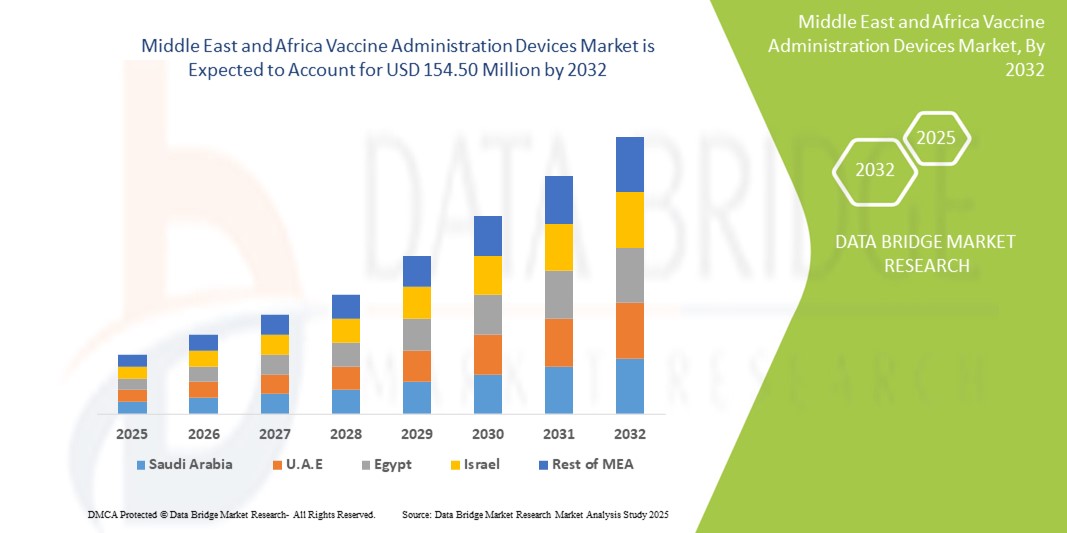
Middle East and Africa Vaccine Administration Devices Market Size
- The Middle East and Africa vaccine administration devices market size was valued at USD 109.48 million in 2024 and is expected to reach USD 154.50 million by 2032, at a CAGR of 4.40% during the forecast period
- The market growth is largely fueled by expanding immunization programs, government vaccination initiatives, and technological advancements in delivery systems such as auto-injectors, jet injectors, and needle-free devices, which enhance vaccination efficiency and safety
- Furthermore, rising demand for accessible, patient-friendly, and reliable vaccine delivery solutions across both urban and underserved populations is positioning advanced administration devices as a critical component of public health infrastructure. These converging factors are accelerating the adoption of modern vaccine delivery methods, thereby significantly boosting the industry’s growth
Middle East and Africa Vaccine Administration Devices Market Analysis
- Vaccine administration devices, including syringes, auto-injectors, jet injectors, and needle-free systems, are increasingly vital tools in immunization programs across the Middle East and Africa, supporting both routine vaccination efforts and large-scale campaigns through improved safety, accuracy, and ease of use
- The escalating demand for advanced vaccine administration devices is primarily fueled by expanding government-led immunization initiatives, rising prevalence of infectious diseases, and growing investments in modern healthcare infrastructure across key countries
- South Africa dominated the Middle East & Africa vaccine administration devices market with the largest revenue share of 33.1% in 2024, supported by strong government vaccination campaigns, partnerships with international health agencies, and high demand for both routine and specialized vaccines across public and private healthcare settings
- Saudi Arabia is expected to be the fastest growing country in the vaccine administration devices market during the forecast period, driven by large-scale investments in healthcare modernization, strong national immunization programs, and increased adoption of advanced devices such as needle-free injectors and auto-injectors
- Syringe-based delivery systems dominated the Middle East & Africa vaccine administration devices market with a 58.9% share in 2024, driven by their wide availability, cost-effectiveness, and central role in both childhood immunization programs and mass adult vaccination drives
Report Scope and Middle East and Africa Vaccine Administration Devices Market Segmentation
|
Attributes |
Middle East and Africa Vaccine Administration Devices Key Market Insights |
|
Segments Covered |
|
|
Countries Covered |
Middle East and Africa
|
|
Key Market Players |
|
|
Market Opportunities |
|
|
Value Added Data Infosets |
In addition to the insights on market scenarios such as market value, growth rate, segmentation, geographical coverage, and major players, the market reports curated by the Data Bridge Market Research also include in-depth expert analysis, pricing analysis, brand share analysis, consumer survey, demography analysis, supply chain analysis, value chain analysis, raw material/consumables overview, vendor selection criteria, PESTLE Analysis, Porter Analysis, and regulatory framework. |
Middle East and Africa Vaccine Administration Devices Market Trends
Advancement of Needle-Free and Auto-Injector Technologies
- A significant and accelerating trend in the Middle East & Africa vaccine administration devices market is the adoption of innovative delivery technologies such as needle-free injectors, auto-injectors, and microneedle patches, which are enhancing patient comfort, reducing needle-stick injuries, and improving compliance in vaccination programs
- For instance, PharmaJet’s needle-free injector systems have been introduced in immunization campaigns supported by global health agencies, allowing safe and rapid vaccine delivery without the risks associated with traditional syringes
- Technological improvements are enabling devices to optimize vaccine delivery, minimize wastage, and reduce pain, while new auto-injector models are being designed to simplify self-administration for patients in both urban and rural healthcare settings
- The increasing focus on improving accessibility and reducing barriers to vaccination is accelerating the use of alternative vaccine delivery methods, particularly in regions with healthcare workforce shortages and underserved populations
- This trend towards more advanced, user-friendly, and innovative vaccine administration devices is fundamentally reshaping immunization strategies in the region, encouraging companies to invest in next-generation platforms that align with public health goals
- The demand for modern vaccine delivery solutions with features such as needle-free administration and simplified usability is growing rapidly across both public immunization campaigns and private healthcare services, as countries prioritize expanding coverage and efficiency
Middle East and Africa Vaccine Administration Devices Market Dynamics
Driver
Expanding Immunization Programs and Government Healthcare Initiatives
- The increasing prevalence of infectious diseases and the rising focus on preventive healthcare, coupled with strong government-led immunization programs, are significant drivers for the growing adoption of vaccine administration devices in the region
- For instance, in 2024, South Africa’s National Department of Health expanded its vaccination program with international aid support, emphasizing the need for large volumes of reliable syringes and auto-injectors to meet rising demand
- As awareness of the benefits of immunization spreads, vaccine administration devices are gaining traction for their ability to deliver accurate doses, improve safety, and support rapid vaccination coverage in mass campaigns
- Furthermore, international collaborations with WHO, UNICEF, and Gavi are supporting investments in immunization infrastructure, making advanced vaccine delivery systems more accessible to underserved populations
- The ability to ensure safe, effective, and rapid vaccine administration through modern devices is a key factor propelling adoption across both public health systems and private healthcare providers in key countries such as South Africa, Saudi Arabia, and the UAE
- The push to expand vaccination coverage, coupled with the need to strengthen healthcare resilience, is positioning vaccine administration devices as a critical element in public health preparedness and response strategies
Restraint/Challenge
Supply Chain Disruptions and Regulatory Compliance Hurdles
- Limited manufacturing capacity in the region, combined with dependency on imports for advanced devices, poses a significant challenge to meeting the rising demand for vaccine administration solutions in all markets
- For instance, temporary shortages of syringes during global vaccination drives highlighted the vulnerability of supply chains in the Middle East and Africa, creating bottlenecks that affected immunization schedules
- Addressing these challenges through increased local manufacturing, diversified sourcing, and improved logistics is crucial to ensure timely availability of vaccine delivery devices across both urban and rural areas
- In addition, stringent regulatory approval processes and differences in compliance standards across countries can delay the introduction of innovative devices such as microneedle patches or auto-injectors into national immunization programs
- The relatively high cost of next-generation devices compared to conventional syringes can act as a barrier for widespread adoption, particularly in low-income countries that rely heavily on donor-funded programs
- Overcoming these barriers through regulatory harmonization, cost reduction strategies, and improved regional production capacity will be vital to ensure equitable access and sustained market growth in the region
Middle East and Africa Vaccine Administration Devices Market Scope
The market is segmented on the basis of product, route of administration, type, brand, dosage, vaccine type, modality, usability, end user, and distribution channel.
- By Product
On the basis of product, the Middle East & Africa vaccine administration devices market is segmented into syringes, auto injectors, jet injectors, micro needles, inhalation/pulmonary delivery, microinjection system, pen injector devices, biodegradable implants, electroporation-based needle free injection systems, buccal/sublingual vaccine delivery systems, autoinjector trainer devices and other devices. The syringes segment dominated the market with the largest revenue share of 58.9% in 2024, driven by its entrenched role in routine immunization programs and mass vaccination campaigns. Syringes remain the default delivery method due to their cost-effectiveness, universal availability, and strong alignment with global procurement initiatives by WHO, UNICEF, and Gavi. Standardized syringe formats simplify logistics, cold-chain storage, and training for healthcare workers, which sustains their dominance. They are also preferred for safety and infection control in high-throughput clinics and outreach programs. Furthermore, large-volume procurement contracts and local manufacturing initiatives reinforce their leading position in the MEA region.
The auto-injectors segment is anticipated to witness the fastest growth rate during the forecast period, driven by the rising trend of self-administration and patient-centric vaccination approaches. Auto-injectors reduce the need for trained personnel, enhancing accessibility in urban and semi-urban areas. Technological advancements, including prefilled and easy-to-use designs, further support adoption. Pilot programs and clinical initiatives in key countries are increasing awareness of the benefits of auto-injectors. Regulatory approvals and donor-funded campaigns are accelerating adoption. The convenience, safety, and growing patient acceptance position auto-injectors as the fastest-growing product segment.
- By Route of Administration
On the basis of route of administration, the Middle East & Africa vaccine administration devices market is segmented into intramuscular, subcutaneous, and intradermal. The intramuscular (IM) segment dominated the market in 2024, due to its compatibility with a wide range of vaccines including DTP, hepatitis, and influenza. IM delivery benefits from well-established training protocols and predictable immune responses. Procurement and cold-chain distribution are optimized for IM syringes, which are widely used in public and private healthcare facilities. IM administration is preferred for both routine childhood and adult vaccination programs. Healthcare workers’ familiarity ensures safe and accurate dosing. National immunization programs heavily rely on IM devices, reinforcing their dominance.
The intradermal (ID) segment is expected to grow at the fastest rate during the forecast period, driven by dose-sparing strategies and innovations such as microneedle patches. ID administration enables effective immune responses with lower antigen volumes, appealing to resource-constrained programs. Pilot initiatives and clinical trials are validating its efficacy, increasing adoption. Device innovations are simplifying administration and reducing technical barriers. International agencies are supporting ID delivery for outbreak response and targeted vaccination. Increasing awareness of cost-effectiveness and reduced wastage will drive its accelerated growth.
- By Type
On the basis of type, the Middle East & Africa vaccine administration devices market is segmented into marketed vaccines and clinical-stage vaccines (electroporation). The marketed vaccines segment dominated the market in 2024, as most vaccination devices are aligned with established immunization schedules. High-volume procurement ensures steady demand for prefilled syringes and auto-disable devices. Manufacturers focus on cost optimization and regulatory compliance for marketed vaccines. Clinical familiarity and training reinforce consistent usage across hospitals and clinics. National programs prioritize marketed vaccines for predictable dosing and coverage targets. Donor agencies and governments maintain continuous demand, sustaining revenue dominance.
The clinical-stage vaccines (electroporation) segment is anticipated to register the fastest growth during forecast period, supported by the development of DNA/RNA vaccines and novel modalities in clinical trials. Electroporation devices enhance immunogenicity for advanced vaccines. Regional pilot programs and clinical studies are driving awareness and adoption. Increased funding for next-generation vaccines is boosting device deployment. Regulatory pathways for clinical-stage vaccines are maturing, encouraging manufacturers. Successful trial outcomes are expected to accelerate market penetration, driving rapid growth.
- By Brand
On the basis of brand, the Middle East & Africa vaccine administration devices market is segmented into BD Accuspray Nasal Spray System, BD Hypak for Vaccines Glass Pre-Fillable Syringe System, BD Uniject Auto-Disable Pre-Fillable Injection System, Gx InnoSafe, Gx RTF ClearJect, Plajex, and others. The BD Uniject Auto-Disable Pre-Fillable Injection System dominated the market in 2024, due to its compatibility with WHO-recommended safety standards and strong presence in donor-funded programs. Its auto-disable mechanism prevents reuse, ensuring safe mass immunizations. Prefilled systems reduce dosing errors and streamline logistics. Distribution networks are well-established across hospitals and community programs. Training materials and programmatic familiarity enhance adoption. Governments and NGOs continue to procure Uniject devices at scale, reinforcing market dominance.
The Gx InnoSafe segment is projected to be the fastest-growing brand during forecast period, driven by innovation in safety-engineered syringes and cost advantages. Local and regional manufacturers are meeting demand for high-quality, affordable alternatives. Safety features align with government tender requirements. Pilot programs validate efficacy, encouraging broader adoption. Strong regional distribution and shorter lead times support rapid market penetration. Competitive pricing and donor interest accelerate growth, positioning Gx InnoSafe as the fastest-growing brand.
- By Dosage
On the basis of dosage, the Middle East & Africa vaccine administration devices market is segmented into fixed and variable. The fixed dosage segment dominated the market in 2024, supported by alignment with standardized vaccination schedules. Prefilled fixed-dose devices minimize preparation errors and reduce training requirements. They enable efficient inventory management for high-volume campaigns. Governments and donors favor fixed dosages for predictability. Cold-chain and storage systems are optimized for standardized devices. Their use in routine and mass immunizations ensures market leadership.
The variable dosage segment is expected to grow at the fastest rate during forecast period, driven by flexibility in adult and booster vaccination programs. Adjustable devices allow dose customization, supporting fractional or personalized dosing. Device innovations improve accuracy and ease of use. Pilot programs in urban and private healthcare settings validate effectiveness. Rising demand for specialized vaccines encourages adoption. Manufacturers are increasingly designing variable-dose auto-injectors to capture emerging opportunities.
- By Vaccine Type
On the basis of vaccine type, the Middle East & Africa vaccine administration devices market is segmented into bivalent oral polio vaccine, B.C.G. vaccine, tetanus-diphtheria vaccine, DTP-HEPB-HIB vaccine, influenza vaccine, pneumococcal conjugate vaccine, measles vaccine, and others. The B.C.G. vaccine segment dominated the market in 2024, as it is included in neonatal immunization schedules across most MEA countries. Neonatal infrastructure supports consistent device demand. Prefilled and auto-disable systems reduce contamination risk. High birth rates ensure volume-driven procurement. Governments prioritize B.C.G. programs in hospitals and clinics. Program continuity and training reinforce its market dominance.
The influenza vaccine segment is projected to grow at the fastest pace during forecast period, driven by expanded adult vaccination programs and pandemic preparedness initiatives. Government and private programs target seasonal influenza coverage. Awareness campaigns increase adoption in urban populations. Emerging flu formulations encourage procurement of compatible devices. Private clinics and workplace vaccination programs expand device use. Increased public focus on seasonal and outbreak immunization fuels growth.
- By Modality
On the basis of modality, the Middle East & Africa vaccine administration devices market is segmented into automatic vaccine administration devices and manual vaccine administration devices. The manual devices segment dominated the market in 2024, due to widespread training and familiarity among healthcare workers. Manual devices are cost-effective, flexible, and widely available. National programs rely on them for mass vaccination campaigns. Low maintenance requirements support adoption in rural areas. Training and programmatic support reinforce usage. High-volume deployment ensures continued dominance.
The automatic devices segment is expected to grow at the fastest rate during forecast period, fueled by precision dosing, safety enhancements, and reduced dependency on skilled staff. Digital tracking and standardized delivery appeal to modern healthcare systems. Pilot programs validate reliability and efficiency. Donor and government interest in automated solutions is rising. Adoption is increasing in tertiary hospitals and private clinics. Technology advancements reduce costs and increase accessibility, driving rapid growth.
- By Usability
On the basis of usability, the Middle East & Africa vaccine administration devices market is segmented into disposable and reusable. The disposable segment dominated the market in 2024, driven by infection control, cost-effectiveness, and donor preference for single-use, auto-disable devices. Single-use devices simplify logistics and minimize cross-contamination risks. Procurement and storage systems are optimized for disposable formats. Widely accepted in public and private programs, they ensure programmatic compliance. Training requirements are minimal, supporting rapid deployment. Large-scale campaigns continue to favor disposables.
The reusable segment is expected to grow at the fastest pace during forecast period, supported by sustainability initiatives and cost-saving benefits in high-volume centers. Advances in sterilization and device design improve practicality. Reusables reduce per-dose cost over long-term use. Private and tertiary care facilities increasingly adopt reusable injectors. Regulatory guidance supports safe reprocessing. Environmental and operational benefits encourage adoption.
- By End User
On the basis of end user, the Middle East & Africa vaccine administration devices market is segmented into hospitals, community centers, homecare settings, research and academic institutes, ambulatory surgical centers, and others. The hospitals segment dominated the market in 2024, serving as primary hubs for mass vaccination, specialized vaccines, and emergency response. Hospitals concentrate skilled staff, storage facilities, and patient throughput. They manage large-volume procurement and programmatic distribution. Tertiary centers pilot new devices before broader rollout. Established training programs ensure safe and accurate device use. High device consumption reinforces dominance.
The community centers segment is projected to grow at the fastest pace during forecast period, driven by outreach campaigns and efforts to increase vaccine coverage in underserved populations. Mobile and school-based programs expand access. Donor and government funding facilitate device deployment in rural areas. Portable, easy-to-use devices enable rapid vaccination. Training and awareness programs support community health workers. Decentralized vaccination initiatives accelerate growth in this segment.
- By Distribution Channel
On the basis of distribution channel, the Middle East & Africa vaccine administration devices market is segmented into direct tender and retail sales. The direct tender segment dominated the market in 2024, reflecting centralized government and donor-funded procurement. Large-scale programs rely on tenders for volume discounts and supply security. Device specifications are standardized through tender processes. Logistics and distribution planning are simplified. Governments and NGOs favor tender mechanisms for predictability. Procurement scale ensures dominant revenue contribution.
The retail sales segment is expected to grow at the fastest pace during forecast period, driven by private healthcare expansion and consumer demand for at-home vaccination solutions. Pharmacies and private clinics increase access to auto-injectors and prefilled devices. Online sales platforms enhance convenience and reach. Rising health awareness and self-care trends fuel adoption. Regulatory support for private access promotes growth. Market education and promotional strategies further accelerate retail sales.
Middle East and Africa Vaccine Administration Devices Market Regional Analysis
- South Africa dominated the Middle East & Africa vaccine administration devices market with the largest revenue share of 33.1% in 2024, supported by strong government vaccination campaigns, partnerships with international health agencies, and high demand for both routine and specialized vaccines across public and private healthcare settings
- Healthcare facilities in South Africa benefit from widespread availability of vaccine delivery devices, skilled healthcare workers, and robust cold-chain logistics, ensuring efficient administration across hospitals, community centers, and outreach programs
- The dominance is further supported by strong government initiatives, donor funding from organizations such as Gavi and UNICEF, and high public awareness of vaccination campaigns, making South Africa a key revenue contributor in the region
The South Africa Vaccine Administration Devices Market Insight
The South Africa vaccine administration devices market captured the largest revenue share of 33.1% in 2024, driven by well-established immunization programs, strong healthcare infrastructure, and high procurement volumes for both routine and outbreak vaccines. Healthcare facilities benefit from widespread availability of vaccine delivery devices, skilled personnel, and robust cold-chain logistics, ensuring efficient administration. Government initiatives and donor funding from organizations such as Gavi and UNICEF further strengthen adoption. The growing awareness of vaccination programs and emphasis on patient safety are fueling market growth. Public and private hospitals continue to serve as primary distribution hubs, enhancing device utilization. South Africa’s leadership in the region positions it as a key revenue contributor in the MEA market.
Saudi Arabia Vaccine Administration Devices Market Insight
The Saudi Arabia vaccine administration devices market is projected to expand at a substantial CAGR during the forecast period, driven by increasing investments in modern healthcare facilities, regulatory support for advanced vaccine delivery devices, and rising focus on adult and seasonal vaccination programs. The country’s robust public health initiatives and growing private healthcare sector foster adoption of prefilled syringes, auto-injectors, and other innovative delivery systems. Awareness campaigns and training programs enhance device utilization across hospitals, clinics, and community centers. Government-backed procurement ensures consistent demand. The adoption of advanced, safety-engineered devices is growing in urban centers, further contributing to market expansion.
UAE Vaccine Administration Devices Market Insight
The UAE vaccine administration devices market is anticipated to grow at a noteworthy CAGR during the forecast period, driven by the nation’s increasing focus on digital health, modern healthcare infrastructure, and adoption of innovative vaccine delivery solutions. Rising immunization awareness and government-supported initiatives encourage the use of auto-disable syringes, microneedles, and prefilled devices. Integration of these devices into hospitals, private clinics, and outreach programs is accelerating market penetration. Strong regulatory frameworks ensure quality and safety, boosting consumer confidence. Donor-funded and government-supported vaccination campaigns further support sustained growth. The UAE is emerging as a key hub for the adoption of advanced vaccine administration technologies in the MEA region.
Nigeria Vaccine Administration Devices Market Insight
The Nigeria vaccine administration devices market is poised to grow at a significant CAGR, fueled by high birth rates, government-led immunization programs, and rising donor-supported campaigns targeting polio, measles, and other vaccine-preventable diseases. Increasing investments in cold-chain infrastructure and training programs support efficient deployment of syringes, auto-injectors, and needle-free devices. Awareness initiatives and school-based vaccination programs drive demand across community centers and primary healthcare facilities. The need for safe, single-use devices is promoting uptake of auto-disable syringes. Expansion of rural healthcare outreach strengthens market growth. Nigeria’s large population base makes it a critical growth market within the MEA region.
Middle East and Africa Vaccine Administration Devices Market Share
The Middle East and Africa vaccine administration devices industry is primarily led by well-established companies, including:
- BD (U.S.)
- Ypsomed (Switzerland)
- CROSSJECT (France)
- SHL Medical (Switzerland)
- Stevanato Group (Italy)
- Idevax (Belgium)
- Gerresheimer AG (Germany)
- ConvaTec Group PLC (U.K.)
- B. Braun SE (Germany)
- Terumo Europe NV (Belgium)
- Owen Mumford (U.K.)
- Vetter Pharma (Germany)
- West Pharmaceutical Services, Inc. (U.S.)
- SCHOTT Pharma (Germany)
- Nipro Europe Group Companies (Belgium)
- AptarGroup, Inc. (U.S.)
- Elcam Medical (Israel)
- ApiJect Systems, Corp (U.S.)
- Kindeva (U.S.)
- Phillips-Medisize (U.S.)
What are the Recent Developments in Middle East and Africa Vaccine Administration Devices Market?
- In August 2025, a study published in Nature Communications highlighted significant progress toward vaccine self-reliance in Africa. The Africa CDC, in collaboration with CHAI and PATH, reported that 25 active vaccine projects are underway across the continent. Crucially, three manufacturers are projected to achieve WHO prequalification for nine vaccine products between 2026–2030, including vaccines for yellow fever, measles-rubella, and polio
- In May 2024, BioNTech secured up to USD 145 million in funding from the Coalition for Epidemic Preparedness Innovations (CEPI) to support the construction of an mRNA vaccine production network in Africa. This funding is part of an expanded partnership aimed at establishing a vaccine manufacturing site in Kigali, Rwanda. The future network will focus on producing vaccines for diseases such as malaria, mpox, and tuberculosis, and will be capable of responding swiftly to infectious disease outbreaks on the African continent
- In May 2024, CEPI announced its support for expanding sustainable vaccine manufacturing in Africa. The African vaccine market is estimated to grow to between USD 2.8 billion and USD 5.6 billion by 2040, encompassing existing and projected products. CEPI's support aims to build capacity for vaccine production, ensuring a more self-reliant and resilient vaccine supply chain across the continent
- In April 2024, Reuters reported that solar-powered refrigerators developed by companies such as Vestfrost and SureChill are playing a critical role in maintaining the efficacy of vaccines, including malaria vaccines, in sub-Saharan Africa. These innovations ensure that vaccines remain within the required 2–8°C temperature range, even in areas without reliable electricity, thereby supporting immunization campaigns across the region
- In January 2024, Cameroon initiated the rollout of the world's first malaria vaccine, RTS,S (Mosquirix), with 662,000 doses administered to children. This marks a transformative chapter in Africa's public health history, aiming to reduce mortality and morbidity associated with malaria, which accounts for 95% of global deaths from the disease, primarily among children under five

- Interactive Data Analysis Dashboard
- Company Analysis Dashboard for high growth potential opportunities
- Research Analyst Access for customization & queries
- Competitor Analysis with Interactive dashboard
- Latest News, Updates & Trend analysis
- Harness the Power of Benchmark Analysis for Comprehensive Competitor Tracking
Data collection and base year analysis are done using data collection modules with large sample sizes. The stage includes obtaining market information or related data through various sources and strategies. It includes examining and planning all the data acquired from the past in advance. It likewise envelops the examination of information inconsistencies seen across different information sources. The market data is analysed and estimated using market statistical and coherent models. Also, market share analysis and key trend analysis are the major success factors in the market report. To know more, please request an analyst call or drop down your inquiry.
The key research methodology used by DBMR research team is data triangulation which involves data mining, analysis of the impact of data variables on the market and primary (industry expert) validation. Data models include Vendor Positioning Grid, Market Time Line Analysis, Market Overview and Guide, Company Positioning Grid, Patent Analysis, Pricing Analysis, Company Market Share Analysis, Standards of Measurement, Global versus Regional and Vendor Share Analysis. To know more about the research methodology, drop in an inquiry to speak to our industry experts.
Data Bridge Market Research is a leader in advanced formative research. We take pride in servicing our existing and new customers with data and analysis that match and suits their goal. The report can be customized to include price trend analysis of target brands understanding the market for additional countries (ask for the list of countries), clinical trial results data, literature review, refurbished market and product base analysis. Market analysis of target competitors can be analyzed from technology-based analysis to market portfolio strategies. We can add as many competitors that you require data about in the format and data style you are looking for. Our team of analysts can also provide you data in crude raw excel files pivot tables (Fact book) or can assist you in creating presentations from the data sets available in the report.













