


Middle East and Africa Vagus Nerve Stimulation Market Overview
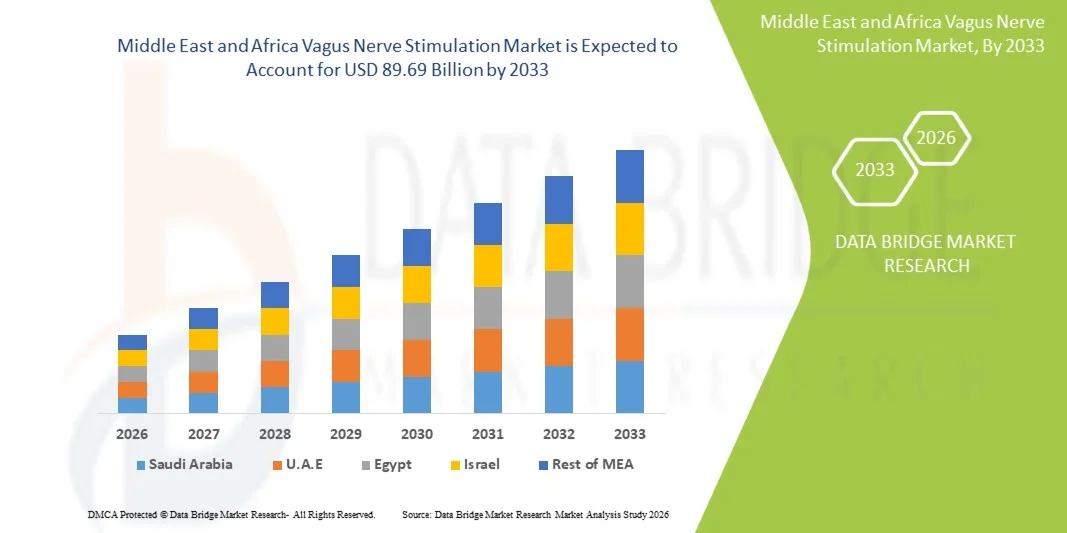
The Middle East and Africa vagus nerve stimulation market was valued at USD 65.04 million in 2025 and is projected to reach USD 89.69 million by 2033, growing at a CAGR of 4.10% from 2026 to 2033. The market is witnessing steady expansion driven by increasing prevalence of drug-resistant epilepsy, rising cases of depression and neurological disorders, and growing awareness of advanced neurostimulation therapies across specialized healthcare centers in the region.
The gradual strengthening of healthcare infrastructure, coupled with expanding adoption of minimally invasive and device-based treatment options, is supporting market growth across both Middle Eastern and African countries. Increasing investments in neurology care, along with rising availability of VNS devices in tertiary hospitals and private neuro-specialty clinics, is further encouraging adoption. However, high treatment costs and limited access to advanced neuromodulation systems in certain African regions continue to moderate overall penetration.
Key Market Trends & Insights
- Saudi Arabia dominated the Middle East & Africa vagus nerve stimulation market with the largest revenue share of 34.6% in 2025, supported by strong government healthcare investment, expanding neurology infrastructure, and increasing adoption of advanced neuromodulation therapies in tertiary hospitals.
- The Implantable VNS Devices segment led the market with a 72.8% share in 2025, driven by strong clinical efficacy in managing drug-resistant epilepsy and long-term treatment-resistant depression.
- United Arab Emirates is expected to be the fastest-growing country from 2026 to 2033, accounting for a CAGR of 8.1%, fueled by rapid adoption of advanced neurotechnology, expansion of specialty neurology hospitals, and increasing medical tourism for neurological treatments.
- External VNS Devices are the fastest-growing product type, projected to register a CAGR of 7.4%, reflecting the surge in demand for non-invasive neuromodulation therapies.
- The Metallic segment dominated the biomaterial category with a 64.1% revenue share in 2025, led by its superior electrical conductivity, durability, and compatibility with implantable neurostimulation devices.
- Epileptic Seizures accounted for 61.4% of the market, preferred by the high prevalence of drug-resistant epilepsy and strong clinical validation of vagus nerve stimulation therapy.
- The Pediatric segment is the fastest-growing patient type category, with a CAGR of 7.2%, driven by increasing cases of drug-resistant childhood epilepsy.
Market Size & Forecast
- Global Market Value (2025): USD 65.04 Million
- Expected Market Value (2033): USD 89.69 Million
- Forecast CAGR (2026–2033): 4.10%
- Leading Country in 2025: Saudi Arabia
- Fastest Growing Country: United Arab Emirates
Report Scope and Middle East and Africa Vagus Nerve Stimulation Market Segmentation
|
Attributes |
Middle East and Africa Vagus Nerve Stimulation Key Market Insights |
|
Segments Covered |
|
|
Countries Covered |
Middle East and Africa · Saudi Arabia · U.A.E. · South Africa · Egypt · Israel · Rest of Middle East and Africa |
|
Key Market Players |
· Medtronic (Ireland) · LivaNova PLC (U.K.) · Abbott (U.S.) · Boston Scientific Corporation (U.S.) · Integer Holdings Corporation (U.S.) · Cyberonics, Inc. (U.S.) · MicroTransponder Inc. (U.S.) · electroCore, Inc. (U.S.) · Nevro Corp. (U.S.) · BIOTRONIK SE & Co. KG (Germany) · B. Braun SE(Germany) · Synapse Biomedical Inc. (U.S.) · Aleva Neurotherapeutics SA (Switzerland) · Soterix Medical Inc. (U.S.) · NeuroPace Inc. (U.S.) · Neuronetics Inc. (U.S.) · Axonics, Inc. (U.S.) · Nervana LLC (U.S.) · Boston Scientific Neuromodulation (U.S.) · Greatbatch Medical (U.S.) |
|
Market Opportunities |
· Rising adoption of non-invasive VNS devices in outpatient and home-care settings · Expansion of clinical indications beyond epilepsy and depression · Increasing integration of AI-driven stimulation parameter optimization to enable personalized neurotherapy |
|
Value Added Data Infosets |
In addition to the insights on market scenarios such as market value, growth rate, segmentation, geographical coverage, and major players, the market reports curated by the Data Bridge Market Research also include in-depth expert analysis, patient epidemiology, pipeline analysis, pricing analysis, and regulatory framework. |
Middle East and Africa Vagus Nerve Stimulation Market Trends
Trend: Expansion of Neuromodulation Adoption in Epilepsy and Depression Care
The adoption of vagus nerve stimulation therapies is gradually increasing across Middle East and Africa as healthcare systems expand access to advanced neuromodulation treatments for drug-resistant epilepsy and treatment-resistant depression. Hospitals and specialty neurology centers are integrating implantable VNS devices into structured treatment pathways, supported by rising clinical awareness among neurologists and improved diagnostic rates. Growing use of minimally invasive implantation techniques and post-operative digital monitoring is also enhancing treatment accessibility in tertiary care settings, while early-stage clinical adoption is being observed in private healthcare networks and academic hospitals. for instance, leading neurology hospitals in Saudi Arabia and Israel are increasingly incorporating VNS therapy into refractory epilepsy treatment protocols.
Middle East and Africa Vagus Nerve Stimulation Market Dynamics
Key Market Driver: Rising Demand for Advanced Neurology Treatment for Drug-Resistant Epilepsy
The growing prevalence of drug-resistant epilepsy and neurological disorders is driving strong demand for vagus nerve stimulation systems across Middle East and Africa, as traditional pharmacological treatments remain ineffective for a significant patient population. Increasing government focus on improving neurological care infrastructure, along with rising healthcare expenditure in Gulf countries, is supporting adoption of implantable neurostimulation devices. Medical professionals are also increasingly recognizing VNS therapy as a viable long-term treatment option for both epilepsy and depression, improving patient outcomes and reducing hospitalization rates. for instance, healthcare expansion programs in UAE and South Africa are enabling wider access to VNS implantation in specialized hospitals.
Key Restraint/Challenge: High Treatment Cost and Limited Reimbursement Coverage
A major restraint in the Middle East and Africa vagus nerve stimulation market is the high cost of implantable devices and associated surgical procedures, which limits adoption in cost-sensitive healthcare systems. Limited insurance reimbursement policies for neuromodulation therapies further restrict patient access, particularly in lower-income African countries where healthcare funding is constrained. In addition, the shortage of trained neurosurgeons and specialized neurostimulation centers creates disparities in treatment availability across the region. for instance, many patients in Egypt and Nigeria face restricted access to VNS therapy due to limited insurance support and high out-of-pocket expenses.
Key Market Opportunity: Expansion of Advanced Neurology Infrastructure and Clinical Research
The increasing investment in neurology infrastructure and growing participation in clinical research present significant growth opportunities for vagus nerve stimulation adoption across Middle East and Africa. Governments and private healthcare providers are expanding specialty hospitals and neuroscience institutes, while international collaborations are supporting clinical trials and technology transfer for advanced neuromodulation therapies. The emergence of telemedicine-enabled post-implant monitoring and digital health integration is further improving long-term patient management and device optimization. for instance, Israel and Saudi Arabia are actively expanding neuromodulation research programs and hospital-based neurology innovation centers.
Middle East and Africa Vagus Nerve Stimulation Market Scope
The Middle East and Africa vagus nerve stimulation market is segmented on the basis of product type, biomaterial, application, patient type, end user, and distribution channel.
- By Product Type
On the basis of product type, the Middle East and Africa vagus nerve stimulation market is segmented into implantable VNS devices and external VNS devices. The Implantable VNS Devices segment dominated the market with a 72.8% share in 2025, driven by strong clinical efficacy in managing drug-resistant epilepsy and long-term treatment-resistant depression. These devices are widely preferred in tertiary hospitals due to their sustained therapeutic outcomes and established regulatory approvals. Increasing neurosurgical capabilities in countries such as Saudi Arabia, Israel, and UAE is further strengthening adoption. Continuous improvements in battery life, device miniaturization, and stimulation precision are enhancing clinical acceptance. Growing physician preference for long-term implantable solutions over non-invasive alternatives continues to reinforce segment dominance. The segment also benefits from expanding reimbursement support in select high-income countries.
The External VNS Devices segment is expected to register the fastest growth at a CAGR of 7.4% from 2026 to 2033, driven by rising demand for non-invasive neuromodulation therapies. These devices are gaining traction among patients seeking alternative treatments with reduced surgical risks and lower recovery time. Increasing adoption in outpatient and homecare settings is expanding accessibility across emerging healthcare systems. Technological advancements in wearable neurostimulation devices are improving comfort and compliance. Growing awareness of neuromodulation benefits is also accelerating early-stage adoption in developing African countries. The segment is further supported by rising telehealth integration and remote monitoring capabilities.
- By Biomaterial
On the basis of biomaterial, the market is segmented into ceramics, metallic, and polymeric materials. The Metallic biomaterial segment dominated the market with a 64.1% share in 2025, primarily due to its superior electrical conductivity, durability, and compatibility with implantable neurostimulation devices. Metals such as titanium are widely used in electrode and casing components of VNS systems, ensuring long-term stability and safety. Strong adoption in implantable devices across hospitals in Saudi Arabia and Israel is reinforcing this dominance. Metallic materials also provide high resistance to corrosion and biological degradation, making them ideal for long-term implantation. Continuous advancements in biocompatible alloys are further enhancing performance. The segment benefits from established manufacturing standards and regulatory approvals.
The Polymeric biomaterial segment is expected to witness the fastest growth at a CAGR of 6.8% from 2026 to 2033, driven by increasing use in flexible and minimally invasive neurostimulation components. Polymers offer lightweight properties, improved patient comfort, and enhanced device flexibility. Rising demand for wearable and external VNS systems is further supporting adoption. Innovations in biocompatible and conductive polymers are improving device efficiency and safety. Expanding research into next-generation neuromodulation materials is accelerating growth. The segment is also benefiting from cost-effective production and scalable manufacturing techniques.
- By Application
On the basis of application, the market is segmented into pain management, epileptic seizures, obesity management, depression and anxiety, and others. The Epileptic Seizures segment dominated the market with a 61.4% share in 2025, driven by high prevalence of drug-resistant epilepsy and strong clinical validation of vagus nerve stimulation therapy. VNS is widely used as an adjunct therapy when anti-epileptic drugs fail to provide adequate seizure control. Increasing diagnosis rates and improved neurological screening in hospitals across Saudi Arabia, UAE, and South Africa are supporting adoption. Long-term reduction in seizure frequency and improved quality of life outcomes are reinforcing clinical preference. Growing pediatric epilepsy cases are further contributing to demand. The segment continues to benefit from expanding neurology care infrastructure.
The Depression and Anxiety segment is expected to register the fastest growth at a CAGR of 7.9% from 2026 to 2033, driven by rising mental health awareness and increasing treatment-resistant psychiatric disorders. VNS therapy is gaining attention as a complementary treatment for patients unresponsive to conventional antidepressants. Expansion of psychiatric care services in urban healthcare centers is supporting adoption. Increasing acceptance of neuromodulation in mental health treatment protocols is further accelerating growth. Rising stress-related disorders across working-age populations is also contributing to demand. The segment is benefiting from growing integration of neurology and psychiatry-based care models.
- By Patient Type
On the basis of patient type, the market is segmented into adults, pediatric, and geriatric populations. The Adult segment dominated the market with a 68.3% share in 2025, driven by higher prevalence of epilepsy, depression, and neurological disorders in working-age populations. Adults are the primary candidates for implantable VNS therapy due to better surgical eligibility and long-term treatment adherence. Increasing awareness of neuromodulation therapies among adult patients is supporting adoption in tertiary hospitals. Expanding insurance coverage in GCC countries is further strengthening demand. Lifestyle-related neurological disorders are also contributing to growth. The segment benefits from strong clinical validation and established treatment protocols.
The Pediatric segment is expected to register the fastest growth at a CAGR of 7.2% from 2026 to 2033, driven by increasing cases of drug-resistant childhood epilepsy. Early intervention using VNS therapy is gaining acceptance among neurologists for improving long-term developmental outcomes. Rising pediatric neurology specialization in advanced hospitals is supporting adoption. Parental awareness of advanced treatment options is also increasing. Growing availability of child-specific implantable devices is further accelerating uptake. The segment is benefiting from improved diagnostic capabilities in neonatal and pediatric neurology units.
- By End User
On the basis of end user, the market is segmented into hospitals, ambulatory surgery centers, specialty centers, and others. The Hospitals segment dominated the market with a 68.9% share in 2025, driven by availability of advanced neurosurgical infrastructure and skilled specialists required for VNS implantation. Hospitals remain the primary treatment centers for complex neurological disorders requiring long-term monitoring and post-operative care. Strong presence of tertiary care hospitals in Saudi Arabia, UAE, Israel, and South Africa supports dominance. Increasing government investments in hospital infrastructure are further strengthening adoption. Hospitals also benefit from integrated neurology and psychiatry departments. The segment continues to lead due to high patient inflow and reimbursement accessibility.
The Ambulatory Surgery Centers segment is expected to register the fastest growth at a CAGR of 7.6% from 2026 to 2033, driven by increasing preference for minimally invasive and cost-efficient treatment settings. These centers offer shorter recovery times and reduced hospital stays for eligible VNS procedures. Expanding private healthcare infrastructure in urban areas is supporting adoption. Rising demand for outpatient neurosurgical procedures is further accelerating growth. Technological advancements in minimally invasive implantation techniques are improving procedural safety. The segment is benefiting from growing healthcare decentralization across emerging MEA economies.
- By Distribution Channel
On the basis of distribution channel, the market is segmented into direct tender, retail sales, and others. The Direct Tender segment dominated the market with a 76.5% share in 2025, driven by bulk procurement of VNS devices by government hospitals and large healthcare institutions. Centralized purchasing systems in GCC countries and select African healthcare networks support this dominance. Direct agreements with manufacturers ensure cost efficiency and long-term supply contracts. Hospitals prefer this channel for high-value implantable devices requiring regulatory compliance. Strong involvement of public healthcare systems is further reinforcing adoption. The segment benefits from structured procurement frameworks and institutional demand.
The Retail Sales segment is expected to register the fastest growth at a CAGR of 6.9% from 2026 to 2033, driven by expanding private healthcare access and increasing availability of neuromodulation devices through specialized distributors. Growing awareness among clinicians and patients is supporting decentralized procurement. Rising private hospital networks in UAE, Saudi Arabia, and South Africa are contributing to growth. Improved supply chain integration is making devices more accessible across smaller healthcare centers. Expanding insurance coverage in private healthcare is further boosting adoption. The segment is benefiting from increasing commercialization of advanced neurology devices.
Middle East and Africa Vagus Nerve Stimulation Market Regional Analysis
Saudi Arabia dominated the Middle East & Africa vagus nerve stimulation market with the largest revenue share of 34.6% in 2025, supported by strong government healthcare investment, expanding neurology infrastructure, and increasing adoption of advanced neuromodulation therapies in tertiary hospitals. The country also benefits from rising prevalence of drug-resistant epilepsy and depression, growing availability of specialized neurosurgery units, and increasing awareness of implantable VNS therapy among clinicians. Continuous expansion of modern hospital networks and integration of advanced neurotechnology platforms further strengthen market penetration. Growing focus on improving neurological outcomes through innovative treatment approaches continues to reinforce Saudi Arabia’s leadership position in the regional market.
The Saudi Arabia Vagus Nerve Stimulation Market Insight
The Saudi Arabia vagus nerve stimulation market is witnessing strong growth due to rising prevalence of drug-resistant epilepsy, expanding neurological care infrastructure, and increasing government investment in advanced healthcare technologies. The country’s rapidly developing tertiary hospital network, along with growing availability of specialized neurosurgical services, is driving demand for implantable neuromodulation devices. In addition, increasing awareness of VNS therapy among clinicians and patients is accelerating adoption across both public and private healthcare sectors. Strong focus on improving treatment outcomes for refractory neurological and psychiatric disorders continues to position Saudi Arabia as a key regional leader in the MEA VNS market.
UAE Vagus Nerve Stimulation Market Insight
The UAE vagus nerve stimulation market is experiencing steady growth, supported by advanced hospital infrastructure, rising medical tourism, and increasing adoption of cutting-edge neurotechnology solutions. The country’s well-developed private healthcare ecosystem and strong presence of specialty neurology centers are contributing to higher uptake of implantable VNS devices. Growing focus on digital health integration and precision medicine is further supporting adoption of advanced neuromodulation therapies. In addition, increasing collaboration with global medical device companies is enhancing access to innovative VNS systems across leading hospitals in the UAE.
South Africa Vagus Nerve Stimulation Market Insight
The South Africa vagus nerve stimulation market is growing steadily, driven by increasing awareness of advanced epilepsy treatments and gradual improvements in neurology care infrastructure. The country’s expanding private healthcare sector and growing availability of specialty neurology clinics are supporting adoption of implantable neurostimulation devices. Rising burden of neurological disorders and improving access to modern treatment options are further encouraging market penetration. However, cost constraints and limited reimbursement coverage continue to moderate widespread adoption, despite increasing demand for advanced therapeutic solutions.
Egypt Vagus Nerve Stimulation Market Insight
The Egypt vagus nerve stimulation market is expanding gradually due to a large patient population suffering from epilepsy and neurological disorders, along with increasing focus on improving specialized healthcare services. Growing investments in hospital modernization and rising awareness of neuromodulation therapies are supporting early-stage adoption of VNS devices. The country’s developing neurology infrastructure and increasing number of trained specialists are further contributing to market growth. In addition, expanding access to private healthcare facilities is improving availability of advanced treatment options for refractory epilepsy patients.
Middle East and Africa Vagus Nerve Stimulation Market Share
The Middle East and Africa vagus nerve stimulation industry is primarily led by well-established companies, including:
- Medtronic (Ireland)
- LivaNova PLC (U.K.)
- Abbott (U.S.)
- Boston Scientific Corporation (U.S.)
- Integer Holdings Corporation (U.S.)
- Cyberonics, Inc. (U.S.)
- MicroTransponder Inc. (U.S.)
- electroCore, Inc. (U.S.)
- Nevro Corp. (U.S.)
- BIOTRONIK SE & Co. KG (Germany)
- Braun SE(Germany)
- Synapse Biomedical Inc. (U.S.)
- Aleva Neurotherapeutics SA (Switzerland)
- Soterix Medical Inc. (U.S.)
- NeuroPace Inc. (U.S.)
- Neuronetics Inc. (U.S.)
- Axonics, Inc. (U.S.)
- Nervana LLC (U.S.)
- Boston Scientific Neuromodulation (U.S.)
- Greatbatch Medical (U.S.)
Latest Developments in Middle East and Africa Vagus Nerve Stimulation Market
- In March 2025, research presented by Tivic Health and the Feinstein Institutes showed that personalized vagus nerve stimulation can optimize autonomic nervous system responses, improving therapeutic precision for inflammatory, neurological, and cardiac conditions. This advancement reflects a broader shift toward individualized neuromodulation therapies, which could influence future adoption strategies in advanced hospitals and research centers in Israel and the UAE. The findings support ongoing development of adaptive VNS systems designed for multi-disease applications beyond epilepsy
- In June 2025, LivaNova reported updated CORE-VNS clinical trial results showing long-term effectiveness of vagus nerve stimulation therapy in patients with drug-resistant epilepsy, demonstrating sustained seizure reduction of up to 77% over 24 months. This development reinforces the clinical reliability of implantable VNS systems and supports their continued adoption in advanced neurology hospitals, including tertiary care centers in Saudi Arabia, UAE, and South Africa where refractory epilepsy treatment demand is rising. The results strengthen physician confidence in long-term neuromodulation therapy as a standard adjunct treatment option for epilepsy management
- In June 2025, LivaNova initiated a CMS coverage reconsideration process for VNS Therapy in treatment-resistant depression, supported by new clinical evidence from the RECOVER study showing meaningful improvements in depressive symptoms, quality of life, and daily functioning. This regulatory milestone is significant for global markets as expanded reimbursement frameworks can accelerate adoption of VNS therapy in emerging healthcare systems, including private and specialized psychiatric hospitals in the Middle East. The development highlights increasing recognition of neuromodulation in mental health treatment pathways
- In December 2024, LivaNova published RECOVER clinical study findings in the journal Brain Stimulation, demonstrating that vagus nerve stimulation provided clinically meaningful benefits in treatment-resistant depression patients, particularly in secondary endpoints related to functional improvement. These findings support broader clinical acceptance of VNS beyond epilepsy into psychiatric indications, which is particularly relevant for advanced neuropsychiatry centers in Israel and Gulf countries. The study strengthens the scientific foundation for expanding neuromodulation applications in the region
- In May 2024, Tivic Health completed clinical research on non-invasive vagus nerve stimulation, demonstrating measurable physiological effects on the autonomic, cardiac, and central nervous systems. This development highlights growing innovation in non-invasive neuromodulation technologies, which are increasingly relevant for cost-sensitive and outpatient healthcare environments in Africa and parts of the Middle East. The study supports future adoption of wearable or external VNS systems as an alternative to implantable devices in early-stage treatment settings

- Interactive Data Analysis Dashboard
- Company Analysis Dashboard for high growth potential opportunities
- Research Analyst Access for customization & queries
- Competitor Analysis with Interactive dashboard
- Latest News, Updates & Trend analysis
- Harness the Power of Benchmark Analysis for Comprehensive Competitor Tracking
Data collection and base year analysis are done using data collection modules with large sample sizes. The stage includes obtaining market information or related data through various sources and strategies. It includes examining and planning all the data acquired from the past in advance. It likewise envelops the examination of information inconsistencies seen across different information sources. The market data is analysed and estimated using market statistical and coherent models. Also, market share analysis and key trend analysis are the major success factors in the market report. To know more, please request an analyst call or drop down your inquiry.
The key research methodology used by DBMR research team is data triangulation which involves data mining, analysis of the impact of data variables on the market and primary (industry expert) validation. Data models include Vendor Positioning Grid, Market Time Line Analysis, Market Overview and Guide, Company Positioning Grid, Patent Analysis, Pricing Analysis, Company Market Share Analysis, Standards of Measurement, Global versus Regional and Vendor Share Analysis. To know more about the research methodology, drop in an inquiry to speak to our industry experts.
Data Bridge Market Research is a leader in advanced formative research. We take pride in servicing our existing and new customers with data and analysis that match and suits their goal. The report can be customized to include price trend analysis of target brands understanding the market for additional countries (ask for the list of countries), clinical trial results data, literature review, refurbished market and product base analysis. Market analysis of target competitors can be analyzed from technology-based analysis to market portfolio strategies. We can add as many competitors that you require data about in the format and data style you are looking for. Our team of analysts can also provide you data in crude raw excel files pivot tables (Fact book) or can assist you in creating presentations from the data sets available in the report.













