


Middle East and Africa X-Ray Detector Market Size
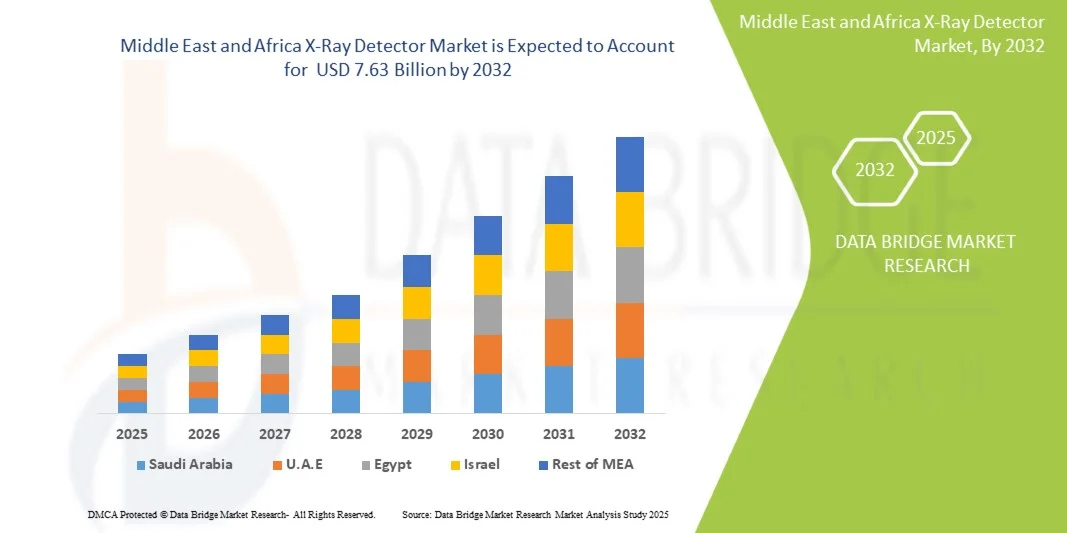
- The Middle East and Africa X-Ray Detector Market size was valued at USD 5.73 billion in 2024 and is expected to reach USD 7.63 billion by 2032, at a CAGR of 3.65% during the forecast period
- The market growth is largely fueled by the growing adoption of advanced digital imaging technologies and the increasing demand for efficient, high-resolution diagnostic tools in healthcare and industrial applications. The rising focus on early and accurate disease detection, particularly in oncology and orthopedics, is further propelling the uptake of X-ray detectors across hospitals and diagnostic centers
- Furthermore, ongoing technological advancements such as the transition from analog to digital detectors, the integration of artificial intelligence for image enhancement, and the development of portable and wireless X-ray systems are establishing digital detectors as the preferred choice in medical imaging. These factors, combined with increasing investments in healthcare infrastructure and expanding applications in dentistry, security, and non-destructive testing, are significantly boosting the growth of the Middle East and Africa X-Ray Detector Market
Middle East and Africa X-Ray Detector Market Analysis
- X-ray detectors, offering advanced digital imaging solutions for medical, dental, and industrial applications, are becoming increasingly vital components in modern diagnostic and inspection systems due to their superior image quality, real-time processing capabilities, and enhanced radiation efficiency
- The escalating demand for X-ray detectors is primarily driven by the growing prevalence of chronic diseases, rising adoption of digital radiography over conventional film-based imaging, and increasing investments in healthcare infrastructure across developing regions
- U.A.E. dominated the Middle East and Africa X-Ray Detector Market with the largest revenue share of 37.8% in 2024, characterized by a strong focus on improving diagnostic capabilities, expanding healthcare infrastructure, and the presence of key international players introducing advanced flat-panel and portable detector technologies. the United Arab Emirates (U.A.E.) are experiencing significant growth in the installation of cutting-edge X-ray systems across hospitals and diagnostic centers, driven by government initiatives to modernize healthcare facilities and encourage digital health transformation
- Saudi Arabia is expected to be the fastest-growing country in the Middle East and Africa X-Ray Detector Market during the forecast period, fueled by substantial healthcare investments under the Saudi Vision 2030 program, rising prevalence of lifestyle diseases, and the increasing adoption of digital medical imaging systems in both public and private hospitals
- The Fixed Detectors segment dominated the market with a revenue share of 58.7% in 2024, attributed to their widespread deployment in hospital radiology departments and diagnostic laboratories. Fixed systems provide high stability, superior image consistency, and compatibility with large imaging equipment
Report Scope and Middle East and Africa X-Ray Detector Market Segmentation
|
Attributes |
X-Ray Detector Key Market Insights |
|
Segments Covered |
|
|
Countries Covered |
Middle East and Africa
|
|
Key Market Players |
|
|
Market Opportunities |
|
|
Value Added Data Infosets |
In addition to the insights on market scenarios such as market value, growth rate, segmentation, geographical coverage, and major players, the market reports curated by the Data Bridge Market Research also include in-depth expert analysis, patient epidemiology, pipeline analysis, pricing analysis, and regulatory framework. |
Middle East and Africa X-Ray Detector Market Trends
“Growing Adoption of Advanced Digital Imaging Systems”
- A significant and accelerating trend in the Middle East and Africa X-Ray Detector Market is the increasing shift from analog to digital X-Ray systems, including flat panel detectors, computed radiography detectors, and portable solutions. This transition is enhancing imaging efficiency, diagnostic accuracy, and workflow automation across healthcare and industrial applications
- For instance, leading hospitals and diagnostic centers are deploying high-resolution flat panel detectors to improve imaging quality and reduce patient exposure to radiation. Similarly, industrial facilities are increasingly adopting mobile and line-scan detectors to optimize inspection and monitoring processes
- The integration of X-Ray detectors with Picture Archiving and Communication Systems (PACS) and Hospital Information Systems (HIS) allows for centralized image storage, real-time access, and efficient data management, significantly improving operational efficiency
- This trend towards advanced digital X-Ray systems is reshaping expectations for medical imaging, security inspections, and industrial nondestructive testing, encouraging vendors to introduce technologically advanced, compact, and energy-efficient solutions
- Companies such as GE Healthcare, Siemens Healthineers, and Shimadzu are investing in developing detectors with enhanced sensitivity, faster image processing, and modular designs to address diverse clinical and industrial requirements
Middle East and Africa X-Ray Detector Market Dynamics
Driver
“Increasing Demand for Medical Imaging and Security Screening”
- The rising prevalence of chronic diseases, expansion of hospitals and diagnostic facilities, and increased investment in healthcare infrastructure are significant drivers for the growth of the Middle East and Africa X-Ray Detector Market in the MEA region
- For instance: In April 2023, Siemens Healthineers launched its ACUSON Redwood digital detector series in select Middle East hospitals, designed to enhance image quality and diagnostic efficiency while reducing radiation exposure. Such developments are expected to propel market growth
- Furthermore, the expanding demand for security screening in airports, border checkpoints, and industrial facilities is driving the adoption of high-resolution and portable X-Ray detectors
- The growth of industrial inspection applications, including non-destructive testing of pipelines, electronics, and manufacturing components, further fuels the demand for reliable and high-performance detectors
- Overall, the convergence of medical, security, and industrial requirements creates a robust market environment, encouraging suppliers to offer versatile and high-precision X-Ray solutions
Restraint/Challenge
“High Initial Costs, Regulatory Compliance, and Technical Limitations”
- The relatively high initial investment required for advanced X-Ray detectors can hinder adoption, particularly among smaller hospitals, diagnostic labs, and industrial facilities in developing MEA countries
- Compliance with stringent regulatory standards, including radiation safety, device certification, and local import regulations, poses a challenge for new entrants and may delay product launch timelines
- For instance, high-end digital X-Ray systems imported from Europe often come with steep upfront costs, limiting adoption among smaller hospitals in countries like Egypt and Nigeria
- Technological complexity and the need for specialized personnel to operate and maintain high-end detectors can restrict market penetration in regions with limited trained staff
- Furthermore, competition from refurbished or low-cost X-Ray systems may impact the adoption of premium digital detectors despite their superior performance
- Limited availability of after-sales support, spare parts, and timely maintenance services in remote or less-developed areas can reduce the operational reliability of X-Ray detectors, creating hesitancy among potential buyers
- High energy consumption and infrastructure requirements for some advanced X-Ray systems may be a barrier in regions with unstable power supply or limited facility upgrades
- The rapid pace of technological innovation can result in shorter equipment lifecycles, making institutions cautious about investing in systems that may become obsolete quickly
- Addressing these challenges requires cost-effective product designs, localized training programs for operators, strong partnerships with distributors for maintenance support, and flexible financing options to improve accessibility and adoption in the MEA region
Middle East and Africa X-Ray Detector Market Scope
The market is segmented on the basis of type, panel size, portability, application, and end user.
On the basis of type, the Middle East and Africa X-Ray Detector Market is segmented into Flat Panel Detectors, Computed Radiography Detectors, Line Scan Detectors, Charged Coupled Device (CCD) Detectors, and Mobile Detectors. The Flat Panel Detector segment dominated the largest market revenue share of 46.8% in 2024, driven by its superior image quality, faster data processing capabilities, and enhanced diagnostic efficiency. The growing adoption of digital radiography systems across hospitals and imaging centers, coupled with declining costs of flat panel technology, is accelerating market penetration. The segment’s dominance is further supported by its wide applications across medical imaging, dental, and security sectors, offering high spatial resolution and low radiation dose. Increasing healthcare modernization projects across the Gulf countries and growing investment in diagnostic infrastructure are fueling demand. The transition from analog to digital imaging and the integration of AI-assisted diagnostic tools further reinforce the leading position of this segment in 2024.
The Mobile Detectors segment is anticipated to witness the fastest growth rate of 22.4% CAGR from 2025 to 2032, fueled by the increasing demand for portable imaging solutions in emergency care, home healthcare, and remote diagnostics. The segment’s rapid expansion is supported by government initiatives to improve access to radiology services in rural and underserved areas across Africa. Technological innovations such as lightweight designs, wireless connectivity, and battery efficiency enhance usability in mobile units. The growing adoption of mobile X-ray systems during pandemic and post-pandemic periods for infection control and bedside imaging has further boosted segment growth. Increased collaborations between manufacturers and regional distributors to provide affordable mobile units are expected to sustain its upward trend through 2032.
• By Panel Size
On the basis of panel size, the market is segmented into Small Area and Large Area. The Large Area panel segment accounted for the largest market share of 54.3% in 2024, driven by its extensive use in general radiography, mammography, and chest imaging procedures. Large-area detectors are preferred for capturing high-quality images in a single exposure, minimizing patient radiation dose and examination time. Hospitals and diagnostic labs favor these systems for their enhanced field of view and compatibility with full-body and skeletal imaging. Technological advancements enabling faster image acquisition and integration with digital PACS systems have further propelled adoption across tertiary care hospitals. Increased investments in high-end radiology equipment in Saudi Arabia, U.A.E., and South Africa are contributing to segment dominance.
The Small Area segment is projected to register the fastest CAGR of 19.8% from 2025 to 2032, primarily due to rising applications in dental imaging, orthopedic diagnostics, and veterinary care. Compact detector sizes are increasingly utilized in specialized diagnostics where precision and portability are essential. The affordability and adaptability of small panels for clinics and point-of-care settings make them a preferred choice in emerging healthcare markets of Africa. Continuous innovations improving resolution, sensitivity, and integration into handheld devices are expected to sustain strong segmental growth throughout the forecast period.
• By Portability
On the basis of portability, the market is segmented into Fixed Detectors and Portable Detectors. The Fixed Detectors segment dominated the market with a revenue share of 58.7% in 2024, attributed to their widespread deployment in hospital radiology departments and diagnostic laboratories. Fixed systems provide high stability, superior image consistency, and compatibility with large imaging equipment. Increased hospital capacity expansions and modernization of radiology rooms across major urban healthcare facilities are driving growth. Additionally, the high throughput of fixed detectors makes them ideal for handling large patient volumes efficiently.
The Portable Detectors segment is expected to witness the fastest CAGR of 21.5% from 2025 to 2032, supported by their growing use in emergency care, ICU, military, and remote medical units. The trend toward decentralized diagnostics, coupled with advancements in wireless technology and real-time image transmission, is accelerating adoption. Portable detectors are increasingly used for bedside imaging, veterinary applications, and home healthcare settings, especially in rural regions of the Middle East and Africa, where fixed infrastructure is limited. Rising investments by healthcare providers in mobile diagnostic units and portable imaging solutions are further fueling market growth. In addition, continuous innovations aimed at improving battery efficiency, image quality, and lightweight designs are enhancing the usability and reliability of portable X-ray detectors across diverse applications.
• By Application
On the basis of application, the market is segmented into Medical Imaging, Dental Application, Security Application, Veterinary Application, and Industrial Application. The Medical Imaging segment dominated with the largest revenue share of 49.1% in 2024, driven by the growing prevalence of chronic diseases and rising diagnostic imaging volumes in hospitals. The adoption of advanced X-ray detector systems enhances diagnostic accuracy, reduces patient exposure, and enables faster clinical decisions. The growing healthcare infrastructure investments across GCC countries and South Africa further bolster segment leadership. Integration of flat panel detectors with AI-based diagnostic imaging platforms has further improved workflow efficiency and radiologist accuracy.
The Veterinary Application segment is expected to witness the fastest CAGR of 20.3% from 2025 to 2032, driven by the rising focus on pet healthcare and livestock diagnostics across the region. The increasing establishment of veterinary hospitals and mobile diagnostic units, coupled with demand for cost-effective imaging solutions, supports segment expansion. The growing awareness of animal welfare and government support for veterinary healthcare in the Middle East are propelling adoption. In addition, advancements in portable and wireless X-ray technologies are enabling efficient field diagnostics for large and small animals. The surge in pet insurance coverage and rising disposable incomes among pet owners are further accelerating the demand for advanced veterinary imaging systems.
• By End User
On the basis of end user, the market is segmented into Hospitals, Diagnostic Laboratories, Original Equipment Manufacturers (OEMs), Clinics, and ICUs. The Hospitals segment dominated the largest market revenue share of 55.6% in 2024, driven by the high patient inflow, availability of advanced imaging infrastructure, and growing demand for accurate diagnostic outcomes. The increasing number of hospital construction projects and government funding for digital radiology transformation further strengthen the segment’s dominance. Hospitals are increasingly adopting advanced flat panel and large-area detectors for improved operational efficiency and diagnostic precision.
The Diagnostic Laboratories segment is anticipated to register the fastest CAGR of 19.9% from 2025 to 2032, fueled by the rising number of independent diagnostic centers and collaborations with OEMs for digital imaging services. The growing demand for preventive health checkups and portable diagnostic systems is accelerating the adoption of digital X-ray detectors in labs. Expansion of regional diagnostic chains and partnerships with international imaging companies continue to strengthen this segment’s growth outlook. Moreover, the increasing incorporation of AI-powered image analysis tools and cloud-based data management systems is further enhancing operational efficiency and diagnostic accuracy within laboratories.
Middle East and Africa X-Ray Detector Market Regional Analysis
- The Middle East and Africa (MEA) Middle East and Africa X-Ray Detector Market is projected to grow steadily throughout the forecast period, driven by rapid advancements in healthcare infrastructure, the adoption of digital imaging technologies, and government initiatives aimed at improving diagnostic capabilities. Increasing investments in modern healthcare facilities, a rising burden of chronic diseases, and a strong focus on technological innovation are propelling the regional market forward
- Moreover, the growing integration of Artificial Intelligence (AI) and cloud-based imaging solutions into X-ray systems is enhancing diagnostic precision and operational efficiency. Key international manufacturers are strengthening their presence through collaborations and distribution partnerships
- Further supporting the adoption of advanced flat-panel and portable X-ray detectors. The region’s expanding medical tourism industry and increasing awareness of preventive healthcare are also fueling demand across both hospital and outpatient settings
U.A.E. Middle East and Africa X-Ray Detector Market Insight
The U.A.E. Middle East and Africa X-Ray Detector Market dominated the Middle East and Africa X-Ray Detector Market with the largest revenue share of 37.8% in 2024, characterized by a strong focus on improving diagnostic capabilities, expanding healthcare infrastructure, and the presence of key international players introducing advanced flat-panel and portable detector technologies. The country has made significant strides toward establishing world-class healthcare facilities, supported by government initiatives encouraging digital health transformation and the deployment of AI-driven imaging solutions. Leading healthcare institutions are adopting high-resolution detectors to enhance diagnostic accuracy and workflow efficiency. Furthermore, continuous investments in research collaborations and public-private partnerships are strengthening the U.A.E.’s position as a regional hub for medical imaging innovation. The rapid expansion of diagnostic centers, along with favorable reimbursement policies and a focus on preventive medicine, continues to drive the demand for advanced X-ray detector systems.
Saudi Arabia Middle East and Africa X-Ray Detector Market Insight
Saudi Arabia Middle East and Africa X-Ray Detector Market is expected to be the fastest-growing country in the Middle East and Africa X-Ray Detector Market during the forecast period, registering a notable CAGR, fueled by substantial healthcare investments under the Saudi Vision 2030 initiative. The country’s strategic focus on improving healthcare accessibility and upgrading diagnostic infrastructure has accelerated the adoption of digital medical imaging systems in both public and private hospitals. Rising prevalence of lifestyle-related diseases such as cardiovascular and respiratory disorders is amplifying the need for efficient diagnostic imaging tools. Government-backed programs to localize medical device manufacturing and expand tele-radiology services are further stimulating market growth. Additionally, collaborations with global imaging solution providers and the introduction of advanced portable detectors tailored for emergency and mobile healthcare units are positioning Saudi Arabia as a key emerging market for next-generation X-ray detector technologies in the MEA region.
Middle East and Africa X-Ray Detector Market Share
The X-Ray Detector industry is primarily led by well-established companies, including:
- Canon Inc. (Japan)
- FUJIFILM Holdings Corporation (Japan)
- Konica Minolta Inc. (Japan)
- Moxtek Inc. (U.S.)
- PerkinElmer Inc. (U.S.)
- Rigaku Corp. (Japan)
- Teledyne Technologies Inc. (U.S.)
- Varex Imaging Corp. (U.S.)
- Varian Medical Systems Inc. (U.S.)
- Vieworks Co., Ltd. (South Korea)
Latest Developments in Middle East and Africa X-Ray Detector Market
- In February 2023, United Imaging participated as a Platinum partner at Arab Health 2023 in Dubai, U.A.E.. The company introduced several state-of-the-art medical imaging devices, including the uDR 380i Pro, a compact mobile digital radiography system. This launch highlights United Imaging's dedication to providing innovative imaging solutions to the MEA healthcare sector
- In July 2023, Canon Medical Systems launched the Zexira i9 digital X-ray RF system in the Middle East. This multi-purpose fluoroscopic table is equipped with advanced features and a compact design, aiming to enhance diagnostic capabilities in medical facilities across the region
- In November 2024, researchers at King Abdullah University of Science and Technology (KAUST) developed cascade-engineered X-ray detectors utilizing perovskite materials. These detectors aim to reduce radiation exposure while maintaining high image quality, representing a significant advancement in low-dose X-ray imaging technology
- In February 2024, NMI showcased the Vieworks VIVIX-S 1751S, the world's longest X-ray flat panel detector, at Arab Health 2024 in Dubai. This 17.5-inch detector is designed to enhance imaging capabilities in various medical applications, offering improved resolution and efficiency. The launch underscores NMI's commitment to advancing diagnostic imaging technology in the Middle East and North Africa region
- In March 2025, Lunit expanded its partnership with Dr. Sulaiman Al Habib Medical Group to deploy its AI-powered chest X-ray solution, Lunit INSIGHT CXR, across Saudi Arabia. This initiative aims to enhance diagnostic accuracy and efficiency in radiology departments nationwide

- Interactive Data Analysis Dashboard
- Company Analysis Dashboard for high growth potential opportunities
- Research Analyst Access for customization & queries
- Competitor Analysis with Interactive dashboard
- Latest News, Updates & Trend analysis
- Harness the Power of Benchmark Analysis for Comprehensive Competitor Tracking
Data collection and base year analysis are done using data collection modules with large sample sizes. The stage includes obtaining market information or related data through various sources and strategies. It includes examining and planning all the data acquired from the past in advance. It likewise envelops the examination of information inconsistencies seen across different information sources. The market data is analysed and estimated using market statistical and coherent models. Also, market share analysis and key trend analysis are the major success factors in the market report. To know more, please request an analyst call or drop down your inquiry.
The key research methodology used by DBMR research team is data triangulation which involves data mining, analysis of the impact of data variables on the market and primary (industry expert) validation. Data models include Vendor Positioning Grid, Market Time Line Analysis, Market Overview and Guide, Company Positioning Grid, Patent Analysis, Pricing Analysis, Company Market Share Analysis, Standards of Measurement, Global versus Regional and Vendor Share Analysis. To know more about the research methodology, drop in an inquiry to speak to our industry experts.
Data Bridge Market Research is a leader in advanced formative research. We take pride in servicing our existing and new customers with data and analysis that match and suits their goal. The report can be customized to include price trend analysis of target brands understanding the market for additional countries (ask for the list of countries), clinical trial results data, literature review, refurbished market and product base analysis. Market analysis of target competitors can be analyzed from technology-based analysis to market portfolio strategies. We can add as many competitors that you require data about in the format and data style you are looking for. Our team of analysts can also provide you data in crude raw excel files pivot tables (Fact book) or can assist you in creating presentations from the data sets available in the report.













