


North America AI in Bioinformatics Market Overview
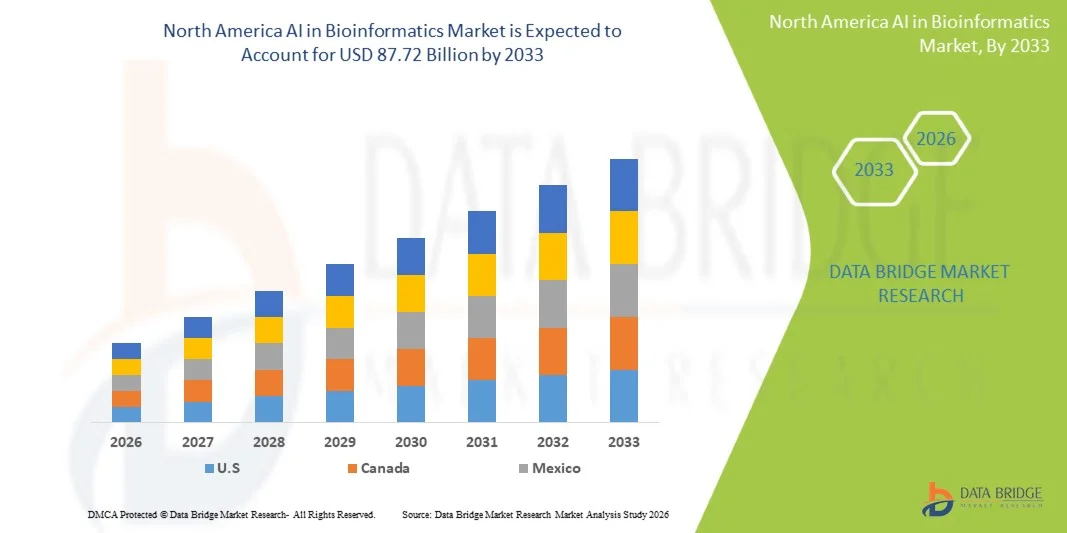
The North America AI in bioinformatics market was valued at USD 4.44 billion in 2025 and is projected to reach USD 87.72 billion by 2033, growing at a CAGR of 45.20% from 2026 to 2033. The market is experiencing robust growth driven by increasing adoption of artificial intelligence in genomics, drug discovery, precision medicine, and biomedical research, along with rising investments in advanced computational biology platforms across the region.
The growing volume of biological and genomic data, combined with the need for faster and more accurate analysis, is encouraging pharmaceutical companies, biotechnology firms, research institutions, and healthcare organizations to integrate AI-powered bioinformatics solutions into their workflows. Machine learning, deep learning, and predictive analytics technologies are transforming traditional bioinformatics processes by enabling efficient genome sequencing, biomarker identification, disease prediction, and drug target discovery. Furthermore, strong government support for life sciences research, expanding collaborations between AI developers and biotechnology companies, and the presence of a well-established healthcare infrastructure are accelerating the adoption of AI-driven bioinformatics tools throughout North America.
Key Market Trends & Insights
- The United States dominated the North America AI in Bioinformatics market with the largest revenue share of 78.64% in 2025, supported by its strong biotechnology industry, advanced genomic research ecosystem, and substantial investments in artificial intelligence and precision medicine initiatives.
- The Software segment led the market with a 63.48% share in 2025, driven by the widespread deployment of AI-powered bioinformatics platforms for genomic analysis, drug discovery, and precision medicine applications.
- Canada is expected to be the fastest-growing country in the market at a CAGR of 15.4% from 2026 to 2033, fueled by expanding government support for genomics research, growing AI innovation hubs, and increasing collaborations between research institutions and biotechnology companies.
- Services are the fastest-growing simulation type, projected to register a CAGR of 16.9%, reflecting the surge in demand for bioinformatics consulting, data analysis, implementation, and managed services.
- The Machine Learning segment dominated the type category with a 46.82% revenue share in 2025, led by extensive use in predictive modeling, genomic analysis, biomarker discovery, and drug development
- Bioinformatics Platforms accounted for 44.26% of the market, preferred by their central role in integrating, analyzing, and managing complex biological datasets.
- The Environmental Biotechnology segment is the fastest-growing sector category, with a CAGR of 15.8%, driven by increasing focus on environmental monitoring, microbial analysis, and sustainability initiatives.
Market Size & Forecast
- Global Market Value (2025): USD 4.44 Billion
- Expected Market Value (2033): USD 87.72 Billion
- Forecast CAGR (2026–2033): 45.20%
- Leading Country in 2025: United States
- Fastest Growing Country: Canada
Report Scope and North America AI in Bioinformatics Market Segmentation
|
Attributes |
North America AI in Bioinformatics Key Market Insights |
|
Segments Covered |
|
|
Countries Covered |
North America · U.S. · Canada · Mexico |
|
Key Market Players |
· Illumina, Inc. (U.S.) · Thermo Fisher Scientific Inc. (U.S.) · QIAGEN (Netherlands) · Agilent Technologies, Inc. (U.S.) · PerkinElmer (U.S.) · DNAnexus, Inc. (U.S.) · Partek Incorporated (U.S.) · SOPHiA GENETICS SA (Switzerland) · Geneious Prime (New Zealand) · Biomatters Ltd. (New Zealand) · BGI Group (China) · GeneGo Inc. (U.S.) · Genedata AG (Switzerland) · Insilico Medicine Hong Kong Limited (Hong Kong) · BenevolentAI (U.K.) · Oxford Nanopore Technologies plc (U.K.) · Fabric Genomics, Inc. (U.S.) · Tempus AI, Inc. (U.S.) · L7 Informatics, Inc. (U.S.) · Seven Bridges Genomics Inc. (U.S.) |
|
Market Opportunities |
· Expansion of precision medicine programs · Increasing adoption of AI in drug discovery · Growth of cross-border genomic data sharing initiatives |
|
Value Added Data Infosets |
In addition to the insights on market scenarios such as market value, growth rate, segmentation, geographical coverage, and major players, the market reports curated by the Data Bridge Market Research also include in-depth expert analysis, patient epidemiology, pipeline analysis, pricing analysis, and regulatory framework. |
North America AI in Bioinformatics Market Trends
Trend: Rising Adoption of AI-Powered Multi-Omics Analysis
Biotechnology companies, pharmaceutical manufacturers, and research institutions are increasingly adopting AI-powered bioinformatics platforms to analyze complex genomic, proteomic, transcriptomic, and metabolomic datasets more efficiently. The integration of machine learning and deep learning technologies enables faster identification of disease biomarkers, improved understanding of biological pathways, and enhanced precision medicine development. Academic centers and healthcare organizations are similarly leveraging AI-driven analytics to accelerate research workflows through standardized, data-driven methodologies, while cloud-based computing environments provide scalable infrastructure that supports large-scale biological data processing and collaborative scientific discovery.
For instance, in March 2025, Illumina expanded AI-enabled genomic analysis capabilities across its bioinformatics ecosystem, supporting faster interpretation of sequencing data and advancing precision medicine research initiatives.
North America AI in Bioinformatics Market Dynamics
Key Market Driver: Expanding Use of AI in Drug Discovery and Genomic Research
The rapid expansion of genomic research and AI-assisted drug discovery has created substantial demand for advanced bioinformatics platforms that can analyze vast biological datasets, identify therapeutic targets, and accelerate clinical development processes across multiple disease areas. Pharmaceutical companies, biotechnology firms, and research organizations are deploying AI-enabled bioinformatics solutions as a core component of their innovation strategies, reducing research timelines, improving predictive accuracy, and enhancing the efficiency of biomarker discovery and precision medicine development programs.
For instance, in January 2024, NVIDIA Corporation announced expanded collaborations with healthcare and life sciences organizations to accelerate AI-driven drug discovery, genomics, and biomedical research applications.
Key Restraint/Challenge: Data Complexity and Regulatory Compliance Requirements
A significant restraint in the North America AI in Bioinformatics market is the complexity of integrating diverse biological datasets while maintaining compliance with evolving regulatory and privacy requirements. Modern bioinformatics platforms process large volumes of genomic, clinical, and molecular information, requiring substantial investment in data governance, cybersecurity infrastructure, and validation frameworks. The operational burden extends to interoperability management, workforce training, and regulatory documentation, making implementation challenging for smaller biotechnology firms, academic laboratories, and resource-constrained healthcare organizations.
For instance, increasing regulatory scrutiny surrounding genomic data management and patient privacy across the United States and Canada continues to require additional compliance investments from organizations deploying AI-enabled bioinformatics solutions
Key Market Opportunity: Growth of Precision Medicine and Predictive Analytics Platforms
The integration of artificial intelligence into precision medicine presents a significant market opportunity. AI-enabled bioinformatics platforms can identify patient-specific treatment pathways, generate predictive disease risk models, and support large-scale genomic interpretation programs. The development of cloud-native analytics environments and federated data-sharing frameworks is further expanding access to advanced bioinformatics capabilities, opening growth opportunities across healthcare systems, research institutions, and biotechnology companies throughout North America.
For instance, in June 2024, Tempus AI, Inc. strengthened its AI-driven precision medicine platform with expanded genomic analytics capabilities designed to improve clinical decision-making and personalized treatment development.
North America AI in Bioinformatics Market Scope
The North America AI in bioinformatics market is segmented on the basis of offering, type, products and services, application, and sector.
- By Offering
On the basis of offering, the North America AI in bioinformatics market is segmented into software, services, and others. The Software segment dominated the market with a 63.48% share in 2025, owing to the widespread deployment of AI-powered bioinformatics platforms for genomic analysis, drug discovery, and precision medicine applications. Software solutions enable automated processing of large biological datasets, reducing analytical time and improving research efficiency. Pharmaceutical and biotechnology companies increasingly rely on advanced algorithms to accelerate biomarker identification and target discovery. The growing adoption of cloud-integrated bioinformatics tools further supports segment growth. Continuous innovation in machine learning models and data visualization capabilities is enhancing software performance. Strong demand for scalable and interoperable solutions continues to reinforce the segment’s market leadership.
The Services segment is projected to register the fastest growth at a CAGR of 16.9% from 2026 to 2033, driven by increasing demand for bioinformatics consulting, data analysis, implementation, and managed services. Many organizations lack in-house expertise to manage complex AI-based bioinformatics workflows, creating strong demand for specialized service providers. The rapid expansion of genomics and personalized medicine projects is increasing outsourcing activities. Service providers are also helping organizations meet regulatory and data security requirements. Growing collaborations between healthcare institutions and technology firms are accelerating adoption. Rising complexity of multi-omics research is expected to further strengthen the segment’s growth trajectory.
- By Type
On the basis of type, the North America AI in bioinformatics market is segmented into machine learning, deep learning, and others. The Machine Learning segment led the market with a 46.82% share in 2025, driven by its extensive use in predictive modeling, genomic analysis, biomarker discovery, and drug development. Machine learning algorithms efficiently analyze large-scale biological datasets and identify hidden patterns that support research decision-making. Pharmaceutical companies use these tools to improve clinical trial outcomes and therapeutic development. The technology offers flexibility across multiple bioinformatics applications, making it widely adopted throughout the life sciences industry. Increasing integration with cloud computing platforms further enhances accessibility and scalability. Its proven effectiveness and broad applicability continue to sustain segment dominance.
The Deep Learning segment is expected to witness the fastest growth at a CAGR of 17.5% from 2026 to 2033, driven by its ability to process highly complex and unstructured biological data. Deep learning models are increasingly utilized for protein structure prediction, genomic sequencing interpretation, and disease classification. Advancements in computational power and AI infrastructure are supporting wider deployment. The technology delivers superior accuracy in image analysis and molecular modeling applications. Growing investments in next-generation healthcare analytics are creating significant opportunities. Expanding use of neural networks in precision medicine is further accelerating segment growth.
- By Products and Services
On the basis of products and services, the North America AI in bioinformatics market is segmented into knowledge management tools, bioinformatics platforms, and bioinformatics services. The Bioinformatics Platforms segment dominated the market with a 44.26% share in 2025, owing to their central role in integrating, analyzing, and managing complex biological datasets. These platforms support genomics, proteomics, transcriptomics, and drug discovery workflows within a unified environment. Research institutions and pharmaceutical companies increasingly depend on platform-based solutions to streamline data processing and collaboration. The incorporation of AI and machine learning capabilities is enhancing analytical efficiency and accuracy. Cloud-enabled platforms are also improving accessibility and scalability. Their comprehensive functionality continues to drive strong market adoption.
The Bioinformatics Services segment is projected to be the fastest-growing segment at a CAGR of 16.7% from 2026 to 2033, driven by rising demand for outsourced data analysis and specialized bioinformatics expertise. Organizations are increasingly partnering with service providers to reduce operational costs and accelerate research timelines. Growing volumes of sequencing data are creating demand for advanced analytical support. Service providers offer customized solutions tailored to specific research requirements. Expansion of precision medicine and genomics initiatives is further strengthening demand. Increasing complexity of AI-driven bioinformatics projects continues to support rapid segment growth.
- By Application
On the basis of application, the North America AI in bioinformatics market is segmented into genomics, microarrays, system biology, text mining, chemoinformatics & drug design, proteomics, transcriptomics, DNA sequencing, metabolomics, and others. The Genomics segment accounted for the largest market share of 29.73% in 2025, driven by extensive use of AI technologies in genome mapping, variant analysis, and personalized medicine development. Increasing investments in genomic research programs across the United States and Canada are supporting segment expansion. AI-powered analytics significantly improve the speed and accuracy of genomic interpretation. Pharmaceutical companies leverage genomic insights to develop targeted therapies and improve treatment outcomes. Growing adoption of next-generation sequencing technologies is generating large datasets requiring advanced analytical tools. These factors continue to position genomics as the leading application segment.
The Chemoinformatics & Drug Design segment is anticipated to register the fastest growth at a CAGR of 18.2% from 2026 to 2033, fueled by rising adoption of AI in molecular modeling, compound screening, and drug candidate optimization. Pharmaceutical companies are increasingly using AI algorithms to shorten drug development cycles and reduce research costs. Advanced predictive models improve the identification of promising therapeutic compounds. Growing demand for precision therapeutics is further supporting adoption. Continuous innovation in computational chemistry platforms is expanding application potential. The increasing focus on accelerating pharmaceutical innovation is expected to drive strong growth.
- By Sector
On the basis of sector, the North America AI in bioinformatics market is segmented into medical biotechnology, animal biotechnology, plant biotechnology, environmental biotechnology, forensic biotechnology, and others. The Medical Biotechnology segment dominated the market with a 51.38% share in 2025, owing to the extensive application of AI-driven bioinformatics in disease research, drug discovery, clinical diagnostics, and precision medicine. Healthcare organizations and pharmaceutical companies continue to invest heavily in advanced bioinformatics technologies to improve patient outcomes. The increasing prevalence of chronic diseases is driving demand for targeted treatment solutions. AI tools enable faster identification of biomarkers and therapeutic targets. Strong government and private-sector funding for biomedical research further supports growth. The segment remains the primary revenue contributor within the market.
The Environmental Biotechnology segment is expected to experience the fastest growth at a CAGR of 15.8% from 2026 to 2033, driven by increasing focus on environmental monitoring, microbial analysis, and sustainability initiatives. AI-powered bioinformatics tools are being used to study ecosystems, pollution patterns, and biodiversity at unprecedented scale. Governments and research organizations are investing in environmental genomics projects to address climate and ecological challenges. Advances in sequencing technologies are generating large environmental datasets requiring sophisticated analytical solutions. Growing emphasis on sustainable resource management is further supporting adoption. These factors are expected to accelerate growth across the environmental biotechnology segment.
North America AI in Bioinformatics Market Regional Analysis
The United States dominated the North America AI in Bioinformatics market with the largest revenue share of 78.64% in 2025, supported by its strong biotechnology industry, advanced genomic research ecosystem, and substantial investments in artificial intelligence and precision medicine initiatives. The country also benefits from extensive genomic research initiatives, strong government and private funding for life sciences innovation, and widespread adoption of AI-powered bioinformatics platforms across drug discovery, precision medicine, and clinical research applications. Increasing focus on multi-omics analysis, personalized healthcare solutions, and accelerated therapeutic development continues to strengthen the United States' leadership position within the North American market.
The U.S. AI in Bioinformatics Market Insight
The U.S. AI in Bioinformatics market is witnessing strong growth due to rising investments in genomic research, precision medicine initiatives, and AI-driven drug discovery technologies. The country’s mature biotechnology and pharmaceutical ecosystem, along with increasing adoption of machine learning, deep learning, and cloud-based bioinformatics platforms, is driving demand across healthcare, research, and life sciences applications. In addition, growing emphasis on personalized healthcare and faster therapeutic development is accelerating the adoption of AI-powered bioinformatics solutions across research institutions, biotechnology companies, and pharmaceutical manufacturers.
Canada AI in Bioinformatics Market Insight
The Canada AI in Bioinformatics market is experiencing steady growth, supported by rising adoption of artificial intelligence technologies in genomics research, healthcare innovation, and biotechnology applications. Increasing investments in advanced bioinformatics infrastructure and growing demand for efficient and scalable biological data analysis solutions are contributing to market growth. Furthermore, integration of machine learning, cloud computing, and predictive analytics technologies is improving research capabilities and operational efficiency, positioning Canada as a key innovation hub in the AI in bioinformatics industry.
Mexico AI in Bioinformatics Market Insight
The Mexico AI in Bioinformatics market is emerging steadily, driven by growing investments in healthcare modernization, biotechnology research, and digital health initiatives. Increasing adoption of AI-powered bioinformatics tools for genomic analysis, disease research, and pharmaceutical development is supporting market expansion across academic and healthcare institutions. In addition, rising collaborations between research organizations, healthcare providers, and technology companies, coupled with increasing awareness of precision medicine and data-driven healthcare solutions, are contributing to the growing adoption of AI in bioinformatics across Mexico.
North America AI in Bioinformatics Market Share
The North America AI in bioinformatics industry is primarily led by well-established companies, including:
- Illumina, Inc. (U.S.)
- Thermo Fisher Scientific Inc. (U.S.)
- QIAGEN (Netherlands)
- Agilent Technologies, Inc. (U.S.)
- PerkinElmer (U.S.)
- DNAnexus, Inc. (U.S.)
- Partek Incorporated (U.S.)
- SOPHiA GENETICS SA (Switzerland)
- Geneious Prime (New Zealand)
- Biomatters Ltd. (New Zealand)
- BGI Group (China)
- GeneGo Inc. (U.S.)
- Genedata AG (Switzerland)
- Insilico Medicine Hong Kong Limited (Hong Kong)
- BenevolentAI (U.K.)
- Oxford Nanopore Technologies plc (U.K.)
- Fabric Genomics, Inc. (U.S.)
- Tempus AI, Inc. (U.S.)
- L7 Informatics, Inc. (U.S.)
- Seven Bridges Genomics Inc. (U.S.)
Latest Developments in North America AI in Bioinformatics Market
- In March 2025, Isomorphic Labs announced the successful completion of a USD 600 million funding round to accelerate its AI-driven drug discovery platform. The company stated that the investment would be used to advance next-generation AI models, expand clinical development programs, and strengthen partnerships with pharmaceutical companies. The funding highlights growing confidence in AI-powered bioinformatics solutions for drug development and molecular research across North America
- In November 2024, Google DeepMind released the AlphaFold 3 model code and weights for academic research use, enabling researchers to integrate advanced biomolecular structure prediction capabilities into bioinformatics workflows. The release expanded access to AI-powered tools capable of predicting interactions among proteins, DNA, RNA, ligands, and other biological molecules, supporting innovation in genomics and drug discovery
- In May 2024, Google DeepMind and Isomorphic Labs introduced AlphaFold 3, a breakthrough AI model capable of predicting the structure and interactions of proteins, DNA, RNA, and small molecules with unprecedented accuracy. The platform significantly improves biomolecular interaction prediction and is expected to accelerate drug discovery, genomics research, and computational biology applications. The launch represented one of the most important advances in AI-enabled bioinformatics in recent years
- In October 2023, Google DeepMind unveiled a new generation of AlphaFold technology capable of generating predictions for nearly all molecules contained within the Protein Data Bank. The enhanced platform expanded the scope of AI-assisted structural biology and enabled broader application of bioinformatics tools in therapeutic discovery and molecular research. The development reinforced the growing role of artificial intelligence in life sciences innovation
- In November 2021, Isomorphic Labs was launched by Alphabet to apply advanced artificial intelligence technologies to drug discovery and biological research. Built on breakthroughs from the AlphaFold program, the company was established to leverage AI for understanding biological systems and accelerating therapeutic development. The launch marked a significant milestone in the commercialization of AI-driven bioinformatics and computational biology platforms

- Interactive Data Analysis Dashboard
- Company Analysis Dashboard for high growth potential opportunities
- Research Analyst Access for customization & queries
- Competitor Analysis with Interactive dashboard
- Latest News, Updates & Trend analysis
- Harness the Power of Benchmark Analysis for Comprehensive Competitor Tracking
Data collection and base year analysis are done using data collection modules with large sample sizes. The stage includes obtaining market information or related data through various sources and strategies. It includes examining and planning all the data acquired from the past in advance. It likewise envelops the examination of information inconsistencies seen across different information sources. The market data is analysed and estimated using market statistical and coherent models. Also, market share analysis and key trend analysis are the major success factors in the market report. To know more, please request an analyst call or drop down your inquiry.
The key research methodology used by DBMR research team is data triangulation which involves data mining, analysis of the impact of data variables on the market and primary (industry expert) validation. Data models include Vendor Positioning Grid, Market Time Line Analysis, Market Overview and Guide, Company Positioning Grid, Patent Analysis, Pricing Analysis, Company Market Share Analysis, Standards of Measurement, Global versus Regional and Vendor Share Analysis. To know more about the research methodology, drop in an inquiry to speak to our industry experts.
Data Bridge Market Research is a leader in advanced formative research. We take pride in servicing our existing and new customers with data and analysis that match and suits their goal. The report can be customized to include price trend analysis of target brands understanding the market for additional countries (ask for the list of countries), clinical trial results data, literature review, refurbished market and product base analysis. Market analysis of target competitors can be analyzed from technology-based analysis to market portfolio strategies. We can add as many competitors that you require data about in the format and data style you are looking for. Our team of analysts can also provide you data in crude raw excel files pivot tables (Fact book) or can assist you in creating presentations from the data sets available in the report.













