


Anticoagulation Therapy Market Size
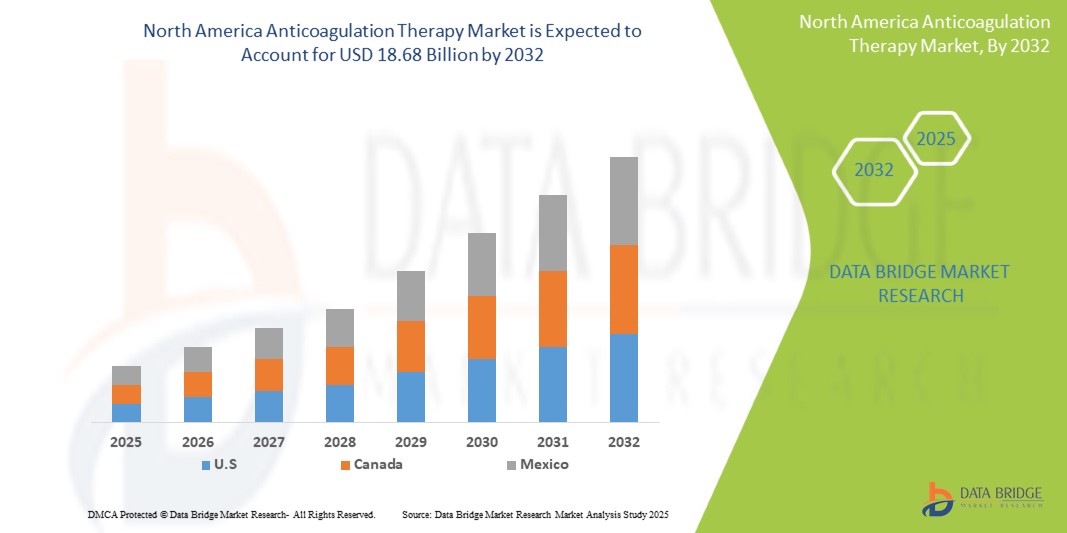
- The North America Anticoagulation Therapy market size was valued at USD 13.87 billion in 2024 and is expected to reach USD 18.68 billion by 2032, at a CAGR of 4.35% during the forecast period
- This growth is driven by rising cardiovascular disease prevalence, the aging population, favorable reimbursement policies, and the increasing uptake of DOACs across the U.S. and Canada
Anticoagulation Therapy Market Analysis:
- Anticoagulation therapies help prevent blood clots, reducing the risk of stroke, heart attacks, and venous thromboembolism. These therapies have become essential in managing cardiovascular and hematological disorders, especially among the elderly and high-risk patient groups.
- North America leads global adoption due to advanced healthcare infrastructure, clinical awareness, and accessibility to high-end therapies.
- The United States dominates the market owing to high healthcare spending, early adoption of new therapies, and the presence of leading pharmaceutical players.
- Canada is projected to witness the fastest growth due to expanding insurance coverage, government health initiatives, and national screening programs.
- Direct Oral Anticoagulants (DOACs) segment is expected to lead with a share of 54.1% driven clinical preference for simplified dosing regimens and safety in elderly populations.
Report Scope and Anticoagulation Therapy Market Segmentation
|
Attributes |
Anticoagulation Therapy Key Market Insights |
|
Segments Covered |
|
|
Countries Covered |
North America
|
|
Key Market Players |
|
|
Market Opportunities |
|
|
Value Added Data Infosets |
In addition to the insights on market scenarios such as market value, growth rate, segmentation, geographical coverage, and major players, the market reports curated by the Data Bridge Market Research also include import export analysis, production capacity overview, production consumption analysis, price trend analysis, climate change scenario, supply chain analysis, value chain analysis, raw material/consumables overview, vendor selection criteria, PESTLE Analysis, Porter Analysis, and regulatory framework. |
Anticoagulation Therapy Market Trends
“Adoption of Digital Therapeutics and AI-Driven Monitoring Tools”
- The North American market is witnessing a surge in digital health tools and AI platforms that support anticoagulation therapy. Remote INR monitoring, e-prescriptions, and smart pill dispensers are enhancing patient engagement and treatment outcomes.
- AI-based models are also helping clinicians predict bleeding risk and optimize dosing.
Anticoagulation Therapy Market Dynamics
Driver
“High Cardiovascular Disease Burden and Aging Population”
- The prevalence of atrial fibrillation, heart failure, and venous thromboembolism is rising, particularly among the elderly.
- This is further supported by routine cardiovascular screenings and improved insurance coverage for anticoagulant therapies.
- For instance, In 2024, the American Heart Association reported that over 6.5 million people in the U.S. live with atrial fibrillation, highlighting the vast treatment population supported by proactive screening programs.
Opportunity
“Government Support for Stroke Prevention and Real-World Evidence”
- Public health agencies across the U.S. and Canada are investing in stroke prevention programs and funding studies on anticoagulant safety and adherence. Medicare and Medicaid coverage for DOACs has improved access for elderly populations.
- For instance, In February 2025, the U.S. FDA granted fast-track status for a wearable INR monitoring device developed in collaboration with Mayo Clinic, aimed at rural populations.
Restraint/Challenge
“Bleeding Risk and Affordability of Novel Therapies”
- Although DOACs offer superior safety profiles, the risk of gastrointestinal bleeding and renal complications remains a concern. Additionally, high drug prices and lack of generic versions limit access among uninsured and underinsured groups.
- For instance, A 2023 study by Harvard Medical School highlighted that 28% of anticoagulation-eligible patients in low-income U.S. neighborhoods delayed therapy initiation due to cost concerns.
Anticoagulation Therapy Market Scope
The market is segmented on the basis of drug class, indication, route of administration, end user, and distribution channel.
|
Segmentation |
Sub-Segmentation |
|
By Drug Class |
|
|
By Indication |
|
|
By Route of Administration |
|
|
By End User |
|
|
By Distribution Channel
|
|
In 2025, the Direct Oral Anticoagulants (DOACs) segment is projected to dominate the market with the largest share in drug class segment
In 2025, the DOACs segment is expected to hold a 54.1% market share, driven by clinical preference for simplified dosing regimens and safety in elderly populations.
The Atrial Fibrillation & Heart Attack segment is expected to account for the largest share during the forecast period in indication segment
In 2025, the Atrial Fibrillation & Heart Attack segment is anticipated to hold a 48.97% market share due to increasing diagnostic rates and guideline-based prescribing patterns.
Anticoagulation Therapy Market Regional Analysis
“United States Holds the Largest Share in the Anticoagulation Therapy Market”
The U.S. dominates the North America Anticoagulation Therapy market due to advanced reimbursement mechanisms, rapid adoption of new therapies, and national atrial fibrillation management programs.
“Canada is Projected to Register the Highest CAGR in the Anticoagulation Therapy Market”
Canada is expected to grow rapidly due to policy-level inclusion of DOACs in public plans, widespread telehealth platforms, and national-level adherence initiatives.
Anticoagulation Therapy Market Share
The market competitive landscape provides details by competitor. Details included are company overview, company financials, revenue generated, market potential, investment in research and development, new market initiatives, North America presence, production sites and facilities, production capacities, company strengths and weaknesses, product launch, product width and breadth, application dominance. The above data points provided are only related to the companies' focus related to market.
The Major Market Leaders Operating in the Market Are:
- Bristol-Myers Squibb Company (U.S.)
- Pfizer Inc. (U.S.)
- Bayer AG (Germany)
- Daiichi Sankyo Company, Limited (Japan)
- Johnson & Johnson Services, Inc. (U.S.)
- Sanofi S.A. (France)
- Boehringer Ingelheim International GmbH (Germany)
- Abbott Laboratories (U.S.)
- AstraZeneca (UK)
- F. Hoffmann-La Roche Ltd (Switzerland)
Latest Developments in North America Anticoagulation Therapy Market
- In March 2025, Pfizer and Bristol-Myers Squibb expanded their U.S.-based study on Eliquis to include Hispanic and African American populations to assess racial disparities in bleeding outcomes.
- In January 2025, Johnson & Johnson’s Janssen division announced the launch of a once-daily oral anticoagulant in the U.S. for post-surgical patients.
- In December 2024, a Canadian health-tech startup received Health Canada approval for a remote INR monitoring wearable for rural elderly populations.

- Interactive Data Analysis Dashboard
- Company Analysis Dashboard for high growth potential opportunities
- Research Analyst Access for customization & queries
- Competitor Analysis with Interactive dashboard
- Latest News, Updates & Trend analysis
- Harness the Power of Benchmark Analysis for Comprehensive Competitor Tracking
Data collection and base year analysis are done using data collection modules with large sample sizes. The stage includes obtaining market information or related data through various sources and strategies. It includes examining and planning all the data acquired from the past in advance. It likewise envelops the examination of information inconsistencies seen across different information sources. The market data is analysed and estimated using market statistical and coherent models. Also, market share analysis and key trend analysis are the major success factors in the market report. To know more, please request an analyst call or drop down your inquiry.
The key research methodology used by DBMR research team is data triangulation which involves data mining, analysis of the impact of data variables on the market and primary (industry expert) validation. Data models include Vendor Positioning Grid, Market Time Line Analysis, Market Overview and Guide, Company Positioning Grid, Patent Analysis, Pricing Analysis, Company Market Share Analysis, Standards of Measurement, Global versus Regional and Vendor Share Analysis. To know more about the research methodology, drop in an inquiry to speak to our industry experts.
Data Bridge Market Research is a leader in advanced formative research. We take pride in servicing our existing and new customers with data and analysis that match and suits their goal. The report can be customized to include price trend analysis of target brands understanding the market for additional countries (ask for the list of countries), clinical trial results data, literature review, refurbished market and product base analysis. Market analysis of target competitors can be analyzed from technology-based analysis to market portfolio strategies. We can add as many competitors that you require data about in the format and data style you are looking for. Our team of analysts can also provide you data in crude raw excel files pivot tables (Fact book) or can assist you in creating presentations from the data sets available in the report.












