




North America At Home Testing Kits Market
Market Size in USD Billion
CAGR :
% 
 USD
4.48 Billion
USD
7.30 Billion
2025
2033
USD
4.48 Billion
USD
7.30 Billion
2025
2033
 Forecast Period Forecast Period |
2026 - 2033 |
 Market Size (Base Year) Market Size (Base Year) |
USD 4.48 Billion |
 Market Size (Forecast Year) Market Size (Forecast Year) |
USD 7.30 Billion |
 CAGR CAGR |
% |
| Major Markets Players |
|
North America At-Home Testing Kits Market Overview
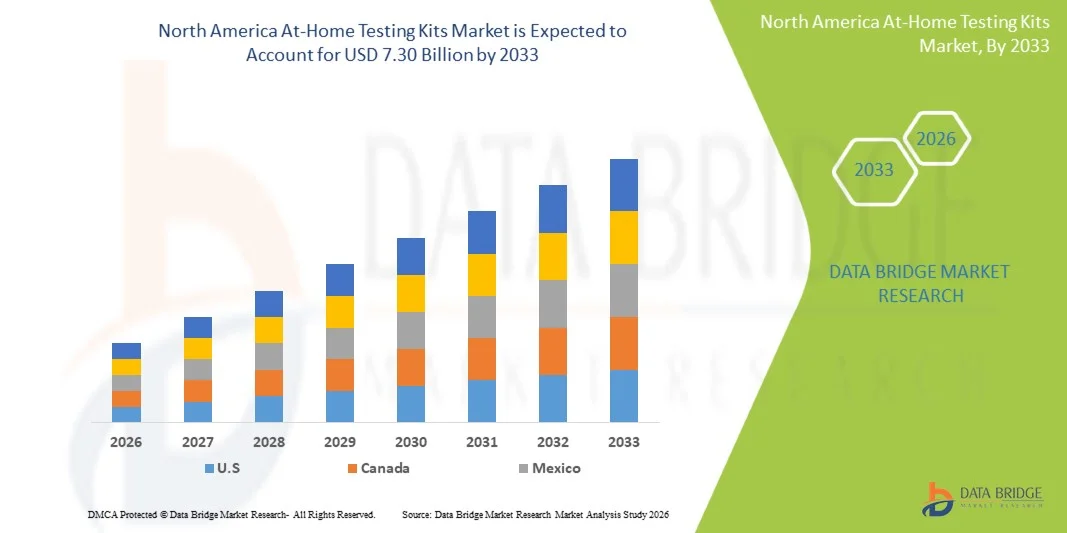
The North America At-Home Testing Kits market was valued at USD 4.48 billion in 2025 and is projected to reach USD 7.30 billion by 2033, growing at a CAGR of 6.3% from 2026 to 2033. The market is experiencing steady growth driven by increasing consumer preference for convenient healthcare solutions, rising awareness of preventive health monitoring, and continuous advancements in diagnostic technologies that enable accurate testing outside traditional clinical settings.
The growing prevalence of chronic and infectious diseases, coupled with increasing demand for early disease detection and personalized healthcare, is encouraging consumers to adopt at-home testing solutions. Supportive regulatory frameworks, expanding availability of digital health platforms, and greater integration of telehealth services are further accelerating market adoption. Self-testing kits for conditions such as diabetes, pregnancy, infectious diseases, cardiovascular risk assessment, and wellness monitoring are becoming widely utilized across the region, providing accessible, cost-effective, and rapid diagnostic capabilities while reducing the burden on healthcare facilities.
Key Market Trends & Insights
- The United States dominated the North America At-Home Testing Kits Market with the largest revenue share of 84.72% in 2025, supported by high consumer awareness, strong healthcare spending, extensive retail availability, and rapid adoption of self-diagnostic technologies.
- The Disposable segment led the market with a 78.54% share in 2025, driven by its convenience, hygiene advantages, and widespread adoption across multiple testing categories.
- Canada is expected to be the fastest-growing country market at a CAGR of 6.8% from 2026 to 2033, fueled by expanding digital healthcare infrastructure, rising adoption of telehealth services, and increasing consumer preference for convenient diagnostic solutions.
- Saliva is the fastest-growing sample type, projected to register a CAGR of 7.3%, reflecting the surge in demand for non-invasive and user-friendly diagnostic solutions.
- The Adult segment dominated the age category with a 61.48% revenue share in 2025, led by high adoption of self-testing products for reproductive health, chronic disease management, and preventive healthcare.
- Strip accounted for 34.12% of the market, preferred by its low manufacturing cost, user-friendly design, and widespread use across pregnancy, glucose, and infectious disease testing applications.
- The Infectious Diseases segment is the fastest-growing test type category, with a CAGR of 7.4%, driven by rising awareness of early disease detection and growing demand for convenient diagnostic solutions.
Market Size & Forecast
- Global Market Value (2025): USD 4.48 Billion
- Expected Market Value (2033): USD 7.30 Billion
- Forecast CAGR (2026–2033): 6.3%
- Leading Country in 2025: United States
- Fastest Growing Country: Canada
Report Scope and North America At-Home Testing Kits Market Segmentation
|
Attributes |
North America At-Home Testing Kits Key Market Insights |
|
Segments Covered |
|
|
Countries Covered |
North America · U.S. · Canada · Mexico |
|
Key Market Players |
· Abbott (U.S.) · F. Hoffmann-La Roche Ltd (Switzerland) · Siemens Healthineers AG (Germany) · BD (U.S.) · Danaher (U.S.) · OraSure Technologies, Inc. (U.S.) · BIOMÉRIEUX (France) · QIAGEN (Netherlands) · Trinity Biotech plc (Ireland) · Acon Laboratories, Inc. (U.S.) · iHealth Labs Inc. (U.S.) · ARKRAY, Inc. (Japan) · Ascensia Diabetes Care Holdings AG (Switzerland) · Nova Biomedical Corporation (U.S.) · SD BIOSENSOR, INC. (South Korea) · Bionime Corporation (Taiwan) · EKF Diagnostics Holdings plc (U.K.) · MedMira Inc. (Canada) · Chembio Diagnostics, Inc. (U.S.) · PTS Diagnostics (U.S.) |
|
Market Opportunities |
· Expansion of self-testing kits for chronic disease management · Growing adoption of telehealth-integrated diagnostic solutions · Increasing penetration of affordable rapid diagnostic kits in underserved rural areas |
|
Value Added Data Infosets |
In addition to the insights on market scenarios such as market value, growth rate, segmentation, geographical coverage, and major players, the market reports curated by the Data Bridge Market Research also include in-depth expert analysis, patient epidemiology, pipeline analysis, pricing analysis, and regulatory framework. |
North America At-Home Testing Kits Market Trends
Trend: Expansion of Digital and Connected Home Diagnostics
Consumers across North America are increasingly adopting digitally connected at-home testing kits that integrate with mobile applications, telehealth platforms, and cloud-based health monitoring systems. These solutions enable users to perform diagnostic tests at home while securely sharing results with healthcare professionals for consultation and follow-up care. Advances in biosensors, smartphone-enabled diagnostics, and AI-assisted result interpretation are enhancing test accuracy and convenience. At-home testing is becoming an essential component of preventive healthcare, chronic disease management, and wellness monitoring, with consumers seeking rapid, accessible, and personalized health insights without visiting healthcare facilities.
North America At-Home Testing Kits Market Dynamics
Key Market Driver: Rising Demand for Convenient and Preventive Healthcare Solutions
The growing emphasis on preventive healthcare and early disease detection is a major driver of the North America at-home testing kits market. Consumers are increasingly seeking convenient diagnostic options that reduce dependence on hospitals and clinics while enabling timely health monitoring. The rising prevalence of chronic diseases, increasing healthcare costs, and expanding awareness of self-care practices are encouraging widespread adoption of home-based testing solutions. Supportive regulatory approvals and advancements in rapid diagnostic technologies are further accelerating market growth by improving the accessibility, reliability, and affordability of at-home testing products.
Key Restraint/Challenge: Concerns Regarding Accuracy and Regulatory Compliance
A significant challenge in the North America at-home testing kits market is the concern surrounding test accuracy, result interpretation, and regulatory compliance. While technological advancements have improved reliability, certain self-administered tests may still produce false-positive or false-negative outcomes due to user error, improper sample collection, or limitations in test sensitivity. Manufacturers must also comply with stringent regulatory requirements and quality standards, increasing development costs and time-to-market. These factors can affect consumer confidence and limit adoption among users who prefer laboratory-confirmed diagnostic procedures.
The growing regulatory scrutiny of direct-to-consumer diagnostic products and the need for continuous validation of test performance highlight the challenges manufacturers face in maintaining compliance while ensuring user-friendly and clinically reliable testing solutions across the region.
Key Market Opportunity: Integration of AI-Powered Diagnostics and Telehealth Ecosystems
The integration of artificial intelligence and telehealth services into at-home testing platforms presents a significant market opportunity. AI-powered diagnostic tools can enhance result interpretation, provide personalized health recommendations, and identify potential health risks through advanced data analytics. The expansion of remote healthcare services is also enabling seamless communication between patients and healthcare providers following test completion. In addition, the development of multi-condition testing kits and connected digital health ecosystems is broadening the scope of home diagnostics, creating growth opportunities across chronic disease management, infectious disease detection, and preventive healthcare applications throughout North America.
North America At-Home Testing Kits Market Scope
The North America At-Home Testing Kits market is segmented on the basis of test type, type, age, sample type, usage, and distribution channel.
- By Test Type
On the basis of test type, the North America at-home testing kits market is segmented into pregnancy test, HIV test kit, diabetes, infectious diseases, glucose tests, ovulation predictor test kit, drug abuse test kit, and others. The Pregnancy Test segment dominated the market with a 28.64% share in 2025, owing to its widespread consumer adoption, affordability, ease of use, and strong retail availability across pharmacies and online channels. Pregnancy tests have been among the earliest and most trusted home diagnostic products, resulting in consistently high demand. The availability of rapid-result and digitally enabled pregnancy tests has further improved consumer confidence and convenience. Increasing awareness regarding reproductive health and family planning continues to support market growth. Strong brand recognition and recurring product purchases also contribute to segment dominance. The segment benefits from established regulatory approval pathways and extensive distribution networks throughout North America.
The Infectious Diseases segment is projected to register the fastest growth at a CAGR of 7.4% from 2026 to 2033, driven by rising awareness of early disease detection and growing demand for convenient diagnostic solutions. Consumers are increasingly utilizing home-based testing kits for respiratory infections, sexually transmitted diseases, and other communicable conditions. Advances in molecular diagnostics and rapid antigen technologies have significantly improved testing accuracy and accessibility. The expansion of telehealth services is enabling easier consultation following test completion. Government initiatives promoting disease surveillance and preventive healthcare are further accelerating adoption. Continuous innovation in multiplex testing platforms is expected to strengthen long-term segment growth.
- By Type
On the basis of type, the North America at-home testing kits market is segmented into cassette, strip, midstream, test panel, dip card, and others. The Strip segment dominated the market with a 34.12% share in 2025 due to its low manufacturing cost, user-friendly design, and widespread use across pregnancy, glucose, and infectious disease testing applications. Strip-based tests provide rapid results while requiring minimal technical expertise from users. Their affordability makes them highly accessible to a broad consumer base. Manufacturers continue to enhance strip sensitivity and reliability through technological improvements. Strong demand from both retail and online distribution channels further supports market leadership. The segment remains a preferred option for routine self-testing and monitoring applications.
The Test Panel segment is anticipated to witness the fastest growth at a CAGR of 7.1% from 2026 to 2033, driven by increasing demand for multi-analyte and comprehensive diagnostic testing. Test panels allow simultaneous screening for multiple conditions, improving convenience and diagnostic efficiency. Growing consumer preference for preventive health assessments is supporting adoption. Technological advancements are enabling enhanced accuracy and broader testing capabilities. Healthcare providers increasingly recommend comprehensive home testing solutions for ongoing health monitoring. The segment is also benefiting from rising demand for personalized healthcare and wellness management.
- By Age
On the basis of age, the North America at-home testing kits market is segmented into pediatric, adult, and geriatric. The Adult segment accounted for the largest market share of 61.48% in 2025, driven by high adoption of self-testing products for reproductive health, chronic disease management, and preventive healthcare. Adults represent the primary consumer group for home diagnostic solutions due to greater healthcare awareness and purchasing power. Rising prevalence of lifestyle-related diseases has further increased testing frequency within this population. Growing demand for convenience and rapid diagnosis supports segment growth. The expansion of direct-to-consumer healthcare services is also encouraging adoption. Strong participation in wellness and preventive health programs continues to reinforce market dominance.
The Geriatric segment is expected to record the fastest growth at a CAGR of 6.9% from 2026 to 2033, owing to the increasing elderly population and rising burden of chronic diseases requiring continuous monitoring. Older adults frequently utilize home testing kits for glucose management, cardiovascular risk assessment, and infectious disease detection. Home-based diagnostics help reduce hospital visits and improve healthcare accessibility for aging populations. Advances in user-friendly testing technologies are improving usability among elderly individuals. Healthcare systems are increasingly promoting remote patient monitoring solutions. Growing demand for independent and convenient healthcare management is accelerating segment expansion.
- By Sample Type
On the basis of sample type, the North America at-home testing kits market is segmented into urine, blood, saliva, and other sample types. The Urine segment dominated the market with a 43.26% share in 2025 due to its non-invasive nature, ease of collection, and extensive use in pregnancy, ovulation, and drug testing applications. Urine-based tests are simple to perform and generally provide rapid results without requiring specialized equipment. Consumers prefer urine testing because of its convenience and accessibility. Manufacturers continue to introduce improved test sensitivity and digital result interpretation features. The segment also benefits from broad regulatory acceptance and established consumer familiarity. High product availability across multiple distribution channels further strengthens demand.
The Saliva segment is projected to experience the fastest growth at a CAGR of 7.3% from 2026 to 2033, driven by increasing demand for non-invasive and user-friendly diagnostic solutions. Saliva collection eliminates the discomfort associated with blood sampling while supporting a wide range of diagnostic applications. Technological advancements are improving the accuracy of saliva-based infectious disease and genetic testing. Growing interest in personalized health monitoring is further supporting adoption. Telehealth integration and direct-to-consumer testing models are expanding market opportunities. The segment is expected to benefit from ongoing innovations in biomarker detection technologies.
- By Usage
On the basis of usage, the North America at-home testing kits market is segmented into disposable and reusable. The Disposable segment held the largest market share of 78.54% in 2025, owing to its convenience, hygiene advantages, and widespread adoption across multiple testing categories. Disposable kits minimize contamination risks and eliminate the need for cleaning or maintenance. Consumers generally prefer single-use products for infectious disease and reproductive health testing. Manufacturers continue to focus on improving affordability and ease of use. Strong retail penetration and regulatory acceptance support segment growth. The segment remains the standard format for most commercially available at-home testing kits.
The Reusable segment is expected to register the fastest growth at a CAGR of 7.0% from 2026 to 2033, driven by increasing adoption of digital health devices and long-term disease monitoring solutions. Reusable testing platforms offer cost savings over time and support repeated testing for chronic conditions. Integration with mobile applications and cloud-based health systems is enhancing consumer engagement. Advances in sensor technologies are improving device performance and reliability. Growing interest in sustainable healthcare products is also contributing to market growth. The segment is benefiting from rising demand for connected health and remote monitoring solutions.
- By Distribution Channel
On the basis of distribution channel, the North America at-home testing kits market is segmented into retail pharmacies, drug store, supermarket/hypermarket, and online pharmacies. The Retail Pharmacies segment dominated the market with a 39.85% share in 2025, supported by strong consumer trust, widespread geographic presence, and immediate product availability. Retail pharmacies serve as a primary purchasing point for diagnostic products due to convenient access and pharmacist guidance. Consumers often prefer pharmacies when purchasing health-related products requiring credibility and support. Strong partnerships between manufacturers and pharmacy chains contribute to product visibility. The segment also benefits from increasing healthcare awareness and preventive health initiatives. Extensive product assortments further reinforce market leadership.
The Online Pharmacies segment is projected to witness the fastest growth at a CAGR of 7.6% from 2026 to 2033, driven by increasing e-commerce adoption and growing demand for convenient healthcare purchasing options. Consumers benefit from home delivery, product comparisons, and broader access to specialized diagnostic kits. Digital healthcare platforms are facilitating seamless integration between testing, consultation, and treatment services. Subscription-based testing models are further supporting market expansion. Improvements in logistics and digital payment infrastructure are enhancing customer experience. Rising preference for privacy and convenience continues to accelerate online channel adoption across North America.
North America At-Home Testing Kits Market Regional Analysis
The United States dominated the North America At-Home Testing Kits Market with the largest revenue share of 84.72% in 2025, supported by high consumer awareness, strong healthcare spending, extensive retail availability, and rapid adoption of self-diagnostic technologies. The country also benefits from a well-established digital health ecosystem, favorable regulatory support for home diagnostics, and increasing adoption of telehealth-integrated testing platforms. Growing demand for preventive healthcare, chronic disease monitoring, and rapid infectious disease detection continues to drive market expansion. Continuous innovation in connected diagnostic technologies and strong participation from leading healthcare and diagnostic companies further reinforce the United States' dominant position in the regional market.
U.S. At-Home Testing Kits Market Insight
The U.S. At-Home Testing Kits Market is witnessing strong growth due to rising consumer preference for convenient healthcare solutions, increasing adoption of preventive health monitoring, and expanding availability of self-diagnostic technologies. The country’s advanced healthcare infrastructure, widespread telehealth adoption, and strong presence of leading diagnostic companies are driving demand across multiple testing categories. In addition, growing awareness of early disease detection, chronic disease management, and personalized healthcare is accelerating the adoption of at-home testing kits. Continuous innovation in digital diagnostics, AI-enabled result interpretation, and connected health platforms is further supporting market expansion across the United States.
Canada At-Home Testing Kits Market Insight
The Canada At-Home Testing Kits market remains a significant contributor to regional revenue, driven by increasing healthcare awareness, expanding access to digital healthcare services, and growing demand for convenient diagnostic solutions. The widespread use of self-testing kits for infectious diseases, chronic condition monitoring, and reproductive health applications is supporting market growth. Rising government focus on preventive healthcare and increasing investments in remote patient monitoring technologies are encouraging adoption across the country. Furthermore, ongoing advancements in rapid diagnostic technologies and telehealth integration continue to strengthen the market outlook in Canada.
Mexico At-Home Testing Kits Market Insight
The Mexico At-Home Testing Kits Market is experiencing steady growth, supported by improving healthcare accessibility, increasing awareness of self-testing solutions, and rising demand for affordable diagnostic products. Consumers are increasingly utilizing at-home testing kits for pregnancy testing, glucose monitoring, and infectious disease screening. Growing penetration of e-commerce platforms and retail pharmacy networks is improving product availability throughout the country. Furthermore, advancements in diagnostic technologies and increasing focus on early disease detection are contributing to market growth. The shift toward decentralized healthcare delivery is also supporting broader adoption of home-based diagnostics in Mexico.
North America At-Home Testing Kits Market Share
The North America At-Home Testing Kits industry is primarily led by well-established companies, including:
- Abbott (U.S.)
- Hoffmann-La Roche Ltd (Switzerland)
- Siemens Healthineers AG (Germany)
- BD (U.S.)
- Danaher (U.S.)
- OraSure Technologies, Inc. (U.S.)
- BIOMÉRIEUX (France)
- QIAGEN (Netherlands)
- Trinity Biotech plc (Ireland)
- Acon Laboratories, Inc. (U.S.)
- iHealth Labs Inc. (U.S.)
- ARKRAY, Inc. (Japan)
- Ascensia Diabetes Care Holdings AG (Switzerland)
- Nova Biomedical Corporation (U.S.)
- SD BIOSENSOR, INC. (South Korea)
- Bionime Corporation (Taiwan)
- EKF Diagnostics Holdings plc (U.K.)
- MedMira Inc. (Canada)
- Chembio Diagnostics, Inc. (U.S.)
- PTS Diagnostics (U.S.)
Latest Developments in North America At-Home Testing Kits Market
- In April 2024, Labcorp announced that the U.S. Food and Drug Administration (FDA) granted Emergency Use Authorization (EUA) for its Mpox PCR Test Home Collection Kit, marking the first FDA-authorized at-home collection kit for mpox testing. The kit allows eligible patients to collect samples privately at home and send them for laboratory analysis, improving accessibility and early detection of infectious diseases. The launch expanded the scope of at-home diagnostics beyond COVID-19 and highlighted growing demand for convenient infectious disease testing solutions. This development reinforced the increasing role of home-based diagnostic services across North America
- In November 2023, LetsGetChecked received FDA authorization for its Simple 2 Test, the first over-the-counter at-home sample collection test for chlamydia and gonorrhea. The solution enables consumers to collect urine or swab samples at home and mail them to a laboratory for analysis, improving access to sexual health testing. The authorization represented a major advancement in direct-to-consumer diagnostics and expanded the range of conditions that can be tested outside traditional healthcare settings. The development also supported broader adoption of preventive and privacy-focused healthcare solutions
- In June 2023, Cue Health received FDA marketing authorization for its Cue COVID-19 Molecular Test, becoming the first at-home COVID-19 test approved through the FDA’s traditional premarket review pathway rather than emergency authorization. The molecular test delivers highly accurate results using self-collected nasal swabs and connects with digital health platforms for result management. This milestone signaled a transition toward long-term adoption of regulated home diagnostic technologies and strengthened consumer confidence in at-home molecular testing solutions
- In February 2023, Lucira Health received FDA Emergency Use Authorization for the first over-the-counter at-home test capable of simultaneously detecting COVID-19 and Influenza A/B. The single-use molecular test provides results in approximately 30 minutes and enables consumers to distinguish between multiple respiratory infections without visiting a healthcare facility. The launch represented a major advancement in multiplex home diagnostics and responded to growing demand for rapid respiratory disease testing. It also demonstrated increasing innovation in consumer-focused infectious disease detection technologies
- In November 2022, Roche Diagnostics expanded its presence in the North American at-home testing market through the nationwide retail launch of the Pilot COVID-19 At-Home Test. The company introduced the product under its new Pilot consumer diagnostics brand, making rapid COVID-19 testing more accessible through over-the-counter retail channels. The initiative strengthened Roche’s direct-to-consumer diagnostics portfolio and reflected the growing commercialization of home healthcare products. Expanded retail availability also supported continued adoption of self-testing solutions across North America
SKU-
Get online access to the report on the World's First Market Intelligence Cloud

- Interactive Data Analysis Dashboard
- Company Analysis Dashboard for high growth potential opportunities
- Research Analyst Access for customization & queries
- Competitor Analysis with Interactive dashboard
- Latest News, Updates & Trend analysis
- Harness the Power of Benchmark Analysis for Comprehensive Competitor Tracking
Research Methodology
Data collection and base year analysis are done using data collection modules with large sample sizes. The stage includes obtaining market information or related data through various sources and strategies. It includes examining and planning all the data acquired from the past in advance. It likewise envelops the examination of information inconsistencies seen across different information sources. The market data is analysed and estimated using market statistical and coherent models. Also, market share analysis and key trend analysis are the major success factors in the market report. To know more, please request an analyst call or drop down your inquiry.
The key research methodology used by DBMR research team is data triangulation which involves data mining, analysis of the impact of data variables on the market and primary (industry expert) validation. Data models include Vendor Positioning Grid, Market Time Line Analysis, Market Overview and Guide, Company Positioning Grid, Patent Analysis, Pricing Analysis, Company Market Share Analysis, Standards of Measurement, Global versus Regional and Vendor Share Analysis. To know more about the research methodology, drop in an inquiry to speak to our industry experts.
Customization Available
Data Bridge Market Research is a leader in advanced formative research. We take pride in servicing our existing and new customers with data and analysis that match and suits their goal. The report can be customized to include price trend analysis of target brands understanding the market for additional countries (ask for the list of countries), clinical trial results data, literature review, refurbished market and product base analysis. Market analysis of target competitors can be analyzed from technology-based analysis to market portfolio strategies. We can add as many competitors that you require data about in the format and data style you are looking for. Our team of analysts can also provide you data in crude raw excel files pivot tables (Fact book) or can assist you in creating presentations from the data sets available in the report.












