


What is the North America Baking Enzymes Market Size and Growth Rate?
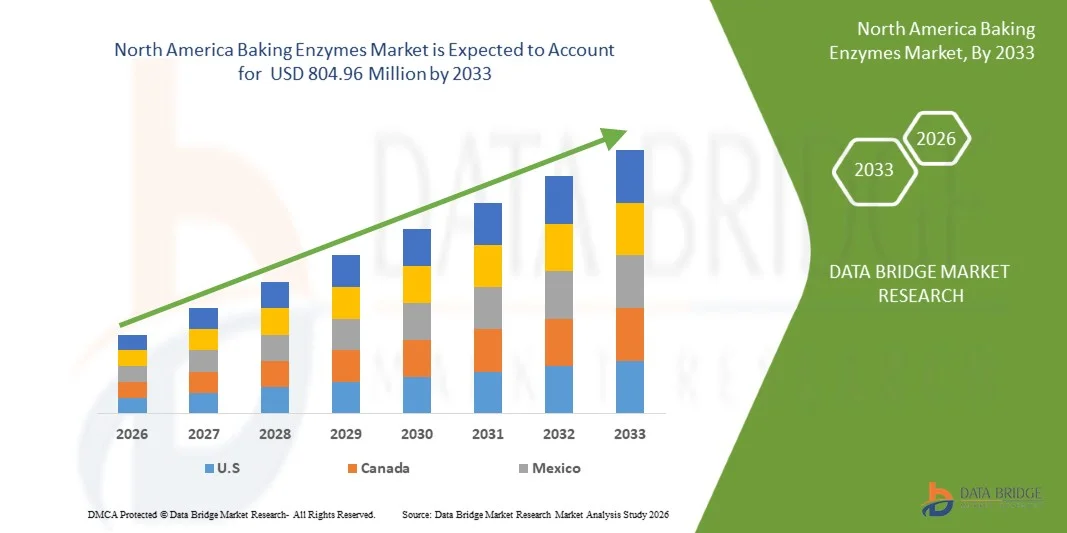
- As per Data Bridge Market Research Analysis the North America baking enzymes market size was valued at USD 532.54 million in 2025 and is expected to reach USD 804.96 million by 2033, at a CAGR of 5.30% during the forecast period
- The market growth is primarily driven by the rising demand for clean-label and organic bakery products, prompting manufacturers to incorporate natural and enzyme-based solutions for dough conditioning, shelf-life enhancement, and improved texture
- In addition, advancements in enzyme biotechnology and increased application in commercial baking operations to enhance processing efficiency and reduce waste are further contributing to the market expansion. The push for sustainable baking practices and reduced reliance on chemical additives is also strengthening the adoption of baking enzymes globally
Market Size & Forecast
Global Market Value (2025): USD 532.54 millio
Expected Market Value (2033): USD 804.96 million
Forecast CAGR (2026–2033): 5.30%
What are the Major Takeaways of North America Baking Enzymes Market?
- Baking enzymes, which include amylases, proteases, lipases, and xylanases, are essential additives in modern baking processes across both artisanal and industrial settings, as they enhance dough handling, improve crumb structure, extend shelf life, and optimize baking performance while aligning with clean-label trends
- The rising demand for baking enzymes is primarily driven by the growing preference for chemical-free and clean-label bakery products, increased health consciousness among consumers, and a need for enhanced production efficiency in commercial baking
- U.S. baking enzymes market captured the largest revenue share in 2025 within North America, driven by the strong presence of industrial bakeries and the growing demand for clean-label and high-quality baked products
- Canada is expected to witness the highest compound annual growth rate (CAGR) in the North America baking enzymes market due to rising demand for clean-label bakery products, increasing preference for natural food additives, and growing expansion of commercial and artisanal bakeries
- The amylases segment held the largest market revenue share in 2025 driven by its strong role in improving dough fermentation, bread volume, and softness. It is widely used across industrial bakeries to enhance product consistency and extend freshness. Growing demand for high-quality baked goods further supports enzyme adoption in large-scale production systems
Report Scope and North America Baking Enzymes Market Segmentation
|
Attributes |
North America Baking Enzymes Key Market Insights |
|
Segments Covered |
|
|
Countries Covered |
North America
|
|
Key Market Players |
• Archer Daniels Midland (U.S.) |
|
Market Opportunities |
• Rising Demand For Clean Label Bakery Ingredients |
|
Value Added Data Infosets |
In addition to the insights on market scenarios such as market value, growth rate, segmentation, geographical coverage, and major players, the market reports curated by the Data Bridge Market Research also include in-depth expert analysis, pricing analysis, brand share analysis, consumer survey, demography analysis, supply chain analysis, value chain analysis, raw material/consumables overview, vendor selection criteria, PESTLE Analysis, Porter Analysis, and regulatory framework. |
What is the Key Trend in the North America Baking Enzymes Market?
“Rising Demand for Clean-Label and Functional Bakery Ingredients”
• The growing preference for clean-label bakery products is significantly shaping the North America baking enzymes market, as consumers increasingly demand natural, non-GMO, and minimally processed ingredients. Baking enzymes are widely used to improve dough stability, texture, and shelf life without relying on chemical additives. This trend is strengthening their adoption across industrial bakeries and packaged food manufacturers, encouraging continuous product innovation
• Increasing consumption of convenience foods and ready-to-eat bakery products has accelerated the use of baking enzymes in bread, cakes, pastries, and cookies. Food manufacturers are focusing on improving product softness, freshness retention, and processing efficiency using enzyme-based solutions. Rising urban lifestyles and demand for consistent bakery quality are further supporting enzyme integration in large-scale production systems
• Sustainability and cost efficiency trends are also influencing the market, as baking enzymes help reduce energy consumption and raw material waste during baking processes. Manufacturers are emphasizing eco-friendly production methods and improved formulation efficiency to meet both environmental and economic goals. This is also driving partnerships between enzyme developers and bakery producers to enhance product performance
• For instance, in 2024, major bakery ingredient manufacturers in the U.S. and Canada expanded enzyme-based product lines targeting industrial bread production and frozen bakery applications. These launches were designed to improve dough handling properties and extend product freshness across supply chains. The introduction of customized enzyme blends also enhanced operational efficiency and supported large-scale commercial bakery growth
• While demand for baking enzymes is increasing, market expansion depends on consistent enzyme stability, cost optimization, and regulatory compliance in food applications. Companies are focusing on advanced fermentation technologies, improved strain development, and scalable production processes to ensure reliable performance and broader industry adoption
North America Baking Enzymes Market Dynamics
Driver
“Growing Demand for Processed and Convenience Bakery Products”
• Rising consumption of packaged and convenience bakery products is a major driver for the baking enzymes market in North America. Consumers are increasingly preferring ready-to-eat and long shelf-life bakery items, boosting demand for enzymes that enhance product quality and consistency. This trend is also supported by expanding retail and foodservice bakery channels across the region
• Bakery manufacturers are increasingly adopting enzymes to improve dough elasticity, fermentation control, and product softness without using artificial additives. This helps them meet clean-label expectations while maintaining production efficiency. The growing demand for premium bakery products such as artisanal bread and high-quality pastries is further strengthening enzyme usage
• Food processing companies are actively investing in enzyme-based formulations to improve operational efficiency and reduce production costs. Baking enzymes help optimize raw material usage and improve yield, making them an attractive solution for large-scale industrial baking operations. Continuous innovation in enzyme blends is further expanding application possibilities across bakery segments
• For instance, in 2023, leading bakery ingredient suppliers in the U.S. expanded enzyme solutions for frozen dough and industrial bread production lines. These developments improved texture consistency and extended shelf life, supporting high-volume bakery manufacturers in meeting growing consumer demand. The initiatives also enhanced supply chain efficiency and reduced waste in production processes
• Although growth is strong, wider adoption depends on enzyme stability under varying baking conditions, regulatory approvals, and cost competitiveness compared to traditional additives. Companies are investing in research and development to improve enzyme performance and expand application scope across diverse bakery formulations
Restraint/Challenge
“Formulation Complexity and Limited Processing Awareness”
• The relatively complex formulation requirements of baking enzymes remain a key challenge in the North America market. Enzyme activity is highly sensitive to temperature, pH, and processing conditions, which can limit their effectiveness in certain bakery applications. This increases dependency on technical expertise during product development
• Limited awareness among small and medium bakery manufacturers also restricts adoption of advanced enzyme solutions. Many producers still rely on conventional additives due to familiarity and perceived formulation simplicity. This slows down the transition toward enzyme-based clean-label bakery production in some segments
• Supply chain variability and storage requirements for enzyme stability further add to operational challenges. Enzymes require controlled conditions to maintain performance, which can increase logistics costs and handling complexity. This becomes a barrier for smaller manufacturers with limited infrastructure capabilities
• For instance, in 2024, several mid-sized bakery producers in the U.S. reported challenges in optimizing enzyme dosage for consistent product quality across different production batches. Variability in raw materials and processing conditions led to inconsistent results, requiring additional technical support from suppliers. This impacted adoption speed in certain regional bakery operations
• Overcoming these challenges will require stronger technical training, improved enzyme formulation stability, and better collaboration between enzyme manufacturers and bakery producers. Investments in application-specific enzyme solutions and simplified product formats will be essential for wider market penetration and long-term growth in the baking enzymes industry
How is the North America Baking Enzymes Market Segmented?
The North America Baking Enzymes Market is segmented into seven notable segments based on type, application, category, form, end-user, source, and functionality.
• By Type
On the basis of type, the market is segmented into hydrolases, oxidoreductases, amylases, proteases, lipases, cellulases, and xylanases. The amylases segment held the largest market revenue share in 2025 driven by its strong role in improving dough fermentation, bread volume, and softness. It is widely used across industrial bakeries to enhance product consistency and extend freshness. Growing demand for high-quality baked goods further supports enzyme adoption in large-scale production systems.
The proteases segment is expected to witness the fastest growth rate from 2026 to 2033, driven by increasing use in biscuit and cracker manufacturing to improve dough extensibility and texture control. Proteases help optimize processing efficiency and reduce mixing time, thereby enhancing productivity in commercial baking operations. Rising demand for specialty bakery products is further accelerating segment growth.
• By Application
On the basis of application, the market is segmented into bread, rolls & buns, biscuits & cookies, cake & pastry, muffins & cupcakes, pizza bases, donuts, tortillas & pretzels, and others. The bread, rolls & buns segment held the largest market revenue share in 2025 driven by high consumption of staple bakery products across North America. Baking enzymes are widely used to improve softness, shelf life, and dough stability in industrial bread production.
The cake & pastry segment is expected to witness the fastest growth rate from 2026 to 2033, driven by increasing demand for premium and indulgent bakery products. Enzymes help improve crumb structure, moisture retention, and product freshness in cakes and pastries. Rising consumer preference for high-quality and convenience bakery items further supports segment expansion.
• By Category
On the basis of category, the market is segmented into inorganic and organic. The inorganic segment held the largest market revenue share in 2025 driven by its widespread availability and cost-effectiveness in large-scale bakery production. It is commonly used in industrial applications where consistent performance and affordability are key requirements. Strong demand from commercial bakeries supports its dominance.
The organic segment is expected to witness the fastest growth rate from 2026 to 2033, driven by increasing consumer preference for clean-label and natural bakery ingredients. Organic enzymes are gaining traction due to their perceived health benefits and alignment with sustainable food production trends. Growing demand for non-GMO bakery products is further accelerating adoption.
• By Form
On the basis of form, the market is segmented into powder/granules, liquid, and others. The powder/granules segment held the largest market revenue share in 2025 driven by its ease of handling, longer shelf life, and stable enzyme activity during storage and transport. It is widely preferred in industrial baking operations for consistent dosing and formulation efficiency.
The liquid segment is expected to witness the fastest growth rate from 2026 to 2033, driven by its superior solubility and ease of integration into automated baking processes. Liquid enzymes enable precise dosing and improved mixing efficiency in large-scale production lines. Increasing adoption in modern bakery facilities is supporting segment growth.
• By End-User
On the basis of end-user, the market is segmented into industries, food service sector, household/retail, commercial bakeries, and artisanal bakeries. The commercial bakeries segment held the largest market revenue share in 2025 driven by high-volume production and strong demand for consistent bakery quality. Enzymes are widely used to enhance efficiency and maintain uniform product characteristics across batches.
The artisanal bakeries segment is expected to witness the fastest growth rate from 2026 to 2033, driven by rising consumer preference for premium, fresh, and specialty baked goods. Enzymes help artisanal producers improve texture, shelf life, and product consistency without compromising traditional baking methods. Growing demand for handcrafted bakery items is further accelerating adoption.
• By Source
On the basis of source, the market is segmented into microorganisms, plant, and animal. The microorganisms segment held the largest market revenue share in 2025 driven by its high efficiency, scalability, and cost-effective production through fermentation processes. Microbial enzymes are widely used in industrial baking due to their stability and consistent performance.
The plant segment is expected to witness the fastest growth rate from 2026 to 2033, driven by increasing demand for natural and plant-derived enzyme solutions. Plant-based enzymes align with clean-label trends and sustainable food production practices. Rising consumer preference for natural ingredients is further supporting segment growth.
• By Functionality
On the basis of functionality, the market is segmented into dough conditioning, improving texture, shelf life extension, and flavor enhancement. The dough conditioning segment held the largest market revenue share in 2025 driven by its critical role in improving dough elasticity, handling, and fermentation performance. It is widely adopted in industrial bread and bun production.
The shelf life extension segment is expected to witness the fastest growth rate from 2026 to 2033, driven by increasing demand for packaged bakery products with longer freshness retention. Enzymes help slow staling and maintain product quality over time. Rising consumption of convenience bakery goods is further accelerating demand for shelf-life enhancing solutions.
Which Region Holds the Largest Share of the North America Baking Enzymes Market?
- U.S. baking enzymes market captured the largest revenue share in 2025 within North America, driven by the strong presence of industrial bakeries and the growing demand for clean-label and high-quality baked products
- Manufacturers are increasingly utilizing baking enzymes to enhance dough stability, improve texture, and extend shelf life across a wide range of bakery applications. The rising consumption of packaged baked goods, along with continuous product innovation in bread, cookies, and pastries, further supports market growth
- In addition, advanced food processing technologies and a well-established bakery industry ecosystem are significantly contributing to the market’s expansion
Canada Baking Enzymes Market Insight
The Canada baking enzymes market is expected to witness the fastest growth rate from 2026 to 2033, supported by rising consumer preference for healthier and clean-label bakery products. Increasing awareness regarding enzyme-based natural alternatives to chemical additives is driving adoption across commercial and artisanal bakeries. The expanding food service sector, coupled with growing demand for premium and specialty baked goods such as gluten-free and organic products, is further accelerating market growth. Moreover, the increasing penetration of innovative baking solutions and product reformulations is significantly boosting the market in the country.
Which are the Top Companies in North America Baking Enzymes Market?
The North America baking enzymes industry is primarily led by well-established companies, including:
• Archer Daniels Midland (U.S.)
• Cargill (U.S.)
• International Flavors & Fragrances (U.S.)
• Ingredion Incorporated (U.S.)
• Enzyme Development Corporation (U.S.)
• Dyadic International (U.S.)
• Sensient Technologies Corporation (U.S.)
• BIO-CAT Inc. (U.S.)
• Advanced Enzyme Technologies USA (U.S.)
• Kerry Ingredients USA (U.S.)
• Lallemand Inc. (Canada)
• Leprino Foods Company (U.S.)
• Tate & Lyle Ingredients Americas (U.S.)
• Corbion USA LLC (U.S.)
• ADM Milling / ADM Food & Beverage Enzymes Division (U.S.)

- Interactive Data Analysis Dashboard
- Company Analysis Dashboard for high growth potential opportunities
- Research Analyst Access for customization & queries
- Competitor Analysis with Interactive dashboard
- Latest News, Updates & Trend analysis
- Harness the Power of Benchmark Analysis for Comprehensive Competitor Tracking
North America Baking Enzyme Market, Supply Chain Analysis and Ecosystem Framework
To support market growth and help clients navigate the impact of geopolitical shifts, DBMR has integrated in-depth supply chain analysis into its North America Baking Enzyme Market research reports. This addition empowers clients to respond effectively to global changes affecting their industries. The supply chain analysis section includes detailed insights such as North America Baking Enzyme Market consumption and production by country, price trend analysis, the impact of tariffs and geopolitical developments, and import and export trends by country and HSN code. It also highlights major suppliers with data on production capacity and company profiles, as well as key importers and exporters. In addition to research, DBMR offers specialized supply chain consulting services backed by over a decade of experience, providing solutions like supplier discovery, supplier risk assessment, price trend analysis, impact evaluation of inflation and trade route changes, and comprehensive market trend analysis.
Data collection and base year analysis are done using data collection modules with large sample sizes. The stage includes obtaining market information or related data through various sources and strategies. It includes examining and planning all the data acquired from the past in advance. It likewise envelops the examination of information inconsistencies seen across different information sources. The market data is analysed and estimated using market statistical and coherent models. Also, market share analysis and key trend analysis are the major success factors in the market report. To know more, please request an analyst call or drop down your inquiry.
The key research methodology used by DBMR research team is data triangulation which involves data mining, analysis of the impact of data variables on the market and primary (industry expert) validation. Data models include Vendor Positioning Grid, Market Time Line Analysis, Market Overview and Guide, Company Positioning Grid, Patent Analysis, Pricing Analysis, Company Market Share Analysis, Standards of Measurement, Global versus Regional and Vendor Share Analysis. To know more about the research methodology, drop in an inquiry to speak to our industry experts.
Data Bridge Market Research is a leader in advanced formative research. We take pride in servicing our existing and new customers with data and analysis that match and suits their goal. The report can be customized to include price trend analysis of target brands understanding the market for additional countries (ask for the list of countries), clinical trial results data, literature review, refurbished market and product base analysis. Market analysis of target competitors can be analyzed from technology-based analysis to market portfolio strategies. We can add as many competitors that you require data about in the format and data style you are looking for. Our team of analysts can also provide you data in crude raw excel files pivot tables (Fact book) or can assist you in creating presentations from the data sets available in the report.













