


North America Biosensors Market
Market Size in USD Billion
CAGR :
% 
 USD
13.13 Billion
USD
25.59 Billion
2025
2033
USD
13.13 Billion
USD
25.59 Billion
2025
2033
 Forecast Period Forecast Period |
2026 –2033 |
 Market Size (Base Year) Market Size (Base Year) |
USD 13.13 Billion |
 Market Size (Forecast Year) Market Size (Forecast Year) |
USD 25.59 Billion |
 CAGR CAGR |
% |
| Major Markets Players |
|
What is the North America Biosensors Market Size and Growth Rate?
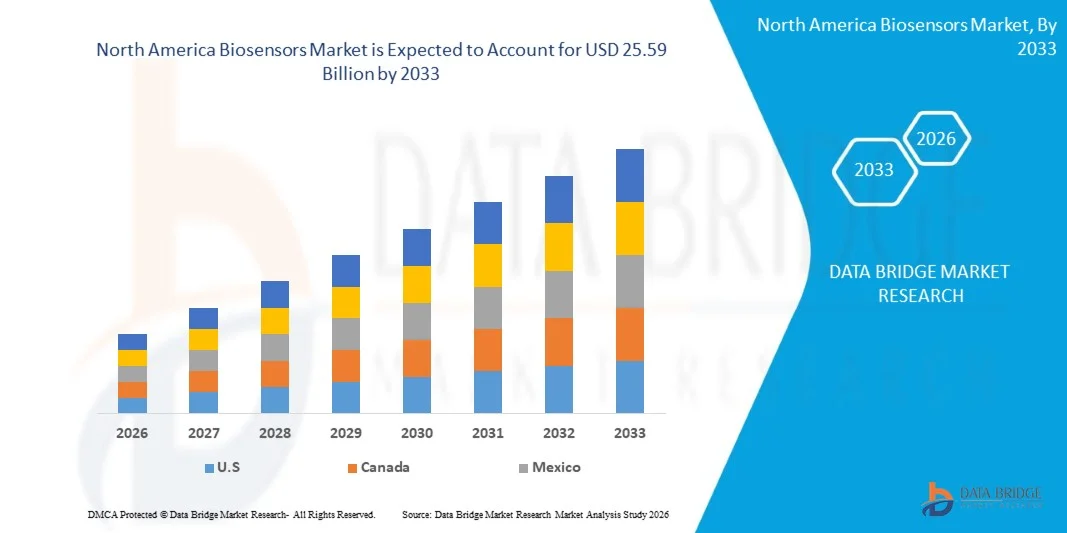
- The North America biosensors market size was valued at USD 13.13 billion in 2025 and is expected to reach USD 25.59 billion by 2033, at a CAGR of 8.7% during the forecast period
- Major factors that are expected to boost the growth of biosensors market in the forecast period are the rise in the utilization of biosensors to monitor glucose levels in individuals with diabetes. Furthermore, the increase in the need of home based POC devices is further anticipated to propel the growth of the biosensors market
What are the Major Takeaways of Biosensors Market?
- Initiatives taken by the government towards diagnostics and significant technological development is further estimated to cushion the growth of the biosensors market. On the other hand, the rise in the cost involved in research and development and slow rate of commercialization is further projected to impede the growth of the biosensors market in the timeline period
- In addition, the rise in the usage in food industry, environmental monitoring and biodefense will further provide potential opportunities for the growth of the biosensors market in the coming years. However, the growing pricing pressure and government regulations that are imposed might further challenge the growth of the biosensors market in the near future
- The U.S. dominated the North America biosensors market with the largest revenue share of 41.7% in 2025, supported by the strong presence of advanced healthcare infrastructure, leading biotechnology companies, and high adoption of innovative diagnostic technologies
- Canada is witnessing the fastest growth rate of 12.1% in the North America region, driven by increasing healthcare digitization, rising adoption of wearable medical devices, and growing focus on early disease detection
- In 2025, the Electrochemical Biosensors segment dominated the market with a share of 42.8%, driven by their high sensitivity, cost-effectiveness, and wide usage in medical diagnostics, particularly in glucose monitoring devices
Report Scope and Biosensors Market Segmentation
|
Attributes |
Biosensors Key Market Insights |
|
Segments Covered |
|
|
Countries Covered |
North America
|
|
Key Market Players |
|
|
Market Opportunities |
|
|
Value Added Data Infosets |
In addition to the insights on market scenarios such as market value, growth rate, segmentation, geographical coverage, and major players, the market reports curated by the Data Bridge Market Research also include in-depth expert analysis, pricing analysis, brand share analysis, consumer survey, demography analysis, supply chain analysis, value chain analysis, raw material/consumables overview, vendor selection criteria, PESTLE Analysis, Porter Analysis, and regulatory framework. |
What is the Key Trend in the Biosensors Market?
“Increasing Adoption of Wearable and Continuous Monitoring Biosensors”
- One prominent trend in the global biosensors market is the increasing adoption of wearable and continuous monitoring biosensors, driven by the growing focus on real-time health tracking and preventive healthcare
- This trend is fueled by rising cases of chronic diseases such as diabetes and cardiovascular conditions, along with increasing consumer awareness toward personal health monitoring
- For instance, companies such as Dexcom, Inc. and Abbott Laboratories are developing advanced continuous glucose monitoring (CGM) systems that provide real-time data insights
- These wearable biosensors are widely used in healthcare, fitness, and home diagnostics due to their ability to deliver non-invasive, accurate, and continuous measurements
- As digital health ecosystems expand and integration with mobile health applications increases, the demand for wearable biosensors is expected to significantly drive innovation and long-term growth in the biosensors market
What are the Key Drivers of Biosensors Market?
- The rising prevalence of chronic diseases is a key driver of growth in the Biosensors market, as healthcare systems increasingly rely on rapid and accurate diagnostic solutions
- Conditions such as diabetes, cardiovascular diseases, and infectious diseases require continuous monitoring, which is accelerating the adoption of biosensor-based diagnostic devices
- Biosensors offer advantages such as real-time detection, high sensitivity, portability, and ease of use, making them essential in both clinical and homecare settings
- The increasing shift toward personalized medicine and point-of-care diagnostics is further boosting demand for advanced biosensor technologies
- Manufacturers are developing innovative biosensors with enhanced accuracy, miniaturization, and connectivity features to meet growing healthcare demands
- For instance, Medtronic plc is expanding its diabetes management solutions using biosensor technologies
- F. Hoffmann-La Roche Ltd is investing in advanced diagnostic biosensor platforms for improved disease detection
- As healthcare systems prioritize early diagnosis and efficient disease management, this driver is expected to significantly accelerate market growth
Which Factor is Challenging the Growth of the Biosensors Market?
- High cost of advanced biosensor devices and technologies presents a major challenge for the Biosensors market, limiting widespread adoption, particularly in developing regions
- The development and production of biosensors involve complex technologies, high-quality materials, and strict regulatory compliance, which increase overall costs
- This challenge is particularly significant in healthcare systems with budget constraints, where affordability plays a critical role in technology adoption
- In addition, the need for continuous calibration, maintenance, and integration with digital systems adds to the total cost of ownership for end users
- For instance, companies such as Siemens Healthineers face challenges in balancing innovation with cost-effectiveness while maintaining high diagnostic accuracy
- Thermo Fisher Scientific Inc. also invests heavily in R&D, contributing to higher product pricing
- Without improvements in cost optimization, scalable manufacturing, and reimbursement frameworks, high costs may continue to restrain market growth, particularly in emerging economies
How is the Biosensors Market Segmented?
The market is segmented on the basis of product, technology, and application.
• By Technology
The biosensors market is segmented into Electrochemical Biosensors, Optical Biosensors, Piezoelectric Biosensors, Nanomechanical Biosensors, Thermal Biosensors, and Others. In 2025, the Electrochemical Biosensors segment dominated the market with a share of 42.8%, driven by their high sensitivity, cost-effectiveness, and wide usage in medical diagnostics, particularly in glucose monitoring devices. These biosensors are widely preferred due to their rapid response time, ease of miniaturization, and compatibility with portable and wearable devices. Their extensive application in point-of-care testing and chronic disease monitoring continues to strengthen their market position.
The Optical Biosensors segment is expected to grow at the fastest CAGR of 15.6% between 2025 and 2032, owing to their high accuracy, real-time detection capabilities, and increasing use in advanced diagnostics and environmental monitoring. Optical biosensors offer label-free detection and enhanced analytical performance, making them suitable for next-generation diagnostic applications, thereby driving rapid growth in this segment.
• By Product
Based on product, the market is segmented into Wearable Biosensors and Non-Wearable Biosensors. In 2025, the Non-Wearable Biosensors segment held the largest market share of 58.4%, supported by their widespread use in hospitals, diagnostic laboratories, and clinical settings. These devices are extensively utilized for accurate disease detection, laboratory testing, and research applications, offering high precision and reliability. Their established presence in healthcare infrastructure continues to drive strong demand across global markets.
The Wearable Biosensors segment is projected to grow at the fastest CAGR of 16.2% during the forecast period, driven by increasing demand for continuous health monitoring, fitness tracking, and remote patient management. The growing adoption of smart wearables and integration with mobile health applications are further accelerating demand. Wearable biosensors enable real-time monitoring of vital parameters, making them highly attractive for personalized healthcare solutions.
• By Application
The Biosensors market based on application is segmented into Point of Care (POC), Home Diagnostics and Biodefence, Environmental Monitoring, Food & Beverage Industry, and Research Labs. In 2025, the Point of Care (POC) segment dominated the market with a share of 44.1%, driven by the increasing need for rapid, on-site diagnostic solutions and early disease detection. POC biosensors are widely used in hospitals, clinics, and emergency settings due to their ability to deliver quick and accurate results, improving patient outcomes and reducing diagnostic time.
The Home Diagnostics and Biodefence segment is expected to grow at the fastest CAGR of 15.9% between 2025 and 2032, supported by rising demand for self-testing devices, increasing health awareness, and advancements in portable diagnostic technologies. The shift toward home-based healthcare and remote monitoring solutions is further boosting adoption, making this segment a key growth area in the biosensors market.
Which Region Holds the Largest Share of the Biosensors Market?
- The U.S. dominated the North America biosensors market with the largest revenue share of 41.7% in 2025, supported by the strong presence of advanced healthcare infrastructure, leading biotechnology companies, and high adoption of innovative diagnostic technologies. The country has a well-established ecosystem for medical research, clinical diagnostics, and digital health solutions, where biosensors are widely used for disease monitoring, glucose tracking, and point-of-care testing. Major healthcare hubs such as New York, Boston, and San Francisco are witnessing significant adoption of wearable and non-wearable biosensor devices across hospitals, research institutions, and homecare settings
- In the country, increasing adoption of wearable health monitoring devices, continuous glucose monitoring systems, and AI-integrated diagnostic tools is significantly enhancing patient care and real-time data analysis. The growing prevalence of chronic diseases, rising demand for personalized medicine, and expansion of remote patient monitoring are further driving the use of biosensors across healthcare and fitness applications
- In the U.S., the strong presence of global healthcare leaders, high R&D investments, and increasing focus on preventive healthcare and digital health transformation continue to reinforce the country’s leadership position within the North America Biosensors market
Canada Biosensors Market Insight
Canada is witnessing the fastest growth rate of 12.1% in the North America region, driven by increasing healthcare digitization, rising adoption of wearable medical devices, and growing focus on early disease detection. The country’s expanding healthcare infrastructure and government support for digital health initiatives are encouraging the use of biosensors in diagnostics and patient monitoring The growing elderly population, increasing cases of chronic diseases, and rising demand for home-based healthcare solutions are further accelerating market growth. In addition, advancements in biosensor technologies and increasing investment in medical research are contributing to higher adoption across healthcare and research institutions
Mexico Biosensors Market Insight
Mexico Biosensors market is expanding steadily, supported by improving healthcare infrastructure, increasing awareness of early disease diagnosis, and rising adoption of medical technologies. The country is witnessing growing demand for cost-effective diagnostic solutions, particularly in hospitals, clinics, and homecare settings. The expansion of private healthcare services, increasing investments in medical device manufacturing, and rising prevalence of chronic conditions such as diabetes are driving adoption of biosensor devices across the country. In addition, the growing focus on preventive healthcare and accessible diagnostics is further supporting steady market growth
Which are the Top Companies in Biosensors Market?
The biosensors industry is primarily led by well-established companies, including:
- Abbott Laboratories (U.S.)
- Medtronic (Ireland)
- Biosensors International Group (Singapore)
- Pinnacle Technology, Inc. (U.S.)
- Dupont (U.S.)
- Sensirion AG (Switzerland)
- Thermo Fisher Scientific, Inc. (U.S.)
- F. Hoffmann-La Roche (Switzerland)
- Siemens Healthineers (Germany)
- Zimmer & Peacock AS (Denmark)
- Metrohm AG (Switzerland)
- DexCom, Inc. (U.S.)
- Universal Biosensors, Inc. (Australia)
- Johnson & Johnson Services, Inc. (U.S.)
- Nix Biosensors (U.S.)
- Cyrcadia Health (U.S.)
- Lifescan (U.S.)
What are the Recent Developments in North America Biosensors Market?
- In May 2025, Cytiva collaborated with Nuclera to accelerate protein production, purification, and characterization for drug research by integrating Nuclera’s eProtein Discovery System with Cytiva’s Biacore surface plasmon resonance (SPR) technology, this collaboration is expected to significantly enhance efficiency in drug development processes and protein analysis workflows
- In April 2025, Medtronic received approval from the U.S. Food and Drug Administration for its Simplera Sync™ sensor to be used with the MiniMed™ 780G system, offering a user-friendly, all-in-one disposable solution that eliminates the need for fingersticks and simplifies glucose monitoring, this advancement is anticipated to improve patient convenience and strengthen adoption of automated diabetes management systems
- In December 2024, DuPont™ Liveo™ Healthcare Solutions partnered with STMicroelectronics to develop an innovative smart wearable device designed for remote biosignal monitoring, leveraging advanced materials and semiconductor technologies, this initiative is expected to drive innovation in wearable healthcare devices and expand remote patient monitoring capabilities
- In November 2024, F. Hoffmann-La Roche Ltd entered into a definitive agreement to acquire Poseida Therapeutics, Inc., aiming to strengthen its portfolio in CAR-T cell therapies, including treatments for cancer, autoimmune diseases, and other conditions, this acquisition is such asly to enhance Roche’s capabilities in advanced cell therapy development and broaden its biopharmaceutical pipeline
- In August 2024, Abbott Laboratories partnered with Medtronic to develop an integrated Continuous Glucose Monitoring (CGM) system combining Abbott’s FreeStyle Libre technology with Medtronic’s automated insulin delivery solutions, this collaboration is expected to improve diabetes management by enabling automated insulin adjustments and better glucose control
SKU-
Get online access to the report on the World's First Market Intelligence Cloud

- Interactive Data Analysis Dashboard
- Company Analysis Dashboard for high growth potential opportunities
- Research Analyst Access for customization & queries
- Competitor Analysis with Interactive dashboard
- Latest News, Updates & Trend analysis
- Harness the Power of Benchmark Analysis for Comprehensive Competitor Tracking
North America Biosensors Market, Supply Chain Analysis and Ecosystem Framework
To support market growth and help clients navigate the impact of geopolitical shifts, DBMR has integrated in-depth supply chain analysis into its North America Biosensors Market research reports. This addition empowers clients to respond effectively to global changes affecting their industries. The supply chain analysis section includes detailed insights such as North America Biosensors Market consumption and production by country, price trend analysis, the impact of tariffs and geopolitical developments, and import and export trends by country and HSN code. It also highlights major suppliers with data on production capacity and company profiles, as well as key importers and exporters. In addition to research, DBMR offers specialized supply chain consulting services backed by over a decade of experience, providing solutions like supplier discovery, supplier risk assessment, price trend analysis, impact evaluation of inflation and trade route changes, and comprehensive market trend analysis.
Research Methodology
Data collection and base year analysis are done using data collection modules with large sample sizes. The stage includes obtaining market information or related data through various sources and strategies. It includes examining and planning all the data acquired from the past in advance. It likewise envelops the examination of information inconsistencies seen across different information sources. The market data is analysed and estimated using market statistical and coherent models. Also, market share analysis and key trend analysis are the major success factors in the market report. To know more, please request an analyst call or drop down your inquiry.
The key research methodology used by DBMR research team is data triangulation which involves data mining, analysis of the impact of data variables on the market and primary (industry expert) validation. Data models include Vendor Positioning Grid, Market Time Line Analysis, Market Overview and Guide, Company Positioning Grid, Patent Analysis, Pricing Analysis, Company Market Share Analysis, Standards of Measurement, Global versus Regional and Vendor Share Analysis. To know more about the research methodology, drop in an inquiry to speak to our industry experts.
Customization Available
Data Bridge Market Research is a leader in advanced formative research. We take pride in servicing our existing and new customers with data and analysis that match and suits their goal. The report can be customized to include price trend analysis of target brands understanding the market for additional countries (ask for the list of countries), clinical trial results data, literature review, refurbished market and product base analysis. Market analysis of target competitors can be analyzed from technology-based analysis to market portfolio strategies. We can add as many competitors that you require data about in the format and data style you are looking for. Our team of analysts can also provide you data in crude raw excel files pivot tables (Fact book) or can assist you in creating presentations from the data sets available in the report.












