


North America Blockchain Identity Management Market Size
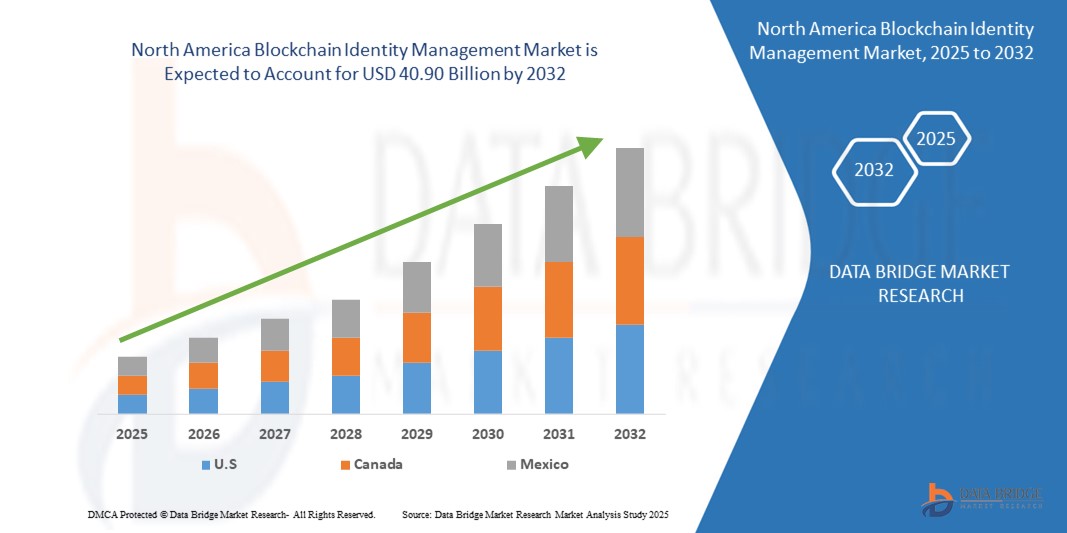
- The North America blockchain identity management market size was valued at USD 1.35 billion in 2024 and is expected to reach USD 40.90 billion by 2032, at a CAGR of 53.1% during the forecast period
- The market growth is largely fueled by increasing concerns around data breaches, identity theft, and regulatory compliance, prompting organizations to adopt blockchain-based identity verification solutions that offer decentralized, tamper-proof records
- Furthermore, rising adoption of Web3 platforms, decentralized finance (DeFi), and digital ID verification across sectors such as banking, government, and healthcare is positioning blockchain identity management as a secure and scalable solution. These converging trends are driving rapid adoption across industries, thereby significantly accelerating the market's growth
Blockchain Identity Management Market Analysis
- Blockchain identity management solutions are increasingly being adopted across industries to address the growing need for secure, decentralized, and tamper-proof identity verification, particularly in finance, healthcare, and government sectors, driven by escalating concerns around data breaches and identity theft
- The adoption of blockchain-based identity systems is significantly accelerating in North America due to stringent regulatory frameworks, including GDPR-like data privacy laws and KYC/AML compliance mandates, which encourage organizations to embrace more transparent and secure identity mechanisms
- The U.S. dominates the North America blockchain identity management market with a market share of 78.4% in 2025, supported by early adoption of blockchain technologies, robust digital infrastructure, and a strong presence of key players such as IBM, Microsoft, and SecureKey, along with government initiatives to enhance digital identity ecosystems
- Canada is expected to witness the highest CAGR of 58.6% during the forecast period in the North America blockchain identity management market, fueled by increased investments in digital identity innovation, support from federal programs such as the Pan-Canadian Trust Framework, and growing demand for secure identity verification in public and private sectors
- The Retail and E-commerce segment is expected to dominate the North America blockchain identity management market with a market share of 38.9% in 2025, driven by the sector’s need for secure customer authentication, fraud prevention, and seamless checkout experiences
Report Scope and Blockchain Identity Management Market Segmentation
|
Attributes |
Blockchain Identity Management Key Market Insights |
|
Segments Covered |
|
|
Countries Covered |
North America
|
|
Key Market Players |
|
|
Market Opportunities |
|
|
Value Added Data Infosets |
In addition to the market insights such as market value, growth rate, market segments, geographical coverage, market players, and market scenario, the market report curated by the Data Bridge Market Research team includes in-depth expert analysis, import/export analysis, pricing analysis, production consumption analysis, and pestle analysis. |
Blockchain Identity Management Market Trends
“Growing Adoption of Decentralized Digital Identity Solutions”
- In North America, a key market trend is the accelerating adoption of decentralized digital identity frameworks that give users greater control over their personal data and privacy. This movement is driven by increasing concerns over data breaches, identity theft, and regulatory pressures such as the California Consumer Privacy Act (CCPA) and evolving federal data privacy regulations
- Leading technology providers and startups in the region, including companies such as Evernym and Civic Technologies, are pioneering self-sovereign identity (SSI) platforms that enable users to verify and share their identity credentials securely without relying on centralized authorities
- Integration with blockchain technology ensures immutability and transparency of identity records, reducing fraud and streamlining verification processes. For instance, Evernym’s Sovrin network allows institutions and individuals to issue, hold, and verify digital credentials in a privacy-respecting way
- The increasing collaboration between governments, financial institutions, and healthcare providers in North America is fostering the adoption of blockchain-based identity management for KYC (Know Your Customer) compliance, patient data security, and seamless access control. For instance, Microsoft’s Azure Active Directory has incorporated blockchain identity components to improve enterprise security
- The trend also includes growing investment in blockchain identity startups and partnerships between established IT firms and niche identity management providers to expand the ecosystem. This growth is supported by the rising demand for solutions that enable cross-platform interoperability and compliance with evolving regulations
- North American consumers and enterprises are rapidly embracing these technologies to enhance security, reduce identity fraud, and improve user experience, fueling a competitive landscape focused on innovative, decentralized, and user-centric identity management solutions
Blockchain Identity Management Market Dynamics
Driver
“Increasing Demand Driven by Heightened Security Concerns and Regulatory Compliance”
- The rising concerns over identity theft, data breaches, and cyber fraud among individuals and organizations in North America are major drivers boosting demand for blockchain-based identity management solutions. The need for robust, tamper-proof identity verification systems is becoming critical across sectors such as finance, healthcare, and government
- For instance, in March 2025, Microsoft expanded its Azure Active Directory blockchain identity features to support decentralized identity verification, enabling enterprises to enhance security while maintaining compliance with evolving regulations such as the California Consumer Privacy Act (CCPA) and the U.S. National Institute of Standards and Technology (NIST) guidelines
- The growing regulatory landscape requiring stringent Know Your Customer (KYC) and Anti-Money Laundering (AML) compliance is encouraging financial institutions and fintech companies to adopt blockchain identity management to streamline verification processes, reduce fraud, and lower operational costs
- Increasing digital transformation initiatives and the widespread adoption of digital wallets, mobile banking, and e-governance services are further propelling the market growth, as blockchain-based solutions offer secure, privacy-preserving, and user-controlled identity frameworks
- The integration of blockchain identity management with emerging technologies such as artificial intelligence (AI) and biometrics enhances authentication accuracy and fraud detection capabilities, making these solutions more attractive to North American enterprises
- Furthermore, growing partnerships and investments by leading IT firms such as IBM and startups such as Evernym in decentralized identity projects demonstrate strong confidence in the market’s potential, fueling innovation and wider adoption in both public and private sectors
Restraint/Challenge
“Concerns Over Cybersecurity Risks and High Implementation Costs”
- Cybersecurity vulnerabilities associated with blockchain identity management systems remain a significant challenge to wider adoption in North America. Although blockchain offers enhanced security features, risks such as smart contract bugs, key management issues, and potential endpoint attacks still raise concerns among enterprises and consumers
- For instance, incidents involving compromised private keys or flaws in decentralized identity protocols have highlighted potential attack vectors, causing hesitation among potential users about the absolute security of blockchain-based identity solutions
- Ensuring robust encryption, secure key recovery mechanisms, and comprehensive identity lifecycle management is essential to building trust in these systems. Companies such as Evernym and IBM emphasize their use of advanced cryptographic techniques and compliance with security standards to mitigate such concerns
- In addition, the high initial costs of deploying blockchain identity infrastructure—covering technology integration, user onboarding, and regulatory compliance—pose a barrier, especially for smaller organizations and government agencies with limited budgets
- While blockchain identity solutions promise long-term cost savings by reducing fraud and manual verification processes, the upfront investment in hardware, software, and training can slow adoption rates in certain sectors
- Overcoming these challenges requires continued innovation to enhance security protocols, consumer and enterprise education on blockchain benefits, and the development of scalable, cost-effective identity management solutions to enable broader market penetration
Blockchain Identity Management Market Scope
The market is segmented on the basis of component, networks, provider, organization size, and industry.
By Component
On the basis of component, the blockchain identity management market is segmented into software and solution. The solution segment dominates the largest market revenue share in 2025, driven by the increasing deployment of end-to-end identity management systems that combine multiple functionalities such as credential issuance, authentication, and verification. Organizations prioritize comprehensive solutions that enable seamless integration with existing IT infrastructure while ensuring robust security and regulatory compliance.
The software segment is expected to witness significant growth as modular software tools for identity verification and management become more accessible and customizable for diverse business needs.
By Networks
On the basis of networks, the market is segmented into permissioned and permissionless networks. The permissioned segment holds the largest market revenue share in 2025, owing to its controlled access environment that provides enterprises and governments with greater privacy and compliance capabilities. Permissioned blockchain networks are favored for their scalability and governance features, which are critical in sensitive identity management applications.
The permissionless segment is anticipated to grow steadily as open decentralized identity models gain traction for their transparency and user sovereignty benefits.
By Provider
On the basis of provider, the market is segmented into application providers, middleware providers, and infrastructure providers. Application providers lead the market revenue share in 2025, driven by the increasing demand for user-facing identity verification and authentication platforms across various sectors.
Middleware providers are growing rapidly as they offer essential connectivity and interoperability solutions that enable seamless communication between blockchain networks and existing enterprise systems. Infrastructure providers maintain steady growth as foundational blockchain networks and protocols evolve to support identity management functionalities.
By Organization Size
On the basis of organization size, the market is segmented into large enterprises, small enterprises, and medium-sized enterprises. Large enterprises account for the largest market revenue share in 2025 due to their early adoption of blockchain identity management to enhance security, compliance, and operational efficiency.
Medium-sized enterprises are projected to exhibit strong growth rates as they increasingly invest in scalable and cost-effective identity management solutions. Small enterprises are gradually adopting these technologies as the market matures and solutions become more affordable and user-friendly.
By Industry
On the basis of industry, the market is segmented into BFSI, government, healthcare and life sciences, telecom and IT, retail and e-commerce, transport and logistics, real estate, media and entertainment, travel and hospitality, and others. The BFSI segment holds the largest market revenue share in 2025, driven by stringent KYC/AML regulations and the critical need for fraud prevention in financial transactions.
The government segment is expected to witness the fastest growth rate, fueled by increasing deployment of blockchain identity solutions for citizen services, voting systems, and public welfare programs. Healthcare and life sciences follow closely as organizations seek secure patient identity management and data privacy compliance.
Blockchain Identity Management Market Regional Analysis
U.S. Blockchain Identity Management Market Insight
The U.S. blockchain identity management market is rapidly gaining momentum, driven by increasing concerns over data privacy, identity theft, and regulatory compliance in digital transactions. Organizations and consumers alike are prioritizing secure and decentralized identity verification systems to combat rising cybersecurity threats. The surge in digital transformation initiatives across sectors such as finance, healthcare, and government is accelerating the adoption of blockchain-based identity solutions. Furthermore, the growing integration of self-sovereign identity (SSI) frameworks and decentralized identity protocols, supported by major technology providers such as Microsoft, IBM, and Amazon Web Services, is significantly propelling market growth. In addition, rising awareness around personal data control and stringent regulations such as the California Consumer Privacy Act (CCPA) are further fueling the demand for blockchain-powered identity management solutions in the U.S.
Canada Blockchain Identity Management Market Insight
The Canada blockchain identity management market is growing steadily, driven by rising concerns over data privacy and identity theft. Government initiatives such as the Pan-Canadian Trust Framework, developed by the Digital ID and Authentication Council of Canada (DIACC), are promoting secure digital identities nationwide. Services such as SecureKey Technologies’ Verified.Me highlight the country’s focus on decentralized, user-controlled identity solutions. Additionally, increasing digital transactions and regulatory compliance requirements across finance and healthcare sectors are further propelling market expansion
Mexico Blockchain Identity Management Market Insight
Mexico's blockchain identity management market is poised for significant growth, supported by the country's expanding digital infrastructure and increasing adoption of decentralized technologies. The broader blockchain technology market in Mexico is projected to reach approximately USD 36.5 billion by 2032, with a remarkable compound annual growth rate (CAGR) of 90.5% from 2025 to 2032. This surge is indicative of a growing interest in secure and transparent digital solutions across various sectors.
Blockchain Identity Management Market Share
The blockchain identity management industry is primarily led by well-established companies, including:
- Amazon Web Services, Inc. (U.S.)
- IBM (U.S.)
- Bitfury Group Limited (Netherlands)
- Civic Technologies, Inc (U.S.)
- EVERNYM INC., (U.S.)
- NETKI (U.S.)
- Microsoft (U.S.)
- Oracle (U.S.)
- KYC-CHAIN LIMITED (China)
- Factom (U.S.)
- OARO (Canada)
- Procivis AG (Germany)
- BTL Group (Ukraine)
- OriginalMy (Brazil)
- Bitnation (U.S.)
- Tracxn Technologies Limited (India)
Latest Developments in North America Blockchain Identity Management Market
- In November 2024, the XRP Ledger activated the Digital Identity (DID) Amendment through XLS-40, enabling decentralized identity management. This update allows users to control their digital identities independently from centralized authorities, enhancing privacy and security in digital transactions. The amendment introduces Decentralized Identifiers (DIDs), which function as unique, verifiable identity markers, preventing identity forgery and streamlining Know Your Customer (KYC) and Anti-Money Laundering (AML) compliance. Analysts anticipate this development will boost adoption of decentralized finance (DeFi) services
- In September 2024, Arianee partnered with ENS Labs to revolutionize digital identity management on the blockchain. This collaboration integrates Ethereum Name Service (ENS) into the Arianee Protocol, enabling brands to link their public wallet addresses to an ENS name connected to their corporate domain. This innovation enhances security, authenticity, and transparency, redefining how brands interact with customers in the digital space. The partnership simplifies identity verification, ensuring trustworthy digital interactions while promoting decentralized identity solutions
- In January 2023, AWS partnered with Ava Labs to accelerate blockchain adoption across enterprises, institutions, and governments. This collaboration simplifies node deployment and management on Avalanche, enhancing the network’s scalability and flexibility for developers. AWS supports Avalanche’s infrastructure and decentralized application (dApp) ecosystem, offering one-click node deployment through its marketplace. Additionally, Ava Labs joined AWS Activate, a program assisting startups in blockchain innovation. This partnership strengthens Avalanche’s presence in Web3, making blockchain technology more accessible
- In May 2022, Microsoft introduced Microsoft Entra, a new product family designed to enhance identity and access management. This suite includes Azure Active Directory (Azure AD) alongside two new categories: Microsoft Entra Permissions Management and Microsoft Entra Verified ID. Verified ID is built on decentralized identity standards, providing a secure, interoperable, and self-owned identity solution. Meanwhile, Permissions Management offers comprehensive visibility and control over permissions across multi-cloud environments, helping organizations reduce access risks. This launch reflects Microsoft's commitment to strengthening security and trust in digital interactions
- In July 2021, Oracle Financial Services Software Ltd partnered with Everest to integrate blockchain technology into global banking operations. This collaboration enables Oracle’s banking clients to verify customer credentials and securely store them on a blockchain platform across multiple jurisdictions. The integration enhances Oracle’s banking software, improving Know Your Customer (KYC) compliance and facilitating remote customer onboarding. Everest’s biometric identity verification and eKYC solutions strengthen financial security while streamlining cross-border transactions

- Interactive Data Analysis Dashboard
- Company Analysis Dashboard for high growth potential opportunities
- Research Analyst Access for customization & queries
- Competitor Analysis with Interactive dashboard
- Latest News, Updates & Trend analysis
- Harness the Power of Benchmark Analysis for Comprehensive Competitor Tracking
Data collection and base year analysis are done using data collection modules with large sample sizes. The stage includes obtaining market information or related data through various sources and strategies. It includes examining and planning all the data acquired from the past in advance. It likewise envelops the examination of information inconsistencies seen across different information sources. The market data is analysed and estimated using market statistical and coherent models. Also, market share analysis and key trend analysis are the major success factors in the market report. To know more, please request an analyst call or drop down your inquiry.
The key research methodology used by DBMR research team is data triangulation which involves data mining, analysis of the impact of data variables on the market and primary (industry expert) validation. Data models include Vendor Positioning Grid, Market Time Line Analysis, Market Overview and Guide, Company Positioning Grid, Patent Analysis, Pricing Analysis, Company Market Share Analysis, Standards of Measurement, Global versus Regional and Vendor Share Analysis. To know more about the research methodology, drop in an inquiry to speak to our industry experts.
Data Bridge Market Research is a leader in advanced formative research. We take pride in servicing our existing and new customers with data and analysis that match and suits their goal. The report can be customized to include price trend analysis of target brands understanding the market for additional countries (ask for the list of countries), clinical trial results data, literature review, refurbished market and product base analysis. Market analysis of target competitors can be analyzed from technology-based analysis to market portfolio strategies. We can add as many competitors that you require data about in the format and data style you are looking for. Our team of analysts can also provide you data in crude raw excel files pivot tables (Fact book) or can assist you in creating presentations from the data sets available in the report.













