


Brain Monitoring Market Size
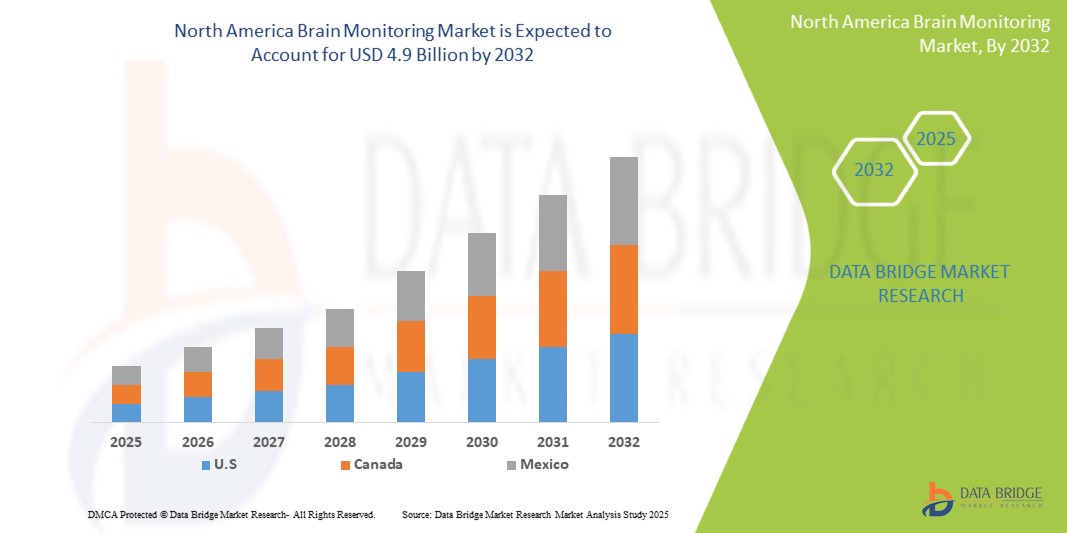
- The North America Brain Monitoring market size was valued at USD 2.45 billion in 2024 and is expected to reach USD 4.9 billion by 2032, at a CAGR of 9.0% during the forecast period
- The market's growth is primarily driven by the increasing prevalence of neurological disorders, such as epilepsy, Alzheimer's, Parkinson's, and traumatic brain injuries, coupled with advancements in neurotechnology
- The rising demand for non-invasive and minimally invasive monitoring techniques, along with the growing adoption of wearable and portable brain monitoring devices, are further accelerating market expansion.
Brain Monitoring Market Analysis
- The North America brain monitoring market encompasses devices and technologies used to assess and track brain activity and neurological function. These devices aid in the diagnosis, treatment, and management of various neurological conditions, improving patient outcomes and contributing to overall brain health.
- The escalating demand for brain monitoring devices is fueled by the increasing geriatric population, which is more susceptible to neurological disorders, and significant investments in research and development activities to create more advanced and user-friendly monitoring solutions.
- The U.S. dominates the Brain Monitoring market with the largest revenue share of 54.25% in 2025, due to a high prevalence of neurological disorders, well-established healthcare infrastructure, and significant investments in medical research and development.
- The strong adoption of advanced technologies and favorable reimbursement policies further contribute to the U.S.'s leading position in the market.
- The Electroencephalography (EEG) Devices segment held the largest market share of 33.5% in 2025, due to their widespread use in diagnosing epilepsy, sleep disorders, and other neurological conditions, coupled with their relatively non-invasive nature and cost-effectiveness.
Report Scope and Brain Monitoring Market Segmentation
|
Attributes |
Brain Monitoring Key Market Insights |
|
Segments Covered |
|
|
Countries Covered |
North America
|
|
Key Market Players |
|
|
Market Opportunities |
|
|
Value Added Data Infosets |
In addition to the insights on market scenarios such as market value, growth rate, segmentation, geographical coverage, and major players, the market reports curated by the Data Bridge Market Research also include in-depth expert analysis, pricing analysis, brand share analysis, consumer survey, demography analysis, supply chain analysis, value chain analysis, raw material/consumables overview, vendor selection criteria, PESTLE Analysis, Porter Analysis, and regulatory framework. |
Brain Monitoring Market Trends
“Growing Adoption of Digital Health and AI Integration"
- A significant trend in the North America brain monitoring market is the increasing adoption of digital health technologies and the integration of Artificial Intelligence (AI) and Machine Learning (ML) into brain monitoring devices. This trend is driven by the need for more precise diagnostics, automated data analysis, and improved patient care.
- For instance, AI algorithms are being used to analyze complex EEG data to detect patterns indicative of seizures or sleep disorders, leading to faster and more accurate diagnoses. Wearable brain monitoring devices are also becoming increasingly sophisticated, offering real-time data collection and remote monitoring capabilities, which are crucial for managing chronic neurological conditions and enabling home-based care.
- Furthermore, advancements in telehealth platforms are facilitating the remote interpretation of brain monitoring data, enhancing accessibility to specialized neurological care, particularly in underserved areas. This integration of digital tools is making brain monitoring more efficient, accessible, and patient-friendly.
Brain Monitoring Market Dynamics
Driver
“Rising Incidence of Neurological Disorders and Traumatic Brain Injuries”
- The increasing prevalence of neurological disorders, such as Alzheimer's disease, Parkinson's disease, epilepsy, stroke, and various sleep disorders, along with the growing incidence of traumatic brain injuries (TBIs), is a major driver for the North America brain monitoring market.
- For Instance , the aging population in North America is particularly susceptible to neurodegenerative diseases, which often require continuous monitoring to manage symptoms and assess disease progression. TBIs, often resulting from accidents or sports injuries, necessitate immediate and ongoing brain monitoring to prevent secondary brain damage and guide treatment.
- The heightened awareness among patients and healthcare providers about the importance of early diagnosis and continuous monitoring for these conditions is fueling the demand for a wide range of brain monitoring devices, from EEGs to intracranial pressure monitors.
- Governments and healthcare organizations are also investing more in neurological research and care, which further supports the adoption of advanced brain monitoring technologies.
Restraint/Challenge
“High Cost of Brain Monitoring Devices and Shortage of Trained Professionals”
- The relatively high cost associated with advanced brain monitoring devices, especially sophisticated imaging equipment like fMRI and MEG systems, poses a significant challenge to broader market adoption, particularly in smaller clinics or healthcare facilities with budget constraints.
- For instance, the initial investment in purchasing and maintaining these devices can be substantial, making them less accessible for some healthcare providers. Additionally, the complex nature of brain monitoring technologies often requires specialized training for healthcare professionals to operate and interpret the data accurately.
- The shortage of highly skilled neurologists, neurophysiologists, and technicians capable of effectively utilizing and managing these devices can limit their widespread implementation. This scarcity of trained personnel can also lead to delays in diagnosis and treatment, impacting patient care.
- Addressing these challenges through innovative financing models, government subsidies, and comprehensive training programs will be crucial for overcoming adoption barriers and ensuring wider accessibility to advanced brain monitoring solutions.
Brain Monitoring Market Scope
The market is segmented on the basis of product type, procedure, application, and end-user.
By Product Type
On the basis of product type, the North America brain monitoring market is segmented into electroencephalography (EEG) devices, magnetoencephalography (MEG) devices, intracranial pressure (ICP) monitors, cerebral oximeters, transcranial doppler (TCD) devices, functional magnetic resonance imaging (fMRI), positron emission tomography (PET), computed tomography (CT), functional near-infrared spectroscopy (fNIRS), and others. The Electroencephalography (EEG) Devices segment held held the largest market share of 33.5% in 2025, due to their widespread use in diagnosing epilepsy, sleep disorders, and other neurological conditions, coupled with their relatively non-invasive nature and cost-effectiveness.
The functional near-infrared spectroscopy (fNIRS) segment is expected to witness the fastest growth of 15.1% from 2025, driven by its non-invasiveness and suitability for continuous brain activity monitoring in various settings.
By Procedure
On the basis of procedure, the North America brain monitoring market is segmented into invasive and non-invasive. The non-invasive segment holds the largest market share, due to the increasing preference for less risky and patient-friendly diagnostic and monitoring methods. This includes devices like EEG, fMRI, and TCD.
The invasive segment is expected to witness the fastest growth due particularly in critical care settings for conditions requiring continuous and precise monitoring, such as intracranial pressure.
By Application
On the basis of application, the North America brain monitoring market is segmented into traumatic brain injury (TBI), stroke, epilepsy, sleep disorders, dementia, Parkinson's disease, headache disorders, and other diseases. The epilepsy segment segment holds the largest market share, driven by the continuous need for brain activity monitoring to diagnose and manage seizures.
The traumatic brain injury (TBI) segment is expected to witness the fastest growth due fueled by the rising incidence of head injuries and the critical need for real-time brain monitoring in acute care settings.
By End-User
On the basis of end-user, the North America brain monitoring market is segmented into hospitals & clinics, neurological centers, diagnostic centers, ambulatory surgical centers (ASCs), and research institutions. The hospitals & clinics segment holds the largest market share, due to the high volume of neurological cases, the availability of advanced medical infrastructure, and the need for comprehensive diagnostic and monitoring capabilities.
The homecare setting/ambulatory care segment is expected to witness the fastest growth due driven by the increasing demand for remote patient monitoring and the development of portable and wearable brain monitoring devices.
Brain Monitoring Market Regional Analysis
- U.S. dominates the Brain Monitoring market with the largest revenue share of 54.25 % in 2024, due to a high prevalence of neurological disorders, well-established healthcare infrastructure, and significant investments in medical research and development.
- The strong adoption of advanced technologies and favorable reimbursement policies further contribute to the U.S.'s leading position in the market.
Canada Brain Monitoring Market Insight
The Canada Brain Monitoring market is projected to expand at a substantial CAGR throughout the forecast period, driven by factors such as an aging population, increasing awareness of neurological health, and government initiatives to improve healthcare access and technology adoption. The growing number of neurological specialists and the demand for advanced diagnostic tools also contribute to market expansion in Canada.
Mexico Brain Monitoring Market Insight
The Mexico Brain Monitoring market is anticipated to grow at a noteworthy CAGR during the forecast period, driven by improving healthcare infrastructure, increasing healthcare expenditure, and a rising awareness of neurological conditions. The growing prevalence of chronic diseases requiring brain monitoring and the increasing investment in medical tourism also contribute to the market's growth in Mexico.
Brain Monitoring Market Share
The Brain Monitoring industry is primarily led by well-established companies, including:
- Medtronic plc (Ireland)
- GE HealthCare (U.S.)
- Koninklijke Philips N.V. (Netherlands)
- Siemens Healthineers AG (Germany)
- Natus Medical Incorporated (U.S.)
- Nihon Kohden Corporation (Japan)
- Compumedics Limited (Australia)
- Advanced Brain Monitoring, Inc. (U.S.)
- Cadwell Industries Inc. (U.S.)
- Masimo Corporation (U.S.)
- Drägerwerk AG & Co. KGaA (Germany)
- Integra LifeSciences Corporation (U.S.)
- Neurosoft (Russia)
- Nonin Medical, Inc. (U.S.)
- Rimed Ltd. (Israel)
Latest Developments in North America Brain Monitoring Market
- In April 2024, Integra LifeSciences relaunched its CereLink® Intracranial Pressure (ICP) Monitoring System in the United States, aiming to enhance its offerings in critical care neurological monitoring.

- Interactive Data Analysis Dashboard
- Company Analysis Dashboard for high growth potential opportunities
- Research Analyst Access for customization & queries
- Competitor Analysis with Interactive dashboard
- Latest News, Updates & Trend analysis
- Harness the Power of Benchmark Analysis for Comprehensive Competitor Tracking
Data collection and base year analysis are done using data collection modules with large sample sizes. The stage includes obtaining market information or related data through various sources and strategies. It includes examining and planning all the data acquired from the past in advance. It likewise envelops the examination of information inconsistencies seen across different information sources. The market data is analysed and estimated using market statistical and coherent models. Also, market share analysis and key trend analysis are the major success factors in the market report. To know more, please request an analyst call or drop down your inquiry.
The key research methodology used by DBMR research team is data triangulation which involves data mining, analysis of the impact of data variables on the market and primary (industry expert) validation. Data models include Vendor Positioning Grid, Market Time Line Analysis, Market Overview and Guide, Company Positioning Grid, Patent Analysis, Pricing Analysis, Company Market Share Analysis, Standards of Measurement, Global versus Regional and Vendor Share Analysis. To know more about the research methodology, drop in an inquiry to speak to our industry experts.
Data Bridge Market Research is a leader in advanced formative research. We take pride in servicing our existing and new customers with data and analysis that match and suits their goal. The report can be customized to include price trend analysis of target brands understanding the market for additional countries (ask for the list of countries), clinical trial results data, literature review, refurbished market and product base analysis. Market analysis of target competitors can be analyzed from technology-based analysis to market portfolio strategies. We can add as many competitors that you require data about in the format and data style you are looking for. Our team of analysts can also provide you data in crude raw excel files pivot tables (Fact book) or can assist you in creating presentations from the data sets available in the report.













