


What is the North America Burn Care Market Size and Growth Rate?
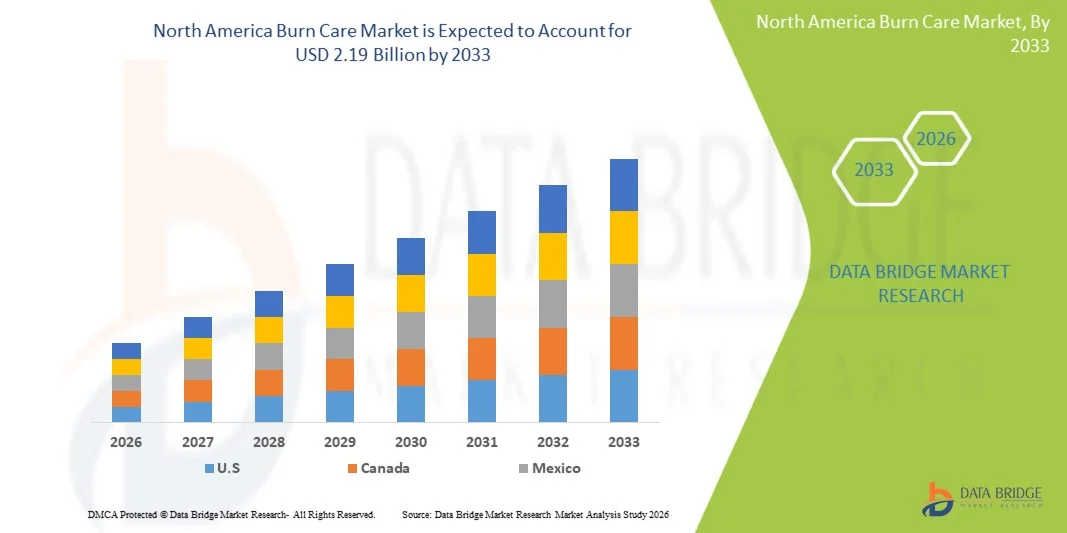
- As per Data Bridge Market Research analysis, the North America Burn Care Market size was valued at USD 1.32 Billion in 2025 and is expected to reach USD 2.19 Billion by 2033, at a CAGR of 6.55% during the forecast period
- The market growth is largely fueled by the increasing incidence of burn injuries, advancements in wound management technologies, and rising awareness regarding advanced treatment options, leading to greater adoption of burn care products across hospitals, clinics, and specialized burn centers
- Furthermore, rising demand for effective, user-friendly, and faster-healing solutions—such as advanced dressings, biologics, and skin grafts—is establishing modern burn care as the preferred approach for improving patient outcomes. These converging factors are accelerating the uptake of Burn Care solutions, thereby significantly boosting the industry’s growth
Market Size & Forecast
- Global Market Value (2025): USD 1.32 billion
- Expected Market Value (2033): USD 2.19 billion
- Forecast CAGR (2026-2033): 6.55%
What are the Major Takeaways of North America Burn Care Market?
- Burn care solutions, including advanced wound dressings, biologics, skin grafts, and topical agents, are increasingly vital components of modern wound management in both hospital and emergency care settings due to their effectiveness in accelerating healing, reducing infection risk, and improving patient comfort
- The escalating demand for burn care products is primarily fueled by the rising incidence of burn injuries, expanding healthcare infrastructure, increasing awareness of advanced treatment options, and growing adoption of innovative therapies such as bioengineered skin substitutes and antimicrobial dressings
- China dominated the North America Burn Care Market with the largest revenue share of approximately 38% in 2025, supported by a large patient population, rapid improvements in healthcare facilities, significant government investment in emergency and trauma care, and strong presence of domestic manufacturers offering cost-effective burn care products. China’s expanding hospital networks and increasing adoption of advanced wound management technologies continue to strengthen its market leadership
- India is expected to be the fastest growing region in the North America Burn Care Market during the forecast period, driven by rising burn incidences, increasing healthcare spending, rapid urbanization, and greater availability of advanced burn units. Government initiatives, expanding medical tourism, and growing adoption of modern wound care solutions in both public and private hospitals are accelerating India’s North America Burn Care Market growth
- The Thermal Burn segment dominated the largest market revenue share of 61.7% in 2025, primarily due to the high global prevalence of flame, hot liquid, and contact burns
Report Scope and North America Burn Care Market Segmentation
|
Attributes |
North America Burn Care Key Market Insights |
|
Segments Covered |
|
|
Countries Covered |
North America
|
|
Key Market Players |
|
|
Market Opportunities |
|
|
Value Added Data Infosets |
In addition to the insights on market scenarios such as market value, growth rate, segmentation, geographical coverage, and major players, the market reports curated by the Data Bridge Market Research also include in-depth expert analysis, patient epidemiology, pipeline analysis, pricing analysis, and regulatory framework. |
What is the Key Trend in the North America Burn Care Market?
“Growing Shift Toward Advanced Wound Management and Minimally Invasive Burn Treatment Solutions”
- A significant and rapidly strengthening trend in the global North America Burn Care Market is the increasing adoption of advanced wound management solutions, biologics, and minimally invasive treatment technologies. This shift is driven by the rising incidence of burn injuries, improvements in healthcare infrastructure, and the demand for faster, more effective recovery outcomes
- Modern burn care approaches such as biosynthetic dressings, regenerative skin substitutes, and advanced hydrocolloid/hydrogel dressings are replacing traditional gauze-based methods. These next-generation solutions help accelerate healing, reduce infection risk, and minimize pain, contributing to improved patient comfort and clinical results
- For instance, leading brands such as Smith+Nephew, Mölnlycke Health Care, and Integra LifeSciences are consistently enhancing their burn care portfolios with innovative dressings engineered to maintain moisture balance, offer antimicrobial protection, and support tissue regeneration. Many newly launched products are designed to shorten hospital stays and reduce the need for surgical interventions
- In addition to dressings, technological advancements such as negative pressure wound therapy (NPWT) and bioengineered skin grafts are increasingly being integrated into burn management protocols across hospitals worldwide, especially for deep and complex burns
- This trend toward more specialized, intelligent, and patient-centric burn care solutions is reshaping provider expectations globally. As a result, major companies are investing in R&D for innovative products such as collagen-based matrices, synthetic skin substitutes, and silver-infused antimicrobial dressings to meet the growing demand for advanced wound healing
- The global need for sophisticated burn care technologies continues to expand across both developed and emerging economies, as healthcare systems prioritize faster recovery, reduced infection rates, and improved long-term outcomes for burn patients
North America Burn Care Market Dynamics
Driver
“Rising Incidence of Burn Injuries and Increasing Adoption of Advanced Wound Care Solutions”
- The global increase in thermal, chemical, electrical, and radiation-related burn injuries is a key driver of the North America Burn Care Market. According to multiple health agencies, millions of burn cases requiring medical attention are reported annually, creating substantial demand for effective treatment solutions
- For instance, in April 2025, announced advancements in IoT-enabled monitoring solutions to improve safety in self-storage facilities, reflecting broader initiatives among healthcare and safety-focused companies to enhance burn and injury prevention technologies. Such developments indirectly support the growth of the burn care ecosystem by improving emergency responsiveness and monitoring
- As hospitals and emergency care centers adopt more modern wound care solutions, advanced products such as antimicrobial dressings, biological skin substitutes, enzymatic debridement agents, and moist wound healing technologies are increasingly preferred over traditional method
- Growing awareness about the benefits of effective burn treatment—such as lower infection rates, reduced scarring, and better long-term cosmetic outcomes—further supports the rising demand for advanced burn care products
- In addition, government initiatives and international programs focused on reducing burn-related mortality, especially in low- and middle-income countries, are accelerating product adoption and improving access to modern burn care
Restraint/Challenge
“High Treatment Costs and Limited Access to Advanced Burn Care in Developing Regions”
- One of the major challenges limiting global market expansion is the high cost of advanced burn care products and treatment procedures. Specialized solutions such as bioengineered skin grafts, NPWT devices, and high-end antimicrobial dressings are significantly more expensive than conventional alternatives, creating a barrier for low-income populations and underfunded healthcare systems
- For instance, while innovative wound care solutions deliver superior outcomes, their premium pricing—combined with the need for continuous clinical support—makes them less accessible in rural and economically constrained regions
- Limited availability of trained professionals, insufficient burn units, and inadequate emergency care infrastructure in many developing countries further impede the widespread adoption of advanced treatment approaches
- Although technological innovations are improving burn care outcomes, the perceived and actual cost burden associated with modern therapies slows adoption, especially where reimbursement frameworks are weak
- Overcoming these restraints will require expanded healthcare funding, increased product affordability, improved medical training, and strengthened global initiatives aimed at enhancing burn care accessibility for all patient groups
How is the North America Burn Care Market Segmented?
The market is segmented on the basis of product type, depth of burn, burn type, end user, and distribution channel.
• By Product Type
On the basis of product type, the North America Burn Care Market is segmented into Advanced Burn Care Products, Traditional Burn Care Products, Biologics, and Others. The Advanced Burn Care Products segment dominated the largest market revenue share of 48.6% in 2025, driven by the increasing adoption of hydrocolloids, alginates, hydrogel sheets, and silver-based dressings that offer superior moisture balance, faster healing, and reduced infection rates. Hospitals prefer these solutions due to their ability to minimize dressing change frequency, reduce pain, and improve patient comfort. The rising global incidence of moderate to severe burns and strong demand for non-adherent, clinically validated dressings further boosts the segment. Continuous product innovations and broader reimbursement coverage in major markets also support dominance. Increased awareness of advanced wound healing techniques and adoption in both inpatient and outpatient settings have strengthened the segment's leadership.
The Biologics segment is anticipated to witness the fastest growth rate of 17.9% from 2026 to 2033, fueled by increasing adoption of bioengineered skin substitutes, collagen matrices, keratin products, and regenerative tissue therapies. Biologics are preferred in full-thickness and complex burns due to their superior ability to promote natural tissue regeneration, reduce scarring, and shorten recovery time. Growing approvals for advanced grafts and rising investments in 3D-printed skin and cellular therapy technologies are accelerating growth. Improved outcomes in pediatric and severe burn cases are also increasing demand. Expansion of specialized burn units and growing clinical evidence supporting biologics contribute to rapid adoption worldwide.
• By Depth of Burn
On the basis of depth of burn, the North America Burn Care Market is segmented into Partial-Thickness Burns, Minor Burns, and Full-Thickness Burns. The Partial-Thickness Burns segment dominated the largest market revenue share of 54.3% in 2025, driven by the high prevalence of scalds, flame burns, and contact burns globally. These burns commonly require advanced moist dressings, antimicrobial agents, and hydrogels to reduce infection and accelerate epithelialization. Increasing hospital admissions for moderate burns and the rise in domestic and occupational injuries support segment dominance. Widespread use of partial-thickness burn protocols in both homecare and clinical settings boosts demand. Growing awareness of early burn management and improved access to outpatient burn services further strengthen the segment's position. The rising use of silver dressings and silicone sheets for scarring control also contributes to its large share.
The Full-Thickness Burns segment is anticipated to witness the fastest growth rate of 16.2% from 2026 to 2033, driven by rising adoption of surgical grafts, biologics, dermal substitutes, and advanced reconstruction techniques. Increasing industrial accidents, fire-related injuries, and electrical burns requiring specialized treatment support rapid growth. Specialized burn care centers are increasingly equipped with advanced technologies for severe burn management, improving treatment outcomes. Rising government investments in trauma and emergency infrastructure and expansion of burn ICUs also accelerate growth. Improved diagnostic tools and availability of next-generation grafting materials further support this fast-expanding segment.
• By Burn Type
On the basis of burn type, the North America Burn Care Market is segmented into Thermal Burn, Electrical Burn, Chemical Burn, Radiation Burn, Friction Burn, and Others. The Thermal Burn segment dominated the largest market revenue share of 61.7% in 2025, primarily due to the high global prevalence of flame, hot liquid, and contact burns. Household kitchen accidents, unsafe heating systems, and industrial exposure contribute significantly to thermal burn cases. Thermal burns require a wide range of treatments including hydrogels, antimicrobial silver products, advanced dressings, and biologics, contributing to strong product demand. Increasing public health awareness and improved emergency care access also support segment dominance. Rising burn admissions in both urban and rural healthcare settings further expand the segment's revenue share.
The Chemical Burn segment is anticipated to witness the fastest growth rate of 15.4% from 2026 to 2033, supported by rising exposure to corrosive chemicals in industrial, manufacturing, and laboratory environments. Chemical burns require specialized cleansing agents, neutralizing solutions, antimicrobial products, and advanced dressings to manage tissue damage, boosting market adoption. Increasing regulatory focus on workplace safety, mandatory availability of chemical burn kits, and rising industrialization in developing economies contribute to accelerated growth. Growing awareness among clinicians regarding optimal management protocols for chemical burns also supports rapid expansion.
• By End User
On the basis of end user, the North America Burn Care Market is segmented into Hospitals, Burn Care Centres, Homecare, Clinics, and Others. The Hospitals segment accounted for the largest market revenue share of 49.8% in 2025, driven by high admission rates of moderate to severe burns requiring surgical intervention, intensive care, and advanced dressing application. Hospitals remain the primary treatment point for full-thickness injuries and burns with infection risk, supporting high consumption of advanced dressings, biologics, and wound care agents. Increasing emergency care capacity, availability of specialized burn units, and government support for trauma care infrastructure strengthen the segment's dominance. Hospitals also handle complex procedures such as debridement, grafting, and reconstructive surgeries, further contributing to their large share.
The Burn Care Centres segment is anticipated to witness the fastest growth rate of 18.1% from 2026 to 2033, fueled by rising establishment of dedicated specialty burn units offering advanced and focused treatment. Burn care centers provide multidisciplinary support including surgical care, infection management, long-term rehabilitation, and scar therapy, making them increasingly preferred for severe cases. Growing investments in specialized burn facilities and rising patient preference for high-quality, expertise-driven treatment enhance growth. Expansion of dedicated pediatric burn centers and improved survival outcomes in specialized centers further accelerate adoption.
• By Distribution Channel
On the basis of distribution channel, the North America Burn Care Market is segmented into Direct Tender and Retail. The Direct Tender segment dominated the largest market revenue share of 68.4% in 2025, driven by bulk purchasing by hospitals, government health agencies, NGOs, and burn specialty centers. Direct tender channels ensure consistent supply of advanced dressings, biologics, surgical kits, and essential care products at negotiated prices, supporting strong institutional adoption. Public hospitals and trauma centers heavily rely on tender-based procurement due to cost efficiency and centralized supply management. Governments in emerging countries increasingly allocate budgets for burn treatment supplies through tenders, reinforcing segment leadership.
The Retail segment is anticipated to witness the fastest growth rate of 14.7% from 2026 to 2033, driven by rising consumer awareness about first-aid burn care, increased availability of OTC burn gels, hydrogel pads, antimicrobial sprays, and silicone scar sheets. Expansion of pharmacy chains and the rapid rise of ecommerce platforms are making burn care products more accessible. Growing preference for home-based management of minor burns supports retail channel growth. Increased marketing of advanced OTC burn products and rising self-treatment trends also fuel this segment.
North America Burn Care Market Regional Analysis
- The global North America Burn Care Market is witnessing robust growth, driven by increasing incidences of burn injuries, rising awareness about advanced wound management, and the adoption of technologically advanced burn care products. Hospitals, specialized burn centers, and homecare services are increasingly investing in hydrocolloids, biologics, and bioengineered skin substitutes to improve patient outcomes
- Government initiatives supporting trauma care infrastructure, coupled with the expansion of private healthcare networks in developed markets, are accelerating market adoption. In addition, rising medical tourism and improvements in emergency response systems are bolstering demand globally
- The integration of advanced dressings, regenerative therapies, and anti-infective solutions is positioning the market for steady growth during the forecast period
U.S. North America Burn Care Market Insight
The U.S. North America Burn Care Market dominated the North America Burn Care Market with the largest revenue share of approximately 37% in 2025, supported by a well-established healthcare infrastructure, high-quality trauma and emergency care systems, and a strong presence of specialized burn centers. The country benefits from widespread adoption of advanced wound care technologies, including biologics, hydrocolloids, and bioengineered skin substitutes. Continuous investments in healthcare innovation, coupled with increasing patient awareness and adoption of modern burn care products in hospitals and homecare services, further reinforce U.S. market leadership.
Canada North America Burn Care Market Insight
Canada North America Burn Care Market is expected to be the fastest-growing region in the North America Burn Care Market during the forecast period, projected to expand at a CAGR of 7.8% from 2026 to 2033, driven by rising burn incidences, expanding healthcare infrastructure, and increased availability of advanced burn units. Government initiatives promoting trauma care, growing adoption of innovative wound care solutions in both public and private hospitals, and rising medical tourism are accelerating Canada’s market growth. The adoption of regenerative therapies, advanced dressings, and biologics in both urban and semi-urban areas is further supporting the rapid expansion of the Canadian North America Burn Care Market.
Which are the Top Companies in North America Burn Care Market?
The Burn Care industry is primarily led by well-established companies, including:
- Smith & Nephew (U.K.)
- Mölnlycke Health Care (Sweden)
- 3M (U.S.)
- Convatec Group (U.K.)
- Coloplast (Denmark)
- Integra LifeSciences (U.S.)
- Johnson & Johnson (U.S.)
- Medline Industries (U.S.)
- Derma Sciences (U.S.)
- Hollister Incorporated (U.S.)
- Essity (Sweden)
- Baxter International (U.S.)
- Pediatric Burn Care Products Inc. (U.S.)
- DeRoyal Industries (U.S.)
- Human BioSciences (U.S.)
- BSN Medical (Germany)
- Medtronic (Ireland)
- Cardinal Health (U.S.)
- Nestle Health Science (Switzerland)
- Acelity (U.S.)
What are the Recent Developments in North America Burn Care Market?
- In December 2022, MediWound received U.S. FDA approval for NexoBrid® (anacaulase‑bcdb) for the treatment of severe thermal burns in adults, marking a key regulatory milestone for enzymatic, non‑surgical eschar removal therapies that can reduce the need for surgical intervention in deep partial‑ and full‑thickness burns
- In March 2023, the U.S. Food and Drug Administration cleared Convatec’s InnovaBurn medical device — a novel placental extracellular matrix product — designed to manage complex surgical wounds and partial‑thickness burns, offering clinicians a biologically‑derived alternative to traditional wound dressings and broadening therapeutic options for second‑degree burns
- In January 2023, Convatec Group PLC introduced Convafoam, an advanced foam dressing for the U.S. market intended to support both patient comfort and clinical needs across a range of wound types including burns, reflecting increased innovation in absorbent, protective dressings for burn wound management
- In August 2024, MediWound announced that the U.S. FDA granted a pediatric indication for NexoBrid, authorizing its use for deep partial‑ and full‑thickness thermal burns in patients from newborn to 18 years old, significantly expanding its utility to treat pediatric burns — a population representing a large share of global burn incidents
- In March 2024, AVITA Medical presented 16 scientific abstracts at the American Burn Association (ABA) Annual Meeting highlighting clinical data and real‑world outcomes for its RECELL System and associated technologies, underscoring continued clinical engagement and evidence‑generation efforts for regenerative and autologous cell‑based burn treatments in professional burn care settings
- In April 2025, industry reports noted broader adoption of advanced burn and wound technologies such as extracellular matrix devices and regenerative dressings, with companies like Smith & Nephew and Coloplast engaging in partnerships and product innovation aimed at personalized, technology‑enhanced burn care solutions
- In September 2025, MediWound expanded the global reach of NexoBrid by securing marketing authorization from Australia’s Therapeutic Goods Administration (TGA) for both adult and pediatric patients with thermal burns, positioning NexoBrid as a globally recognized standard‑of‑care enzymatic therapy for eschar removal

- Interactive Data Analysis Dashboard
- Company Analysis Dashboard for high growth potential opportunities
- Research Analyst Access for customization & queries
- Competitor Analysis with Interactive dashboard
- Latest News, Updates & Trend analysis
- Harness the Power of Benchmark Analysis for Comprehensive Competitor Tracking
Data collection and base year analysis are done using data collection modules with large sample sizes. The stage includes obtaining market information or related data through various sources and strategies. It includes examining and planning all the data acquired from the past in advance. It likewise envelops the examination of information inconsistencies seen across different information sources. The market data is analysed and estimated using market statistical and coherent models. Also, market share analysis and key trend analysis are the major success factors in the market report. To know more, please request an analyst call or drop down your inquiry.
The key research methodology used by DBMR research team is data triangulation which involves data mining, analysis of the impact of data variables on the market and primary (industry expert) validation. Data models include Vendor Positioning Grid, Market Time Line Analysis, Market Overview and Guide, Company Positioning Grid, Patent Analysis, Pricing Analysis, Company Market Share Analysis, Standards of Measurement, Global versus Regional and Vendor Share Analysis. To know more about the research methodology, drop in an inquiry to speak to our industry experts.
Data Bridge Market Research is a leader in advanced formative research. We take pride in servicing our existing and new customers with data and analysis that match and suits their goal. The report can be customized to include price trend analysis of target brands understanding the market for additional countries (ask for the list of countries), clinical trial results data, literature review, refurbished market and product base analysis. Market analysis of target competitors can be analyzed from technology-based analysis to market portfolio strategies. We can add as many competitors that you require data about in the format and data style you are looking for. Our team of analysts can also provide you data in crude raw excel files pivot tables (Fact book) or can assist you in creating presentations from the data sets available in the report.













