


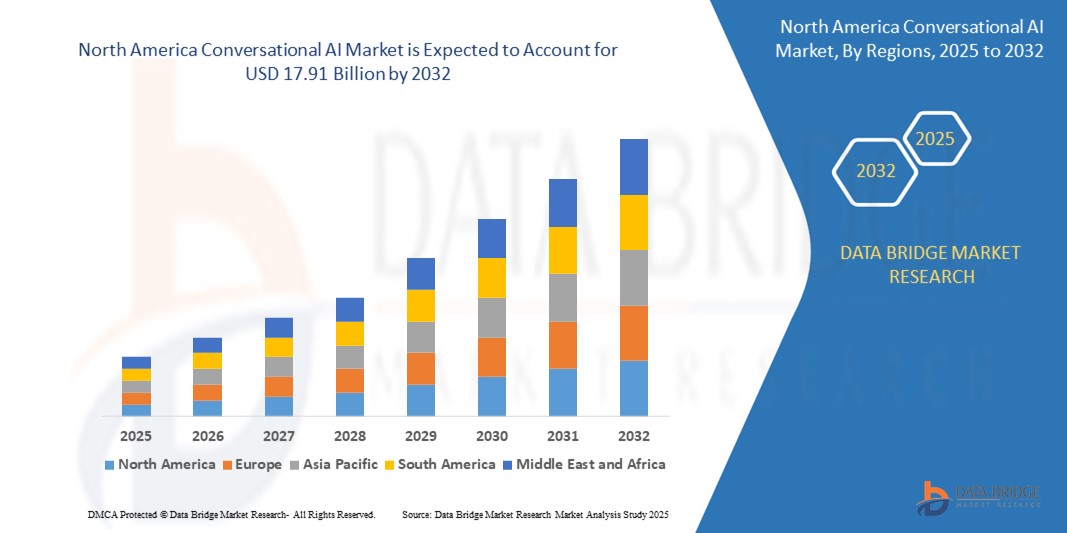
North America Conversational AI Market Size
- The North America conversational AI market size was valued at USD 3.04 billion in 2024 and is expected to reach USD 17.91 billion by 2032, at a CAGR of 24.8% during the forecast period
- The market growth is largely fuelled by the widespread adoption of virtual assistants, chatbots, and voice-enabled applications across industries such as banking, healthcare, retail, and telecommunications
- The increasing focus on customer experience optimization, coupled with advancements in natural language processing and machine learning, is driving the rapid expansion of conversational AI in the region
North America Conversational AI Market Analysis
- Organizations across North America are rapidly embracing conversational AI technologies to streamline operations, enhance customer support, and reduce operational costs. The region's strong digital infrastructure and early technology adoption enable seamless deployment of AI-driven communication platforms
- The growing demand for 24/7 customer service and personalized experiences is encouraging enterprises to integrate AI chatbots and voice assistants into their customer engagement strategies. This trend is particularly prominent in sectors such as finance and e-commerce
- U.S. conversational AI market captured the largest revenue share in 2024 within North America, supported by a highly developed IT sector and rapid deployment of AI technologies in enterprises
- Canada is expected to witness the highest compound annual growth rate (CAGR) in the North America conversational AI market due to the rapid digital transformation across industries, increased government support for artificial intelligence initiatives, and a growing demand for personalized and automated customer experiences. Canadian businesses are increasingly leveraging conversational AI to streamline operations, improve customer service, and support bilingual communication needs across both English and French-speaking populations
- The platform segment dominated the market with the largest revenue share in 2024, driven by increased adoption of integrated conversational AI frameworks that allow seamless deployment across multiple channels. These platforms offer core functionalities such as natural language processing, dialogue management, and integration capabilities, making them essential for businesses building custom conversational interfaces. The market is also witnessing rising investment in platform enhancements to support multilingual and multimodal interaction
Report Scope and North America Conversational AI Market Segmentation
|
Attributes |
North America Conversational AI Key Market Insights |
|
Segments Covered |
|
|
Countries Covered |
North America
|
|
Key Market Players |
|
|
Market Opportunities |
• Rising Adoption of Multilingual Conversational AI Solutions • Integration of Conversational AI With Internet of Things (IoT) Devices |
|
Value Added Data Infosets |
In addition to the market insights such as market value, growth rate, market segments, geographical coverage, market players, and market scenario, the market report curated by the Data Bridge Market Research team includes in-depth expert analysis, import/export analysis, pricing analysis, production consumption analysis, and pestle analysis. |
North America Conversational AI Market Trends
“Rising Integration of Conversational AI with Generative AI Capabilities”
- A prominent trend in the North America conversational AI market is the merging of generative AI with traditional conversational tools to produce more natural, fluid, and context-aware responses. This integration is enabling virtual assistants to handle complex and multi-turn conversations with improved accuracy and coherence. As a result, businesses are delivering more intuitive and satisfying customer experiences
- Enterprises are adopting generative AI-backed chatbots that can summarize long customer queries, extract key information, and provide tailored solutions in real time. These systems significantly reduce resolution time and improve customer engagement across various sectors, including banking, telecom, and retail. The ability to personalize interactions at scale is transforming how customer service is delivered
- Healthcare providers are integrating conversational AI with generative AI models to streamline patient interactions, appointment scheduling, and post-consultation guidance. These intelligent systems help reduce administrative burdens and ensure patients receive consistent and reliable information. This also enhances data accuracy and overall service quality
- For instance, JPMorgan Chase in the U.S. has incorporated generative AI to support customer service operations by drafting response suggestions and guiding agents during live chats. This not only improves efficiency but also ensures compliance and consistent tone across customer interactions. Such implementations are setting benchmarks for financial institutions adopting AI
- The growing emphasis on hyper-personalization and dynamic customer interaction is propelling this trend forward. As more companies seek to differentiate themselves through experience, the use of generative AI in conversational interfaces is poised to become a key competitive advantage
North America Conversational AI Market Dynamics
Driver
“Surging Demand for Automated Customer Support Across Industries”
• The demand for instant, around-the-clock customer support is pushing organizations in North America to invest heavily in conversational AI platforms. Chatbots and virtual agents are being used to automate common queries, handle high interaction volumes, and reduce pressure on human support teams. This allows businesses to maintain service quality even during peak hours or holidays
• Companies across retail, e-commerce, and telecommunications are leveraging conversational AI to provide faster responses, minimize wait times, and boost user satisfaction. These platforms can also collect valuable customer data for future interactions, enabling continuous improvement of service. Customers increasingly expect immediate support, making automation essential
• In the healthcare sector, AI chatbots are being deployed for appointment scheduling, health screening, and post-care instructions, ensuring patients receive timely and accurate support. These tools also help reduce administrative workload on medical staff. Hospitals are reporting improved patient satisfaction and resource optimization as a result
• For instance, Walmart has implemented conversational AI across its digital platforms in the U.S. to assist customers with order tracking, return processing, and product inquiries. This strategic move not only enhances the shopping experience but also reduces operational overheads and reliance on call centers
• The widespread adoption of conversational AI is reshaping how companies interact with customers, shifting focus toward efficiency, personalization, and scalability. As competition intensifies, AI-enabled customer service is becoming a critical tool for retaining and attracting consumers across industries
Restraint/Challenge
“Data Privacy Concerns and Regulatory Compliance Limit Widespread Adoption”
• Conversational AI systems require access to sensitive user data such as personal identifiers, medical history, or financial transactions, raising serious privacy concerns and making companies vulnerable to cyberattacks or data leaks that could erode customer trust and attract legal scrutiny
• Complying with regional and sector-specific regulations such as the California Consumer Privacy Act (CCPA) or Health Insurance Portability and Accountability Act (HIPAA) adds technical and financial burdens on businesses seeking to implement conversational AI at scale
• Many organizations face challenges in building privacy-by-design AI frameworks that can encrypt data, ensure secure processing, and provide audit trails, making implementation slow, especially in healthcare, banking, and insurance sectors
• For instance, several hospitals in the U.S. delayed rolling out AI-based chatbots for patient intake after facing challenges meeting HIPAA compliance standards and ensuring data was not shared with unauthorized third parties
• These privacy, compliance, and technical hurdles are collectively limiting the market’s growth potential, especially in high-risk applications, reinforcing the need for transparent data governance models and secure AI development practices
North America Conversational AI Market Scope
The market is segmented on the basis of component, type, technology, deployment model, enterprise size, application, and vertical.
- By Component
On the basis of component, the North America conversational AI market is segmented into platform and services. The platform segment dominated the market with the largest revenue share in 2024, driven by increased adoption of integrated conversational AI frameworks that allow seamless deployment across multiple channels. These platforms offer core functionalities such as natural language processing, dialogue management, and integration capabilities, making them essential for businesses building custom conversational interfaces. The market is also witnessing rising investment in platform enhancements to support multilingual and multimodal interaction.
The services segment is expected to witness the fastest growth rate from 2025 to 2032, propelled by growing demand for consulting, system integration, and support services among enterprises deploying conversational AI solutions. Service providers play a key role in ensuring successful implementation and scalability, especially for businesses lacking internal AI expertise. This segment also benefits from the rising trend of conversational AI-as-a-service models among small and medium-sized enterprises.
- By Type
On the basis of type, the market is segmented into intelligent virtual assistants and chatbots. The intelligent virtual assistants segment held the largest revenue share in 2024, driven by widespread usage across industries for managing customer inquiries, booking appointments, and performing administrative tasks. Virtual assistants are increasingly employed in banking, healthcare, and telecom sectors for their ability to simulate human-like conversations and automate repetitive tasks with contextual awareness.
The chatbot segment is expected to witness the fastest growth rate from 2025 to 2032, fuelled by increasing deployment across websites, apps, and social platforms for customer support and lead generation. Chatbots are favored for their cost-efficiency, fast response times, and ability to handle high volumes of queries simultaneously. Their evolving capabilities, including sentiment analysis and multilingual support, are enhancing customer engagement and retention.
- By Technology
On the basis of technology, the North America conversational AI market is segmented into machine learning and deep learning, natural language processing, and automated speech recognition. The natural language processing segment dominated the market in 2024, supported by growing reliance on NLP for enabling systems to understand and process human language inputs accurately. NLP enables the extraction of intent, sentiment, and context, making it central to the performance of conversational interfaces.
The automated speech recognition segment is expected to witness the fastest growth rate from 2025 to 2032, driven by the surge in voice-based interactions across smart devices and enterprise applications. ASR technology enhances accessibility and user convenience, especially in hands-free environments such as automobiles, healthcare, and smart homes. Advancements in speech-to-text accuracy and multilingual capabilities further propel the demand for this technology.
- By Deployment Model
On the basis of deployment model, the market is categorized into on-premises and on-cloud. The on-cloud segment held the dominant revenue share in 2024, owing to its scalability, cost-effectiveness, and ease of integration with digital platforms. Cloud-based models allow businesses to leverage AI capabilities without large infrastructure investments, accelerating adoption across various sectors.
The on-premises segment is expected to witness the fastest growth rate from 2025 to 2032, particularly among organizations prioritizing data privacy and compliance. Industries such as finance and healthcare continue to adopt on-premise solutions to maintain control over sensitive data while ensuring low-latency performance for mission-critical applications.
- By Enterprise Size
On the basis of enterprise size, the market is segmented into small and medium-sized enterprises and large enterprises. The large enterprise segment accounted for the largest market share in 2024, driven by substantial budgets and early adoption of AI-powered customer engagement solutions. These organizations implement conversational AI at scale across departments, including customer service, IT support, and human resources, to enhance operational efficiency.
The small and medium-sized enterprises segment is expected to witness the fastest growth rate from 2025 to 2032, supported by the emergence of cost-efficient AI-as-a-service platforms. SMEs are increasingly recognizing the value of conversational AI in improving customer experience, streamlining operations, and staying competitive in digital markets without heavy IT infrastructure.
- By Application
On the basis of application, the market is segmented into customer support, personal assistant, branding and advertisement, customer engagement and retention, onboarding and employment engagement, data privacy and compliance, and others. The customer support segment dominated the market in 2024, fuelled by a growing need for 24/7 automated assistance and cost reduction in customer service operations. Businesses are deploying chatbots and virtual agents to handle routine queries, reducing response time and enhancing user satisfaction.
The customer engagement and retention segment is expected to witness the fastest growth rate from 2025 to 2032, driven by growing demand for personalized and real-time interaction. Conversational AI helps businesses maintain continuous engagement, analyze user behavior, and deliver timely recommendations or offers. This leads to increased customer loyalty and repeat business across sectors such as retail, telecom, and travel.
- By Vertical
On the basis of vertical, the North America conversational AI market is segmented into banking, financial services, and insurance; retail and e-commerce; travel and hospitality; telecom; media and entertainment; and others. The banking, financial services, and insurance segment led the market in 2024, supported by rising adoption of conversational AI for fraud detection, account assistance, and loan processing. Financial institutions are using virtual assistants to enhance customer experience and reduce manual workload in routine interactions.
The retail and e-commerce segment is expected to witness the fastest growth rate from 2025 to 2032, driven by the surge in online shopping and digital engagement. Retailers leverage conversational AI to provide product recommendations, assist with order tracking, and facilitate personalized shopping experiences. The technology plays a critical role in improving conversion rates and customer satisfaction across digital storefronts.
North America Conversational AI Market Regional Analysis
U.S. Conversational AI Market Insight
- The U.S. conversational AI market captured the largest revenue share in 2024 within North America, supported by a highly developed IT sector and rapid deployment of AI technologies in enterprises
- Businesses are increasingly utilizing conversational AI tools to automate interactions, improve service responsiveness, and optimize operational efficiency
- Strong investments in research and development, as well as partnerships between tech firms and industry verticals, are accelerating innovation in the conversational AI space
- Moreover, the high penetration of smart devices and digital assistants is strengthening the U.S. market outlook
Canada Conversational AI Market Insight
The Canada conversational AI market is expected to witness the fastest growth rate from 2025 to 2032, supported by increasing digital transformation across sectors such as banking, telecommunications, and healthcare. Canadian enterprises are adopting conversational AI solutions to enhance customer engagement, reduce operational costs, and improve service delivery efficiency. The rise in multilingual chatbot deployment, particularly to accommodate both English and French-speaking customers, is a unique driver in the market. Moreover, government initiatives promoting responsible AI adoption and a growing ecosystem of AI startups are further fostering market development.
North America Conversational AI Market Share
The North America Conversational AI industry is primarily led by well-established companies, including:
- Microsoft (U.S.)
- IBM (U.S.)
- Amazon Web Services, Inc. (U.S.)
- Baidu (China)
- Oracle (U.S.)
- SAP SE (Germany)
- FIS (U.S.)
- Artificial Solutions (Sweden)
- Kore.ai, Inc. (U.S.)
- Conversica, Inc. (U.S.)
- Google, LLC (U.S.)
- Inbenta Holdings Inc. (U.S.)
- Creative Virtual Ltd. (U.S.)
- SoundHound AI, Inc. (U.S.)
- Avaamo (U.S.)
- Jio Haptik Technologies Limited (U.S.)
- Solvvy (U.S.)
- Cisco Systems, Inc. (U.S.)
- Kasisto (U.S.)
- Gupshup (U.S.)
Latest Developments in North America Conversational AI Market
- In March 2023, Nuance Communications launched Dragon Ambient eXperience Express, integrating conversational and ambient AI with OpenAI's GPT-4 model. This fully automated clinical documentation system enhances the Dragon Medical product line, advancing the market-leading DAX ambient solution. The innovative solution improves workflow efficiency and sets new standards in conversational AI applications for healthcare
- In September 2021, Nuance Communications partnered with Leidos to advance digital patient engagement solutions for healthcare. This collaboration integrates conversational AI technology to improve patient experiences, streamline processes, and provide personalized care. Together, they aim to revolutionize healthcare delivery by leveraging innovative AI-driven interactions and solutions

- Interactive Data Analysis Dashboard
- Company Analysis Dashboard for high growth potential opportunities
- Research Analyst Access for customization & queries
- Competitor Analysis with Interactive dashboard
- Latest News, Updates & Trend analysis
- Harness the Power of Benchmark Analysis for Comprehensive Competitor Tracking
Data collection and base year analysis are done using data collection modules with large sample sizes. The stage includes obtaining market information or related data through various sources and strategies. It includes examining and planning all the data acquired from the past in advance. It likewise envelops the examination of information inconsistencies seen across different information sources. The market data is analysed and estimated using market statistical and coherent models. Also, market share analysis and key trend analysis are the major success factors in the market report. To know more, please request an analyst call or drop down your inquiry.
The key research methodology used by DBMR research team is data triangulation which involves data mining, analysis of the impact of data variables on the market and primary (industry expert) validation. Data models include Vendor Positioning Grid, Market Time Line Analysis, Market Overview and Guide, Company Positioning Grid, Patent Analysis, Pricing Analysis, Company Market Share Analysis, Standards of Measurement, Global versus Regional and Vendor Share Analysis. To know more about the research methodology, drop in an inquiry to speak to our industry experts.
Data Bridge Market Research is a leader in advanced formative research. We take pride in servicing our existing and new customers with data and analysis that match and suits their goal. The report can be customized to include price trend analysis of target brands understanding the market for additional countries (ask for the list of countries), clinical trial results data, literature review, refurbished market and product base analysis. Market analysis of target competitors can be analyzed from technology-based analysis to market portfolio strategies. We can add as many competitors that you require data about in the format and data style you are looking for. Our team of analysts can also provide you data in crude raw excel files pivot tables (Fact book) or can assist you in creating presentations from the data sets available in the report.













