


North America Electromagnetic Tracking Systems Market Size
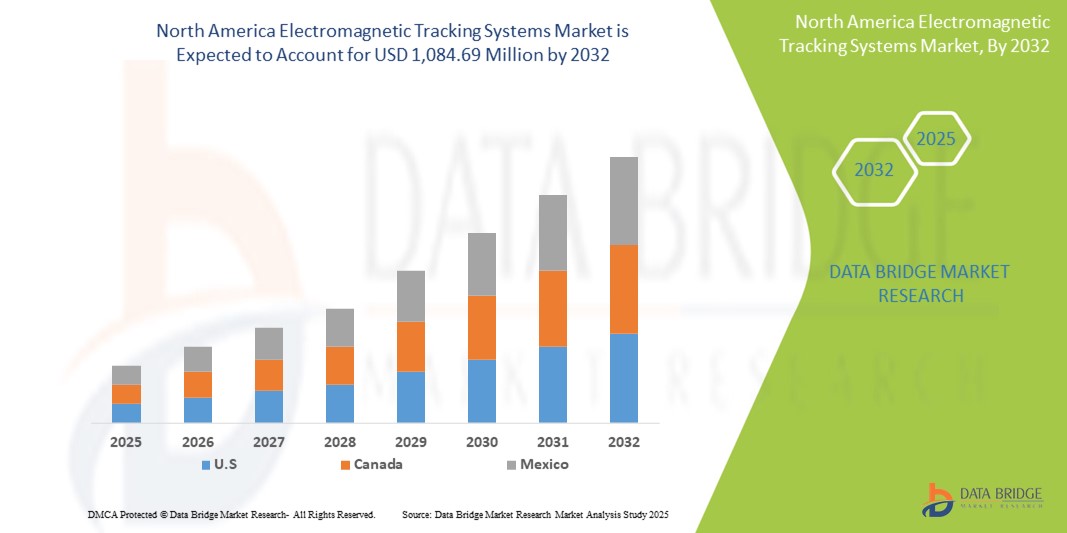
- The North America electromagnetic tracking systems market size was valued at USD 484.47 Million in 2024 and is expected to reach USD 1,084.69 Million by 2032, at a CAGR of 10.60% during the forecast period
- The market growth is largely fueled by the increasing adoption of advanced surgical navigation and interventional technologies, leading to enhanced precision, safety, and efficiency in clinical procedures across hospitals, specialty clinics, and research centers
- Furthermore, rising demand for minimally invasive procedures, image-guided interventions, and real-time tracking solutions is accelerating the uptake of Electromagnetic Tracking Systems, thereby significantly boosting the industry's growth. These systems enable accurate localization of surgical instruments, catheters, and devices within the body, improving procedural outcomes, reducing complications, and supporting personalized patient care
North America Electromagnetic Tracking Systems Market Analysis
- Electromagnetic Tracking Systems, offering precise real-time location and orientation tracking for medical, industrial, and aerospace applications, are increasingly vital components of modern operational and diagnostic systems due to their enhanced accuracy, non-invasiveness, and seamless integration with digital platforms
- The escalating demand for electromagnetic tracking systems is primarily fueled by the growing adoption of advanced tracking technologies, rising need for precision in healthcare and industrial processes, and increasing investments in automation and IoT-enabled solutions
- U.S. dominated the electromagnetic tracking systems market with the largest revenue share of 42.0% in 2025, driven by early adoption of advanced tracking technologies, high investment in research and development, and the strong presence of leading industry players. The country has seen substantial uptake of ETS solutions across hospitals, aerospace, and industrial applications, fueled by continuous innovations from both established companies and startups
- Canada is expected to be the fastest-growing country in the electromagnetic tracking systems market during the forecast period, supported by increasing investments in healthcare infrastructure, rising adoption of advanced tracking solutions in surgical and diagnostic procedures, and expanding applications in research and industrial sectors
- The Wired Systems segment dominated the electromagnetic tracking systems market with a market share of 58.4% in 2024, driven by its proven reliability, consistent signal transmission, and seamless integration with existing surgical setups. These systems are widely preferred in hospitals, specialty clinics, and research institutions for high-precision and critical applications, where uninterrupted data flow and stable connectivity are essential for patient safety and successful surgical outcomes
Report Scope and Electromagnetic Tracking Systems Market Segmentation
|
Attributes |
Electromagnetic Tracking Systems Key Market Insights |
|
Segments Covered |
|
|
Countries Covered |
North America
|
|
Key Market Players |
|
|
Market Opportunities |
|
|
Value Added Data Infosets |
In addition to the insights on market scenarios such as market value, growth rate, segmentation, geographical coverage, and major players, the market reports curated by the Data Bridge Market Research also include in-depth expert analysis, pricing analysis, brand share analysis, consumer survey, demography analysis, supply chain analysis, value chain analysis, raw material/consumables overview, vendor selection criteria, PESTLE Analysis, Porter Analysis, and regulatory framework. |
North America Electromagnetic Tracking Systems Market Trends
Rising Adoption Driven by Precision and Real-Time Navigation
- A significant and accelerating trend in the North America electromagnetic tracking systems market is the increasing adoption of these systems for precise, real-time navigation in minimally invasive surgical procedures. Electromagnetic tracking enables accurate localization of instruments and devices within the human body, improving procedural outcomes and reducing operative risks
- For instance, in interventional cardiology and neurosurgery, electromagnetic tracking systems allow clinicians to navigate catheters, guidewires, and endoscopes with enhanced accuracy, minimizing tissue damage and shortening procedure times. Similarly, in image-guided interventions, these systems integrate seamlessly with MRI, CT, and ultrasound modalities to provide real-time positional feedback
- The technology also supports advanced clinical applications, such as biopsy guidance, tumor localization, and catheter-based treatments, enhancing procedural precision and workflow efficiency. Electromagnetic tracking systems are increasingly preferred over conventional navigation tools due to their ability to deliver continuous, dynamic positional information without line-of-sight limitations.
- The integration of electromagnetic tracking systems into surgical suites and hybrid operating rooms allows centralized monitoring of multiple instruments, facilitating coordinated interventions and improving procedural safety. This capability is particularly valuable in complex multi-device procedures, where precise navigation is critical for successful outcomes
- The growing focus on minimally invasive surgeries, rising demand for image-guided interventions, and increased investments in technologically advanced surgical equipment are collectively driving the North America Electromagnetic Tracking Systems market. Leading companies are innovating with higher-resolution sensors, compact designs, and system interoperability to meet the evolving needs of clinicians and healthcare facilities
- The demand for electromagnetic tracking systems is expanding across hospitals, specialty clinics, and research institutions, as these technologies support better patient outcomes, reduced procedural complications, and enhanced operational efficiency in surgical and interventional care
North America Electromagnetic Tracking Systems Market Dynamics
Driver
Rising Demand Driven by Accuracy, Safety, and Clinical Efficiency
- The increasing focus on minimally invasive procedures and precision interventions is a significant driver for the growing adoption of Electromagnetic Tracking Systems in healthcare. These systems enable clinicians to navigate instruments accurately within the body, reducing procedural risks and improving patient outcomes
- For instance, in April 2024, leading companies such as Medtronic and NDI announced innovations in electromagnetic tracking for image-guided surgeries, aiming to enhance real-time instrument localization and workflow efficiency. Such advancements by key players are expected to drive growth in the Electromagnetic Tracking Systems market over the forecast period
- Healthcare providers are increasingly seeking systems that offer reliable, real-time positional feedback, seamless integration with imaging modalities like MRI, CT, and ultrasound, and compatibility with various surgical instruments. These capabilities improve procedural precision, shorten operation times, and reduce complications
- Furthermore, the trend toward hybrid operating rooms and image-guided interventions is promoting the adoption of electromagnetic tracking systems, as they facilitate centralized control of multiple instruments and support complex, multi-device procedures
- The growing emphasis on patient safety, accuracy in surgical navigation, and operational efficiency across hospitals, specialty clinics, and research institutions is propelling demand for advanced electromagnetic tracking solutions. Manufacturers are responding with high-resolution sensors, improved system interoperability, and compact designs to cater to diverse clinical environments
Restraint/Challenge
“High Initial Costs and Integration Complexities
- The adoption of advanced Electromagnetic Tracking Systems is often limited by their relatively high upfront investment, which can pose a significant barrier for smaller healthcare facilities, outpatient centers, and clinics in emerging regions with constrained budgets. The cost factor can slow decision-making, particularly when balancing other capital expenditures and operational priorities
- Integration challenges with existing imaging equipment, surgical navigation tools, and hospital IT infrastructure can further impede widespread implementation. Hospitals and clinics require assurance that these systems will deliver consistent performance across multiple procedural settings without causing workflow disruptions or compatibility issues
- Extensive training requirements for clinicians, surgeons, and technicians to effectively operate these systems add another layer of complexity, especially in institutions with limited access to specialized training resources or certified support personnel
- To overcome these barriers, manufacturers are focusing on developing cost-efficient, highly compatible Electromagnetic Tracking Systems, along with standardized interfaces, streamlined installation processes, and comprehensive training and support programs
- Such measures are essential to ensure seamless integration, operational efficiency, and sustainable adoption across healthcare facilities globally
North America Electromagnetic Tracking Systems Market Scope
The market is segmented on the basis of product type, technology, connectivity, maneuverability, end user application and distribution channel.
- By Product Type
On the basis of product type, the North America electromagnetic tracking systems market is segmented into ENT Tracking Systems, Orthopedics Tracking Systems, Neuronavigation Tracking Systems, Cardiac Tracking Systems, Electrophysiology Tracking Systems, Dental Tracking Systems, and Others. The Neuronavigation Tracking Systems segment dominated with a revenue share of 28.5% in 2024, due to its critical role in minimally invasive neurosurgeries and spinal procedures, where precise tracking is crucial to patient safety and surgical outcomes. These systems enable real-time visualization of surgical instruments relative to patient anatomy, reducing complications and improving operative efficiency. Their extensive adoption is driven by the rising prevalence of neurological disorders, increasing number of neurosurgeries globally, and integration with robotic-assisted surgical platforms and advanced imaging technologies. Continuous innovations in software algorithms, sensor precision, and compatibility with a wide range of surgical instruments have further reinforced the segment’s leadership.
The Orthopedics Tracking Systems segment is expected to witness the fastest CAGR of 13.7% from 2025 to 2032, as hospitals and surgical centers increasingly adopt precision-guided navigation for joint replacement and spinal procedures. The growing trend toward minimally invasive surgeries, combined with rising patient demand for faster recovery and reduced post-operative complications, is fueling rapid adoption. Technological advancements such as lightweight, portable tracking devices, improved software integration, and enhanced real-time visualization are making these systems more accessible, accelerating their market growth.
- By Technology
On the basis of technology, the North America electromagnetic tracking systems market is categorized into Optical Navigation Systems, Electromagnetic (EM) Navigation Systems, Hybrid Navigation Systems, Fluoroscopy-Based Navigation Systems, and Others. The Electromagnetic (EM) Navigation Systems segment held the largest revenue share of 33.2% in 2024, attributed to its high accuracy, line-of-sight independence, and compatibility with a wide range of surgical instruments. Its dominance is further strengthened by the increasing adoption of minimally invasive surgeries in neurosurgery, ENT, orthopedic, and cardiac procedures, where precision and reliability are paramount. Continuous advancements, including miniaturized sensors, improved electromagnetic field stability, and sophisticated algorithms for noise reduction, have enhanced performance and broadened clinical applications.
The Hybrid Navigation Systems segment is projected to grow at the fastest CAGR of 14.5% from 2025 to 2032, as healthcare providers seek solutions that combine the precision of optical tracking with the flexibility of EM systems. This hybrid approach reduces errors, enhances surgical workflow efficiency, and allows real-time adjustments during complex procedures. Growing awareness of these advantages, along with increased investments in hospitals and research institutions for advanced surgical navigation solutions, is driving rapid adoption of hybrid systems worldwide. In addition, ongoing technological innovations and partnerships between medical device manufacturers and software developers are further expanding the capabilities and appeal of hybrid navigation systems in the global market.
- By Connectivity
On the basis of connectivity, the North America electromagnetic tracking systems market is segmented into wired systems and wireless systems. The Wired Systems segment dominated with a market share of 58.4% in 2024, driven by its proven reliability, consistent signal transmission, and seamless integration with existing surgical setups. These systems are widely preferred in hospitals, specialty clinics, and research institutions for high-precision and critical applications, where uninterrupted data flow and stable connectivity are essential for patient safety and successful surgical outcomes. Wired ETS solutions also benefit from robust infrastructure compatibility, reduced interference risks, and long-term durability, making them the primary choice for institutions requiring dependable performance in complex procedures and advanced surgical environments.
The Wireless Systems segment is projected to register the fastest CAGR of 15.1% from 2025 to 2032, driven by the need for portability, reduced surgical clutter, and seamless integration with robotic-assisted procedures. Wireless ETS solutions allow surgeons to move freely, connect multiple devices simultaneously, and adopt new surgical workflows with ease. Recent technological advancements, including low-latency wireless transmission, enhanced security, and longer battery life, are further supporting growth in this segment, particularly in outpatient surgical centers and smaller clinics seeking flexible and mobile tracking solutions.
- By Maneuverability
On the basis of maneuverability, the North America electromagnetic tracking systems market is segmented into 6-DOF, 5-DOF, and Others. The 6-DOF segment dominated with a market share of 46.7% in 2024, reflecting its superior ability to track six degrees of freedom in real-time, including both translational and rotational movements. This capability is particularly critical in neurosurgery, spinal operations, and complex orthopedic procedures, where precise instrument positioning can directly impact patient outcomes. High adoption is driven by the growing need for precision, improved surgical planning, and integration with robotic-assisted technologies.
The 5-DOF segment is expected to witness the fastest CAGR of 12.9% from 2025 to 2032, as these systems provide a more affordable yet efficient option for applications that do not require full six-degree tracking. They are increasingly adopted in smaller clinics, outpatient centers, and research institutions that need accurate tracking for less complex procedures. The combination of lower cost, ease of setup, and reliable performance is driving strong growth in this segment globally, as healthcare facilities seek to balance investment costs with operational efficiency. Furthermore, ongoing technological improvements and software enhancements are expanding the range of procedures and research applications where 5-DOF systems can be effectively utilized, further fueling market adoption.
- By End-User
On the basis of end-user, the North America electromagnetic tracking systems market is segmented into healthcare facilities, military and defense, industrial automation, and others. The Healthcare Facilities segment dominated with a market share of 61.1% in 2024, reflecting extensive adoption of ETS in hospitals, surgical centers, and research institutions for precision surgeries, real-time diagnostics, and minimally invasive procedures. Healthcare facilities integrate ETS with advanced imaging systems, surgical robots, and patient management platforms to optimize outcomes, reduce procedure times, and ensure patient safety. Their capacity to invest in high-quality systems, implement strict operational protocols, and manage high patient volumes reinforces their dominant position.
The Military and Defense segment is expected to witness the fastest CAGR of 14.3% from 2025 to 2032, as defense organizations adopt ETS for training simulations, robotic-assisted equipment, and situational awareness operations. The ability of ETS to provide real-time location and orientation tracking enhances mission preparedness and operational efficiency. Increased defense R&D budgets, rising emphasis on advanced training technologies, and the integration of ETS with simulation and robotic systems are fueling strong growth in this segment. Moreover, growing collaborations between defense contractors and technology providers are accelerating the development of next-generation ETS solutions tailored to specific military applications, further driving market expansion.
- By Application
On the basis of application, the North America electromagnetic tracking systems market is segmented into ENT Tracking Systems, Orthopedics Tracking Systems, Neuronavigation Tracking Systems, Cardiac Tracking Systems, Electrophysiology Tracking Systems, Dental Tracking Systems, and Others. The Neuronavigation Tracking Systems application segment accounted for the largest market share of 29.0% in 2024, reflecting its critical importance in complex neurosurgeries and spinal interventions where precision and real-time tracking are essential for patient safety and surgical success. The increasing prevalence of neurological disorders, coupled with a rising number of neurosurgical and spinal procedures globally, has significantly driven adoption. Furthermore, the integration of neuronavigation systems with advanced robotic surgical platforms and imaging technologies has enhanced surgical accuracy, reduced complication rates, and improved patient outcomes, solidifying the segment’s dominant position in the global market.
The Orthopedics Tracking Systems application segment is expected to register the fastest CAGR of 13.5% from 2025 to 2032, driven by the rising number of joint replacement and spinal surgeries worldwide. The growing adoption of minimally invasive surgical techniques has further fueled the demand for precise, real-time instrument tracking systems, which help surgeons navigate complex procedures with higher accuracy. Hospitals and surgical centers are increasingly integrating these systems into their operating rooms to reduce overall procedure times, enhance surgical precision, and improve patient recovery outcomes
- By Distribution Channel
On the basis of distribution channel, the North America electromagnetic tracking systems market is segmented into Direct Tender, Retail Sales, and Online Sales. The Direct Tender segment dominated with a market share of 54.2% in 2024, due to the preference of large hospitals, government health institutions, and research centers for bulk procurement. These tenders offer reliable supply chains, long-term maintenance contracts, and dedicated after-sales support, which are critical for high-value and high-precision ETS equipment. Direct tender procurement ensures compliance with institutional procurement standards, facilitates integration with existing hospital infrastructure, and often includes bundled services such as installation, training, and software updates.
The Online Sales segment is expected to witness the fastest CAGR of 16.2% from 2025 to 2032, driven by increasing digitalization in healthcare procurement and the rise of e-commerce platforms that allow direct access to manufacturers and certified distributors. Online channels offer convenience, wider product visibility, transparent pricing, and quick ordering processes, making them attractive to smaller clinics, diagnostic centers, and research facilities. The ability to access product reviews also technical specifications, and comparison tools online further accelerates adoption
North America Electromagnetic Tracking Systems Market Regional Analysis
- North America dominated the electromagnetic tracking systems market with the largest revenue share in 2025, characterized by early adoption of advanced tracking technologies, strong R&D investments, high disposable incomes, and a well-established presence of key industry players
- The region has witnessed substantial deployment of ETS solutions across hospitals, specialized surgical centers, aerospace, and industrial applications. In healthcare, these systems improve surgical precision, reduce procedure times, and enhance patient outcomes, particularly in neuronavigation and orthopedic procedures. In aerospace and defense, ETS enables high-precision navigation and simulation training, contributing significantly to regional market growth.
- Advanced tracking solutions are increasingly being integrated into both medical and industrial applications, allowing complex operations and procedures to be executed efficiently and accurately. Continuous R&D, collaboration between established companies and agile startups, and the integration of sophisticated hardware and software solutions are driving innovation and commercialization within the North America region
U.S. Electromagnetic Tracking Systems Market Insight
The U.S. electromagnetic tracking systems market captured the largest share of the North American electromagnetic tracking systems market in 2025, accounting for 42.0% revenue share, fueled by rapid adoption in hospitals, specialized surgical centers, aerospace, and industrial applications. The country benefits from strong technological infrastructure, high R&D funding, and an early uptake of advanced ETS solutions, positioning it as the primary hub for market growth in the region. Healthcare facilities leverage ETS for improving surgical accuracy, reducing procedure times, and enhancing patient outcomes in complex surgeries, while aerospace and defense sectors rely on ETS for precision navigation and simulation training.
Canada Electromagnetic Tracking Systems Market Insight
The Canada electromagnetic tracking systems market is expected to be the fastest-growing country in the North America Electromagnetic Tracking Systems market during the forecast period. This growth is supported by increasing investments in healthcare infrastructure, the expanding adoption of advanced ETS solutions in surgical and diagnostic procedures, and rising applications in research and industrial sectors. The government and private healthcare institutions are actively upgrading technology capabilities, contributing to a robust CAGR in the Canadian ETS market.
North America Electromagnetic Tracking Systems Market Share
The electromagnetic tracking systems industry is primarily led by well-established companies, including:
- TT Electronics (U.K.)
- Northern Digital Inc (Canada)
- Amfitech ApS (Denmark)
- Radwave (U.S.)
- Ommo Technologies (U.S.)
- Polhemus (U.S.)
- Stryker (U.S.)
- Medtronic (Ireland)
- Heal Force (China)
- Augmedics (Israel)
- Orthalign (U.S.)
- Koninklijke Philips N.V. (Netherlands)
Latest Developments in North America Electromagnetic Tracking Systems Market
- In March 2024, General Atomics Electromagnetic Systems (GA-EMS) announced that it was awarded a contract from Lockheed Martin Space to deliver missile warning, tracking, and defense payloads. GA-EMS is developing Electro Optical and Infrared (EO/IR) sensor systems, including 16 Wide-Field-of-View (WFOV) Missile Warning/Missile Tracking infrared payloads and two Fire Control/Missile Defense (FC/MD) infrared payloads, for integration into Lockheed Martin satellites scheduled for launch in 2027
- In August 2024, TTElectronics highlighted the use of electromagnetic sensors in medical devices with computer-assisted navigation. These sensors are integral to electromagnetic tracking systems, enabling real-time visualization and navigation of medical devices inside the body, even when they are out of view
- In August 2025, Electro Optic Systems (EOS) secured a $125 million order for a 100kW high-power laser weapon system for counter-drone warfare. This system utilizes electromagnetic tracking technology to detect and neutralize drone threats, showcasing the application of electromagnetic tracking systems in defense and security.
- In August 2025, TTElectronics emphasized the role of electromagnetic tracking sensors in medical devices with computer-assisted navigation. These sensors are essential for precise tracking and localization of medical instruments during procedures, enhancing the accuracy and safety of surgeries

- Interactive Data Analysis Dashboard
- Company Analysis Dashboard for high growth potential opportunities
- Research Analyst Access for customization & queries
- Competitor Analysis with Interactive dashboard
- Latest News, Updates & Trend analysis
- Harness the Power of Benchmark Analysis for Comprehensive Competitor Tracking
Data collection and base year analysis are done using data collection modules with large sample sizes. The stage includes obtaining market information or related data through various sources and strategies. It includes examining and planning all the data acquired from the past in advance. It likewise envelops the examination of information inconsistencies seen across different information sources. The market data is analysed and estimated using market statistical and coherent models. Also, market share analysis and key trend analysis are the major success factors in the market report. To know more, please request an analyst call or drop down your inquiry.
The key research methodology used by DBMR research team is data triangulation which involves data mining, analysis of the impact of data variables on the market and primary (industry expert) validation. Data models include Vendor Positioning Grid, Market Time Line Analysis, Market Overview and Guide, Company Positioning Grid, Patent Analysis, Pricing Analysis, Company Market Share Analysis, Standards of Measurement, Global versus Regional and Vendor Share Analysis. To know more about the research methodology, drop in an inquiry to speak to our industry experts.
Data Bridge Market Research is a leader in advanced formative research. We take pride in servicing our existing and new customers with data and analysis that match and suits their goal. The report can be customized to include price trend analysis of target brands understanding the market for additional countries (ask for the list of countries), clinical trial results data, literature review, refurbished market and product base analysis. Market analysis of target competitors can be analyzed from technology-based analysis to market portfolio strategies. We can add as many competitors that you require data about in the format and data style you are looking for. Our team of analysts can also provide you data in crude raw excel files pivot tables (Fact book) or can assist you in creating presentations from the data sets available in the report.













