


North America Environmental Controls and Remote Monitoring for Agriculture Market Analysis
The environmental controls and remote monitoring for agriculture market is rapidly growing due to the increasing need for precision farming, resource efficiency, and sustainability in agriculture. These systems leverage advanced technologies such as IoT, sensors, data analytics, and automation to monitor and control critical environmental variables like soil moisture, temperature, humidity, and weather patterns. Farmers can access real-time data and remotely manage agricultural environments, enabling better decision-making and optimizing input use, such as water, fertilizers, and energy. The market is driven by factors like government incentives for smart farming, the need to adapt to climate change, and the rising adoption of sustainable agricultural practices. This technology enhances crop yields, reduces operational costs, and supports environmental conservation, playing a key role in modern agricultural practices.
North America Environmental Controls and Remote Monitoring for Agriculture Market Size
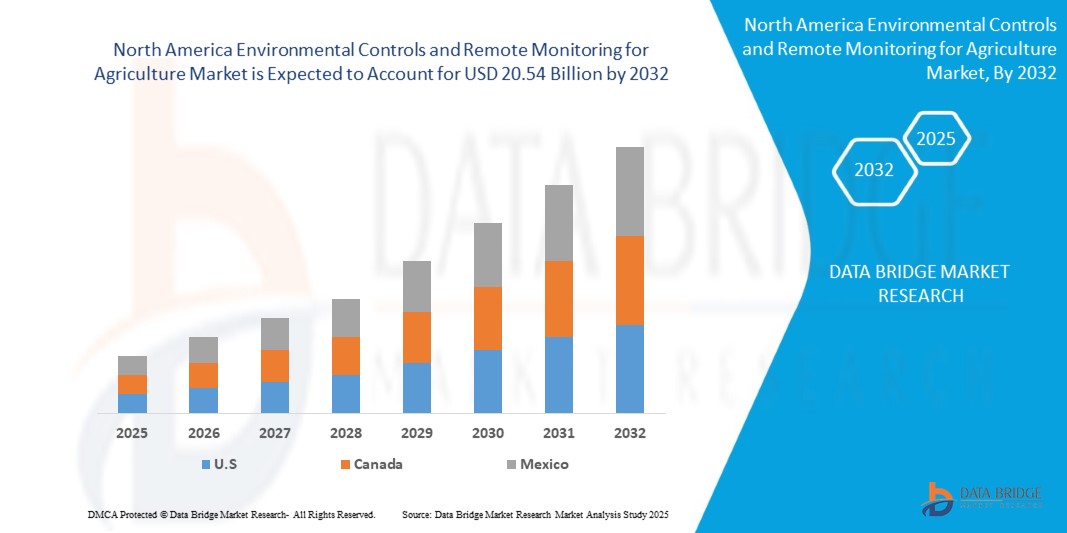
North America Environmental Controls and Remote Monitoring for Agriculture Market size was valued at USD 8.42 billion in 2024 and is projected to reach USD 20.54 billion by 2032, with a CAGR of 11.8% during the forecast period of 2025 to 2032.
Report Scope and Market Segmentation
|
Attributes |
Environmental Controls and Remote Monitoring for Agriculture Key Market Insights |
|
Segmentation |
|
|
Countries Covered |
U.S, Canada and Mexico |
|
Key Market Players |
Monnit Corporation (U.S.), AGCO Corporation (U.S.), Climate Control Systems (Canada), Rain Bird Corporation (U.S.), Valmont Industries, Inc. (U.S.), Netafim (Israel), Lindsay Corporation (U.S.), The Toro Company (U.S.), Hunter Industries Inc. (U.S.), Galcon (U.S.), Weathermatic (U.S.), WeatherTRAK (U.S.), Signify Holding (Netherlands), Topcon (Japan), Trimble Inc. (U.S.), Controlled Environments Limited (Canada), Bayer AG (Germany), Ag Leader Technology (U.S.), EOS Data Analytics, Inc. (U.S.), CropX Inc. (Israel), AgEagle Aerial Systems Inc (U.S.), Wadsworth Controls (U.S.), Bartlett Instrument Company (U.S.), Link4 Corporation (U.S.), Priva (U.S.), Hydrotek Hydroponics (Canada), Argus Control Systems Limited (Canada), Cropking Incorporated (U.S.), Ridder (Canada), Agrowtek Inc. (U.S.), Growlink, Inc. (U.S.), Blue Lab (New Zealand), Grow Director (Israel), Maximus Solutions (Canada), Hoogendoorn (Netherlands), Sensaphone (U.S.), Autogrow Systems Ltd (New Zealand), and Orisha (Canada) among others |
|
Market Opportunities |
|
|
Value Added Data Infosets |
In addition to the insights on market scenarios such as market value, growth rate, segmentation, geographical coverage, and major players, the market reports curated by the Data Bridge Market Research also include in-depth expert analysis, geographically represented company-wise production and capacity, network layouts of distributors and partners, detailed and updated price trend analysis and deficit analysis of supply chain and demand. |
Environmental Controls and Remote Monitoring for Agriculture Market Trends
The agriculture market is increasingly embracing environment control and remote monitoring technologies. These innovations enhance crop management by utilizing IoT devices, sensors, and AI to monitor soil conditions, weather patterns, and plant health in real-time. The trend toward precision agriculture is driven by the need for sustainable practices and increased productivity. Farmers are investing in automated systems to optimize irrigation, fertilization, and pest control, reducing resource waste and improving yields. As climate change intensifies, the demand for resilient agricultural solutions is rising, making this sector ripe for growth and technological advancement in the coming years.
Environmental Controls and Remote Monitoring for Agriculture Market Definition
Environment control and remote monitoring in agriculture refers to the use of technology to regulate and observe agricultural conditions. This includes systems that manage factors like temperature, humidity, soil moisture, and light, often through IoT devices and sensors. Remote monitoring allows farmers to collect real-time data on crop health and environmental conditions, enabling informed decision-making and optimizing resource use. These practices aim to improve crop yields, reduce waste, and promote sustainable farming by providing precise control and insights into agricultural operations.
Environmental Controls and Remote Monitoring for Agriculture Market Dynamics
Drivers
- Rapid Advancements In Iot and Sensor Technologies
The increasing integration of the Internet of Things (IoT) and advanced sensor technologies is transforming environmental control and remote monitoring in agriculture. IoT enables real-time data collection from various environmental parameters such as temperature, humidity, soil moisture, and light intensity, helping farmers make informed decisions. Sensors deployed across agricultural fields and equipment provide precise and continuous monitoring of the crop and environmental conditions, ensuring optimal resource use and boosting efficiency. These technologies not only enhance productivity but also help mitigate the effects of changing weather conditions, making agriculture more resilient and adaptive.
Moreover, the combination of IoT and sensor technologies supports the growth of precision farming, where farmers can tailor inputs like water, fertilizers, and pesticides based on real-time field data. This reduces waste, lowers costs, and promotes sustainable farming practices. The seamless integration of IoT networks with cloud-based platforms allows for data-driven decision-making and automation, further enhancing operational efficiency. As these technologies continue to advance, they will play a critical role in driving the adoption of sophisticated environmental controls and remote monitoring solutions in agriculture, addressing challenges related to labor shortages, climate variability, and resource management
For instance,
- In July 2024, according to an article published by IoT for all, the pivotal role of IOT in environmental monitoring, especially for tracking climate change, lies in its ability to utilize interconnected sensor networks to provide real-time data on environmental conditions. This data aids in predicting and mitigating climate-related disasters. Advances in IoT and sensor technologies are expected to drive growth in environmental controls and remote monitoring for the agriculture market by enabling farmers to monitor key variables such as soil moisture, temperature, and humidity in real-time. This improved data collection allows for more precise resource management, enhancing agricultural productivity and sustainability
- In March 2023, according to the article published by TOI, IoT-based smart crop monitoring systems leveraged sensors and data analytics to deliver real-time insights on environmental factors, crop health, and growth patterns. These systems enhance efficiency in irrigation, pest management, and fertilization, resulting in higher yields and optimized resource use. By incorporating advanced technologies like AI, edge computing, and drones, these IoT innovations empower farmers to manage key agricultural variables remotely. This progress fuels the expansion of the environmental controls and remote monitoring market, driving increased productivity and sustainability in farming practices
Increasing Demand for Efficient Resource Management
The growing demand for efficient resource management in agriculture is significantly shaping the environmental controls and remote monitoring market. As global food production needs rise and environmental concerns escalate, farmers are seeking technologies that optimize resource use and minimize waste. Advanced IoT-based solutions, such as smart irrigation systems and real-time soil moisture sensors, are becoming crucial. These technologies enable precise monitoring of environmental conditions, allowing for targeted water usage, accurate fertilizer application, and timely pest control. This efficiency not only enhances crop yield and reduces costs but also supports sustainable farming practices.
In response to this demand, the market for environmental controls and remote monitoring systems is expanding rapidly. Innovations in sensor technology and data analytics are driving the development of sophisticated tools that offer detailed insights into crop health and soil conditions. These tools help farmers make data-driven decisions, leading to more effective resource management. The integration of AI and machine learning further enhances these systems by providing predictive analytics and automated recommendations, thereby maximizing productivity and contributing to environmental sustainability. As efficiency and sustainability become central to agricultural practices, the demand for advanced monitoring solutions continues to grow, driving significant advancements in the market.
For instance,
- In March 2024, according to the article published by BBC, US farms are swiftly embracing AI technologies to tackle labor shortages, boost crop yields, and streamline farming operations. This includes innovations like autonomous tractors, precision agriculture, and AI-powered monitoring systems, which are transforming traditional farming practices. The integration of AI in agriculture aligns with the rising need for efficient resource management. By utilizing AI to track soil health, manage water usage, and monitor crop conditions, farmers can optimize resources, reduce waste, and increase efficiency. This growing reliance on accurate, real-time data is expected to drive demand for environmental controls and remote monitoring solutions in agriculture
Opportunities
- Expansion of Precision Agriculture Practices
The expansion of precision agriculture practices presents a notable opportunity for the environmental controls and remote monitoring market in agriculture. As precision farming continues to evolve, the demand for sophisticated environmental control systems and real-time monitoring solutions is increasing. This growth is driven by the need for more accurate data and refined management techniques to enhance crop yields and resource efficiency. By integrating advanced sensors, automated systems, and data analytics into farming operations, precision agriculture can provide more targeted and effective environmental controls. This integration allows farmers to optimize water usage, monitor soil health, and manage pest control with higher precision, ultimately leading to more sustainable agricultural practices
Furthermore, the expansion of precision agriculture opens up avenues for innovation and development within the environmental controls and remote monitoring sector. As technology advances, new solutions are being introduced that offer enhanced capabilities for tracking environmental conditions and managing agricultural resources. This creates opportunities for companies to develop and market cutting-edge products that cater to the evolving needs of precision farming. By leveraging these advancements, the environmental controls and remote monitoring market can support the growing trend of precision agriculture, offering solutions that improve operational efficiency, reduce waste, and promote environmental sustainability
- Integration of Environmental Controls and Remote Monitoring Systems with Renewable Energy Sources
The integration of environmental controls and remote monitoring systems with renewable energy sources offers a transformative opportunity for the agricultural sector. By incorporating solar panels or wind turbines to power these systems, farms can achieve greater energy efficiency and sustainability. This approach not only reduces dependence on conventional energy sources but also lowers operational costs associated with powering advanced monitoring equipment. Renewable energy integration supports the seamless operation of environmental controls, such as climate sensors and irrigation systems, ensuring that they function optimally without the interruptions or costs related to traditional energy supply.
Additionally, the synergy between renewable energy and remote monitoring enhances the capability to manage agricultural operations in real-time. With renewable energy sources providing a stable and independent power supply, farmers can deploy advanced sensors and monitoring tools across their fields, even in remote areas. This setup enables continuous data collection on soil conditions, weather patterns, and crop health, leading to more informed decision-making and efficient resource use. As the agricultural sector moves towards more sustainable practices, integrating environmental controls with renewable energy sources represents a significant advancement in achieving both operational efficiency and environmental stewardship
Restraints/Challenges
- High Initial Investment Costs
High initial investment costs represent a significant barrier to the adoption of environmental controls and remote monitoring systems in agriculture. The advanced technology required for these systems often involves substantial upfront expenses, including the purchase of sophisticated sensors, data analytics platforms, and integration with existing farm infrastructure. These costs can be prohibitive for small to mid-sized farms, which may struggle to allocate sufficient funds for such investments despite the potential long-term benefits.
Moreover, the complexity and specialized nature of these technologies further contributes to the financial burden. Farmers must not only invest in the equipment but also training and maintenance, adding to the overall expenditure. This high cost of entry can deter many agricultural producers from implementing these advanced systems, potentially limiting the widespread adoption of environmental controls and remote monitoring solutions.
For instance,
- In January 2024, according to the article published by U.S. Government accountability office, precision agriculture technologies provide significant benefits, including increased profits and environmental improvements. However, their high upfront costs pose a barrier to adoption, especially for smaller farms. These investment costs act as a major restraint on the adoption of advanced environmental controls and remote monitoring systems, as many farmers are deterred by the financial burden of purchasing and integrating these technologies
Complexity in Integration of Environmental Control and Remote Monitoring Technologies with Existing Farm Operations
Integrating environmental control and remote monitoring technologies into existing farm operations presents significant challenges due to the complexity and variability of agricultural environments. Farms often have diverse microclimates, crop types, and livestock, all of which require different environmental conditions for optimal growth and health. Standardizing these conditions using remote technologies is problematic because it requires precise control of factors like temperature, humidity, irrigation, and ventilation. Moreover, the technology must adapt to the dynamic nature of farm operations, such as changes in planting schedules or unforeseen weather events, complicating the integration process.
For instance,
- In June 2024, according to the article published by webmakers, the transformation of agriculture through technology has brought significant advancements, but data integration remains a key challenge. Integrating environmental control and remote monitoring technologies with existing farm operations is particularly complex due to diverse data sources like soil sensors, weather data, and drones, all in different formats. Seamless integration is essential for effective monitoring, yet the absence of standardized data exchange and the vast volume of information hinders the creation of a unified system, reducing the overall efficiency of environmental management in agriculture
The integration of environmental control and remote monitoring technologies into existing farm operations is a complex process marked by the diverse needs of agricultural environments and the limitations of legacy systems. These challenges create barriers to achieving seamless, real-time monitoring and automation, highlighting the need for careful consideration of both technological and operational factors when implementing such systems in agriculture.
This market report provides details of new recent developments, trade regulations, import-export analysis, production analysis, value chain optimization, market share, impact of domestic and localized market players, analyses opportunities in terms of emerging revenue pockets, changes in market regulations, strategic market growth analysis, market size, category market growths, application niches and dominance, product approvals, product launches, geographic expansions, technological innovations in the market. To gain more info on the market contact Data Bridge Market Research for an Analyst Brief, our team will help you take an informed market decision to achieve market growth.
Impact and Current Market Scenario of Raw Material Shortage and Shipping Delays
Data Bridge Market Research offers a high-level analysis of the market and delivers information by keeping in account the impact and current market environment of raw material shortage and shipping delays. This translates into assessing strategic possibilities, creating effective action plans, and assisting businesses in making important decisions.
Apart from the standard report, we also offer in-depth analysis of the procurement level from forecasted shipping delays, distributor mapping by region, commodity analysis, production analysis, price mapping trends, sourcing, category performance analysis, supply chain risk management solutions, advanced benchmarking, and other services for procurement and strategic support.
Expected Impact of Economic Slowdown on the Pricing and Availability of Services
When economic activity slows, industries begin to suffer. The forecasted effects of the economic downturn on the pricing and accessibility of the products are taken into account in the market insight reports and intelligence services provided by DBMR. With this, our clients can typically keep one step ahead of their competitors, project their sales and revenue, and estimate their profit and loss expenditures.
North America Environmental Controls and Remote Monitoring for Agriculture Market Scope
The market is segmented on the basis of offering, farm size, connectivity, application, distribution channel. The growth amongst these segments will help you analyze meagre growth segments in the industries and provide the users with a valuable market overview and market insights to help them make strategic decisions for identifying core market applications.
Offering
- Climate Control System
- Type
- Air Heaters
- Type
- gas Fired
- Oil Fired
- Evaporative Coolers
- Air Inlets
- Dehumidifier
- Controllers
- Others
- Type
- Lighting Control System
- hard Drive
- Led Drivers
- hard Drive
- Sensors
- Switches and Dimmers
- Relay Units
- Gateway
- Communication Protocol
- Wired
- Wired Less
- Communication Protocol
- Irrigation Control System
- Type
- Weather Based Controller (Evapotranspiration)
- Sensor Based Controller
- Type
- Moisture Sensor
- Temperature Sensor
- Fertigation Sensor
- Others
- Type
- Irrigation Type
- Drip Irrigation
- Sprinkler Irrigation
- Surface Irrigation
- Remote Monitoring
- Type
- Automation and Control
- Type
- GNSS/GPS
- Real-Time Kinematic(RTK)
- Differential Global Positioning System (DGPS)
- GNSS/GPS
- Smart Controllers
- Display
- Handheld Mobile Devices/Computers
- Flow and Application Control Devices
- Drones/UAVS
- Rotary Drones
- Fixed Wing Drones
- Variable Rate Controllers
- Type
- Sensing and Monitoring Device
- RFID Tags and Readers
- Sensors
- Type
- soil and Moisture Sensors
- Climate Sensor
- Soil and Moisture Sensor
- Temperature and Environmental Sensor
- Nutrient Sensor
- Others
- Type
- GPS
- Cameras
- Others
- Fertigation Control System
- Channel
- Dual
- Single
- Multi
- Technology
- Automated
- Manual
- Channel
- Fertigation Control System
- Software
- Type
- Cloud
- Type
- Software as a Service
- Platform as a Service
- On Premises
- Type
- Services
- Type
- Managed Services
- Type
- Farm Operations
- Ai based Analytics
- Data Services
- Professional Services
- Type
- Climate Information Service
- Supply Chain Management Services
- Support and Maintenance
- System Integration AND Consulting
- Connectivity Services
Farm Type
- Large Sized Farm (More than 500 Hectares)
- Small Sized Farm (Less than 100 Hectares)
- Mid-Sized Farm (100 Hectares-500 Hectares)
Connectivity
- Wi-Fi
- Bluetooth
- RF Technology
- Zigbee
- Others
Application
- Precision Farming
- Application
- Crop Scouting and Monitoring
- Yield Mapping and Monitoring
- Type
- Off Farm
- On Farm
- Type
- Field Mapping
- Type
- Boundary Mapping
- Drainage Mapping
- Type
- Soil Mapping
- Weather Tracking and Forecasting
- Variable Rate Application
- Type
- Precision Irrigation
- Precision Seeding
- Precision Fertilization
- Type
- Nitrogen VRA
- Phosphorous VRA
- Lime VRA
- Type
- Pesticide VRA
- Pest Management
- Precision Farming
- Type
- Vegetable
- Fruit
- Trees
- Herbs
- Shrubs
- Flowers
- Type
- Livestock Monitoring
- Application
- Feeding Management
- Milk Harvesting
- Behavior Monitoring and Control
- Heat Stress Management
- Breeding Management
- Others
- Livestock Monitoring
- Type
- Cattle
- Poultry
- Type
- Chicken
- Turkey
- Pork
- Dairy
- Smart Greenhouse
- Application
- Yield Monitoring and Harvesting
- Water and Fertilizer Management
- HVAC Management
- Others
- Farming Type
- Hydroponic
- Soilbased Growing System
- Aeroponic
- Aquaponic
Distribution Channel
- Direct Sales
- Type
- E-Commerce
- Company Website
- In-Direct Sales
- Type
- Retailer and Wholesaler
Environmental Controls and Remote Monitoring for Agriculture Market Analysis
The market is analyzed and market size insights and trends are provided by country, offering, farm size, connectivity, application, distribution channel as referenced above.
The countries covered in environmental controls and remote monitoring for agriculture market report are U.S., Canada and Mexico.
U.S. is expected to dominate the environmental controls and remote monitoring for agriculture market due to rapid advancements in IoT and sensor technologies.
The country section of the report also provides individual market impacting factors and changes in regulation in the market domestically that impacts the current and future trends of the market. Data points like down-stream and upstream value chain analysis, technical trends and porter's five forces analysis, case studies are some of the pointers used to forecast the market scenario for individual countries. Also, the presence and availability of regional brands and their challenges faced due to large or scarce competition from local and domestic brands, impact of domestic tariffs and trade routes are considered while providing forecast analysis of the country data.
Environmental Controls and Remote Monitoring for Agriculture Market Share
The market competitive landscape provides details by competitor. Details included are company overview, company financials, revenue generated, market potential, investment in research and development, new market initiatives, regional presence, production sites and facilities, production capacities, company strengths and weaknesses, product launch, product width and breadth, application dominance. The above data points provided are only related to the companies' focus related to market.
Environmental Controls and Remote Monitoring for Agriculture Market Leaders Operating in the Market Are:
- Monnit Corporation: (U.S.)
- AGCO Corporation: (U.S.)
- Climate Control Systems: (Canada)
- Rain Bird Corporation: (U.S.)
- Valmont Industries, Inc.: (U.S.)
- Netafim: (Israel)
- Lindsay Corporation: (U.S.)
- The Toro Company: (U.S.)
- Hunter Industries Inc.: (U.S.)
- Galcon: (U.S.)
- Weathermatic: (U.S.)
- WeatherTRAK: (U.S.)
- Signify Holding: (Netherlands)
- Topcon: (Japan)
- Trimble Inc.: (U.S.)
- Controlled Environments Limited: (Canada)
- Bayer AG: (Germany)
- Ag Leader Technology: (U.S.)
- EOS Data Analytics, Inc.: (U.S.)
- CropX Inc.: (Israel)
- AgEagle Aerial Systems Inc: (U.S.)
- Wadsworth Controls: (U.S.)
- Bartlett Instrument Company: (U.S.)
- Link4 Corporation: (U.S.)
- Priva: (U.S.)
- Hydrotek Hydroponics: (Canada)
- Argus Control Systems Limited: (Canada)
- Cropking Incorporated: (U.S.)
- Ridder: (Canada)
- Agrowtek Inc.: (U.S.)
- Growlink, Inc.: (U.S.)
- Blue Lab: (New Zealand)
- Grow Director: (Israel)
- Maximus Solutions: (Canada)
- Hoogendoorn: (Netherlands)
- Sensaphone: (U.S.)
- Autogrow Systems Ltd: (New Zealand)
- Orisha: (Canada)
Latest Developments in the Environmental Controls and Remote Monitoring for Agriculture Market
- In July 2024, Trimble and Esri are deepening their strategic partnership to advance GIS solutions, location intelligence, and asset lifecycle management. Their collaboration, highlighted at the 2024 Esri User Conference, focuses on optimizing processes and automating workflows for greener infrastructure planning. As a Platinum partner in the Esri Partner Network, Trimble aims to integrate advanced geospatial technologies with Esri's ArcGIS software, enabling clients to achieve greater accuracy and sustainability in projects. The partnership also emphasizes humanitarian efforts, exemplified by their joint work with The HALO Trust to improve landmine detection
- In May 2024, Topcon Positioning Systems has opened a new Topcon Solutions Store in Spokane, Washington, expanding its retail presence to 14 locations nationwide. This store will provide cutting-edge products and services for the construction and geopositioning sectors, featuring an Autodesk Authorized Training Center to enhance customer experience and support local professionals
- In January 2024, Toro’s Transpiram has been awarded the 2023 New Product of the Year. This innovative solution enhances irrigation efficiency with advanced technology, improving water management and crop health. The accolade highlights Toro’s commitment to cutting-edge solutions in the irrigation industry
- In September 2020, Signify Holding partnered with GoodLeaf Farms, a Canadian vertical farming company, to provide Philips Horticulture LED lighting. This technology enhances the year-round production of fresh, pesticide-free greens. The collaboration strengthens Signify's position in Environmental Controls and Remote Monitoring by showcasing precise LED systems that optimize growth conditions, increase yield, and reduce waste, reinforcing its expertise in smart, sustainable farming solutions
- In April 2023, Sensaphone has launched new remote monitoring systems—Sentinel, WSG30, and IMS-1000E—that improve laboratory management and safety with real-time alerts and detailed data logging. This advancement enhances Sensaphone’s presence in the environmental controls and remote monitoring market by demonstrating its expertise in ensuring optimal laboratory conditions and preventing equipment issues

- Interactive Data Analysis Dashboard
- Company Analysis Dashboard for high growth potential opportunities
- Research Analyst Access for customization & queries
- Competitor Analysis with Interactive dashboard
- Latest News, Updates & Trend analysis
- Harness the Power of Benchmark Analysis for Comprehensive Competitor Tracking
North America Environmental Controls And Remote Monitoring For Agriculture Market, Supply Chain Analysis and Ecosystem Framework
To support market growth and help clients navigate the impact of geopolitical shifts, DBMR has integrated in-depth supply chain analysis into its North America Environmental Controls And Remote Monitoring For Agriculture Market research reports. This addition empowers clients to respond effectively to global changes affecting their industries. The supply chain analysis section includes detailed insights such as North America Environmental Controls And Remote Monitoring For Agriculture Market consumption and production by country, price trend analysis, the impact of tariffs and geopolitical developments, and import and export trends by country and HSN code. It also highlights major suppliers with data on production capacity and company profiles, as well as key importers and exporters. In addition to research, DBMR offers specialized supply chain consulting services backed by over a decade of experience, providing solutions like supplier discovery, supplier risk assessment, price trend analysis, impact evaluation of inflation and trade route changes, and comprehensive market trend analysis.
Data collection and base year analysis are done using data collection modules with large sample sizes. The stage includes obtaining market information or related data through various sources and strategies. It includes examining and planning all the data acquired from the past in advance. It likewise envelops the examination of information inconsistencies seen across different information sources. The market data is analysed and estimated using market statistical and coherent models. Also, market share analysis and key trend analysis are the major success factors in the market report. To know more, please request an analyst call or drop down your inquiry.
The key research methodology used by DBMR research team is data triangulation which involves data mining, analysis of the impact of data variables on the market and primary (industry expert) validation. Data models include Vendor Positioning Grid, Market Time Line Analysis, Market Overview and Guide, Company Positioning Grid, Patent Analysis, Pricing Analysis, Company Market Share Analysis, Standards of Measurement, Global versus Regional and Vendor Share Analysis. To know more about the research methodology, drop in an inquiry to speak to our industry experts.
Data Bridge Market Research is a leader in advanced formative research. We take pride in servicing our existing and new customers with data and analysis that match and suits their goal. The report can be customized to include price trend analysis of target brands understanding the market for additional countries (ask for the list of countries), clinical trial results data, literature review, refurbished market and product base analysis. Market analysis of target competitors can be analyzed from technology-based analysis to market portfolio strategies. We can add as many competitors that you require data about in the format and data style you are looking for. Our team of analysts can also provide you data in crude raw excel files pivot tables (Fact book) or can assist you in creating presentations from the data sets available in the report.













