


North America FDM Composite Large-Size Tooling Market Size
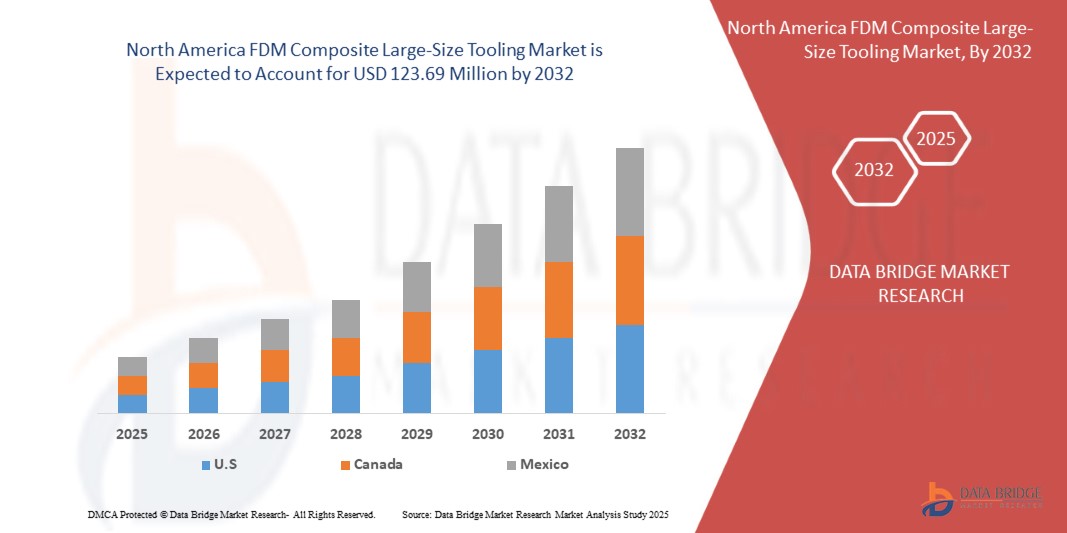
- The North America FDM composite large-size tooling market size was valued at USD 93.93 million in 2024 and is expected to reach USD 123.69 million by 2032, at a CAGR of 3.50% during the forecast period
- The market growth is largely fuelled by the increasing adoption of additive manufacturing in aerospace, automotive, marine, and energy sectors, which demand large, lightweight, and cost-effective tooling solutions
- Advancements in high-performance thermoplastics and carbon-fiber-reinforced filaments have significantly enhanced the mechanical properties of FDM-produced tooling, making them viable alternatives to traditional metal tools
North America FDM Composite Large-Size Tooling Market Analysis
- The growing demand for lightweight, cost-effective, and rapidly producible tooling solutions has accelerated the adoption of FDM composite large-size tooling in industries such as aerospace, automotive, marine, and energy
- Development of high-performance thermoplastics reinforced with carbon or glass fiber has significantly improved the mechanical strength, thermal stability, and durability of FDM tooling
- U.S. FDM composite large-size tooling market dominated the market in 2024, driven by the country’s advanced manufacturing capabilities, extensive aerospace and automotive industries, and significant investments in additive manufacturing technologies
- Canada is expected to witness the highest compound annual growth rate (CAGR) in the North America FDM composite large-size tooling market due to growing adoption of 3D printing in aerospace, automotive, and renewable energy sectors, as well as its commitment to sustainable manufacturing practices
- The Carbon Fiber segment held the largest revenue share in 2024, attributed to its exceptional strength-to-weight ratio, dimensional stability, and compatibility with high-temperature processes such as autoclaving. Carbon fiber-reinforced thermoplastics are increasingly used for aerospace, automotive, and renewable energy tooling applications due to their high performance and durability
Report Scope and North America FDM Composite Large-Size Tooling Market Segmentation
|
Attributes |
North America FDM Composite Large-Size Tooling Key Market Insights |
|
Segments Covered |
|
|
Countries Covered |
North America
|
|
Key Market Players |
|
|
Market Opportunities |
|
|
Value Added Data Infosets |
In addition to the insights on market scenarios such as market value, growth rate, segmentation, geographical coverage, and major players, the market reports curated by the Data Bridge Market Research also include import export analysis, production capacity overview, production consumption analysis, price trend analysis, climate change scenario, supply chain analysis, value chain analysis, raw material/consumables overview, vendor selection criteria, PESTLE Analysis, Porter Analysis, and regulatory framework. |
North America FDM Composite Large-Size Tooling Market Trends
Rise of Additive Tooling for Rapid, Cost-Efficient Manufacturing
- The increasing use of FDM (Fused Deposition Modeling) in large-size composite tooling is transforming traditional manufacturing workflows by reducing lead times and tooling costs. This shift is particularly impactful in sectors such as aerospace and automotive, where production agility and design flexibility are critical. FDM enables faster iteration and on-demand production of jigs, fixtures, molds, and trim tools
- Growing demand for high-strength, lightweight tooling solutions is driving innovation in thermoplastic composites used in FDM. Materials such as carbon fiber-reinforced PEKK and ULTEM™ are gaining traction due to their durability, thermal resistance, and suitability for autoclave and out-of-autoclave processes. These materials are enabling large-format additive tools to meet performance standards previously dominated by metal tools
- The increasing integration of digital design with FDM platforms allows for rapid prototyping and customization of tooling at a fraction of conventional cost. OEMs benefit from faster product validation, easier tool redesign, and reduced downtime during production transitions. This is helping manufacturers maintain competitiveness in fast-evolving markets
- For instance, in 2023, several manufacturers reported up to 50% reductions in lead time and 60% cost savings after adopting FDM-based composite tooling for low-volume production and prototyping. These tools typically required minimal post-processing and were able to meet the necessary strength and thermal performance standards for operational use
- While FDM tooling continues to replace traditional tooling in select applications, widespread adoption depends on improving print speeds, enhancing surface finish quality, and automating post-processing steps. The development of multi-material systems and AI-driven print path optimization are expected to drive future innovation in this space
North America FDM Composite Large-Size Tooling Market Dynamics
Driver
Growing Demand for Lightweight, Customizable, and Cost-Effective Tooling Solutions
- As industries transition toward lighter, more complex structures, the demand for large-size tooling that can accommodate rapid changes in design and geometry is rising. FDM addresses this need by offering agile tooling production using thermoplastic composites that match structural and thermal performance requirements without the weight and cost of metal
- Manufacturers are increasingly seeking tools that can be produced in shorter cycles without sacrificing quality. FDM tooling offers significant time-to-market advantages, especially for low-volume production runs and prototypes, where conventional methods are cost- and time-prohibitive. The scalability of FDM platforms further enables parallel tool production for improved throughput
- Investments in automation and high-throughput FDM printers are accelerating adoption among OEMs and tier suppliers. From aerospace fuselage molds to automotive trim tools, companies are integrating FDM into mainstream tooling operations to gain production efficiency and flexibility
- For instance, in 2022, multiple automotive manufacturers began shifting a significant portion of their interior part tooling to FDM technology, citing faster turnaround times and improved worker safety due to the reduced weight of composite tools. The transition also supported sustainability initiatives by minimizing material waste and lowering overall energy consumption.
- While demand continues to grow, consistent performance benchmarking, material certification, and operator training remain key to enabling broader implementation. As more case studies validate FDM tooling in critical applications, industry confidence and adoption rates are expected to rise
Restraint/Challenge
Surface Quality Limitations and Post-Processing Requirements for End-Use Tools
- Despite significant advancements, FDM tools often face challenges related to surface finish and dimensional accuracy. Most printed tools require additional machining, sealing, or coating to meet industrial standards—especially in applications involving high pressure or vacuum bagging. This increases labor input and may offset initial time and cost savings
- Surface porosity and layer lines can also impact the thermal and mechanical performance of tools if not properly addressed during post-processing. These factors are particularly relevant for autoclave-compatible tools where sealing integrity is critical. Inconsistent results across different printers and materials further complicate quality control
- Limited availability of large-scale FDM systems with controlled environments (e.g., heated build chambers) restricts production capabilities in certain regions. In addition, knowledge gaps in composite material behavior and printer calibration hinder effective adoption, especially in mid-sized firms with limited technical resources
- For instance, in 2023, several tooling failures were reported in the production of marine components due to insufficient curing and surface prep in unsealed FDM tools. These incidents highlighted the need for improved validation protocols and better integration of design-for-additive principles
- To overcome these challenges, manufacturers must focus on integrated workflows that combine additive printing with precision post-processing. The development of new coatings, hybrid FDM-CNC platforms, and intelligent slicing software will be vital in bridging the gap between prototype and production-quality tooling
North America FDM Composite Large-Size Tooling Market Scope
The market is segmented on the basis of material and end-user.
• By Material
On the basis of material, the North America FDM composite large-size tooling market is segmented into Carbon Fiber, Fiberglass, Metal Alloys, Silicone Rubber, and Others. The Carbon Fiber segment held the largest revenue share in 2024, attributed to its exceptional strength-to-weight ratio, dimensional stability, and compatibility with high-temperature processes such as autoclaving. Carbon fiber-reinforced thermoplastics are increasingly used for aerospace, automotive, and renewable energy tooling applications due to their high performance and durability.
The Fiberglass segment is expected to register the fastest growth rate from 2025 to 2032, driven by its cost-effectiveness, moderate strength characteristics, and suitability for medium-load tooling applications. Fiberglass-based materials offer good printability, thermal resistance, and mechanical properties, making them ideal for sectors that require rapid, affordable tooling without compromising reliability.
• By End-User
Based on end-user, the market is segmented into Aerospace and Aviation, Automotive Industry, Renewable Energy, Electrical and Electronics, Building and Construction, Medical, and Others. The Aerospace and Aviation segment dominated the market in 2024 due to the industry's growing reliance on lightweight, high-precision composite tooling for aircraft components and interior structures. The demand is supported by strict performance standards and the need for tooling that can endure repeated production cycles.
The Automotive Industry segment is expected to register the fastest growth rate from 2025 to 2032, driven by increased adoption of additive tooling for prototyping, low-volume part production, and electric vehicle (EV) component manufacturing. FDM technology enables automotive OEMs and suppliers to reduce tooling costs, accelerate development timelines, and improve design flexibility in an increasingly competitive landscape.
North America FDM Composite Large-Size Tooling Market Regional Analysis
- The U.S. FDM composite large-size tooling market dominated the market in 2024, driven by the country’s advanced manufacturing capabilities, extensive aerospace and automotive industries, and significant investments in additive manufacturing technologies
- The U.S. also benefits from a well-established supply chain and robust innovation in composite material development, further fueling the growth of large-size tooling applications across various sectors
Canada FDM Composite Large-Size Tooling Market Insight
Canada is expected to register the fastest growth rate from 2025 to 2032, due to increasing adoption of additive manufacturing in aerospace, automotive, and renewable energy industries. Canada’s focus on sustainable manufacturing practices, coupled with its growing investments in advanced materials and technologies, is expected to drive rapid market expansion, particularly in regions with strong industrial hubs.
North America FDM Composite Large-Size Tooling Market Share
The North America FDM composite large-size tooling industry is primarily led by well-established companies, including:
- Stratasys Ltd. (U.S.)
- 3D Systems Corporation (U.S.)
- GE Additive (U.S.)
- Desktop Metal, Inc. (U.S.)
- Markforged, Inc. (U.S.)
- HP Inc. (U.S.)
- ExOne (a part of Desktop Metal) (U.S.)
- EOS North America, Inc. (U.S.)
- Materialise Inc. (U.S.)
- Rize, Inc. (U.S.)
Latest Developments in North America FDM Composite Large-Size Tooling Market
- In July 2024, Stratasys received four Sustainability Recognition Awards at the AMGTA 2024 Annual Summit, highlighting its leadership in environmental sustainability through ISO 14001 EMS certification, sustainability reporting, research, and sustainable manufacturing practices. This reinforces Stratasys’ commitment to mindful manufacturing and strengthens its market position as a sustainability leader
- In December 2023, Stratasys won the 3D Printing Industry Award for its PolyJet-based dental and medical 3D printers, while also receiving honorable mentions for Company of the Year (Enterprise) and Enterprise 3D Printer of the Year (Polymers). These accolades underscore Stratasys’ innovation and leadership in healthcare applications
- In December 2023, Stratasys partnered with NOCTI to launch the first-ever FDM Process Certification, validated by NOCTI, aimed at certifying additive manufacturing skills for students and professionals. This initiative supports education funding and workforce development, fostering expertise in additive manufacturing and boosting industry growth

- Interactive Data Analysis Dashboard
- Company Analysis Dashboard for high growth potential opportunities
- Research Analyst Access for customization & queries
- Competitor Analysis with Interactive dashboard
- Latest News, Updates & Trend analysis
- Harness the Power of Benchmark Analysis for Comprehensive Competitor Tracking
North America Fdm Composite Large Size Tooling Market, Supply Chain Analysis and Ecosystem Framework
To support market growth and help clients navigate the impact of geopolitical shifts, DBMR has integrated in-depth supply chain analysis into its North America Fdm Composite Large Size Tooling Market research reports. This addition empowers clients to respond effectively to global changes affecting their industries. The supply chain analysis section includes detailed insights such as North America Fdm Composite Large Size Tooling Market consumption and production by country, price trend analysis, the impact of tariffs and geopolitical developments, and import and export trends by country and HSN code. It also highlights major suppliers with data on production capacity and company profiles, as well as key importers and exporters. In addition to research, DBMR offers specialized supply chain consulting services backed by over a decade of experience, providing solutions like supplier discovery, supplier risk assessment, price trend analysis, impact evaluation of inflation and trade route changes, and comprehensive market trend analysis.
Data collection and base year analysis are done using data collection modules with large sample sizes. The stage includes obtaining market information or related data through various sources and strategies. It includes examining and planning all the data acquired from the past in advance. It likewise envelops the examination of information inconsistencies seen across different information sources. The market data is analysed and estimated using market statistical and coherent models. Also, market share analysis and key trend analysis are the major success factors in the market report. To know more, please request an analyst call or drop down your inquiry.
The key research methodology used by DBMR research team is data triangulation which involves data mining, analysis of the impact of data variables on the market and primary (industry expert) validation. Data models include Vendor Positioning Grid, Market Time Line Analysis, Market Overview and Guide, Company Positioning Grid, Patent Analysis, Pricing Analysis, Company Market Share Analysis, Standards of Measurement, Global versus Regional and Vendor Share Analysis. To know more about the research methodology, drop in an inquiry to speak to our industry experts.
Data Bridge Market Research is a leader in advanced formative research. We take pride in servicing our existing and new customers with data and analysis that match and suits their goal. The report can be customized to include price trend analysis of target brands understanding the market for additional countries (ask for the list of countries), clinical trial results data, literature review, refurbished market and product base analysis. Market analysis of target competitors can be analyzed from technology-based analysis to market portfolio strategies. We can add as many competitors that you require data about in the format and data style you are looking for. Our team of analysts can also provide you data in crude raw excel files pivot tables (Fact book) or can assist you in creating presentations from the data sets available in the report.













