


North America Flexible Sensors Market Overview
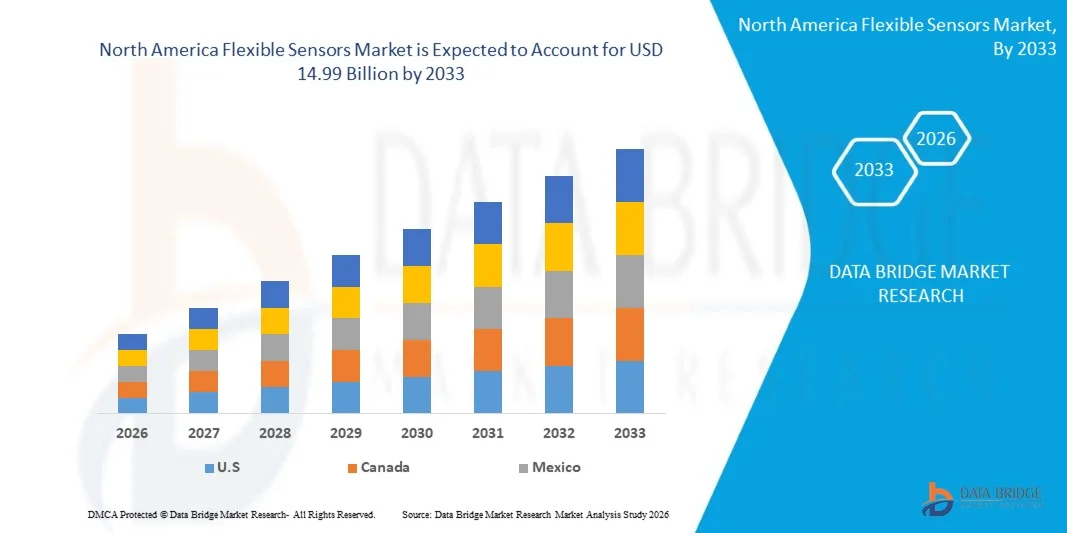
As per Data Bridge Market Research analysis, the North America flexible sensors market was valued at USD 9.27 billion in 2025 and is projected to reach USD 14.99 billion by 2033, growing at a CAGR of 6.20% from 2026 to 2033. The market is experiencing consistent growth driven by increasing adoption of flexible sensing technologies across healthcare, consumer electronics, automotive, and industrial applications. The market is experiencing consistent growth due to rising demand for lightweight, bendable, and highly sensitive sensor solutions, advancements in flexible electronics, and growing integration of wearable and smart devices.
The increasing demand for real-time monitoring solutions, coupled with advancements in printed electronics, nanotechnology, and flexible substrates, is encouraging manufacturers to develop next-generation sensors with improved flexibility, durability, and performance. Flexible sensors are gaining traction in medical devices, fitness products, automotive controls, robotics, and biometric applications, offering compact, energy-efficient, and adaptable sensing capabilities compared with conventional rigid sensors.
Market Size & Forecast
- Global Market Value (2025): USD 9.27 Billion
- Expected Market Value (2033): USD 14.99 Billion
- Forecast CAGR (2026–2033): 6.20%
- Leading Country in 2025: United States
- Fastest Growing Country: Canada
Key Market Trends & Insights
- The United States dominated the North America flexible sensors market with the largest revenue share of 80.4% in 2025, supported by strong adoption of flexible sensing technologies across healthcare, consumer electronics, automotive, aerospace, and industrial automation sectors, along with significant investments in flexible electronics research and development
- The capacitive flex sensors segment led the market with a 65% share in 2025, driven by their extensive adoption across wearable electronics, medical devices, automotive controls, robotics, and consumer applications
- Canada is expected to be the fastest-growing country in the North America flexible sensors market, expanding at a CAGR of 10.2% during the forecast period, driven by increasing adoption of wearable healthcare technologies, smart medical devices, IoT-enabled solutions, and rising investments in flexible and printed electronics technologies
- Fiber optics flex sensors are the fastest-growing product type, projected to register a CAGR of 11.5%, reflecting the surge in demand for high-precision sensing technologies in healthcare, aerospace, industrial automation, and robotics
- The biosensor segment dominated the type category with a 28% revenue share in 2025, led by increasing adoption of wearable healthcare devices, remote patient monitoring systems, and personalized healthcare technologies.
- Uni-directional accounted for 70% of the market, preferred by its widespread usage in motion detection, wearable devices, industrial controls, and robotics applications
- The robotics segment is the fastest-growing application category, with a CAGR of 13%, driven by increasing adoption of flexible sensors in robotic systems, artificial intelligence applications, and human robot interaction technologies
Report Scope and North America Flexible Sensors Market Segmentation
|
Attributes |
North America Flexible Sensors Key Market Insights |
|
Segments Covered |
|
|
Countries Covered |
North America
|
|
Key Market Players |
|
|
Market Opportunities |
|
|
Value Added Data Infosets |
In addition to the insights on market scenarios such as market value, growth rate, segmentation, geographical coverage, and major players, the market reports curated by the Data Bridge Market Research also include in-depth expert analysis, geographically represented company-wise production and capacity, network layouts of distributors and partners, detailed and updated price trend analysis and deficit analysis of supply chain and demand. |
North America Flexible Sensors Market Trends
Trend: Rising Adoption of Flexible Sensors in Wearable Healthcare Applications
The increasing adoption of flexible sensors in wearable healthcare devices is transforming patient monitoring, fitness tracking, and personalized healthcare solutions across North America. These sensors provide lightweight, stretchable, and conformable designs that enable continuous measurement of vital parameters such as pressure, temperature, motion, and biochemical signals. Healthcare providers and technology companies are increasingly integrating flexible sensing technologies into smart patches, electronic skin, and remote monitoring platforms to improve real-time health assessment and patient outcomes. The combination of flexible electronics, wireless connectivity, and IoT integration is accelerating the development of next-generation wearable medical devices. For instance, in July 2025, researchers at the University of California, San Diego developed a flexible wearable wristband sensor capable of continuously tracking glucose, lactate, alcohol levels, blood pressure, arterial stiffness, and heart rate, highlighting the advancement of flexible sensors for comprehensive health monitoring applications
The expansion of wearable healthcare technologies and remote monitoring solutions is expected to remain a major growth trend for flexible sensors across North America.
North America Flexible Sensors Market Dynamics
Key Market Driver: Growing Demand for Flexible Sensors in Advanced Electronics and IoT Applications
The increasing adoption of smart electronics, connected devices, and Internet of Things (IoT) applications is driving demand for flexible sensors across North America. Flexible sensors enable lightweight, compact, and highly adaptable sensing solutions for consumer electronics, automotive systems, industrial automation, robotics, and smart infrastructure. The growing deployment of flexible and printed electronics technologies is supporting the development of low-power, scalable, and cost-effective sensor solutions. Manufacturers are increasingly focusing on advanced materials, flexible substrates, and miniaturized sensor designs to enhance performance across diverse applications.
The rapid growth of IoT ecosystems and smart electronic devices is creating strong demand for flexible sensors as key components of connected technologies.
Key Restraint/Challenge: High Manufacturing Complexity and Material Integration Costs
A significant challenge in the North America flexible sensors market is the complexity associated with manufacturing flexible sensing systems using advanced materials and fabrication processes. Flexible sensors require specialized substrates, conductive materials, nanomaterials, and precise manufacturing techniques to achieve durability, sensitivity, and reliability. The integration of flexible components with existing electronic systems increases production complexity and costs compared with conventional rigid sensors. These challenges can limit large-scale commercialization, particularly for applications requiring high-volume production and strict performance requirements.
Overcoming manufacturing challenges and improving cost-effective production methods will be essential for wider adoption of flexible sensors across industrial and consumer applications.
Key Market Opportunity: Expansion of Flexible Sensors in Automotive and Human–Machine Interface Technologies
The integration of flexible sensors into automotive systems and human–machine interfaces represents a significant market opportunity in North America. Automotive manufacturers are exploring flexible sensing technologies for smart interiors, touch-sensitive surfaces, pressure monitoring systems, and advanced vehicle interaction solutions. Flexible sensors enable seamless integration into curved and complex surfaces, supporting the development of next-generation vehicles with enhanced user experience and intelligent sensing capabilities. The growing adoption of electric vehicles, autonomous technologies, and connected mobility solutions is further increasing opportunities for flexible sensor manufacturers. For instance, in October 2024, General Motors highlighted advancements in software-defined vehicles, connected vehicle platforms, and autonomous driving technologies, including Super Cruise hands-free driving systems that integrate cameras, radars, high-precision maps, and connectivity technologies, demonstrating the growing demand for advanced sensing solutions in next-generation vehicles.
Increasing automotive innovation and demand for intelligent vehicle interfaces are expected to create significant growth opportunities for flexible sensor technologies in North America.
North America Flexible Sensors Market Scope
The North America flexible sensors market is segmented on the basis of simulation type, vehicle type, training application, end user.
- By Product Type
On the basis of product type, the North America flexible sensors market is segmented into capacitive flex sensors and fiber optics flex sensors. The capacitive flex sensors segment dominated the market with 65% share in 2025, owing to their extensive adoption across wearable electronics, medical devices, automotive controls, robotics, and consumer applications. These sensors provide high sensitivity, low power consumption, lightweight construction, and excellent flexibility for applications requiring repeated bending and deformation. Their compatibility with flexible substrates and printed electronics enables cost-effective manufacturing. Increasing demand for smart wearables, touch interfaces, and healthcare monitoring devices is further supporting segment growth. The segment benefits from broader commercial availability and easier integration compared with advanced optical sensing technologies.
The fiber optics flex sensors segment is projected to register the fastest growth at a CAGR of 11.5% from 2026 to 2033, driven by increasing demand for high-precision sensing technologies in healthcare, aerospace, industrial automation, and robotics. These sensors provide superior accuracy, electromagnetic interference resistance, and reliable operation in complex environments. Growing adoption of optical sensing solutions in critical applications is supporting market expansion. Advancements in optical materials and miniaturized sensor designs are improving commercialization opportunities. Increasing investments in advanced diagnostics and industrial monitoring are expected to accelerate adoption.
- By Type
On the basis of type, the North America flexible sensors market is segmented into touch sensor, temperature sensor, image sensor, biosensor, digital X-ray sensor, piezoelectric, piezoresistive, gas sensor, photodetector, hybrid complementary metal oxide semiconductor (CMOS), and others. The biosensor segment dominated the market with 28% share in 2025, supported by increasing adoption of wearable healthcare devices, remote patient monitoring systems, and personalized healthcare technologies. Flexible biosensors enable continuous monitoring of biological parameters such as glucose, sweat biomarkers, and vital signs. Growing demand for non-invasive diagnostic solutions is strengthening adoption. Increasing research activities in flexible biomedical electronics are further expanding applications. Healthcare digitization and rising investments in smart medical devices continue to support segment dominance.
The touch sensor segment is expected to witness the fastest growth at a CAGR of 12.2% from 2026 to 2033, driven by increasing demand for flexible displays, smart electronics, automotive touch interfaces, and human–machine interaction technologies. Flexible touch sensors enable integration into curved and foldable surfaces, supporting next-generation product designs. Growth in consumer electronics and connected devices is increasing demand for advanced touch technologies. Automotive manufacturers are adopting flexible touch solutions for intelligent vehicle interiors. Continuous improvements in printed electronics are enhancing scalability and reducing manufacturing costs.
- By Rotation Type
On the basis of rotation type, the North America flexible sensors market is segmented into uni-directional and bi-directional sensors. The uni-directional segment dominated the market with 70% share in 2025, owing to its widespread usage in motion detection, wearable devices, industrial controls, and robotics applications. These sensors offer simple designs, lower production costs, and easy integration into electronic systems. Their ability to measure bending movements efficiently supports broad adoption. Increasing demand for affordable flexible sensing solutions is supporting segment growth. The segment remains preferred for applications where single-axis movement detection is sufficient.
The bi-directional segment is projected to grow at the fastest CAGR of 10.8% from 2026 to 2033, driven by increasing demand for multi-axis motion sensing in robotics, wearable technologies, and advanced human–machine interfaces. These sensors provide improved movement analysis and enhanced sensing accuracy. Growing adoption of electronic skin technologies and robotic systems is creating new opportunities. Advancements in flexible materials are improving durability and sensitivity. Increasing demand for intelligent sensing systems is expected to accelerate segment expansion.
- By Power Range
On the basis of power range, the North America flexible sensors market is segmented into 1K OHM–20K OHM, 21K OHM–100K OHM, 100K OHM–200K OHM, and more than 200K OHM. The 1K OHM–20K OHM segment dominated the market with 38% share in 2025, due to extensive utilization in wearable devices, consumer electronics, healthcare monitoring systems, and robotics. These sensors provide an effective balance between sensitivity, response time, and energy efficiency. Their compatibility with low-power electronic systems supports adoption in portable devices. Increasing demand for compact and efficient sensing solutions is strengthening segment growth. The segment benefits from broad application across commercial products.
The more than 200K OHM segment is expected to register the fastest growth at a CAGR of 11% from 2026 to 2033, driven by increasing demand for highly sensitive sensing applications. These sensors are gaining adoption in advanced medical devices, electronic skin, and precision monitoring systems. Rising research activities in next-generation flexible electronics are creating opportunities. Improvements in material engineering are enhancing performance and reliability. Growing demand for detecting small mechanical changes is supporting segment expansion.
- By Application
On the basis of application, the North America flexible sensors market is segmented into fitness products, medical devices and medicines, automotive controls, diagnostic tools, biometrics, gaming gloves, robotics, industrial control, musical instruments, computer peripherals, bumper switches, and others. The medical devices and medicines segment dominated the market with 32% share in 2025, driven by rising adoption of wearable healthcare devices, flexible biosensors, and remote monitoring solutions. Flexible sensors enable continuous tracking of health parameters while improving patient comfort. Increasing healthcare digitization and personalized medicine adoption are supporting growth. Smart patches and wearable diagnostic devices are expanding application opportunities. Strong healthcare technology investments in North America continue to drive segment leadership.
The robotics segment is projected to register the fastest growth at a CAGR of 13% from 2026 to 2033, supported by increasing adoption of flexible sensors in robotic systems, artificial intelligence applications, and human–robot interaction technologies. Flexible sensors enable robots to detect pressure, movement, and environmental changes. Growing industrial automation and collaborative robotics adoption are accelerating demand. Electronic skin and tactile sensing technologies are expanding application possibilities. Increasing investments in robotics research are expected to further support segment growth.
- By End Use
On the basis of end use, the North America flexible sensors market is segmented into healthcare, automotive, IT and telecommunication, sports, environment, agriculture, and others. the healthcare segment dominated the market with 35% share in 2025, owing to increasing adoption of wearable medical devices, biosensors, and continuous monitoring technologies. Flexible sensors support real-time health tracking and remote patient care. Rising chronic disease prevalence and preventive healthcare adoption are driving demand. Healthcare providers are increasingly integrating flexible sensing technologies into diagnostic platforms. Continued innovation in biomedical electronics is strengthening segment growth.
The automotive segment is expected to be the fastest-growing end-use segment at a CAGR of 12.5% from 2026 to 2033, driven by increasing integration of flexible sensors in smart vehicle interiors, ADAS technologies, touch interfaces, and connected vehicle systems. Flexible sensors enable lightweight and adaptable sensing solutions. Growth in electric vehicles and autonomous driving technologies is creating new opportunities. Automotive manufacturers are investing in advanced sensing platforms to improve safety and user experience. Increasing demand for intelligent mobility solutions is expected to accelerate adoption.
North America Flexible Sensors Market Regional Analysis
The United States dominated the North America flexible sensors market with the largest revenue share of 80.4% in 2025, supported by strong adoption of flexible sensing technologies across healthcare, consumer electronics, automotive, aerospace, and industrial automation sectors, along with significant investments in flexible electronics research and development. The country benefits from the presence of leading technology companies, research institutions, and manufacturers developing flexible sensor technologies for medical devices, consumer electronics, automotive systems, and industrial applications. In August 2022, researchers at the Massachusetts Institute of Technology (MIT) developed a chip-free, wireless electronic skin (e-skin) using flexible semiconductor materials that can sense and wirelessly transmit signals related to pulse, sweat, and ultraviolet exposure without bulky chips or batteries, demonstrating advancements in flexible sensor technologies for next-generation healthcare monitoring applications
Canada Flexible Sensors Market Insight
The Canada flexible sensors market is experiencing steady growth, supported by increasing adoption of wearable medical devices, flexible healthcare monitoring technologies, and advancements in printed electronics research. The country’s growing focus on digital healthcare, biomedical innovation, and IoT-based monitoring solutions is creating new opportunities for flexible sensor manufacturers. Increasing research activities in flexible materials, biosensing technologies, and smart devices are further supporting market expansion across healthcare and industrial applications. In March 2024, researchers at the University of Waterloo developed a miniaturized wearable health monitoring technology using flexible and compact antenna systems capable of transmitting medical-related data, demonstrating Canada’s growing innovation in wearable sensing technologies for non-invasive healthcare monitoring applications
Mexico Flexible Sensors Market Insight
The Mexico flexible sensors market is witnessing steady growth due to increasing adoption of flexible electronics, wearable sensing technologies, automotive applications, and industrial IoT solutions. The country’s expanding electronics manufacturing ecosystem, growing automotive production base, and increasing investments in advanced manufacturing technologies are driving demand for flexible sensor solutions. Rising adoption of wearable healthcare devices, smart automotive components, and flexible electronic systems is supporting market expansion across multiple industries. In addition, Mexico’s growing role as a manufacturing hub for electronics and automotive components is creating new opportunities for flexible sensor integration. In October 2024, Honeywell and Qualcomm Technologies announced a collaboration to develop AI-enabled industrial sensing solutions by combining low-power wireless connectivity, AI processors, and Honeywell’s sensing technologies, supporting the expansion of connected sensor systems across industrial applications in North America, including manufacturing operations in Mexico.
North America Flexible Sensors Market Share
The North America flexible sensors industry is primarily led by well-established companies, including:
- Abbott (U.S.)
- Medtronic (U.S.)
- Honeywell International Inc. (U.S.)
- Texas Instruments Incorporated (U.S.)
- Analog Devices, Inc. (U.S.)
- TE Connectivity Ltd. (Switzerland)
- Molex, LLC (U.S.)
- ams-OSRAM AG (Austria)
- Microchip Technology Inc. (U.S.)
- STMicroelectronics (Switzerland)
- Renesas Electronics Corporation (Japan)
- NXP Semiconductors (Netherlands)
- Infineon Technologies AG (Germany)
- Panasonic Holdings Corporation (Japan)
- Samsung Electronics Co., Ltd. (South Korea)
- LG Electronics Inc. (South Korea)
- 3M (U.S.)
- Zebra Technologies Corp. (U.S.)
- Apple Inc. (U.S.)
- Qualcomm Technologies, Inc. (U.S.)
Latest Developments in North America Flexible Sensors Market
- In May 2025, Abbott launched the TactiFlex Sensor Enabled Ablation Catheter, a flexible-tip medical device incorporating contact force sensing technology for improved precision in cardiac ablation procedures. The catheter combines a flexible electrode tip with advanced sensor capabilities to provide physicians with enhanced control and real-time feedback during treatment of atrial fibrillation. This product launch highlights the increasing integration of flexible sensing technologies into advanced medical devices and supports the growing adoption of flexible sensors in healthcare applications
- In March 2025, Helo Corp announced the upcoming market launch of its BioSense Watch, a sensor-enabled wearable device integrating artificial intelligence and health monitoring capabilities. The wearable incorporates multiple sensing technologies, including an embedded air-quality sensor designed to monitor environmental conditions near the user. This development reflects the growing commercialization of sensor-based wearable platforms and increasing demand for compact, connected sensing solutions in consumer healthcare applications
- In November 2024, Wave Company commercialized its TracSil wearable strain sensor, a flexible silicone-based sensor designed to monitor body movements and joint angles for healthcare, sports, and wearable technology applications. The flexible sensor can be attached to fabric and provides movement tracking capabilities through a lightweight and durable design. This commercialization demonstrates the expansion of flexible sensor technologies into wearable monitoring and human motion analysis applications
- In October 2024, Future Electronics announced the availability of Melexis Triphibian MEMS pressure sensor technology, introducing a new sensing solution designed for automotive and industrial applications. The sensor technology provides improved durability and pressure measurement performance in challenging environments, supporting the broader advancement of compact and reliable sensing systems. This launch reflects continued innovation in advanced sensor technologies for automotive and industrial applications
- In June 2024, Baker Hughes launched a collection of hydrogen measurement sensor technologies, including advanced gas, flow, and moisture sensing solutions designed for industrial and energy applications. These sensor technologies improve measurement accuracy, reliability, and durability in demanding operating environments. The launch demonstrates continued advancement in sensor technologies supporting industrial monitoring, automation, and next-generation energy systems

- Interactive Data Analysis Dashboard
- Company Analysis Dashboard for high growth potential opportunities
- Research Analyst Access for customization & queries
- Competitor Analysis with Interactive dashboard
- Latest News, Updates & Trend analysis
- Harness the Power of Benchmark Analysis for Comprehensive Competitor Tracking
North America Flexible Sensors Market, Supply Chain Analysis and Ecosystem Framework
To support market growth and help clients navigate the impact of geopolitical shifts, DBMR has integrated in-depth supply chain analysis into its North America Flexible Sensors Market research reports. This addition empowers clients to respond effectively to global changes affecting their industries. The supply chain analysis section includes detailed insights such as North America Flexible Sensors Market consumption and production by country, price trend analysis, the impact of tariffs and geopolitical developments, and import and export trends by country and HSN code. It also highlights major suppliers with data on production capacity and company profiles, as well as key importers and exporters. In addition to research, DBMR offers specialized supply chain consulting services backed by over a decade of experience, providing solutions like supplier discovery, supplier risk assessment, price trend analysis, impact evaluation of inflation and trade route changes, and comprehensive market trend analysis.
Data collection and base year analysis are done using data collection modules with large sample sizes. The stage includes obtaining market information or related data through various sources and strategies. It includes examining and planning all the data acquired from the past in advance. It likewise envelops the examination of information inconsistencies seen across different information sources. The market data is analysed and estimated using market statistical and coherent models. Also, market share analysis and key trend analysis are the major success factors in the market report. To know more, please request an analyst call or drop down your inquiry.
The key research methodology used by DBMR research team is data triangulation which involves data mining, analysis of the impact of data variables on the market and primary (industry expert) validation. Data models include Vendor Positioning Grid, Market Time Line Analysis, Market Overview and Guide, Company Positioning Grid, Patent Analysis, Pricing Analysis, Company Market Share Analysis, Standards of Measurement, Global versus Regional and Vendor Share Analysis. To know more about the research methodology, drop in an inquiry to speak to our industry experts.
Data Bridge Market Research is a leader in advanced formative research. We take pride in servicing our existing and new customers with data and analysis that match and suits their goal. The report can be customized to include price trend analysis of target brands understanding the market for additional countries (ask for the list of countries), clinical trial results data, literature review, refurbished market and product base analysis. Market analysis of target competitors can be analyzed from technology-based analysis to market portfolio strategies. We can add as many competitors that you require data about in the format and data style you are looking for. Our team of analysts can also provide you data in crude raw excel files pivot tables (Fact book) or can assist you in creating presentations from the data sets available in the report.













