


North America Healthcare Logistics Market Size
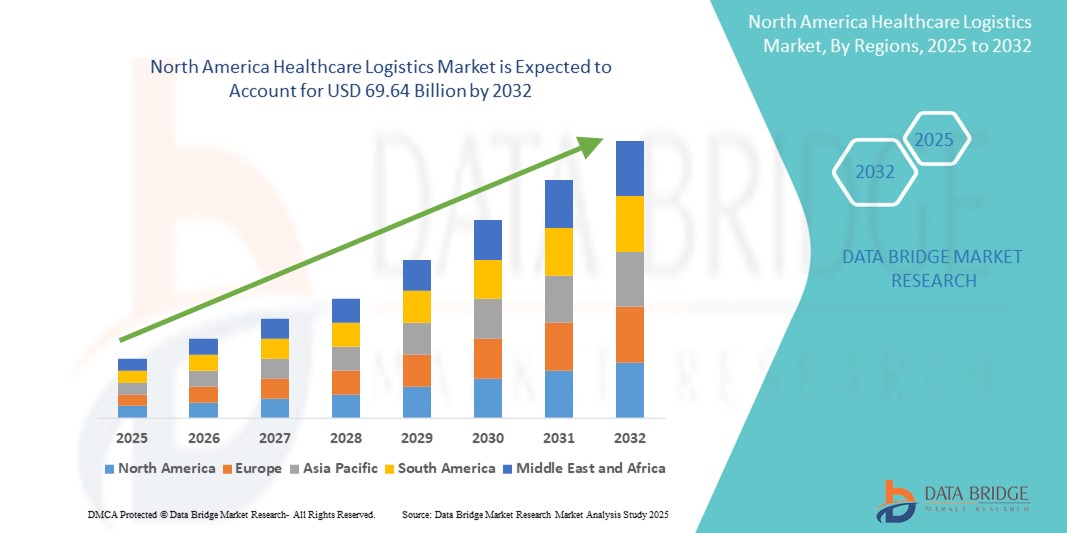
- The North America healthcare logistics market size was valued at USD 36.80 billion in 2024 and is expected to reach USD 69.64 billion by 2032, at a CAGR of 8.30% during the forecast period
- The market growth is primarily driven by the rising demand for time-sensitive and temperature-controlled pharmaceutical and medical product deliveries, supported by advancements in cold chain logistics and regulatory compliance
- In addition, the increasing prevalence of chronic diseases, growth in biopharmaceuticals, and expanding healthcare infrastructure are pushing the need for more efficient, secure, and responsive logistics solutions. These factors are collectively enhancing the region’s healthcare logistics capabilities and accelerating market expansion
North America Healthcare Logistics Market Analysis
- Healthcare logistics in North America encompasses the efficient transportation, storage, and management of medical devices, pharmaceuticals, and other healthcare products, playing a critical role in maintaining supply chain integrity, especially for temperature-sensitive and time-critical shipments
- The surging demand for healthcare logistics is driven by the expansion of pharmaceutical manufacturing, growth in biologics and personalized medicine, and the increasing need for streamlined cold chain logistics
- U.S. dominated the North America healthcare logistics market with the largest revenue share of 79.1% in 2024, attributed to a well-established healthcare infrastructure, strong regulatory framework, and the presence of major pharmaceutical companies and third-party logistics providers
- Canada is expected to witness the fastest growth during the forecast period in the North America healthcare logistics market, fueled by increasing investments in healthcare supply chains, rising demand for specialty drug delivery, and advancements in logistics technology
- The cold chain logistics segment dominated the North America healthcare logistics market with a 52.9% share in 2024, driven by the growing need for temperature-controlled transport of vaccines, biologics, and other sensitive healthcare products
Report Scope and North America Healthcare Logistics Market Segmentation
|
Attributes |
North America Healthcare Logistics Key Market Insights |
|
Segments Covered |
|
|
Countries Covered |
North America
|
|
Key Market Players |
|
|
Market Opportunities |
|
|
Value Added Data Infosets |
In addition to the insights on market scenarios such as market value, growth rate, segmentation, geographical coverage, and major players, the market reports curated by the Data Bridge Market Research also include in-depth expert analysis, pricing analysis, brand share analysis, consumer survey, demography analysis, supply chain analysis, value chain analysis, raw material/consumables overview, vendor selection criteria, PESTLE Analysis, Porter Analysis, and regulatory framework. |
North America Healthcare Logistics Market Trends
“Digitization and Cold Chain Innovation for Enhanced Supply Chain Visibility”
- A key and accelerating trend in the North America healthcare logistics market is the integration of advanced digital technologies and cold chain innovations to enhance transparency, efficiency, and reliability across the supply chain, particularly for temperature-sensitive pharmaceuticals and biologics
- For instance, leading logistics providers such as UPS Healthcare and FedEx are implementing real-time tracking systems, IoT-enabled monitoring devices, and data analytics platforms to improve shipment visibility, reduce spoilage, and ensure regulatory compliance throughout the cold chain
- Technologies such as RFID, GPS-enabled sensors, and blockchain are being adopted to maintain end-to-end traceability, automate inventory management, and minimize human errors in handling critical medical goods. In addition, digital platforms allow stakeholders to monitor environmental conditions such as temperature, humidity, and shock exposure in real time
- These advancements are especially critical in the transportation of vaccines, gene therapies, and high-value biologics that require stringent temperature control. For example, DHL Supply Chain has expanded its North American cold storage facilities, integrating AI-driven predictive maintenance to reduce logistics downtime and risk
- The shift towards digitized and intelligent logistics infrastructure is reshaping service expectations in the healthcare sector, enabling greater customization, faster delivery times, and compliance with regulations such as the Drug Supply Chain Security Act (DSCSA)
- As demand grows for precise, secure, and efficient logistics services, the healthcare sector is witnessing increasing partnerships between pharma companies and logistics firms to co-develop specialized cold chain solutions. This collaborative innovation is accelerating the evolution of the region’s healthcare logistics ecosystem
North America Healthcare Logistics Market Dynamics
Driver
“Growing Biopharma Demand and Expansion of Personalized Medicine”
- The rapid expansion of the biopharmaceutical industry and the increasing demand for personalized medicine and cell and gene therapies are major drivers of healthcare logistics growth in North America
- For instance, in January 2024, AmerisourceBergen (now Cencora) announced expanded cold chain capabilities across the U.S. to support the surging need for individualized therapies and complex biologics. These initiatives are expected to fuel market growth by ensuring secure and compliant delivery of high-value products
- Biologics and specialty drugs often require highly controlled environments and time-critical logistics, making advanced healthcare logistics services indispensable. Moreover, as the pipeline for rare disease and gene therapies grows, there is an increased demand for temperature-sensitive, just-in-time, and white-glove logistics solutions
- In addition, rising investments in healthcare infrastructure, stringent regulatory requirements for drug traceability, and the need for uninterrupted supply during public health crises are further propelling the demand for agile, reliable logistics operations tailored to healthcare needs
- The emergence of 3PL and 4PL providers with dedicated healthcare logistics divisions is supporting this transformation, offering specialized warehousing, last-mile delivery, and real-time data visibility across the value chain
Restraint/Challenge
“Regulatory Complexity and Cost Pressures in Cold Chain Compliance”
- One of the main challenges facing the North America healthcare logistics market is the complex and evolving regulatory landscape surrounding pharmaceutical transportation, particularly for temperature-sensitive and high-risk products
- Compliance with regulations such as FDA’s Title 21 CFR Part 11, DSCSA, and Health Canada’s Good Distribution Practices (GDP) can be resource-intensive and require sophisticated quality assurance systems, validated transport methods, and trained personnel
- For instance, logistics providers must demonstrate strict adherence to temperature excursion logs, equipment calibration, and serialization tracking, all of which increase operational costs
- These regulatory and quality assurance requirements, while essential for patient safety, can pose a financial and administrative burden on smaller logistics firms or pharmaceutical manufacturers lacking in-house logistics capabilities
- In addition, the capital investment required for advanced cold chain infrastructure, such as ultra-low temperature freezers, insulated packaging, and continuous monitoring systems, may limit entry or expansion for some players
- Addressing these challenges through collaborative industry frameworks, investment in scalable technologies, and leveraging automation to reduce human error will be key to sustaining long-term growth in this dynamic market
North America Healthcare Logistics Market Scope
The market is segmented on the basis of type, component, temperature type, logistics, logistic type, application, and end user
- By Type
On the basis of type, the North America healthcare logistics market is segmented into cold chain and non-cold chain. The cold chain segment dominated the market with the largest market revenue share of 52.9% in 2024, driven by the increasing demand for transporting temperature-sensitive pharmaceutical products such as biologics, vaccines, and insulin. Cold chain logistics ensure product integrity by maintaining precise temperature ranges throughout the supply chain, thereby meeting strict regulatory and safety standards.
The non-cold chain segment is anticipated to grow steadily from 2025 to 2032, supported by consistent logistics demand for general medicines, medical equipment, and consumables that do not require refrigeration. With increasing healthcare consumption across North America, this segment remains crucial for operational efficiency in non-specialized product transport.
- By Component
On the basis of component, the North America healthcare logistics market is segmented into hardware, software, and services. The services segment held the largest market revenue share in 2024, driven by the growing reliance on third-party logistics (3PL) providers for transportation, warehousing, customs clearance, and regulatory compliance across the healthcare sector. These services streamline supply chain operations and reduce infrastructure burdens on manufacturers.
The software segment is expected to witness the fastest growth rate from 2025 to 2032, fueled by increased adoption of logistics software solutions such as real-time tracking, route optimization, inventory management, and cold chain monitoring. Integration of AI, IoT, and cloud computing is transforming supply chain transparency and responsiveness across the region.
- By Temperature Type
On the basis of temperature type, the North America healthcare logistics market is segmented into ambient, chilled/refrigerated, frozen, and cryogenic. The chilled/refrigerated segment dominated the market in 2024 with the largest revenue share due to high demand for controlled temperature transportation of vaccines, blood products, and injectable drugs. These products require stable temperature conditions (2°C–8°C) to preserve their efficacy.
The cryogenic segment is projected to grow at the fastest CAGR from 2025 to 2032, driven by rising adoption of cell and gene therapies, organ transport, and ultra-low temperature biologics. Cryogenic logistics (below −150°C) is gaining importance in advanced therapeutic applications and clinical research.
- By Logistics
On the basis of logistics, the North America healthcare logistics market is segmented into transportation, packaging, storage, and others. The transportation segment accounted for the largest market share in 2024, driven by the critical need for safe and timely delivery of pharmaceuticals and medical devices across long distances. Growth in air and ground transportation networks, including express delivery services, supports the rising expectations for faster delivery timelines.
The storage segment is anticipated to witness significant growth from 2025 to 2032, owing to increasing investment in specialized storage infrastructure, including refrigerated and cryogenic warehouses that meet GDP and FDA compliance for healthcare products.
- By Logistic Type
On the basis of logistic type, the North America healthcare logistics market is segmented into sea freight logistics, air freight logistics, overland logistics, and contract logistics. The air freight logistics segment held the largest market share in 2024, owing to the growing need for speed in delivering time-sensitive and temperature-controlled pharmaceuticals. The widespread use of air cargo in vaccine and specialty drug distribution contributed to segment growth.
The contract logistics segment is expected to experience the highest CAGR from 2025 to 2032, as healthcare manufacturers increasingly outsource warehousing, inventory control, and last-mile delivery to experienced logistics providers for improved efficiency, scalability, and cost management.
- By Application
On the basis of application, the North America healthcare logistics market is segmented into medicine, bulk drug handlers, vaccine, chemical and other raw material, biological material and organs, hazardous cargo, and others. The vaccine segment dominated the market in 2024 with the largest revenue share, driven by global immunization campaigns and the emergence of mRNA vaccines requiring precise cold chain handling.
The biological material and organs segment is anticipated to witness the fastest growth from 2025 to 2032, supported by rising demand for organ transplantation and personalized medicine. These applications require stringent regulatory adherence and real-time tracking to ensure preservation and traceability.
- By End User
On the basis of end user, the North America healthcare logistics market is segmented into biopharmaceutical companies, hospitals and clinics, research institutes, and others. The biopharmaceutical companies segment held the largest market revenue share in 2024, attributed to their continuous need for secure logistics for R&D samples, clinical trial supplies, and commercial product distribution, especially across regional and international borders.
The hospitals and clinics segment is projected to grow rapidly from 2025 to 2032 due to the increasing use of just-in-time delivery models and outsourcing of non-core logistics functions. As these facilities prioritize operational efficiency and patient safety, demand for reliable and compliant logistics support continues to rise.
North America Healthcare Logistics Market Regional Analysis
- The U.S. led the North America healthcare logistics market with the largest revenue share of 79.1% in 2024, attributed to a well-established healthcare infrastructure, strong regulatory framework, and the presence of major pharmaceutical companies and third-party logistics providers
- The country’s leadership is reinforced by a strong network of biopharmaceutical manufacturers, research institutions, and third-party logistics providers that specialize in regulated healthcare transport, particularly for vaccines, biologics, and clinical trial materials
- In addition, the presence of robust regulatory standards, widespread adoption of digital supply chain technologies, and continued investment in cold chain capabilities have positioned the U.S. as the central hub for healthcare logistics across the region
U.S. North America Healthcare Logistics Market Insight
The U.S. healthcare logistics market captured the largest revenue share of 79.1% in 2024 within North America, driven by the country’s expansive pharmaceutical industry, robust regulatory framework, and high demand for cold chain and time-sensitive logistics solutions. The growing focus on biologics, personalized medicine, and clinical trials is fueling the need for specialized logistics infrastructure. Furthermore, the integration of digital technologies such as IoT-enabled tracking, automation, and AI-based logistics management systems is enhancing operational efficiency. Strong partnerships between pharma manufacturers and 3PL providers are further accelerating market growth.
Canada Healthcare Logistics Market Insight
The Canada healthcare logistics market is projected to grow at a steady CAGR during the forecast period, supported by the country’s investment in healthcare infrastructure and rising demand for temperature-sensitive pharmaceutical transportation. The increasing prevalence of chronic diseases and the growing need for biologics are driving the adoption of cold chain logistics solutions. In addition, regulatory alignment with international standards and advancements in supply chain visibility technologies are promoting reliable and compliant healthcare logistics services across the country.
Mexico Healthcare Logistics Market Insight
The Mexico healthcare logistics market is anticipated to expand at a considerable CAGR over the forecast period, driven by the development of pharmaceutical manufacturing hubs and improved cross-border logistics capabilities. Increasing government support for healthcare expansion, along with growing demand for vaccines and essential medicines, is fueling the need for efficient transportation and storage services. Mexico’s strategic geographic position and improving regulatory practices are further enhancing its role as a critical link in the North American healthcare supply chain.
North America Healthcare Logistics Market Share
The North America Healthcare Logistics industry is primarily led by well-established companies, including:
- Cencora, Inc. (U.S.)
- McKesson Corporation (U.S.)
- Cardinal Health, Inc. (U.S.)
- UPS Healthcare (U.S.)
- FedEx Corporation (U.S.)
- DHL Supply Chain (Germany)
- Kuehne + Nagel International AG (Switzerland)
- GEODIS (France)
- CEVA Logistics (France)
- DB Schenker (Germany)
- XPO, Inc. (U.S.)
- Ryder System, Inc. (U.S.)
- SF Express Co., Ltd. (China)
- Expeditors International of Washington, Inc. (U.S.)
- Thermo Fisher Scientific Inc. (U.S.)
- Nippon Express Holdings, Inc. (Japan)
- Bolloré Logistics (France)
- World Courier (U.S.)
- Maersk Logistics & Services (Denmark)
- Agility Public Warehousing Company K.S.C.P. (Kuwait)
What are the Recent Developments in North America Healthcare Logistics Market?
- In April 2024, Cencora (formerly AmerisourceBergen) announced the expansion of its cold chain logistics network across the U.S., aimed at supporting the increasing demand for temperature-controlled pharmaceutical distribution. This strategic move includes the development of new refrigerated facilities and the enhancement of real-time tracking capabilities. The initiative reflects Cencora’s commitment to advancing healthcare logistics infrastructure and strengthening supply chain resilience in response to the growing complexity of biologics and personalized therapies
- In March 2024, UPS Healthcare launched its first dedicated healthcare logistics facility in Canada, featuring advanced cold chain capabilities and automated systems to handle sensitive medical shipments. This investment marks a significant step in supporting Canada’s expanding pharmaceutical and biotech industries. The facility enhances UPS Healthcare’s ability to meet strict regulatory standards while providing faster, more efficient service across the Canadian healthcare sector
- In February 2024, DHL Supply Chain North America introduced a next-generation warehouse automation system in its healthcare logistics centers across the U.S. The system uses robotics and AI for inventory management, picking accuracy, and temperature monitoring, significantly improving operational efficiency. This development demonstrates DHL’s focus on innovation and reinforces its leadership in high-performance healthcare logistics services
- In January 2024, FedEx Express expanded its SenseAware ID tracking technology across critical healthcare shipments in the U.S. to enhance visibility and real-time monitoring. The technology allows clients to access location, temperature, humidity, and light exposure data during transit, reducing the risk of spoilage or delay. This deployment highlights FedEx’s continued investment in precision logistics to support sensitive pharmaceutical and clinical trial shipments
- In January 2024, Cardinal Health announced a partnership with a leading U.S. biopharma manufacturer to optimize its last-mile delivery solutions for specialty pharmaceuticals. This collaboration involves deploying predictive analytics and dynamic routing technologies to improve delivery timelines and reduce costs. The initiative underscores Cardinal Health’s commitment to leveraging data-driven strategies to elevate service quality and reliability in the evolving healthcare logistics landscape

- Interactive Data Analysis Dashboard
- Company Analysis Dashboard for high growth potential opportunities
- Research Analyst Access for customization & queries
- Competitor Analysis with Interactive dashboard
- Latest News, Updates & Trend analysis
- Harness the Power of Benchmark Analysis for Comprehensive Competitor Tracking
Data collection and base year analysis are done using data collection modules with large sample sizes. The stage includes obtaining market information or related data through various sources and strategies. It includes examining and planning all the data acquired from the past in advance. It likewise envelops the examination of information inconsistencies seen across different information sources. The market data is analysed and estimated using market statistical and coherent models. Also, market share analysis and key trend analysis are the major success factors in the market report. To know more, please request an analyst call or drop down your inquiry.
The key research methodology used by DBMR research team is data triangulation which involves data mining, analysis of the impact of data variables on the market and primary (industry expert) validation. Data models include Vendor Positioning Grid, Market Time Line Analysis, Market Overview and Guide, Company Positioning Grid, Patent Analysis, Pricing Analysis, Company Market Share Analysis, Standards of Measurement, Global versus Regional and Vendor Share Analysis. To know more about the research methodology, drop in an inquiry to speak to our industry experts.
Data Bridge Market Research is a leader in advanced formative research. We take pride in servicing our existing and new customers with data and analysis that match and suits their goal. The report can be customized to include price trend analysis of target brands understanding the market for additional countries (ask for the list of countries), clinical trial results data, literature review, refurbished market and product base analysis. Market analysis of target competitors can be analyzed from technology-based analysis to market portfolio strategies. We can add as many competitors that you require data about in the format and data style you are looking for. Our team of analysts can also provide you data in crude raw excel files pivot tables (Fact book) or can assist you in creating presentations from the data sets available in the report.













