


North America Hernia Repair Devices (Permanent and Absorbable Hernia Fixation) Market Size
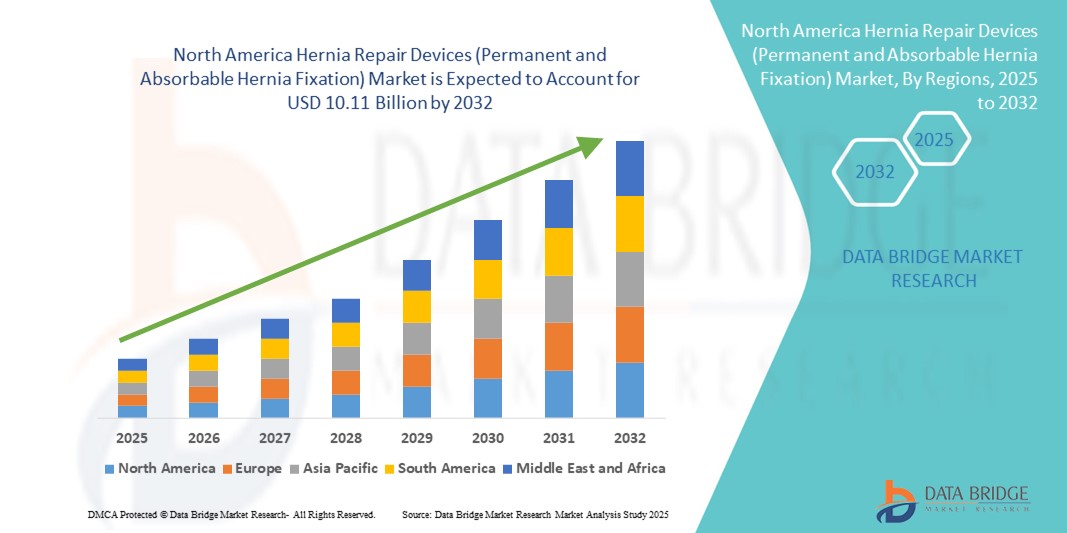
- The North America hernia repair devices (permanent and absorbable hernia fixation) market size was valued at USD 5.8 billion in 2024 and is expected to reach USD 10.11 billion by 2032, at a CAGR of 7.20% during the forecast period
- The Hernia Repair Devices (Permanent and Absorbable Hernia Fixation) market growth is primarily driven by the increasing prevalence of hernia cases globally, along with the rising preference for advanced surgical solutions that reduce recurrence rates and enhance patient recovery outcomes. Technological advancements have led to the development of innovative permanent and absorbable fixation devices, improving surgical precision, minimizing post-operative complications, and increasing overall treatment success rates. These factors are encouraging wider adoption across hospitals, ambulatory surgical centers, and specialized clinics
- In addition, the growing shift toward minimally invasive surgical techniques, supported by favorable reimbursement policies and an expanding geriatric population more prone to hernia conditions, is further propelling market growth. Patients and healthcare providers are increasingly opting for devices that offer strong fixation, faster recovery, and reduced post-surgery discomfort, contributing to sustained market expansion
North America Hernia Repair Devices (Permanent and Absorbable Hernia Fixation) Market Analysis
- Hernia repair devices (permanent and absorbable hernia fixation) are witnessing strong adoption across North America, driven by the rising incidence of hernia cases, greater access to surgical care, and the steady shift toward minimally invasive laparoscopic and robotic-assisted repairs
- The increasing volume of elective and emergency hernia surgeries, improvements in perioperative care, and patient preference for faster recovery are fueling demand for both permanent and absorbable fixation systems. Hospitals, ambulatory surgical centers (ASCs), and specialized hernia clinics are upgrading their device portfolios to include self-fixating meshes, absorbable tack systems, and hybrid implants
- U.S. dominated the North America hernia repair devices market, accounting for the largest revenue share of 34.9% of the global market 2024. This dominance is due to the U.S.’s highly developed surgical infrastructure, high procedure volumes, favorable reimbursement for hernia repairs, strong clinical research activity, and proximity to leading device manufacturers and innovators that accelerate technology adoption
- Canada is projected to be the fastest-growing country in the North America hernia repair devices market, with an estimated CAGR of 7.5% from 2025 to 2032. Growth drivers include expanding surgical capacity in regional hospitals, targeted government healthcare investments to improve access in remote areas, rising awareness and screening for hernias among older adults, and growing adoption of minimally invasive and absorbable fixation technologies that reduce long-term complications and revision rates
- The inguinal hernia segment dominated the North America hernia repair devices market in 2024, accounting for 41.2% of the total share. This dominance is attributed to the high prevalence of inguinal hernia cases in the region, especially among older adults and physically active populations
Report Scope and North America Hernia Repair Devices (Permanent and Absorbable Hernia Fixation) Market Segmentation
|
Attributes |
North America Hernia Repair Devices (Permanent and Absorbable Hernia Fixation) Key Market Insights |
|
Segments Covered |
|
|
Countries Covered |
North America
|
|
Key Market Players |
|
|
Market Opportunities |
|
|
Value Added Data Infosets |
In addition to the insights on market scenarios such as market value, growth rate, segmentation, geographical coverage, and major players, the market reports curated by the Data Bridge Market Research also include in-depth expert analysis, pricing analysis, brand share analysis, consumer survey, demography analysis, supply chain analysis, value chain analysis, raw material/consumables overview, vendor selection criteria, PESTLE Analysis, Porter Analysis, and regulatory framework. |
North America Hernia Repair Devices (Permanent and Absorbable Hernia Fixation) Market Trends
Advancements in Minimally Invasive Technologies and Patient-Centric Solutions
- A significant and accelerating trend in the North America hernia repair devices (Permanent and Absorbable Hernia Fixation) market is the continuous innovation in minimally invasive surgical technologies, aimed at reducing postoperative complications, enhancing patient comfort, and shortening recovery times. These innovations are driving wider adoption among surgeons and healthcare facilities seeking more effective yet less invasive hernia repair options
- For instance, advanced laparoscopic and robotic-assisted surgical systems are being optimized to improve precision in mesh placement and fixation while minimizing tissue trauma. The development of absorbable fixation systems with bioresorbable materials further reduces the risk of chronic pain and long-term foreign body complications
- Growing focus on patient-centric customization has led manufacturers to design hernia repair devices in multiple sizes, shapes, and fixation types—permanent or absorbable—tailored to individual anatomical and procedural needs. The integration of preoperative imaging and 3D surgical planning tools supports better patient-specific outcomes
- The introduction of hybrid fixation devices combining mechanical fixation with tissue adhesive technologies is also gaining traction, enabling improved mesh stability while reducing postoperative discomfort
- These advancements are reshaping the hernia repair device landscape by emphasizing surgical safety, long-term durability, and improved quality of life for patients. Companies such as Medtronic, Becton, Dickinson and Company, and Johnson & Johnson (Ethicon) are leading the charge in developing next-generation fixation systems to meet evolving clinical requirements
- The demand for advanced, minimally invasive hernia repair devices is growing rapidly across both developed and emerging markets, fueled by increasing hernia incidence rates, rising surgical volumes, expanding access to specialized surgical centers, and greater patient awareness about modern treatment options
North America Hernia Repair Devices (Permanent and Absorbable Hernia Fixation) Market Dynamics
Driver
Growing Demand Driven by Rising Surgical Volumes and Advancements in Repair Technologies
- The increasing incidence of hernias across diverse age groups, coupled with the rising number of elective and emergency hernia repair procedures, is a major driving force behind the surge in demand for advanced hernia repair devices, including both permanent and absorbable fixation solutions. The growing preference for minimally invasive and laparoscopic techniques is further accelerating the shift toward innovative mesh materials and fixation methods that offer better patient outcomes
- For instance, in March 2024, Medtronic introduced its next-generation absorbable fixation device aimed at improving tissue integration, reducing chronic pain, and minimizing recurrence rates in hernia repair surgeries. These technological advancements by leading manufacturers are anticipated to accelerate the growth of the hernia repair devices market throughout the forecast period
- As surgeons increasingly seek reliable yet patient-friendly solutions for inguinal, umbilical, and incisional hernia repairs, devices that enable shorter recovery times, reduced postoperative complications, and enhanced surgical precision are gaining widespread adoption across hospitals, specialty clinics, and ambulatory surgical centers in North America
- Furthermore, the growing demand for patient-specific meshes, improved fixation systems, and hybrid materials combining the benefits of both permanent and absorbable technologies is further propelling market growth. Devices offering enhanced biocompatibility, optimized pore structure, and antimicrobial properties are particularly favored for their long-term safety and efficacy
- The expanding number of trained hernia repair surgeons, along with increasing healthcare expenditure in emerging economies, is also contributing to the broader adoption of advanced hernia repair devices, enabling access to high-quality surgical interventions in diverse geographical regions
Restraint/Challenge
Concerns Regarding High Device Costs and Stringent Regulatory Requirements
- The high upfront investment required to procure premium hernia repair devices and fixation systems remains a significant barrier, particularly for smaller healthcare facilities and providers in cost-sensitive markets. This challenge is compounded by the need for specialized training and the potential for device-specific learning curves, which may limit adoption in low-resource settings
- For instance, composite and coated meshes, as well as absorbable fixation devices with advanced design features, often come with a considerable price premium compared to traditional solutions, restricting their accessibility in certain markets
- In addition, the stringent and varying regulatory requirements across different countries—covering device classification, biocompatibility testing, and clinical evaluations—can delay product approvals and increase compliance costs, thereby impacting time-to-market for new innovations
- While manufacturers are increasingly offering more cost-effective mesh solutions, bulk procurement discounts, and flexible payment models to ease the financial burden, the combination of high capital cost and complex regulatory compliance continues to present challenges for broader market penetration
- To ensure sustained growth, the industry must focus on developing affordable, high-performance devices, streamlining the regulatory approval process, and providing comprehensive training to healthcare professionals to maximize device safety, efficacy, and patient outcomes
North America Hernia Repair Devices (Permanent and Absorbable Hernia Fixation) Market Scope
The market is segmented on the basis of type end user, and distribution channel.
- By Type
On the basis of type, the North America hernia repair devices (permanent and absorbable hernia fixation) market is segmented into inguinal hernia, femoral hernia, umbilical hernia, hiatal (hiatus) hernia, incisional hernia, epigastric hernia, spigelian hernia, and diaphragmatic hernia. The inguinal hernia segment dominated the market in 2024, accounting for 41.2% of the total share. This dominance is attributed to the high prevalence of inguinal hernia cases in the region, especially among older adults and physically active populations. In addition, widespread surgeon familiarity with mesh-based laparoscopic repair techniques, coupled with their well-documented low recurrence rates, reinforces the strong demand for these procedures. Permanent mesh and fixation devices continue to be the preferred choice for inguinal hernia repairs, as they offer predictable long-term outcomes and reduced postoperative complications.
The incisional segment is anticipated to witness the fastest CAGR of 7.8% from 2025 to 2032. Growth in this category is being propelled by the rising number of abdominal surgeries, increasing rates of obesity-related complications, and recurrent hernia cases. Moreover, the adoption of advanced biologic and composite meshes, absorbable fixation devices, and hybrid implants is gaining traction, as these technologies aim to reduce foreign-body complications, promote better tissue integration, and improve overall patient recovery.
- By End User
On the basis of end user, the market is segmented into hospitals, specialty clinics, ambulatory centers, and others. Hospitals led the market in 2024 with a 44.7% revenue share. Their dominance is due to the ability to manage complex hernia repair cases, including emergency and inpatient procedures. Hospitals also benefit from early access to innovative implant technologies through participation in clinical research and trials, ensuring the adoption of cutting-edge surgical solutions.
Ambulatory centers are expected to register the fastest CAGR of 8.5% through 2032, driven by the rapid shift of hernia repairs toward minimally invasive laparoscopic and robotic techniques. These procedures can be efficiently performed in same-day, outpatient settings, reducing patient costs, improving recovery times, and minimizing hospital stays. Specialty clinics and dedicated hernia centers also play a growing role in providing targeted, high-quality care.
- By Distribution Channel
On the basis of distribution channel, the market is divided into direct tender and retail sales. The direct tender segment dominated in 2024 with a 55.8% market share. This channel benefits from bulk procurement contracts between manufacturers and large healthcare institutions, ensuring cost advantages, supply stability, and standardized product availability.
The retail sales segment is projected to grow at a CAGR of 7.1% from 2025 to 2032, supported by the increasing role of specialized surgical distributors, the expansion of e-commerce platforms for medical devices, and the improved accessibility of hernia repair products to smaller clinics, independent surgeons, and outpatient centers.
North America Hernia Repair Devices (Permanent and Absorbable Hernia Fixation) Market Regional Analysis
- Hernia repair devices (permanent and absorbable hernia fixation) are witnessing strong adoption across North America, driven by the rising incidence of hernia cases, greater access to surgical care, and the steady shift toward minimally invasive laparoscopic and robotic-assisted repairs
- In 2024, North America accounted for 40.2% of the global hernia repair devices market revenue, supported by advanced healthcare infrastructure, a strong network of specialist surgeons, and the presence of major device manufacturers offering a broad range of mesh and fixation products
- Continuous innovation, such as the development of lightweight composite meshes, bioresorbable fixation systems, and patient-specific solutions, is further boosting market penetration. In addition, growing awareness about early hernia diagnosis, coupled with enhanced training for surgeons in minimally invasive techniques, is improving surgical outcomes and driving higher procedure volumes across the region
U.S. Hernia Repair Devices (Permanent and Absorbable Hernia Fixation) Market Insight
The U.S. hernia repair devices (permanent and absorbable hernia fixation) dominated the North America hernia repair devices market, accounted for the largest revenue share of 34.9% of the global market in 2024. This leadership stems from the country’s highly developed surgical infrastructure, high annual hernia repair procedure volumes, favorable reimbursement for both open and minimally invasive repairs, and proximity to leading device manufacturers and research centers. The U.S. market benefits from rapid adoption of advanced technologies, such as robotic-assisted hernia repairs, enhanced laparoscopic instruments, and next-generation absorbable fixation systems designed to minimize chronic pain and recurrence rates. A strong focus on clinical trials, surgeon training programs, and hospital-supplier partnerships continues to reinforce the U.S.’s position as the leading innovator and adopter of hernia repair technologies.
Canada Hernia Repair Devices (Permanent and Absorbable Hernia Fixation) Market Insight
Canada hernia repair devices (permanent and absorbable hernia fixation) is projected to be the fastest-growing country in the North America hernia repair devices market, with an estimated CAGR of 7.5% (estimated) from 2025 to 2032. Market growth is driven by expanding surgical capacity in regional and tertiary care hospitals, targeted government healthcare investments to improve access in remote and underserved areas, and increasing adoption of advanced minimally invasive techniques. Rising awareness campaigns around hernia prevention and early diagnosis, combined with favorable provincial healthcare policies, are enabling timely interventions and improved patient outcomes. The adoption of absorbable fixation technologies that reduce long-term complications and the need for revision surgeries is accelerating, particularly among older adult populations. Medical tourism from neighboring regions and cross-border collaborations with U.S. healthcare providers are also contributing to Canada’s rapid market expansion.
North America Hernia Repair Devices (Permanent and Absorbable Hernia Fixation) Market Share
The hernia repair devices (permanent and absorbable hernia fixation) industry is primarily led by well-established companies, including:
- Medtronic (Ireland)
- BD (U.S.)
- Cook Group (U.S.)
- W. L. Gore & Associates, Inc. (U.S.)
- ETHICON (U.S.)
- Baxter (U.S.)
- Cooper Surgical Inc. (U.S.)
- Betatech Medical (Netherlands?)
- pfm medical ag (Germany)
- B. Braun SE (Germany)
- Integra LifeSciences Corporation (U.S.)
- Herniamesh S.r.L. (Italy)
- Dipromed Srl (Italy)
- Meril Life Sciences Pvt. Ltd. (India)
- Insightra Medical, Inc. (U.S.)
- Invamed (U.S.)
- Secqure Surgical, Corp. (U.S.)
- DemeTECH (U.S.)
Latest Developments in North America Hernia Repair Devices (Permanent and Absorbable Hernia Fixation) Market
- In June 2021, B.G. Medical., the manufacturer and distributor of the 21st Century SURGIMESH Platform, announced it was honoring Hernia Awareness Month by partnering with CQInsights to pioneer a new approach that delivers better outcomes for patients, with a larger mission to share sustainable solutions that improve healthcare for everyone
- In July 2021, B.D. (Becton, Dickinson and Company) announced it has acquired Tepha, Inc., a leading developer and manufacturer of proprietary resorbable polymer technology. The acquisition of Tepha provides strategic vertical integration of an important supply chain component for B.D.'s existing Phasix Mesh products. Tepha's GalaFLEX portfolio, also based on the novel P4HB polymer, is included in the acquisition
- In April 2025, BD (Becton, Dickinson and Company) received FDA 510(k) clearance and launched Phasix ST Umbilical Hernia Patch, the first fully absorbable mesh designed specifically for umbilical hernia repair. This innovation offers surgeons a resorbable alternative to permanent mesh while permitting use of familiar placement techniques
- In June 2025, NC State University and Duke University researchers announced that their novel hernia mesh technology, aimed at improving patient outcomes and reducing complications, has been selected for the AUTM Better World Project, highlighting its clinical and commercial potential

- Interactive Data Analysis Dashboard
- Company Analysis Dashboard for high growth potential opportunities
- Research Analyst Access for customization & queries
- Competitor Analysis with Interactive dashboard
- Latest News, Updates & Trend analysis
- Harness the Power of Benchmark Analysis for Comprehensive Competitor Tracking
Data collection and base year analysis are done using data collection modules with large sample sizes. The stage includes obtaining market information or related data through various sources and strategies. It includes examining and planning all the data acquired from the past in advance. It likewise envelops the examination of information inconsistencies seen across different information sources. The market data is analysed and estimated using market statistical and coherent models. Also, market share analysis and key trend analysis are the major success factors in the market report. To know more, please request an analyst call or drop down your inquiry.
The key research methodology used by DBMR research team is data triangulation which involves data mining, analysis of the impact of data variables on the market and primary (industry expert) validation. Data models include Vendor Positioning Grid, Market Time Line Analysis, Market Overview and Guide, Company Positioning Grid, Patent Analysis, Pricing Analysis, Company Market Share Analysis, Standards of Measurement, Global versus Regional and Vendor Share Analysis. To know more about the research methodology, drop in an inquiry to speak to our industry experts.
Data Bridge Market Research is a leader in advanced formative research. We take pride in servicing our existing and new customers with data and analysis that match and suits their goal. The report can be customized to include price trend analysis of target brands understanding the market for additional countries (ask for the list of countries), clinical trial results data, literature review, refurbished market and product base analysis. Market analysis of target competitors can be analyzed from technology-based analysis to market portfolio strategies. We can add as many competitors that you require data about in the format and data style you are looking for. Our team of analysts can also provide you data in crude raw excel files pivot tables (Fact book) or can assist you in creating presentations from the data sets available in the report.













