


What is the North America Hydrogen Storage Market Size and Growth Rate?
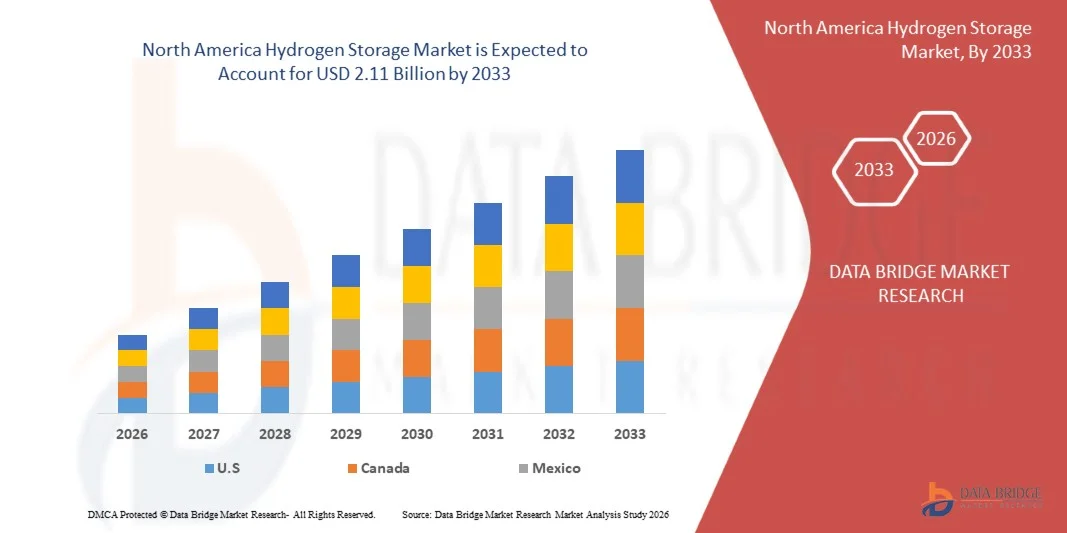
- As per Data Bridge Market Research analysis, the North America hydrogen storage market was valued at USD 1.72 billion in 2025 and is projected to reach USD 2.11 billion by 2033, growing at a CAGR of 2.60% from 2026 to 2033.
- The market is experiencing consistent growth driven by increasing investments in hydrogen infrastructure, supportive government policies and incentives, and rising demand for hydrogen storage solutions across industrial, commercial, and emerging clean-energy applications.
- The expansion of clean hydrogen hubs and investments in large-scale hydrogen infrastructure across the U.S. and Canada are accelerating demand for reliable storage technologies. Compressed and other physical storage solutions are supporting industrial hydrogen supply, while growing integration of hydrogen with renewable energy systems is creating additional demand for scalable storage capacity.
Market Size & Forecast
- Global Market Value (2025): USD 1.72 Billion
- Expected Market Value (2033): USD 2.11 Billion
- Forecast CAGR (2026–2033): 2.60%
- Leading Country in 2025: United States
- Fastest Growing Country: Canada
What are the Major Takeaways of the North America Hydrogen Storage Market?
- The United States dominated the North America hydrogen storage market with the largest revenue share of 84% in 2025, supported by significant investments in clean hydrogen production, storage infrastructure, government initiatives, and industrial demand.
- Canada is expected to be the fastest-growing country at a CAGR of 6.7% from 2026 to 2033, fueled by government-backed clean hydrogen initiatives, investments in hydrogen infrastructure, and the development of renewable hydrogen projects.
- The physical segment led the market with a 60% share in 2025, driven by the established use of compressed and liquefied hydrogen storage technologies across industrial, transportation, and stationary applications
- Material-based are the fastest-growing form type, projected to register a CAGR of 8%, reflecting the surge in continued development of advanced hydrides, adsorbents, and chemical hydrogen carriers.
- The cylinder segment dominated the type category with a 37% revenue share in 2025, led by widespread use of high-pressure cylinders for industrial hydrogen storage, transportation, and fueling applications.
- Transportation accounted for 30% of the market share in 2025, preferred by increasing use of hydrogen storage systems in fuel-cell vehicles and mobility applications
- The stationary power segment is the fastest-growing application category, with a CAGR of 7%, driven by increasing interest in hydrogen as a long-duration energy-storage and backup-power solution.
Report Scope and North America Hydrogen Storage Market Segmentation
|
Attributes |
North America Hydrogen Storage Key Market Insights |
|
Segments Covered |
|
|
Countries Covered |
North America
|
|
Key Market Players |
|
|
Market Opportunities |
|
|
Value Added Data Infosets |
In addition to the insights on market scenarios such as market value, growth rate, segmentation, geographical coverage, and major players, the market reports curated by the Data Bridge Market Research also include import export analysis, production capacity overview, production consumption analysis, price trend analysis, climate change scenario, supply chain analysis, value chain analysis, raw material/consumables overview, vendor selection criteria, PESTLE Analysis, Porter Analysis, and regulatory framework. |
What is the Key Trend in the North America Hydrogen Storage Market?
- Large-scale hydrogen storage is increasingly shifting toward underground salt caverns and geological formations, enabling bulk storage, repeated cycling, and long-duration balancing of renewable hydrogen supply across North America and grid reliability.
- For instance, in January 2025, Pacific Northwest National Laboratory published an assessment of underground hydrogen storage potential in Alaska’s Cook Inlet, finding that depleted hydrocarbon reservoirs could theoretically store up to 286 TWh of hydrogen and identifying seven particularly prospective storage pools, supporting the development of large-scale geological hydrogen storage in North America.
- Hydrogen storage projects are increasingly integrated with renewable power generation to provide dispatchable energy and improve grid flexibility.
- Industrial hydrogen hubs are increasingly incorporating storage infrastructure to connect producers, pipelines, large consumers, and power-generation assets across hydrogen clean energy networks.
- For instance, in April 2025, Pacific Northwest National Laboratory investigated hydrogen storage in a deep saline aquifer in southern Illinois, evaluating hydrogen–methane interactions and geochemical and microbial effects to assess the feasibility and risks of underground hydrogen storage in non-salt geological formations.
- As hydrogen production scales alongside renewable electricity and industrial demand, underground storage and integrated hub infrastructure are expected to become increasingly important for balancing supply, improving reliability, and supporting long-duration clean energy applications across regional energy systems efficiently.
What are the Key Drivers of the North America Hydrogen Storage Market?
- The government funding and regional clean hydrogen hub programs are significantly increasing demand for storage infrastructure capable of connecting hydrogen production, transportation, industrial consumption, and long-duration energy applications across North America and emerging sectors effectively.
- For instance, in January 2025, the U.S. Department of Energy awarded initial funding to the Heartland and Mid-Atlantic Regional Clean Hydrogen Hubs, supporting the development of commercial-scale hydrogen production and end-use infrastructure, which is expected to increase the need for associated hydrogen storage capacity across the United States.
- Growing renewable energy deployment is increasing the need for hydrogen storage to absorb excess electricity and provide energy when renewable generation is unavailable and grid balancing.
- For instance, in December 2024, the U.S. Department of Energy released its updated Hydrogen Program Plan, which identified hydrogen production, transport, storage, and utilization as coordinated priorities and highlighted regional hydrogen hubs and storage opportunities, supporting continued development of hydrogen storage infrastructure in North America.
- With federal programs, renewable power expansion, and industrial decarbonization accelerating hydrogen deployment, storage infrastructure will remain essential for reliable supply, system flexibility, and large-scale clean energy integration across North America.
Which Factors are Challenging the Growth of the North America Hydrogen Storage Market?
- Hydrogen storage faces substantial capital requirements because large-scale facilities need specialized caverns, compression systems, pipelines, monitoring equipment, and safety infrastructure and surface equipment.
- For instance, in June 2024, the U.S. Department of Energy reported that ensuring the safe and effective storage of hydrogen remains a key challenge, noting that not all regions of the United States have suitable geological conditions for salt-cavern storage and that hydrogen leakage, well integrity, and subsurface interactions require additional risk-mitigation technologies.
- Geological availability also limits deployment because suitable salt formations are unevenly distributed regionally across North America.
- For instance, in August 2024, the U.S. Department of Energy reported that hydrogen storage costs remain a significant barrier, with continued innovation needed to reduce the levelized cost of storage for both above-ground and below-ground hydrogen systems, highlighting the economic challenge of deploying large-scale storage infrastructure.
- These infrastructure costs and geological constraints continue to challenge project economics, particularly where suitable underground formations are unavailable near hydrogen production or demand centers. In addition, extensive technical validation, permitting, and safety requirements can lengthen development timelines and increase investment risk for large-scale storage projects and increase project financing requirements.
How is the North America Hydrogen Storage Market Segmented?
The North America hydrogen storage market is segmented on the basis of form, type, application, end-user, and distribution.
- By Form
On the basis of form, the North America hydrogen storage market is segmented into physical and material-based storage. The physical storage segment dominated the market with 60% share in 2025, supported by the established use of compressed and liquefied hydrogen storage technologies across industrial, transportation, and stationary applications. Physical storage technologies offer commercially mature solutions for handling hydrogen at different scales. High-pressure cylinders and tanks are widely used for hydrogen storage and transportation. These systems are also compatible with established hydrogen distribution infrastructure. The availability of proven pressure-vessel technologies supports adoption among industrial gas suppliers and hydrogen users.
The material-based storage segment is projected to register the fastest growth at 8% CAGR from 2026 to 2033, driven by continued development of advanced hydrides, adsorbents, and chemical hydrogen carriers. These technologies can provide higher volumetric storage density compared with conventional approaches. Research is focused on improving hydrogen absorption and release characteristics and reducing storage-system weight and complexity. Material-based systems can potentially operate at lower pressures, providing advantages for selected stationary and portable applications. Increasing research investment in advanced hydrogen-storage materials is expanding their commercial potential. Their ability to address storage-density limitations is particularly important for applications where space is constrained.
- By Type
On the basis of type, the North America hydrogen storage market is segmented into cylinder, merchant, on-site, and on-board storage. The cylinder segment dominated the market with 37% share in 2025, supported by widespread use of high-pressure cylinders for industrial hydrogen storage, transportation, and fueling applications. Cylinders provide a flexible storage solution for users requiring relatively compact hydrogen inventories. They are extensively used across chemical, manufacturing, metalworking, and transportation applications. Established manufacturing and safety standards support their deployment across North America. Cylinder-based systems can also be integrated into tube trailers and hydrogen dispensing infrastructure.
The on-board segment is projected to register the fastest growth at a 6% CAGR from 2026 to 2033, driven by increasing adoption of hydrogen fuel-cell vehicles and the expansion of hydrogen mobility infrastructure. On-board storage allows hydrogen to be carried directly by vehicles and supplied to fuel-cell systems during operation. High-pressure composite vessels are increasingly being developed to provide greater storage capacity while limiting vehicle weight. Growing interest in hydrogen-powered commercial vehicles, buses, trucks, and other heavy-duty applications is creating additional demand. Expansion of hydrogen refueling infrastructure is further supporting deployment of on-board storage systems.
- By Application
On the basis of application, the North America hydrogen storage market is segmented into stationary power, portable power, and transportation. The transportation segment dominated the market with 30% share in 2025, supported by increasing use of hydrogen storage systems in fuel-cell vehicles and mobility applications. Hydrogen must be stored onboard vehicles at sufficient pressure to provide practical driving range. High-pressure storage systems are widely established for hydrogen transportation applications. Demand is also emerging from buses, trucks, material-handling equipment, and other commercial mobility platforms. Increasing investment in hydrogen refueling infrastructure is supporting the deployment of transportation storage systems.
The stationary power segment is projected to register the fastest growth at a 7% CAGR from 2026 to 2033, driven by increasing interest in hydrogen as a long-duration energy-storage and backup-power solution. Hydrogen can store energy for extended periods and subsequently provide electricity when required. This characteristic makes it relevant for renewable-energy integration and grid-resilience applications. Hydrogen storage can also support backup power for critical infrastructure and distributed energy systems. Increasing deployment of electrolyzers is creating opportunities for integrated hydrogen production, storage, and power-generation systems. Large-scale underground storage projects are further expanding the potential role of hydrogen in stationary energy applications.
- By End-User
On the basis of end-user, the North America hydrogen storage market is segmented into chemicals, oil refining, transportation, industrial, metal working, and others. The oil refining segment dominated the market with 24% share in 2025, supported by the extensive use of hydrogen in refining processes such as hydrotreating and hydrocracking. Refineries require reliable hydrogen supplies to support fuel processing and product-quality requirements. Existing refinery infrastructure provides established hydrogen production, handling, and storage capabilities. Hydrogen storage allows facilities to manage variations between hydrogen production and process consumption. The concentration of hydrogen-intensive refining operations in North America supports continued demand for storage infrastructure.
The transportation segment is projected to register the fastest growth at a 7% CAGR from 2026 to 2033, driven by increasing adoption of hydrogen fuel-cell vehicles and expanding mobility infrastructure. Transportation applications require reliable storage systems capable of providing adequate vehicle range. Hydrogen storage demand is increasing alongside the development of fueling stations and hydrogen corridors. Heavy-duty trucks and buses represent important potential applications because of their high energy requirements. Advanced composite storage vessels are helping reduce vehicle weight while maintaining high-pressure capability. Increasing interest in low-emission commercial transportation is creating additional demand for hydrogen storage.
- By Distribution
On the basis of distribution, the North America hydrogen storage market is segmented into pipelines, on-site production, and road transport. The pipelines segment dominated the market wit 40% share in 2025, supported by established hydrogen pipeline infrastructure serving large industrial and refining consumers. Pipelines provide continuous hydrogen delivery between production facilities and high-volume users. They are particularly suitable for industrial clusters where hydrogen demand is concentrated geographically. Existing infrastructure provides an established distribution pathway for industrial hydrogen. Pipeline delivery can reduce the need for repeated road transportation over high-volume routes. Hydrogen hubs are also encouraging development of interconnected production, storage, and distribution infrastructure.
The on-site production segment is projected to register the fastest growth at a 8% CAGR from 2026 to 2033, driven by increasing deployment of decentralized hydrogen production close to end users. On-site production can reduce dependence on long-distance hydrogen transportation and external deliveries. Electrolyzers can be installed alongside renewable-energy systems to produce hydrogen where it is required. This approach is increasingly relevant for fueling stations, industrial facilities, and stationary power applications. On-site production can also improve supply flexibility and reduce logistics requirements for smaller hydrogen users. Growing investment in distributed hydrogen infrastructure is supporting the development of integrated production and storage systems.
Which Country Holds the Largest Share of the North America Hydrogen Storage Market?
- The United States dominated the North America hydrogen storage market with the largest revenue share of 84% in 2025, supported by significant investments in clean hydrogen production, storage infrastructure, government initiatives, and industrial demand.
- The country also benefits from strong government support for hydrogen infrastructure, extensive refining and chemical industries, and growing investments in large-scale hydrogen production and storage projects. The presence of major hydrogen producers, industrial clusters, and established pipeline networks further supports market development. Increasing deployment of hydrogen hubs and storage facilities, together with growing demand from transportation and stationary power applications, continues to strengthen the United States' position within the North American hydrogen storage market.
Canada Hydrogen Storage Market Insight
The Canada hydrogen storage market is expected to witness steady growth, driven by increasing investments in clean hydrogen production, energy infrastructure, and low-carbon transportation across provinces such as Alberta, British Columbia, and Quebec. Growing development of hydrogen hubs, industrial applications, and renewable-energy projects is supporting demand for scalable storage solutions. In addition, Canada’s abundant renewable energy resources, established natural-gas infrastructure, and increasing focus on hydrogen exports are accelerating investment in advanced storage technologies across industrial and energy applications.
Mexico Hydrogen Storage Market Insight
The Mexico hydrogen storage market is witnessing gradual growth, driven by increasing interest in clean hydrogen production, industrial decarbonization, and low-carbon energy infrastructure. The country’s established oil refining, chemicals, manufacturing, and transportation industries are creating potential applications for hydrogen storage technologies. In addition, growing investments in renewable energy and emerging hydrogen projects are supporting demand for reliable storage and distribution solutions. Increasing interest in hydrogen for industrial processes, mobility, and energy applications is expected to encourage further development of storage infrastructure across Mexico.
Which are the Top Companies in North America Hydrogen Storage Market?
The North America hydrogen storage industry is primarily led by well-established companies, including:
- Air Products and Chemicals, Inc. (U.S.)
- Linde plc (U.K.)
- Air Liquide (France)
- Plug Power Inc. (U.S.)
- Cummins Inc. (U.S.)
- Chart Inc. (U.S.)
- Quantum Fuel Systems (U.S.)
- Steelhead Composites, Inc. (U.S.)
- Worthington Enterprises, Inc. (U.S.)
- Ballard Power Systems Inc. (Canada)
- Bloom Energy, Inc. (U.S.)
- Nel (Norway)
- Hexagon Purus (Norway)
- Hexagon Composites ASA (Norway)
- Baker Hughes Company (U.S.)
- Exxon Mobil Corporation (U.S.)
- Shell plc (U.K.)
- Nucor Corporation (U.S.)
- FirstElement Fuel, Inc. (U.S.)
- ITM Power plc (U.K.)
What are Latest Developments in North America Hydrogen Storage Market?
- In January 2025, Pacific Northwest National Laboratory (PNNL) published an assessment of underground hydrogen storage potential in Alaska’s Cook Inlet, identifying depleted hydrocarbon reservoirs as potential large-scale hydrogen storage sites and establishing a framework for further site characterization and development. The study supports the expansion of geological hydrogen storage beyond conventional salt-cavern applications in North America.
- In April 2024, PNNL highlighted progress under the SHASTA program, which is developing technologies and methods for underground hydrogen storage in existing gas-storage fields, including salt caverns and aquifers. The program is examining reservoir behavior, hydrogen-natural-gas interactions, microbial effects, and operational considerations to support the wider deployment of subsurface hydrogen storage in the United States.
- In July 2023, the U.S. Department of Energy initiated a project to evaluate the seal integrity of hydrogen-storage caverns in bedded salt within the Salado Formation in the Permian Basin. The project is designed to assess whether existing salt-cavern formations can safely contain hydrogen, supporting the development of large-scale underground hydrogen storage in the United States.
- In January 2023, PNNL and Sandia National Laboratories began a risk-assessment effort with Seattle City Light and the Port of Seattle to evaluate large-scale hydrogen storage systems. The work examined compressed hydrogen, liquid hydrogen, and liquid organic hydrogen carrier storage for applications including heavy-duty transportation, port operations, energy resilience, and future maritime uses.
- In June 2022, the U.S. Department of Energy issued a USD 504.4 million loan guarantee for the Advanced Clean Energy Storage project in Delta, Utah, supporting construction of a large-scale clean hydrogen storage facility using underground salt caverns. The project combines hydrogen production with long-duration storage and is designed to supply hydrogen for power generation, representing a major development in utility-scale hydrogen storage infrastructure in North America

- Interactive Data Analysis Dashboard
- Company Analysis Dashboard for high growth potential opportunities
- Research Analyst Access for customization & queries
- Competitor Analysis with Interactive dashboard
- Latest News, Updates & Trend analysis
- Harness the Power of Benchmark Analysis for Comprehensive Competitor Tracking
North America Hydrogen Storage Market, Supply Chain Analysis and Ecosystem Framework
To support market growth and help clients navigate the impact of geopolitical shifts, DBMR has integrated in-depth supply chain analysis into its North America Hydrogen Storage Market research reports. This addition empowers clients to respond effectively to global changes affecting their industries. The supply chain analysis section includes detailed insights such as North America Hydrogen Storage Market consumption and production by country, price trend analysis, the impact of tariffs and geopolitical developments, and import and export trends by country and HSN code. It also highlights major suppliers with data on production capacity and company profiles, as well as key importers and exporters. In addition to research, DBMR offers specialized supply chain consulting services backed by over a decade of experience, providing solutions like supplier discovery, supplier risk assessment, price trend analysis, impact evaluation of inflation and trade route changes, and comprehensive market trend analysis.
Data collection and base year analysis are done using data collection modules with large sample sizes. The stage includes obtaining market information or related data through various sources and strategies. It includes examining and planning all the data acquired from the past in advance. It likewise envelops the examination of information inconsistencies seen across different information sources. The market data is analysed and estimated using market statistical and coherent models. Also, market share analysis and key trend analysis are the major success factors in the market report. To know more, please request an analyst call or drop down your inquiry.
The key research methodology used by DBMR research team is data triangulation which involves data mining, analysis of the impact of data variables on the market and primary (industry expert) validation. Data models include Vendor Positioning Grid, Market Time Line Analysis, Market Overview and Guide, Company Positioning Grid, Patent Analysis, Pricing Analysis, Company Market Share Analysis, Standards of Measurement, Global versus Regional and Vendor Share Analysis. To know more about the research methodology, drop in an inquiry to speak to our industry experts.
Data Bridge Market Research is a leader in advanced formative research. We take pride in servicing our existing and new customers with data and analysis that match and suits their goal. The report can be customized to include price trend analysis of target brands understanding the market for additional countries (ask for the list of countries), clinical trial results data, literature review, refurbished market and product base analysis. Market analysis of target competitors can be analyzed from technology-based analysis to market portfolio strategies. We can add as many competitors that you require data about in the format and data style you are looking for. Our team of analysts can also provide you data in crude raw excel files pivot tables (Fact book) or can assist you in creating presentations from the data sets available in the report.













