


North America Image-Guided Surgery Equipment and Navigation-Assisted Surgical Equipment Market Size
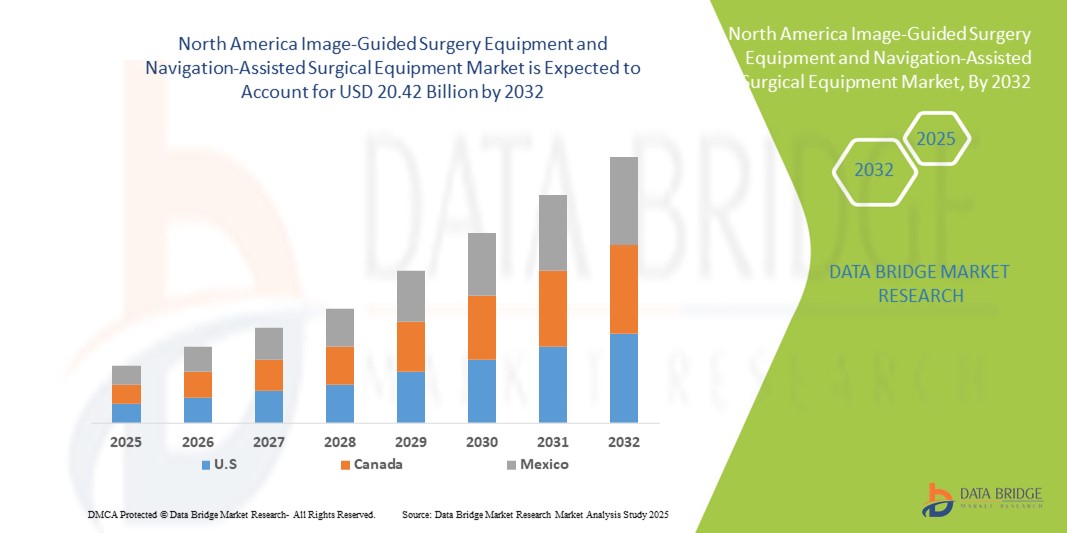
- The North America image-guided surgery equipment and navigation-assisted surgical equipment market size was valued at USD 9.52 billion in 2024 and is expected to reach USD 20.42 billion by 2032, at a CAGR of 10.00% during the forecast period
- The market growth is largely fueled by the increasing adoption of minimally invasive procedures and advancements in imaging modalities, enabling surgeons to achieve greater precision and safety during complex operations across specialties
- Furthermore, rising demand for technologically advanced navigation systems in neurosurgery, orthopedics, ENT, and cardiovascular procedures is driving higher integration of these solutions in hospitals and specialty clinics. These converging factors are accelerating the uptake of image-guided and navigation-assisted platforms, thereby significantly boosting the region’s surgical equipment industry growth
North America Image-Guided Surgery Equipment and Navigation-Assisted Surgical Equipment Market Analysis
- Image-guided surgery equipment and navigation-assisted systems, offering real-time visualization and precision during complex operations, are increasingly vital components of modern surgical practices across neurosurgery, orthopedics, ENT, and cardiovascular interventions due to their accuracy, minimally invasive capabilities, and seamless integration with advanced imaging technologies
- The escalating demand for these systems is primarily fueled by the rising prevalence of chronic diseases requiring surgery, the growing preference for minimally invasive procedures, and rapid technological advancements in 3D imaging, robotics, and AI-driven navigation platforms
- U.S. dominated the North America image-guided surgery equipment and navigation-assisted surgical equipment market with the largest revenue share of 85% in 2024, supported by advanced healthcare infrastructure, high healthcare spending, and the strong presence of leading device manufacturers, with U.S. hospitals and specialty centers showing strong adoption driven by favorable reimbursement and continuous product innovation
- Canada is expected to witness fastest growth in the North America image-guided surgery equipment and navigation-assisted surgical equipment market during the forecast period owing to increasing healthcare investments, expansion of tertiary care hospitals, and rising surgeon adoption of technologically advanced surgical navigation platforms
- Spine Surgery segment dominated the North America image-guided surgery equipment and navigation-assisted surgical equipment market with a market share of 43% in 2024, driven by high prevalence of spinal disorders and the critical need for precision and safety in complex spine procedures
Report Scope and North America Image-Guided Surgery Equipment and Navigation-Assisted Surgical Equipment Market Segmentation
|
Attributes |
North America Image-Guided Surgery Equipment and Navigation-Assisted Surgical Equipment Key Market Insights |
|
Segments Covered |
|
|
Countries Covered |
North America
|
|
Key Market Players |
|
|
Market Opportunities |
|
|
Value Added Data Infosets |
In addition to the insights on market scenarios such as market value, growth rate, segmentation, geographical coverage, and major players, the market reports curated by the Data Bridge Market Research also include in-depth expert analysis, pricing analysis, brand share analysis, consumer survey, demography analysis, supply chain analysis, value chain analysis, raw material/consumables overview, vendor selection criteria, PESTLE Analysis, Porter Analysis, and regulatory framework. |
North America Image-Guided Surgery Equipment and Navigation-Assisted Surgical Equipment Market Trends
Advancement Through AI, Robotics, and Real-Time Imaging Integration
- A significant and accelerating trend in the North America image-guided surgery and navigation-assisted equipment market is the deeper integration of artificial intelligence (AI), robotics, and advanced 3D imaging modalities, enhancing surgical precision, safety, and outcomes across multiple specialties
- For instance, Medtronic’s StealthStation S8 integrates real-time navigation with advanced imaging to provide neurosurgeons with enhanced visibility during complex brain and spine procedures. Similarly, Brainlab’s Curve Navigation platform offers intuitive digital integration for multi-specialty surgical workflows
- AI integration in surgical navigation enables features such as predictive analytics, automated anatomical mapping, and intelligent surgical alerts. For instance, platforms incorporating AI can assist surgeons in identifying optimal incision points and trajectories, reducing operative time and potential complications. Furthermore, robotic navigation systems enhance consistency and reduce surgeon fatigue
- The seamless integration of image-guided and navigation systems with hospital IT and PACS platforms facilitates centralized data management, allowing surgeons to plan, simulate, and execute procedures with greater accuracy. Through unified interfaces, care teams can access imaging data alongside patient records, streamlining preoperative and intraoperative workflows
- This trend toward more intelligent, intuitive, and interoperable systems is fundamentally reshaping surgical navigation standards. Consequently, companies such as Stryker are advancing AI-enabled and robotic-compatible navigation platforms with real-time intraoperative imaging integration, raising the benchmark for precision surgery
- The demand for advanced image-guided and navigation-assisted systems that provide AI-driven support and robotic compatibility is rapidly growing across hospitals and specialty clinics in North America, as healthcare providers prioritize minimally invasive precision and patient safety
North America Image-Guided Surgery Equipment and Navigation-Assisted Surgical Equipment Market Dynamics
Driver
Growing Adoption of Minimally Invasive Surgery and Technological Advancements
- The rising prevalence of chronic diseases requiring surgical intervention, coupled with the growing adoption of minimally invasive techniques, is a significant driver for the increased demand for image-guided and navigation-assisted surgical equipment in North America
- For instance, in March 2024, Zimmer Biomet announced the expansion of its ROSA Robotics platform integrated with navigation-assisted modules, enabling surgeons to perform knee and hip procedures with enhanced accuracy and improved patient outcomes. Such strategies are expected to accelerate market growth
- As patients and providers seek procedures with reduced recovery time, lower complications, and greater precision, these systems offer advanced visualization, navigation accuracy, and support for complex interventions, making them essential tools in modern surgery
- Furthermore, continuous innovation in 3D imaging, intraoperative CT/MRI, and robotics is driving widespread adoption, as surgeons demand advanced platforms that can integrate seamlessly into existing hospital ecosystems and deliver consistent surgical outcomes
- The ability of navigation-assisted systems to reduce operative errors, minimize revisions, and enhance overall surgical efficiency is a key factor propelling adoption across high-volume specialties such as neurosurgery, orthopedics, and ENT. Growing investments in healthcare infrastructure across North America further reinforce this trend
Restraint/Challenge
High System Cost and Data Integration Complexity
- The high initial cost of advanced image-guided and navigation-assisted surgical equipment poses a significant challenge to broader adoption, particularly in smaller hospitals and outpatient facilities across North America
- For instance, the installation and maintenance costs of advanced navigation platforms can exceed several hundred thousand dollars, making them less accessible to mid-sized healthcare providers with limited budgets
- Addressing these financial barriers through cost-effective models, leasing programs, and reimbursement support is crucial for expanding adoption. Companies such as Medtronic and Brainlab highlight their flexible financing options and modular platforms to support broader access. In addition, the complexity of integrating these systems with hospital IT and imaging infrastructure can create implementation hurdles
- For instance, delays in interoperability with existing PACS and EHR systems may hinder seamless workflows and discourage rapid adoption in some facilities. Ensuring compatibility and providing comprehensive training are essential to overcome this challenge
- While ongoing technological advancements are reducing system sizes and offering portable solutions, the perceived high upfront investment and integration complexity can still slow market penetration, especially among smaller healthcare networks
- Overcoming these challenges through modular system development, cost-reduction strategies, enhanced interoperability, and provider education will be vital for sustained market growth in North America
North America Image-Guided Surgery Equipment and Navigation-Assisted Surgical Equipment Market Scope
The market is segmented on the basis of type, application, procedure type, workflow, usability, modality, end user, and distribution channel.
- By Type
On the basis of type, the image-guided surgery and navigation-assisted surgical equipment market is segmented into systems, instruments and accessories, and services and software. The systems segment dominated the market with the largest revenue share in 2024, driven by the growing need for integrated solutions that combine imaging, navigation, and robotic assistance. Hospitals and specialty centers prefer systems for complex neurosurgery, orthopedic, and spine procedures because they enhance surgical precision and reduce operative errors. Systems also provide real-time intraoperative visualization, supporting surgeons in critical decision-making during high-risk surgeries. Their compatibility with hospital IT platforms and PACS enables seamless workflow integration. The adoption of systems is further supported by the availability of advanced features such as 3D imaging, AI-guided navigation, and robotic compatibility, making them indispensable in modern surgical settings. Hospitals benefit from improved patient outcomes, reduced surgical complications, and operational efficiency through these comprehensive platforms.
The services and software segment is anticipated to witness the fastest growth rate from 2025 to 2032, fueled by the rising demand for continuous software updates, maintenance, and specialized training. Advanced software platforms provide AI-driven surgical planning, simulation, and predictive analytics, improving procedure accuracy. Hospitals increasingly rely on software for preoperative planning and intraoperative guidance to minimize errors and reduce surgery times. Professional services, including installation, maintenance, and user training, are essential to ensure seamless operation of complex navigation systems. Software and services also allow for remote monitoring and data analytics, enabling better resource management and patient care. The growth of this segment is further accelerated by the proliferation of AI-assisted solutions in minimally invasive and complex surgical procedures.
- By Application
On the basis of application, the image-guided surgery and navigation-assisted surgical equipment market is segmented into neurology, otorhinolaryngology, cardiology, spine surgery, orthopedic trauma surgery, urology, oral-maxillofacial medicine and dentistry, oncology, gynecology, thoracic surgery, abdominal surgery, ophthalmology, respiratory, minimally invasive revascularization surgery, and other surgeries. The spine surgery segment dominated the market with a revenue share of 43% in 2024, driven by the critical need for precision in complex spinal procedures. Image-guided and navigation-assisted systems reduce the risk of complications, improve anatomical accuracy, and enhance postoperative recovery. Spine centers and hospitals prefer these technologies for real-time visualization, robotic assistance, and 3D anatomical mapping. Continuous innovations in navigation platforms further boost accuracy, supporting surgeons in complex spinal reconstructions. The segment also benefits from increasing prevalence of spinal disorders, growing surgical volumes, and higher adoption of minimally invasive techniques. These factors make spine surgery the largest application segment in North America.
The orthopedic trauma surgery segment is expected to witness the fastest growth from 2025 to 2032, driven by the rising incidence of traumatic injuries and fractures requiring precise intervention. Advanced imaging and navigation systems enable accurate fracture fixation, joint reconstruction, and alignment correction. The integration of AI and robotic assistance further improves surgical outcomes and reduces intraoperative errors. Hospitals and trauma centers are increasingly adopting these technologies for emergency and high-volume procedures. The segment also benefits from growing awareness of post-surgical recovery advantages, patient safety improvements, and hospital investments in advanced orthopedic infrastructure. Overall, orthopedic trauma surgery is emerging as a high-growth application for navigation-assisted systems.
- By Procedure Type
On the basis of procedure type, the image-guided surgery and navigation-assisted surgical equipment market is segmented into minimally invasive and open surgery. The minimally invasive surgery segment dominated the market, due to benefits including smaller incisions, reduced recovery time, and lower postoperative pain. Integration with image-guided and navigation-assisted systems enhances procedural precision, reduces complications, and improves overall surgical outcomes. Surgeons and patients prefer minimally invasive procedures for neurosurgery, orthopedics, and ENT. Advanced imaging, AI-driven guidance, and robotic integration support high procedural accuracy and operational efficiency. Hospitals adopt these systems to optimize operating room workflows, enhance patient satisfaction, and reduce readmissions. The segment’s dominance is strengthened by the continuous innovation in imaging and navigation technologies tailored to minimally invasive surgery.
The open surgery segment is expected to witness the fastest growth during forecast period, driven by hybrid surgical approaches combining traditional techniques with modern navigation-assisted support. These hybrid procedures allow surgeons to tackle complex cases with higher precision and safety. Hospitals increasingly adopt open surgeries using advanced navigation to ensure better outcomes in challenging procedures. Integration with imaging and planning software improves intraoperative decision-making. Surgeons benefit from enhanced anatomical visualization and reduced error rates. The growing adoption of advanced platforms in trauma and oncology surgery also supports rapid growth in open surgery procedures.
- By Workflow
On the basis of workflow, the image-guided surgery and navigation-assisted surgical equipment market is segmented into surgical procedures, preoperative imaging, and surgical planning. The surgical procedures segment dominated the market, as navigation-assisted systems are primarily utilized intraoperatively to provide real-time guidance and control. Hospitals adopt these systems to enhance procedural accuracy, reduce complications, and improve patient outcomes. Integration with advanced imaging and robotics facilitates efficient and precise workflows during complex surgeries. The segment also benefits from higher procedural volumes in neurosurgery, orthopedics, and spine surgery. Real-time visualization, AI-driven alerts, and intraoperative decision support strengthen its dominance. Hospitals benefit from operational efficiency and optimized resource utilization.
The surgical planning segment is expected to witness the fastest growth during forecast period, driven by the need for detailed preoperative imaging, simulation, and AI-based planning tools. Advanced software enables surgeons to map anatomical structures, predict complications, and optimize incision sites. Hospitals increasingly rely on surgical planning for complex neurosurgery and orthopedic procedures. The growth is supported by adoption of predictive analytics, 3D modeling, and integration with hospital IT systems. Improved surgical planning reduces operative times and enhances patient outcomes. Hospitals benefit from risk mitigation, better resource allocation, and higher procedural confidence.
- By Usability
On the basis of usability, the image-guided surgery and navigation-assisted surgical equipment market is segmented into reusable and non-reusable instruments. The reusable segment dominated the market, driven by cost-effectiveness, long-term usability, and reliability in multiple procedures. Hospitals prefer reusable instruments for their durability, standardization, and ability to maintain high-quality performance over time. Sterilization and maintenance protocols ensure safety and compliance with regulations. Reusable instruments are widely adopted in neurosurgery, orthopedics, and spine procedures. Operational efficiency, reduced procurement frequency, and lower overall costs further support the segment. The segment’s dominance is strengthened by strong infrastructure in North American hospitals.
The non-reusable segment is expected to witness the fastest growth during forecast period, fueled by the increasing demand for single-use instruments that minimize infection risk and eliminate the need for sterilization. Hospitals adopt non-reusable instruments in high-risk procedures and emergency surgeries. The segment is also supported by regulatory emphasis on patient safety and infection control. Non-reusable devices are often lightweight, portable, and compatible with modern navigation systems. Surgeons benefit from convenience, hygiene assurance, and reduced cross-contamination risks. Growing awareness and adoption of disposable instruments drive rapid growth in this segment.
- By Modality
On the basis of modality, the image-guided surgery and navigation-assisted surgical equipment market is segmented into portable, compact, standalone, and handheld devices. The standalone segment dominated the market, providing fully integrated solutions that do not require additional devices. Hospitals and specialty centers prefer standalone systems for high-volume procedures requiring comprehensive functionality. Integration with AI, imaging, and navigation modules makes them indispensable in complex surgeries. Surgeons benefit from real-time guidance, intraoperative imaging, and workflow efficiency. The segment also supports multiple specialties including neurosurgery, orthopedics, and ENT. Hospitals achieve better patient outcomes and operational reliability with standalone systems.
The portable segment is expected to witness the fastest growth during forecast period, driven by demand for mobile, flexible, and point-of-care solutions. Portable navigation and imaging devices allow use in multiple ORs, outpatient centers, and emergency environments. The systems offer convenience, rapid deployment, and integration with hospital IT platforms. Hospitals and clinics increasingly adopt portable devices to extend surgical navigation capabilities beyond large ORs. The segment is also fueled by technological advancements, lighter designs, and lower costs. Increasing outpatient procedures contribute to strong adoption rates.
- By End User
On the basis of end user, the image-guided surgery and navigation-assisted surgical equipment market is segmented into hospitals, ambulatory surgical centers, cardiac cath labs, clinics, and others. The hospitals segment dominated the market, driven by advanced infrastructure, high surgical volumes, and substantial capital expenditure capacity. Hospitals adopt navigation-assisted systems to improve patient safety, reduce errors, and enhance procedural precision. Integration with imaging and IT platforms supports comprehensive care delivery. High adoption is seen in tertiary care centers, specialty hospitals, and academic institutions. Hospitals benefit from better workflow management and improved surgical outcomes.
The ambulatory surgical centers segment is expected to witness the fastest growth during forecast period, fueled by the shift of minimally invasive procedures to outpatient settings. ASCs increasingly adopt portable, cost-effective, and easy-to-use navigation systems to enhance efficiency. The segment is supported by growth in outpatient surgeries, reduced hospital stays, and increasing patient preference for outpatient care. ASCs benefit from improved procedure accuracy, patient satisfaction, and operational throughput. Rising investments in outpatient infrastructure further accelerate adoption.
- By Distribution Channel
On the basis of distribution channel, the image-guided surgery and navigation-assisted surgical equipment market is segmented into direct tender and retail sales. The direct tender segment dominated the market, as hospitals prefer bulk procurement agreements directly with manufacturers to ensure supply continuity, warranties, and service contracts. Direct tendering ensures timely availability of high-value navigation systems and allows better negotiation on pricing. Hospitals also benefit from manufacturer support for installation, training, and maintenance. The segment is favored for its reliability, scalability, and long-term cost advantages. Integration with service contracts further strengthens dominance.
The retail sales segment is expected to witness the fastest growth during forecast period, particularly for smaller, portable devices and accessories. Retail sales are gaining traction in outpatient facilities, clinics, and emerging healthcare networks seeking accessible, flexible solutions. Portable systems, single-use instruments, and software packages are increasingly sold via retail channels. The segment benefits from the rising trend of outpatient surgeries and decentralized healthcare delivery. Growth is also supported by easier access, faster procurement, and lower upfront costs for smaller facilities.
North America Image-Guided Surgery Equipment and Navigation-Assisted Surgical Equipment Market Regional Analysis
- U.S. dominated the North America market with the largest revenue share of 85% in 2024, supported by advanced healthcare infrastructure, high healthcare spending, and the strong presence of leading device manufacturers, with U.S. hospitals and specialty centers showing strong adoption driven by favorable reimbursement and continuous product innovation
- Hospitals and specialty surgical centers in the U.S. highly value the precision, real-time imaging, and enhanced safety offered by navigation-assisted systems, which integrate seamlessly with robotic platforms, hospital IT, and PACS systems
- This dominance is further supported by high healthcare spending, a technologically advanced medical workforce, and the strong presence of leading device manufacturers, establishing navigation-assisted systems as the preferred choice across tertiary care hospitals, academic medical centers, and high-volume surgical facilities
U.S. Image-Guided Surgery Equipment and Navigation-Assisted Surgical Equipment Market Insight
The U.S. image-guided surgery and navigation-assisted surgical equipment market with the largest revenue share in 2024, fueled by the advanced healthcare infrastructure and high adoption of minimally invasive and complex surgical procedures. Hospitals and specialty surgical centers increasingly prioritize precision, safety, and real-time imaging support, driving demand for integrated navigation and robotic-assisted systems. The widespread use of AI-enabled surgical planning tools, intraoperative imaging, and advanced software platforms further supports market expansion. In addition, rising investments by private and public healthcare providers in high-tech surgical equipment contribute to growth. The strong presence of leading manufacturers and robust R&D activities in the U.S. ensures continuous innovation, making it the most influential market in North America.
Canada Image-Guided Surgery Equipment and Navigation-Assisted Surgical Equipment Market Insight
The Canada image-guided surgery and navigation-assisted surgical equipment market is anticipated to grow at a noteworthy CAGR during the forecast period, driven by rising healthcare spending, government initiatives for modern surgical infrastructure, and increased adoption of minimally invasive and navigation-assisted procedures. Hospitals and specialized surgical centers are increasingly deploying compact, portable, and standalone navigation systems to enhance procedural efficiency. The growing awareness of the benefits of image-guided surgery in reducing complications and improving patient outcomes is fostering adoption. Integration of AI, 3D imaging, and robotic assistance in surgical workflows is further supporting market growth. In addition, a strong focus on improving patient safety and outcomes is accelerating the uptake of advanced surgical systems across Canadian hospitals.
Mexico Image-Guided Surgery Equipment and Navigation-Assisted Surgical Equipment Market Insight
The Mexico market is poised to expand at a considerable CAGR during the forecast period, supported by growing investments in private hospitals and healthcare infrastructure. Increasing awareness of minimally invasive procedures and the advantages of navigation-assisted surgery is driving demand for advanced systems. Surgeons and hospitals are adopting compact and portable imaging solutions to support high-precision procedures across neurosurgery, orthopedics, and spinal surgeries. Government initiatives aimed at improving healthcare quality, coupled with rising patient expectations for better outcomes, are further boosting adoption. The presence of regional distributors and service providers facilitates access to state-of-the-art surgical equipment. Overall, Mexico is emerging as a growing market within North America, particularly for cost-efficient and flexible navigation-assisted solutions.
North America Image-Guided Surgery Equipment and Navigation-Assisted Surgical Equipment Market Share
The North America Image-Guided Surgery Equipment and Navigation-Assisted Surgical Equipment industry is primarily led by well-established companies, including:
- Medtronic (Ireland)
- Stryker (U.S.)
- Zimmer Biomet. (U.S.)
- Brainlab SE (Germany)
- Johnson & Johnson and its affiliates (U.S.)
- Intuitive Surgical, Inc. (U.S.)
- Koninklijke Philips N.V., (Netherlands)
- General Electric Company (U.S.)
- Siemens Healthineers AG (Germany)
- Varian Medical Systems, Inc. (U.S.)
- Accuray Incorporated (U.S.)
- Abbott (U.S.)
- Orthofix Medical Inc.. (Canada)
- Medrobotics Corporation (U.S.)
- Stereotaxis, Inc. (U.S.)
- Titan Medical Inc. (Canada)
- Renishaw plc (U.K.)
- Integra LifeSciences Holdings Corporation (U.S.)
- ICU Medical, Inc. (U.S.)
- PS-Medtech (Netherlands)
What are the Recent Developments in North America Image-Guided Surgery Equipment and Navigation-Assisted Surgical Equipment Market?
- In March 2025, Johnson & Johnson MedTech launched the DUALTO Energy System. This new surgical solution integrates multiple energy modalities into a single, consolidated platform for both open and minimally invasive surgeries. It received 510(k) clearance from the U.S. Food & Drug Administration and is designed to simplify the user experience, enhance efficiency in the operating room, and is also designed for future use with the company's OTTAVA Robotic Surgical System
- In September 2024, Zeta Surgical received FDA approval for its AI-powered surgical navigation technology. The FDA granted 510(k) clearance for its Zeta Navigation System, which utilizes a mixed reality system with a "GPS-such as" guidance for neurological procedures. This development highlights the increasing use of artificial intelligence and mixed reality to provide real-time tracking and guidance, particularly for intricate neurosurgical interventions that traditional systems may not support
- In July 2024, DePuy Synthes introduced its first active robotics and navigation platform for spine surgery. This platform marks a significant move by the company into the robotic-assisted and navigation-enabled spine surgery market. The development of such a system underscores the growing importance of robotics and navigation in enhancing the precision and control of complex surgical procedures
- In July 2024, Stryker received product approval from the FDA for its Spine guidance software. This software is designed to assist with bone resection, pedicle preparation, and screw delivery in spine surgeries. The approval highlights the continued focus on using software to enhance surgical navigation and improve patient outcomes, particularly in complex procedures such as those involving the spine
- In April 2023, Seattle-based medical tech startup Proprio received FDA 510(k) clearance for its innovative surgical imaging tool, Paradigm. This device is the first light-enabled navigation tool for spine surgery approved by the FDA. Utilizing light field computer vision and AI, Paradigm creates a real-time 3D visual image of the spine during surgery, potentially enhancing clinical outcomes

- Interactive Data Analysis Dashboard
- Company Analysis Dashboard for high growth potential opportunities
- Research Analyst Access for customization & queries
- Competitor Analysis with Interactive dashboard
- Latest News, Updates & Trend analysis
- Harness the Power of Benchmark Analysis for Comprehensive Competitor Tracking
Data collection and base year analysis are done using data collection modules with large sample sizes. The stage includes obtaining market information or related data through various sources and strategies. It includes examining and planning all the data acquired from the past in advance. It likewise envelops the examination of information inconsistencies seen across different information sources. The market data is analysed and estimated using market statistical and coherent models. Also, market share analysis and key trend analysis are the major success factors in the market report. To know more, please request an analyst call or drop down your inquiry.
The key research methodology used by DBMR research team is data triangulation which involves data mining, analysis of the impact of data variables on the market and primary (industry expert) validation. Data models include Vendor Positioning Grid, Market Time Line Analysis, Market Overview and Guide, Company Positioning Grid, Patent Analysis, Pricing Analysis, Company Market Share Analysis, Standards of Measurement, Global versus Regional and Vendor Share Analysis. To know more about the research methodology, drop in an inquiry to speak to our industry experts.
Data Bridge Market Research is a leader in advanced formative research. We take pride in servicing our existing and new customers with data and analysis that match and suits their goal. The report can be customized to include price trend analysis of target brands understanding the market for additional countries (ask for the list of countries), clinical trial results data, literature review, refurbished market and product base analysis. Market analysis of target competitors can be analyzed from technology-based analysis to market portfolio strategies. We can add as many competitors that you require data about in the format and data style you are looking for. Our team of analysts can also provide you data in crude raw excel files pivot tables (Fact book) or can assist you in creating presentations from the data sets available in the report.













