


Low-E Glass Market Size
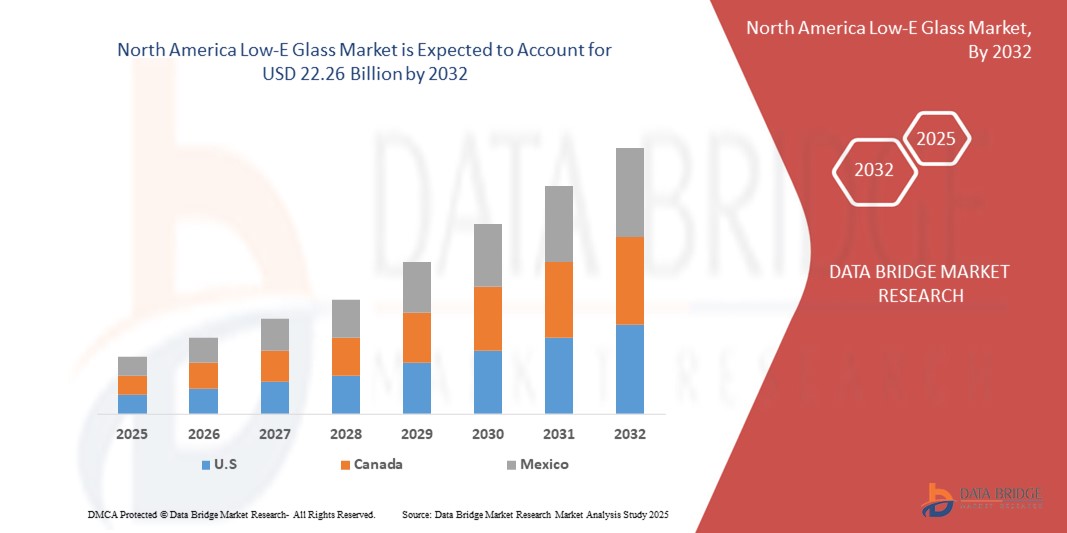
- The North America Low-E Glass Market size was valued at USD 11.23 Billion in 2024 and is expected to reach USD 22.26 Billion by 2032, at a CAGR of 7.9% during the forecast period
- This growth is driven by factors such as increase in demand for processed food across the globe
Low-E Glass Market Analysis
- Low- e glass refers to the type of glass that is made by coating metallic particles to the glass. This glass has low emissivity that means a surface emitting low levels of radiant heat.
- All surfaces are known to reflect, transmit and absorb heat, to reduce the amount of heat that is transferred. It is also used to stop UV radiation waves in visible light.
- The increase in number of construction activities across the globe acts as one of the major factors driving the growth of low-e glass market
- U.S. is expected to dominate the Low-E Glass market due to significant investments in smart buildings and retrofit programs
- Canada is expected to be the fastest growing region in the Low-E Glass market during the forecast period due to the country's increasing construction activities and rising investments in sustainable infrastructure
- The soft coat Low-E glass segment is expected to dominate the market with a market share of 64.6% due to its superior thermal performance, higher energy efficiency, and enhanced optical clarity compared to hard coat alternatives.
Report Scope and Low-E Glass Market Segmentation
|
Attributes |
Low-E Glass Key Market Insights |
|
Segments Covered |
|
|
Countries Covered |
North America
|
|
Key Market Players |
|
|
Market Opportunities |
|
|
Value Added Data Infosets |
In addition to the insights on market scenarios such as market value, growth rate, segmentation, geographical coverage, and major players, the market reports curated by the Data Bridge Market Research also include import export analysis, production capacity overview, production consumption analysis, price trend analysis, climate change scenario, supply chain analysis, value chain analysis, raw material/consumables overview, vendor selection criteria, PESTLE Analysis, Porter Analysis, and regulatory framework. |
Low-E Glass Market Trends
“Increased Demand for Energy-Efficient and Sustainable Building Materials”
- One prominent trend in the North America Low-E Glass market is the rising adoption of energy-efficient glazing solutions in both commercial and residential construction due to stricter building energy codes and consumer preference for green buildings.
- Low-E glass helps reduce energy consumption by minimizing heat loss in winter and solar heat gain in summer, improving indoor comfort and lowering HVAC costs
- For instance, U.S. Energy Star certification increasingly mandates the use of high-performance glazing like Low-E coated glass in new construction and retrofitting projects.
- The trend is further supported by growing awareness of carbon footprints and the role of building envelopes in sustainable design
Low-E Glass Market Dynamics
Driver
“Stringent Energy Efficiency Regulations and Green Building Codes”
- Regulatory frameworks such as the International Energy Conservation Code (IECC) and LEED certification programs are major drivers behind the increased deployment of Low-E glass in North America.
- These codes require building materials that reduce energy consumption and greenhouse gas emissions, creating a stable demand for advanced glazing technologies
For instance,
- California’s Title 24 Building Energy Efficiency Standards mandate high-performance windows, significantly boosting Low-E glass adoption in the state.
- As governments continue to tighten energy standards, demand for Low-E glass is expected to grow across the residential, commercial, and institutional sectors
Opportunity
“Growth in Smart Windows and Retrofit Markets”
- The expanding market for smart windows, which integrate Low-E coatings with dynamic tinting or solar control technologies, presents a significant opportunity for innovation and market expansion.
- Additionally, retrofitting older buildings with Low-E glass for improved energy efficiency represents a substantial untapped segment, especially in metropolitan areas with aging infrastructure
For instance,
- U.S. Department of Energy initiatives offering incentives for retrofitting public buildings have driven an increase in Low-E glass installations in schools and hospitals.
- These developments open avenues for manufacturers to supply both standard and customized Low-E solutions in emerging applications.
Restraint/Challenge
“High Initial Costs and Market Education Barriers”
- Despite long-term energy savings, the upfront cost of Low-E glass remains higher than conventional glass, which can deter adoption—especially in budget-sensitive residential or small-scale commercial projects.
- In addition, lack of awareness among contractors, builders, and consumers about the benefits and variations of Low-E coatings limits widespread market penetration
For instance,
- Builders in rural areas or smaller cities may opt for cheaper glazing options due to limited exposure to energy-efficiency benefits or absence of local incentives
- Overcoming this challenge requires focused marketing, stakeholder education, and policy support to ensure broader adoption across all construction tiers
Low-E Glass Market Scope
The market is segmented on the basis of type, coating type, coating material, glazing, technology, and end-user.
|
Segmentation |
Sub-Segmentation |
|
By Type |
|
|
By Coating Type |
|
|
By Coating Material |
|
|
By Glazing |
|
|
By Technology |
|
|
By End-User |
|
In 2025, the soft coat Low-E glass segment is projected to dominate the market with a largest share in type segment
The soft coat Low-E glass segment is expected to dominate the Low-E Glass market with the largest share of 64.6% in 2025 due to its superior thermal performance, higher energy efficiency, and enhanced optical clarity compared to hard coat alternatives. Soft coat glass is particularly favored in residential and commercial buildings aiming for LEED certification and compliance with stringent energy codes. Its advanced sputter-coating process allows for better solar control and insulation, making it ideal for climates with significant temperature variations.
The sparkling construction segment is expected to account for the highest CAGR during the forecast period in end-user market
In 2025, the construction segment is expected to account for the highest CAGR in the market due to stricter energy codes and growing homeowner demand for energy-efficient and eco-friendly homes. Government incentives and rising utility costs are pushing builders to use Low-E glass for better insulation and sustainability.
Low-E Glass Market Regional Analysis
“U.S. Holds the Largest Share in the Low-E Glass Market”
- U.S. dominates the Low-E Glass market with a share of 79.36%, driven by stringent energy efficiency codes (e.g., IECC, Title 24), widespread adoption of green building certifications (LEED), and a strong demand for energy-saving materials in both residential and commercial construction.
- Additionally, significant investments in smart buildings and retrofit programs further strengthen the U.S. position in this market.
“U.S. is Projected to Register the Highest CAGR in the Low-E Glass Market”
- Canada leads in the market due to the country's increasing construction activities and rising investments in sustainable infrastructure.
- While the United States currently dominates the market due to its developed infrastructure, Canada's focus on energy-efficient building practices positions it for significant growth in the Low-E Glass sector.
Low-E Glass Market Share
The market competitive landscape provides details by competitor. Details included are company overview, company financials, revenue generated, market potential, investment in research and development, new market initiatives, global presence, production sites and facilities, production capacities, company strengths and weaknesses, product launch, product width and breadth, application dominance. The above data points provided are only related to the companies' focus related to market.
The Major Market Leaders Operating in the Market Are:
- AGC Inc. (Japan)
- Central Glass Co., Ltd. (Japan)
- CSG Holding Co., Ltd. (China)
- Taiwan Glass Ind. Corp. (Taiwan)
- Guangzhou Topo Glass Co., Ltd. (China)
- Beijing Northglass Technologies Co. Ltd (China)
- Qingdao Creation Classic Glass Co., Ltd. (China)
- Nippon Sheet Glass Co., Ltd. (Japan)
- Saint-Gobain (France)
- Arcon Flachglas-Veredlung GmbH & Co. KG (Germany)
- Guardian Glass (U.S.)
- JSC "Salavatsteklo" (Russia)
- Xiamen Togen Building Products CO., LTD (China)
- SCHOTT Inc. (Germany)
- ROMAG (U.K.)
- Qingdao Tsing Glass Co. Limited (China)
- Metro Performance Glass (New Zealand)
- Qingdao Migo Glass Co., Ltd. (China)
Latest Developments in North America Low-E Glass Market
- In December 2023, Saint-Gobain completed the acquisition of a leading provider of insulation solutions to strengthen its low-emissivity (low-e) glass production and boost its portfolio of energy-efficient offerings
- In January 2023, Guardian Glass introduced an advanced low-e coating technology designed to improve solar control and thermal insulation in residential windows, offering enhanced UV protection
- In February 2023, AGC Inc. entered into a collaboration with a prominent architectural firm to develop integrated smart window solutions that leverage low-e glass for improved energy efficiency
- In March 2023, Pilkington launched its new Optiwhite low-e glass, known for superior clarity and high energy performance, targeting upscale architectural projects and skyscrapers
- In April 2023, Cardinal Glass Industries expanded its manufacturing operations to increase capacity for low-e glass production, addressing the rising demand across the North American market

- Interactive Data Analysis Dashboard
- Company Analysis Dashboard for high growth potential opportunities
- Research Analyst Access for customization & queries
- Competitor Analysis with Interactive dashboard
- Latest News, Updates & Trend analysis
- Harness the Power of Benchmark Analysis for Comprehensive Competitor Tracking
North America Low E Glass Market, Supply Chain Analysis and Ecosystem Framework
To support market growth and help clients navigate the impact of geopolitical shifts, DBMR has integrated in-depth supply chain analysis into its North America Low E Glass Market research reports. This addition empowers clients to respond effectively to global changes affecting their industries. The supply chain analysis section includes detailed insights such as North America Low E Glass Market consumption and production by country, price trend analysis, the impact of tariffs and geopolitical developments, and import and export trends by country and HSN code. It also highlights major suppliers with data on production capacity and company profiles, as well as key importers and exporters. In addition to research, DBMR offers specialized supply chain consulting services backed by over a decade of experience, providing solutions like supplier discovery, supplier risk assessment, price trend analysis, impact evaluation of inflation and trade route changes, and comprehensive market trend analysis.
Data collection and base year analysis are done using data collection modules with large sample sizes. The stage includes obtaining market information or related data through various sources and strategies. It includes examining and planning all the data acquired from the past in advance. It likewise envelops the examination of information inconsistencies seen across different information sources. The market data is analysed and estimated using market statistical and coherent models. Also, market share analysis and key trend analysis are the major success factors in the market report. To know more, please request an analyst call or drop down your inquiry.
The key research methodology used by DBMR research team is data triangulation which involves data mining, analysis of the impact of data variables on the market and primary (industry expert) validation. Data models include Vendor Positioning Grid, Market Time Line Analysis, Market Overview and Guide, Company Positioning Grid, Patent Analysis, Pricing Analysis, Company Market Share Analysis, Standards of Measurement, Global versus Regional and Vendor Share Analysis. To know more about the research methodology, drop in an inquiry to speak to our industry experts.
Data Bridge Market Research is a leader in advanced formative research. We take pride in servicing our existing and new customers with data and analysis that match and suits their goal. The report can be customized to include price trend analysis of target brands understanding the market for additional countries (ask for the list of countries), clinical trial results data, literature review, refurbished market and product base analysis. Market analysis of target competitors can be analyzed from technology-based analysis to market portfolio strategies. We can add as many competitors that you require data about in the format and data style you are looking for. Our team of analysts can also provide you data in crude raw excel files pivot tables (Fact book) or can assist you in creating presentations from the data sets available in the report.













