


Mass Spectroscopy Market Size
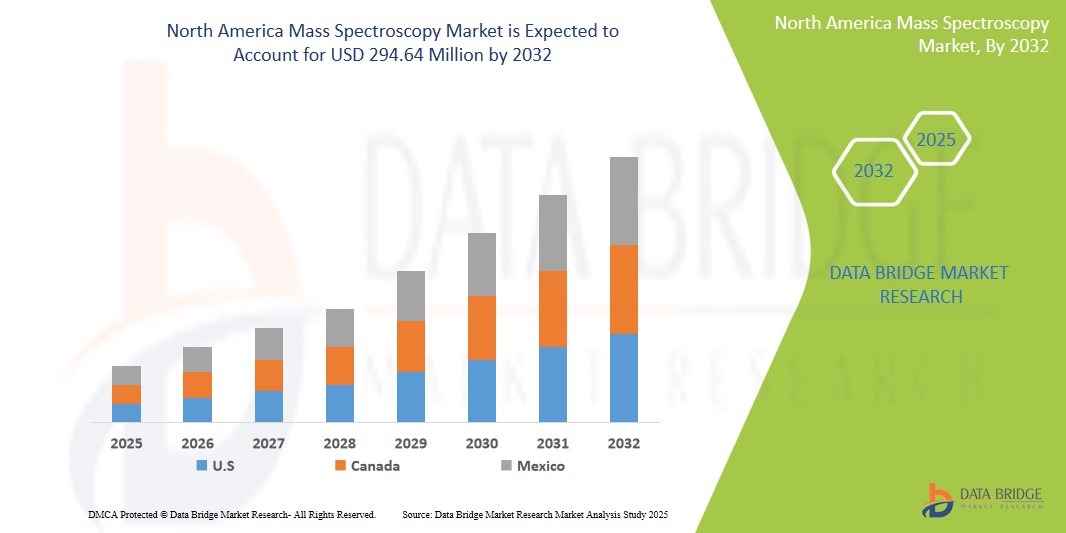
- The North America Mass Spectroscopy Market size was valued at USD 156.85 million in 2024 and is expected to reach USD 294.64 million by 2032, at a CAGR of 8.2% during the forecast period
- The market growth is largely fueled by the increasing adoption of advanced analytical technologies across pharmaceutical, biotechnology, and environmental testing sectors, coupled with ongoing innovations in mass spectrometry instrumentation and software solutions.
- Furthermore, rising demand for accurate, sensitive, and high-throughput analytical techniques in clinical diagnostics and drug development is positioning mass spectrometry as a critical tool in modern laboratory workflows. These converging factors are accelerating the deployment of mass spectroscopy solutions, thereby significantly boosting the industry's growth.
Mass Spectroscopy Market Analysis
- Mass spectroscopy, offering precise molecular analysis and quantification capabilities, is becoming an essential component in modern laboratory and research settings across industries such as pharmaceuticals, biotechnology, environmental science, and food safety due to its high sensitivity, accuracy, and ability to identify complex compounds.
- The escalating demand for mass spectroscopy is primarily fueled by the rise in R&D investments, stringent regulatory requirements for product safety and quality, and the growing application of omics technologies in drug discovery and clinical diagnostics.
- U.S. dominates the Mass Spectroscopy market with the largest revenue share of 38.01% in 2025, characterized by early adoption of cutting-edge laboratory technologies, strong research infrastructure, and the presence of key industry players. The U.S. is experiencing substantial growth in mass spectroscopy installations, particularly in pharmaceutical manufacturing and clinical labs, driven by innovations in high-resolution and hybrid spectrometry platforms from both established companies and emerging startups.
- Canada is expected to be the fastest growing region in the Mass Spectroscopy market during the forecast period due to increasing industrialization, government support for healthcare and environmental testing, and rising investments in life sciences research.
- The hybrid mass spectrometry segment is expected to dominate the Mass Spectroscopy market with a market share of 35.67% in 2025, driven by its enhanced analytical capabilities, versatility across applications, and growing adoption in complex biological and chemical analysis workflows.
Report Scope and Mass Spectroscopy Market Segmentation
|
Attributes |
Mass Spectroscopy Key Market Insights |
|
Segments Covered |
|
|
Countries Covered |
North America
|
|
Key Market Players |
|
|
Market Opportunities |
|
|
Value Added Data Infosets |
In addition to the insights on market scenarios such as market value, growth rate, segmentation, geographical coverage, and major players, the market reports curated by the Data Bridge Market Research also include in-depth expert analysis, pricing analysis, brand share analysis, consumer survey, demography analysis, supply chain analysis, value chain analysis, raw material/consumables overview, vendor selection criteria, PESTLE Analysis, Porter Analysis, and regulatory framework. |
Mass Spectroscopy Market Trends
“Enhanced Precision and Efficiency Through AI and Automation”
- A significant and accelerating trend in the North America Mass Spectroscopy Market is the integration of artificial intelligence (AI) and advanced automation technologies into analytical workflows. This convergence is enhancing instrument precision, reducing human error, and significantly improving data processing speed and interpretability.
- For instance, AI-enabled mass spectrometry platforms can now automatically optimize parameters such as ionization settings, scan modes, and collision energies to maximize analytical performance without manual intervention. Some leading vendors are also offering cloud-based AI tools that assist in real-time data analysis, anomaly detection, and predictive maintenance of instruments.
- AI integration allows mass spectrometers to learn from previous datasets, enabling more accurate peak detection, compound identification, and even quantification in complex matrices. Additionally, machine learning algorithms are being deployed to streamline workflows in metabolomics and proteomics, helping researchers identify biomarkers faster and with greater confidence.
- The seamless integration of mass spectrometry instruments with laboratory information management systems (LIMS), cloud-based data platforms, and electronic lab notebooks (ELNs) facilitates centralized control over experiment management, data sharing, and compliance tracking—creating a more automated and connected lab environment.
- This trend towards smarter, automated, and AI-driven mass spectrometry systems is fundamentally reshaping expectations in life sciences, diagnostics, and quality control. Leading players such as Thermo Fisher Scientific, Bruker, and SCIEX are investing in next-generation platforms that combine AI, high-resolution detection, and real-time analytics to deliver deeper insights with minimal user intervention.
- The demand for intelligent mass spectroscopy solutions is growing rapidly across sectors including pharmaceuticals, environmental testing, and food safety, as end users increasingly seek higher throughput, better reproducibility, and actionable insights through streamlined, data-driven workflows.
Mass Spectroscopy Market Dynamics
Driver
“Growing Need for High-Precision Analytical Tools Across Industries”
- The increasing demand for accurate, sensitive, and high-throughput analytical techniques across sectors such as pharmaceuticals, biotechnology, environmental monitoring, and food safety is a major driver of the mass spectroscopy market.
- For instance, in April 2024, Thermo Fisher Scientific announced a new suite of high-resolution mass spectrometers powered by AI-driven software, aimed at accelerating clinical research and improving molecular diagnostics. Such innovations are expected to significantly contribute to industry growth in the coming years.
- The need for precise molecular profiling, especially in drug development and disease diagnostics, has intensified reliance on mass spectroscopy due to its superior ability to identify, characterize, and quantify chemical compounds in complex biological matrices.
- Furthermore, regulatory agencies such as the FDA and EMA are placing stronger emphasis on analytical accuracy and compliance in pharmaceutical manufacturing, reinforcing the importance of mass spectrometry in quality assurance and validation workflows.
- The technology’s expanding role in cutting-edge research, including metabolomics, proteomics, and forensic science, as well as its integration with liquid chromatography and AI-based data processing tools, continues to broaden its applicability and adoption across academic, clinical, and industrial settings.
Restraint/Challenge
“High Capital Investment and Technical Complexity”
- Despite its analytical advantages, mass spectroscopy presents notable challenges related to high initial costs and operational complexity, which can hinder adoption, particularly among smaller laboratories and institutions in developing regions.
- For example, the procurement of high-resolution or hybrid systems (such as LC-MS/MS or Orbitrap instruments) often requires substantial capital investment—not just for the instruments themselves, but also for facility upgrades, specialized personnel, and ongoing maintenance.
- In addition, the technical expertise required to operate, calibrate, and interpret results from mass spectrometry platforms can act as a barrier, especially for labs lacking trained staff or resources for continuous training.
- Addressing these concerns, vendors are increasingly focusing on user-friendly interfaces, cloud-based data analysis platforms, and robust technical support. However, the perceived complexity still discourages adoption among users unfamiliar with the technology.
- Furthermore, budget-conscious organizations may struggle to justify the upfront investment without guaranteed high sample volumes or external funding. Though prices are gradually declining and leasing options are becoming more available, affordability remains a concern for many potential users.
- Overcoming these challenges will require collaborative efforts across industry stakeholders to reduce costs, simplify usage, and expand access through educational outreach, especially in emerging markets.
Mass Spectroscopy Market Scope
The market is segmented on the basis of technology, modality, application, end user, and distribution channel.
- By Technology
On the basis of Technology, the Mass Spectroscopy market is segmented into Hybrid Mass Spectrometry, Single Mass Spectrometry, and Others. The Hybrid Mass Spectrometry segment dominates the largest market revenue share of 35.67% in 2025, driven by its enhanced analytical accuracy and versatility across complex biological and chemical analyses.Its ability to combine multiple detection techniques enables broader application in drug discovery, clinical diagnostics, and proteomics research.
The Single Mass Spectrometry segment is anticipated to witness the fastest growth rate of 21.7% from 2025 to 2032, fueled by its cost-effectiveness and ease of use for routine analysis. Its growing adoption in small- to mid-sized laboratories and academic research settings is further driving this rapid expansion.
- By Modality
On the basis of Modality, the Mass Spectroscopy market is segmented into Benchtop and Standalone. The Benchtop held the largest market revenue share in 2025 of, driven by its compact design, high performance, and suitability for a wide range of laboratory environments. Its widespread use in pharmaceutical, clinical, and academic labs supports consistent demand across both developed and emerging markets.
The Standalone segment is expected to witness the fastest CAGR from 2025 to 2032, driven by its ease of integration, user-friendly operation, and lower dependency on auxiliary systems. Its growing adoption in decentralized and point-of-care settings is further accelerating market expansion.
- By Application
On the basis of application, the Mass Spectroscopy market is segmented into Life Science Research, Drug Discovery, Environmental Testing, Food Testing, Applied Industries, Clinical Diagnostics, and Others. The Life Science Research held the largest market revenue share in 2025, driven by the increasing demand for advanced analytical techniques in genomics, proteomics, and metabolomics studies. Continuous advancements in mass spectrometry technologies are enabling deeper biological insights, fueling growth in pharmaceutical and academic research.
The Drug Discovery is expected to witness the fastest CAGR from 2025 to 2032, favored for its critical role in identifying and validating new therapeutic targets. Its ability to provide precise molecular characterization accelerates the development of safer and more effective drugs.
- By End User
On the basis of end suer, the Mass Spectroscopy is segmented into Pharmaceutical Industry, Research and Academic Institutes, Food & Beverage Industry, Petrochemical Industry, and Others. The Pharmaceutical Industry segment accounted for the largest market revenue share in 2024, driven by the increasing need for precise drug analysis, quality control, and regulatory compliance. Mass spectrometry’s role in accelerating drug development and ensuring product safety continues to fuel strong demand in this sector.
The Research and Academic Institutes segment is expected to witness the fastest CAGR from 2025 to 2032, driven by the rising investments in scientific research and the growing focus on life sciences and biotechnology. Increased adoption of mass spectrometry for educational purposes and cutting-edge research is further accelerating market growth in this segment.
- By distribution channel
On the basis of distribution channel, the Mass Spectroscopy is segmented into Direct Tenders, Retail Sales, and Others. The direct tenders segment accounted for the largest market revenue share in 2024, driven by strong relationships between manufacturers and large institutional buyers ensuring streamlined procurement processes. This approach allows for customized solutions, competitive pricing, and reliable after-sales support, making it the preferred purchasing method for major laboratories and healthcare organizations.
The Retail Sales segment is expected to witness the fastest CAGR from 2025 to 2032, driven by increasing demand from smaller laboratories and decentralized testing facilities seeking quick and easy access to mass spectrometry equipment. The growing availability of affordable, user-friendly instruments through retail channels is further accelerating market expansion.
Mass Spectroscopy Market Regional Analysis
- U.S. dominates the Mass Spectroscopy market with the largest revenue share of 38.01% in 2024, driven by increasing investments in pharmaceutical research, clinical diagnostics, and environmental testing.
- The country’s benefits from strong research infrastructure, early adoption of advanced analytical technologies, and a well-established presence of key industry players.
- High demand for precision, regulatory compliance, and technological innovation, coupled with substantial government and private sector funding, supports the widespread use of mass spectrometry across academic, healthcare, and industrial sectors.
U.S. Mass Spectroscopy Market Insight
The U.S. Mass Spectroscopy market captured the largest revenue share of 38.01% within North America in 2025, fueled by rapid advancements in pharmaceutical research, clinical diagnostics, and biotechnology applications. Strong investments in healthcare infrastructure, widespread adoption of cutting-edge analytical technologies, and increasing demand for high-precision instrumentation in drug development are key growth drivers. Additionally, the growing integration of AI and automation in mass spectrometry platforms is accelerating adoption across academic, clinical, and industrial laboratories.
Mexico Mass Spectroscopy Market Insight
The Mexico Mass Spectroscopy market is projected to expand at a substantial CAGR throughout the forecast period, driven by rising industrialization and increasing investments in healthcare and environmental monitoring. Growing awareness about product safety, quality control, and regulatory compliance in pharmaceuticals and food industries is fostering the adoption of advanced mass spectrometry techniques. Emerging research institutions and government initiatives aimed at improving laboratory capabilities further support market growth.
Canada Mass Spectroscopy Market Insight
The Canada Mass Spectroscopy market is anticipated to grow at a noteworthy CAGR during the forecast period, supported by expanding pharmaceutical manufacturing and life sciences research activities.
Heightened demand for precise analytical tools in clinical diagnostics and environmental testing, coupled with strong government support for innovation, drives the market forward. Moreover, the adoption of integrated data management systems and AI-enhanced instrumentation is contributing to the increasing utilization of mass spectrometry in both academic and industrial sectors.
Mass Spectroscopy Market Share
The Mass Spectroscopy industry is primarily led by well-established companies, including:
- Thermo Fisher Scientific
- Agilent Technologies
- PerkinElmer Inc.
- SCIEX
- Bruker Corporation
- Waters Corporation
- Ionis Pharmaceuticals
- JEOL USA
- LECO Corporation
- Shimadzu Scientific Instruments
Latest Developments in North America Mass Spectroscopy Market
- In April 2023, Thermo Fisher Scientific launched a new high-resolution mass spectrometry platform designed to accelerate drug discovery and improve clinical diagnostics. This innovation enhances analytical capabilities, reinforcing the company’s leadership in the North America market.
- In March 2023, Agilent Technologies introduced advanced AI-powered data analysis software integrated with its mass spectrometry systems, aimed at improving accuracy and efficiency for life science research and environmental testing.
- In March 2023, PerkinElmer Inc. expanded its product portfolio with a novel hybrid mass spectrometer that offers improved sensitivity and throughput, catering to pharmaceutical and biotech industries’ growing demands.
- In February 2023, SCIEX announced a strategic partnership with major academic institutions to develop next-generation mass spectrometry techniques, promoting innovation and collaboration within the research community.
- In January 2023, Waters Corporation unveiled an enhanced benchtop mass spectrometer model featuring simplified operation and cloud-based data management, targeting small to mid-sized laboratories seeking cost-effective solutions.

- Interactive Data Analysis Dashboard
- Company Analysis Dashboard for high growth potential opportunities
- Research Analyst Access for customization & queries
- Competitor Analysis with Interactive dashboard
- Latest News, Updates & Trend analysis
- Harness the Power of Benchmark Analysis for Comprehensive Competitor Tracking
Data collection and base year analysis are done using data collection modules with large sample sizes. The stage includes obtaining market information or related data through various sources and strategies. It includes examining and planning all the data acquired from the past in advance. It likewise envelops the examination of information inconsistencies seen across different information sources. The market data is analysed and estimated using market statistical and coherent models. Also, market share analysis and key trend analysis are the major success factors in the market report. To know more, please request an analyst call or drop down your inquiry.
The key research methodology used by DBMR research team is data triangulation which involves data mining, analysis of the impact of data variables on the market and primary (industry expert) validation. Data models include Vendor Positioning Grid, Market Time Line Analysis, Market Overview and Guide, Company Positioning Grid, Patent Analysis, Pricing Analysis, Company Market Share Analysis, Standards of Measurement, Global versus Regional and Vendor Share Analysis. To know more about the research methodology, drop in an inquiry to speak to our industry experts.
Data Bridge Market Research is a leader in advanced formative research. We take pride in servicing our existing and new customers with data and analysis that match and suits their goal. The report can be customized to include price trend analysis of target brands understanding the market for additional countries (ask for the list of countries), clinical trial results data, literature review, refurbished market and product base analysis. Market analysis of target competitors can be analyzed from technology-based analysis to market portfolio strategies. We can add as many competitors that you require data about in the format and data style you are looking for. Our team of analysts can also provide you data in crude raw excel files pivot tables (Fact book) or can assist you in creating presentations from the data sets available in the report.













