


North America Medical Clothing Market Overview
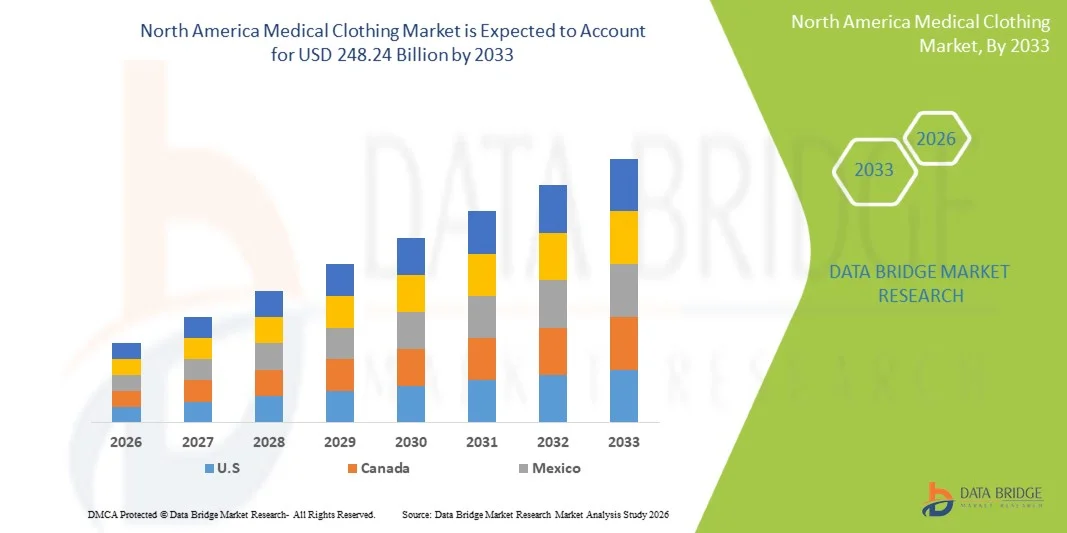
The North America medical clothing market was valued at USD 130.21 billion in 2025 and is projected to reach USD 248.24 billion by 2033, growing at a CAGR of 8.40% from 2026 to 2033. Market growth is supported by the rising prevalence of chronic diseases and hospital-acquired infections (HAIs), alongside the widespread adoption of stringent infection control protocols across healthcare facilities.
The excellent protection rates associated with medical clothing, combined with heightened awareness of hygiene standards and improved patient outcomes compared to unprotected environments, are driving increased adoption among both healthcare institutions and medical professionals. Ongoing technological advancements in medical textiles, including enhanced antimicrobial fabrics, improved breathability, and integrated smart textile features, are expanding the clinical applicability of medical clothing across hospitals, ambulatory surgical centers, and specialty clinics. In addition, growing healthcare infrastructure investments and the expansion of outpatient care facilities are creating new opportunities for stakeholders across the forecast period.
Key Market Trends & Insights
- The U.S. dominated the North America medical clothing market with the largest revenue share of 72.5% in 2025, supported by high adoption rates of advanced infection control measures, robust regulatory frameworks, and the presence of leading market players.
- Canada is expected to be the fastest-growing country at a CAGR of 9.15% from 2026 to 2033, driven by expanding healthcare infrastructure, rising demand for protective medical apparel, and increasing healthcare expenditure.
- The Professional Apparel segment led the market with a 38.2% market share in 2025, reflecting its established position as the primary category for healthcare worker protection and strong clinical evidence supporting improved infection control outcomes.
- The Specialty Apparel segment is anticipated to be the fastest-growing product category, projected to register a CAGR of 9.85% during the forecast period, driven by increasing demand for specialized protective garments, surgical applications, and technological advancements enabling enhanced barrier protection.
- The Hospitals segment dominated the end-user category with a 45.8% market share in 2025, supported by access to comprehensive infection control programs, multidisciplinary medical teams, and extensive perioperative care infrastructure.
- The Ambulatory Centres segment is expected to witness strong growth during the forecast period, driven by cost-effective healthcare delivery, shorter patient stays, and expanding outpatient surgical programs.
Market Size & Forecast
- North America Market Value (2025): USD 130.21 Billion
- Expected Market Value (2033): USD 248.24 Billion
- Forecast CAGR (2026–2033): 8.40%
Report Scope and Medical Clothing Market Segmentation
|
Attributes |
Medical Clothing Key Market Insights |
|
Segments Covered |
|
|
Countries Covered |
North America · U.S. · Canada · Mexico |
|
Key Market Players |
|
|
Market Opportunities |
· Expansion of antimicrobial and smart textile technologies into mainstream medical apparel manufacturing · Development of sustainable, eco-friendly medical clothing enabling adoption across environmentally conscious healthcare systems and institutions |
|
Value Added Data Infosets |
In addition to the insights on market scenarios such as market value, growth rate, segmentation, geographical coverage, and major players, the market reports curated by the Data Bridge Market Research also include depth expert analysis, patient epidemiology, pipeline analysis, pricing analysis, and regulatory framework. |
North America Medical Clothing Market Trends
Trend: Technological Advancements Enhancing Protective Performance and Sustainability
Clinical adoption of advanced medical clothing continues to accelerate as technological innovations improve protective performance, comfort, and environmental sustainability. Advanced antimicrobial fabrics, integrated moisture-wicking systems, and enhanced barrier protection technologies enable healthcare facilities to maintain optimal hygiene standards while ensuring worker comfort during extended shifts. Sustainable manufacturing practices, including the development of recyclable and biodegradable medical textiles, allow healthcare systems to meet environmental responsibility goals while maintaining infection control standards.
For instance,
The Butter-Soft Stretch scrub line has gained significant market traction due to its innovative fabric technology, enhanced durability compared to conventional scrubs, and seamless integration with modern healthcare facility requirements, providing hospitals with a comfortable and protective option for healthcare workers.
In addition, research demonstrates that antimicrobial medical clothing reduces bacterial contamination rates and cross-contamination risks compared to conventional textiles, supporting broader clinical adoption across hospitals, ambulatory centers, and specialty clinics. Rising emphasis on sustainability and technological innovation is expected to strengthen adoption of advanced medical clothing solutions across North America.
North America Medical Clothing Market Dynamics
Key Market Driver: Rising Prevalence of Hospital-Acquired Infections and Chronic Diseases
The growing concern over hospital-acquired infections (HAIs) and the increasing prevalence of chronic diseases are primary drivers of market growth. Medical clothing creates essential barriers between healthcare workers, patients, and potentially infectious materials, reducing transmission risks and improving patient safety outcomes. The increasing prevalence of conditions requiring extended hospitalization, including cancer, diabetes, and cardiovascular diseases, is expanding the patient population requiring enhanced infection control measures.
For instance,
According to the Centers for Disease Control and Prevention (CDC), approximately 1 in 31 hospital patients has at least one healthcare-associated infection on any given day, demonstrating the critical need for enhanced protective measures including medical clothing.
Rising concern over HAIs is expected to strengthen adoption of advanced medical clothing technologies across North America.
Key Restraint/Challenge: Cost Pressures and Supply Chain Disruptions
The significant cost pressures associated with high-quality medical clothing, combined with ongoing supply chain disruptions and raw material price volatility, present substantial barriers to consistent adoption, particularly for smaller healthcare facilities and institutions with limited budgets. The total cost of maintaining adequate medical clothing inventory, including procurement, laundering, and replacement cycles, can limit the financial feasibility of comprehensive protective apparel programs.
For instance,
Healthcare systems evaluating medical clothing procurement must balance protective requirements against budget constraints, with premium antimicrobial and specialty apparel requiring substantial investment compared to standard textile options.
High acquisition and maintenance costs may constrain adoption, particularly among budget-sensitive healthcare providers.
Key Market Opportunity: Expansion of Sustainable and Smart Textile Technologies
The development of sustainable, eco-friendly medical clothing and integration of smart textile technologies is creating significant opportunities for market expansion. Healthcare systems are increasingly prioritizing environmental responsibility alongside infection control, driving demand for recyclable, biodegradable, and sustainably manufactured medical apparel. Simultaneously, smart textile integration, including embedded sensors for vital sign monitoring and contamination detection, is expanding the functional capabilities of medical clothing beyond traditional protective applications.
For instance,
The global medical clothing market, including sustainable and smart textile innovations, is projected to grow significantly through 2033, driven by increasing adoption of environmentally responsible manufacturing practices and technological advancements enabling enhanced functionality.
Expansion into sustainable and smart textile technologies presents substantial growth opportunities for market participants.
North America Medical Clothing Market Scope
The medical clothing market is segmented on the basis of product, usage, end user, and distribution channel.
- By Product
On the basis of product, the North America medical clothing market is segmented into professional apparel, patient apparel, specialty apparel, first aid clothing, wraps and towels, and others. The professional apparel segment dominated the market with a 38.2% market share in 2025, reflecting its established position as the primary category for healthcare worker protection. Strong clinical evidence supporting improved infection control outcomes, enhanced worker comfort, and professional appearance standards has driven widespread adoption across hospitals, clinics, and ambulatory care facilities. High demand volumes in academic medical centers, large health systems, and specialty practices contribute to segment leadership.
The specialty apparel segment is expected to witness the fastest growth from 2026 to 2033 at a CAGR of 9.85%, driven by rising demand for surgical gowns, isolation apparel, and specialized protective garments required for high-risk procedures. Technological advancements enabling enhanced barrier protection, fluid resistance, and breathability continue to expand clinical applications, while increasing surgical volumes and heightened infection control awareness support segment expansion.
- By Usage
On the basis of usage, the North America medical clothing market is segmented into reusable and disposable. The disposable segment dominated the market with a market share of 58.6% in 2025, driven by stringent infection control requirements, convenience of single-use products, and reduced risk of cross-contamination between patients. Disposable medical clothing eliminates laundering requirements and ensures consistent barrier protection for each use, making it the preferred choice for high-risk clinical applications and surgical procedures.
The reusable segment is expected to witness the fastest growth from 2026 to 2033 at a CAGR of 9.25%, driven by growing sustainability concerns, cost-effectiveness over extended use cycles, and advancements in durable antimicrobial fabric technologies. Healthcare systems seeking to reduce environmental impact while maintaining protective standards are increasingly investing in high-quality reusable medical apparel programs with validated laundering protocols.
- By End User
On the basis of end user, the North America medical clothing market is segmented into hospitals, specialty clinics, ambulatory centres, home care settings, research & clinical laboratories, and others. The hospitals segment dominated the market with a market share of 45.8% in 2025, driven by comprehensive infection control programs, high patient volumes, and extensive protective apparel requirements across multiple departments. Hospitals serve as primary consumers of all medical clothing categories, from professional scrubs and lab coats to surgical gowns and isolation apparel. The concentration of surgical, emergency, and intensive care services within hospital systems contributes to high product consumption and equipment utilization.
The ambulatory centres segment is expected to witness the fastest growth from 2026 to 2033 at a CAGR of 10.15%, driven by expanding outpatient surgical programs, cost-effective healthcare delivery models, and increasing procedure volumes performed outside traditional hospital settings. The shift toward ambulatory care and same-day discharge procedures is driving demand for professional and specialty apparel in these settings, while favorable reimbursement policies support segment expansion.
- By Distribution Channel
On the basis of distribution channel, the North America medical clothing market is segmented into direct tender, retail sales, third party distributor, and others. The direct tender segment dominated the market with a market share of 42.3% in 2025, driven by large healthcare systems' preference for negotiated contracts ensuring consistent supply, competitive pricing, and quality assurance. Direct procurement relationships between manufacturers and major hospital networks provide supply chain stability and customization capabilities for institutional requirements.
The retail sales segment is expected to witness the fastest growth from 2026 to 2033 at a CAGR of 9.45%, driven by increasing individual practitioner purchasing, expansion of e-commerce platforms for medical apparel, and growing demand from smaller healthcare facilities without established distributor relationships. Online retail channels providing convenient access to diverse product selections and competitive pricing are supporting segment expansion.
North America Medical Clothing Market Regional Analysis
North America continues to dominate the medical clothing market, supported by advanced healthcare infrastructure, stringent regulatory requirements, and high adoption rates of infection control measures. The region benefits from the presence of major market players, robust distribution networks, and comprehensive healthcare worker safety standards that drive consistent demand for high-quality medical apparel.
U.S. Medical Clothing Market Insight
The U.S. medical clothing market dominated the North America region with a 72.5% market share in 2025, benefiting from the largest healthcare infrastructure globally, extensive infection control programs, and strong regulatory frameworks governing healthcare worker protection. Academic medical centers, large integrated health systems, and specialty practices maintain comprehensive medical clothing programs across professional, patient, and specialty apparel categories. Favorable commercial and government payer structures support institutional investment in protective apparel, while the presence of leading manufacturers including Cardinal Health, Medline Industries, and 3M ensures robust product availability.
Canada Medical Clothing Market Insight
The Canada medical clothing market is expected to be the fastest-growing country at a CAGR of 9.15% from 2026 to 2033, driven by healthcare system modernization initiatives, expanding infection control requirements, and increasing healthcare expenditure. Provincial health authorities are investing in enhanced protective apparel programs across acute care hospitals, long-term care facilities, and community health centers. Growing emphasis on healthcare worker safety following pandemic experiences continues to support market expansion.
Mexico Medical Clothing Market Insight
The Mexico medical clothing market is characterized by expanding private healthcare infrastructure and growing adoption of international infection control standards. Investment in hospital construction and healthcare facility upgrades is driving demand for quality medical apparel, while increasing medical tourism supports premium protective clothing adoption in private hospital networks.
North America Medical Clothing Market Share
The medical clothing industry is primarily led by well-established companies, including:
- Cardinal Health, Inc. (U.S.)
- Medline Industries, LP (U.S.)
- 3M (U.S.)
- Mölnlycke Health Care AB (Sweden)
- ANSELL LTD. (Australia)
- Halyard Health, Inc. (U.S.)
- Superior Uniform Group (U.S.)
- Barco Uniforms (U.S.)
- Cintas Corporation (U.S.)
- Kimberly-Clark Corporation (U.S.)
- Semperit AG Holding (Austria)
- Alpha Pro Tech, Ltd. (U.S.)
Latest Developments in North America Medical Clothing Market
- In March 2026, Medline Industries announced the expansion of its sustainable medical apparel line, introducing scrubs manufactured from 100% recycled polyester fibers. The launch supports healthcare systems' environmental sustainability goals while maintaining protective performance standards required for clinical applications.
- In January 2026, Cardinal Health launched its enhanced AAMI Level 4 surgical gown portfolio, featuring improved fluid resistance and breathability technologies. The expansion strengthens Cardinal Health's position in the high-protection surgical apparel segment and addresses growing demand for premium barrier protection in surgical settings.
- In November 2025, Barco Uniforms introduced its Grey's Anatomy Edge collection featuring advanced antimicrobial fabric technology and enhanced stretch performance. The product line addresses healthcare worker demand for comfortable, protective professional apparel suitable for extended shifts.
- In September 2025, 3M Company expanded its healthcare apparel portfolio with the introduction of enhanced isolation gowns featuring improved donning and doffing efficiency. The innovation addresses healthcare worker feedback regarding ease of use during high-volume patient care situations.
- In June 2025, Cintas Corporation announced a strategic partnership with major hospital systems to provide comprehensive managed medical apparel programs, including sustainable laundering services and inventory management solutions. The partnership model addresses healthcare facility demand for simplified procurement and environmental responsibility.
- In April 2025, Mölnlycke Health Care AB launched its BARRIER Comfort surgical gown line in the North American market, featuring enhanced breathability and reduced heat stress for surgical teams. The introduction expands Mölnlycke's presence in the premium surgical apparel segment.
- In February 2025, Halyard Health, Inc. announced the receipt of FDA clearance for its enhanced MICROCOOL breathable surgical gown, featuring improved moisture vapor transmission while maintaining fluid barrier protection. The clearance supports adoption in extended surgical procedures requiring enhanced comfort.
- In October 2024, Superior Uniform Group expanded its Fashion Seal Healthcare brand with the introduction of antimicrobial scrub collections designed for long-term care and senior living facilities. The expansion addresses growing demand for protective professional apparel in extended care settings.

- Interactive Data Analysis Dashboard
- Company Analysis Dashboard for high growth potential opportunities
- Research Analyst Access for customization & queries
- Competitor Analysis with Interactive dashboard
- Latest News, Updates & Trend analysis
- Harness the Power of Benchmark Analysis for Comprehensive Competitor Tracking
Data collection and base year analysis are done using data collection modules with large sample sizes. The stage includes obtaining market information or related data through various sources and strategies. It includes examining and planning all the data acquired from the past in advance. It likewise envelops the examination of information inconsistencies seen across different information sources. The market data is analysed and estimated using market statistical and coherent models. Also, market share analysis and key trend analysis are the major success factors in the market report. To know more, please request an analyst call or drop down your inquiry.
The key research methodology used by DBMR research team is data triangulation which involves data mining, analysis of the impact of data variables on the market and primary (industry expert) validation. Data models include Vendor Positioning Grid, Market Time Line Analysis, Market Overview and Guide, Company Positioning Grid, Patent Analysis, Pricing Analysis, Company Market Share Analysis, Standards of Measurement, Global versus Regional and Vendor Share Analysis. To know more about the research methodology, drop in an inquiry to speak to our industry experts.
Data Bridge Market Research is a leader in advanced formative research. We take pride in servicing our existing and new customers with data and analysis that match and suits their goal. The report can be customized to include price trend analysis of target brands understanding the market for additional countries (ask for the list of countries), clinical trial results data, literature review, refurbished market and product base analysis. Market analysis of target competitors can be analyzed from technology-based analysis to market portfolio strategies. We can add as many competitors that you require data about in the format and data style you are looking for. Our team of analysts can also provide you data in crude raw excel files pivot tables (Fact book) or can assist you in creating presentations from the data sets available in the report.













