


What is North America Medical Device Reprocessing Market Size and Growth Rate ?
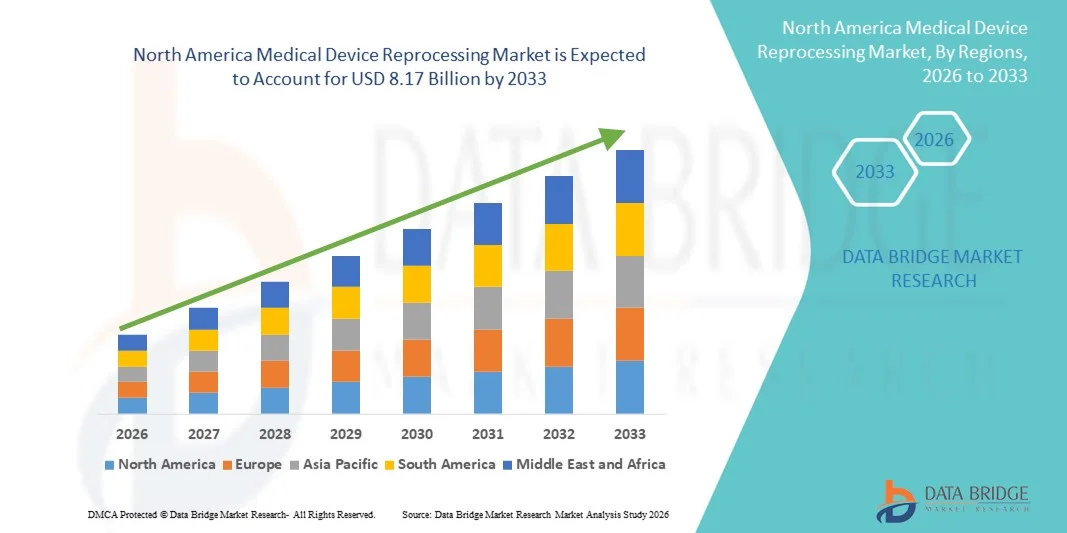
- As per Data Bridge Market Research Analysis the North America medical device reprocessing market size was valued at USD 2.51 billion in 2025 and is expected to reach USD 8.17 billion by 2033, at a CAGR of 15.90% during the forecast period
- The market growth is primarily driven by rising cost-containment pressures on healthcare providers, coupled with increasing adoption of sustainable healthcare practices and stringent regulatory frameworks supporting safe reprocessing
- Furthermore, growing awareness among hospitals regarding infection control, environmental benefits, and reduced medical waste is positioning medical device reprocessing as a reliable and cost-effective alternative to single-use devices. These factors are collectively accelerating the adoption of reprocessed medical devices, thereby significantly supporting market growth in the region
Market Size & Forecast
- North America Market Value (2025): USD 2.51 Billion
- Expected Market Value (2033): USD 8.17 Billion
- Forecast CAGR (2026–2033): 15.90%
What are the Major Takeaways of North America Medical Device Reprocessing Market ?
- Medical device reprocessing, involving the cleaning, disinfection, and sterilization of reusable and reprocessable medical devices, is increasingly essential within modern healthcare systems due to its role in lowering procedural costs, improving patient safety, and supporting environmentally sustainable healthcare practices
- The rising demand for medical device reprocessing is primarily driven by escalating healthcare expenditures, stringent regulatory requirements, growing emphasis on infection prevention, and increasing pressure on healthcare providers to reduce medical waste and optimize resource utilization
- The United States dominated the medical device reprocessing market with the largest revenue share of 72.5% in 2025, supported by a highly developed healthcare infrastructure, strict FDA regulatory oversight, and widespread adoption across large hospital networks, with strong utilization of reprocessing services driven by cost-containment strategies and standardized sterile processing practices
- Canada is expected to be the fastest growing country in the North America medical device reprocessing market during the forecast period driven by increasing healthcare spending, growing awareness of sustainable medical practices, and rising adoption of reprocessing programs across public and private healthcare facilities
- Reprocessing support & services segment dominated the market with a market share of 55% in 2025, driven by the growing reliance on specialized third-party service providers, regulatory compliance requirements, and the need for validated, high-quality reprocessing workflows.
Report Scope and North America Medical Device Reprocessing Market Segmentation
|
Attributes |
North America Medical Device Reprocessing Key Market Insights |
|
Segments Covered |
|
|
Countries Covered |
North America
|
|
Key Market Players |
|
|
Market Opportunities |
|
|
Value Added Data Infosets |
In addition to the insights on market scenarios such as market value, growth rate, segmentation, geographical coverage, and major players, the market reports curated by the Data Bridge Market Research also include in-depth expert analysis, patient epidemiology, pipeline analysis, pricing analysis, and regulatory framework |
What are the Key Trends in North America Medical Device Reprocessing Market ?
Rising Emphasis on Sustainability and Cost Optimization in Healthcare
- A significant and accelerating trend in the North America medical device reprocessing market is the growing emphasis on sustainable healthcare practices combined with the need to reduce operational and procedural costs across hospitals and healthcare facilities
- Medical device reprocessing programs are increasingly being adopted as hospitals seek to lower procurement expenses while minimizing environmental impact by reducing single-use medical waste generated during surgical and diagnostic procedures
- For instance, large hospital networks in the United States are expanding centralized sterile processing departments and partnering with third-party reprocessing service providers to standardize workflows, ensure regulatory compliance, and achieve consistent cost savings
- Advancements in cleaning technologies, including automated cleaning systems and validated disinfection protocols, are enhancing the safety, reliability, and scalability of reprocessed medical devices across critical and semi-critical device categories
- The integration of reprocessing programs within broader hospital sustainability initiatives is enabling healthcare providers to align cost-efficiency goals with environmental, social, and governance objectives, particularly in publicly funded healthcare systems
- Increasing collaboration between hospitals and specialized reprocessing service providers is improving access to expertise, infrastructure, and validated processes, supporting broader market penetration
- This growing focus on efficiency, compliance, and environmental responsibility is reshaping purchasing and utilization strategies, encouraging long-term adoption of medical device reprocessing across North America
North America Medical Device Reprocessing Market Dynamics
Driver
Growing Pressure to Reduce Healthcare Costs and Medical Waste
- The increasing pressure on healthcare systems to reduce overall treatment costs while maintaining high standards of patient safety is a major driver fueling the adoption of medical device reprocessing across North America
- Rising surgical volumes, high prices of single-use medical devices, and constrained hospital budgets are prompting healthcare providers to seek cost-effective alternatives such as reprocessed devices
- For instance, hospitals adopting structured reprocessing programs have reported significant reductions in annual supply chain expenditures while maintaining compliance with strict regulatory and quality standards
- Furthermore, heightened awareness of environmental sustainability and regulatory encouragement to reduce medical waste are reinforcing the role of reprocessing as a viable long-term solution
- The growing acceptance of reprocessed devices among clinicians, supported by validated safety data and standardized protocols, is further accelerating market growth across hospitals and ambulatory surgical centers
- Supportive reimbursement frameworks and institutional purchasing policies are also contributing to increased adoption of reprocessing solutions across large healthcare systems
- The expansion of value-based care models is strengthening demand for reprocessing by prioritizing cost efficiency, waste reduction, and optimized resource utilization
Restraint/Challenge
Regulatory Complexity and Safety Compliance Concerns
- The stringent regulatory requirements governing the cleaning, disinfection, and reuse of medical devices present a significant challenge to the widespread adoption of medical device reprocessing
- Compliance with complex regulatory frameworks, documentation requirements, and validation protocols can be resource-intensive, particularly for smaller healthcare facilities lacking advanced sterile processing infrastructure
- For instance, meeting detailed regulatory expectations related to device traceability, performance testing, and quality assurance may limit adoption among clinics and smaller diagnostic centers
- In addition, concerns among some clinicians regarding infection risks and device performance, despite strong evidence supporting reprocessed devices, can slow acceptance in certain care settings
- The need for continuous staff training and strict adherence to evolving regulatory standards further increases operational complexity for healthcare providers
- Limited internal expertise and capital investment requirements for in-house reprocessing capabilities can act as barriers for smaller end users
- Addressing these challenges through standardized guidelines, continued clinical education, and investments in advanced reprocessing technologies will be essential to ensure sustained growth of the medical device reprocessing market in North America
North America Medical Device Reprocessing Market Scope
The market is segmented on the basis of type, product & service, process, device type, application, and end user.
- By Type
On the basis of type, the market is segmented into enzymatic and non-enzymatic detergent. The enzymatic segment dominated the market with the largest revenue share in 2025. Enzymatic detergents are highly effective in breaking down organic residues, ensuring surgical instruments and critical devices are thoroughly cleaned before sterilization. Hospitals and large healthcare facilities prefer enzymatic detergents due to their validated efficacy, which reduces infection risks and complies with FDA and CDC guidelines. They are compatible with automated cleaning systems, allowing high-volume processing and improving operational efficiency. The detergents also shorten turnaround time, supporting faster surgical schedules and reducing instrument downtime. Their long-standing reputation for reliability and safety in critical and semi-critical device reprocessing reinforces their market leadership.
The non-enzymatic detergent segment is expected to witness the fastest growth during the forecast period. Non-enzymatic detergents are more cost-effective and easier to handle, making them suitable for smaller clinics, outpatient centers, and home healthcare providers. Growing awareness of affordable reprocessing solutions and adoption of automated and semi-automated cleaning systems is boosting demand. They can be used on a wide variety of instruments and accessories, including non-critical devices. Rising focus on operational efficiency and sustainability in smaller healthcare facilities contributes to rapid growth. Increasing support from service providers for standardized workflows using non-enzymatic detergents is also driving adoption.
- By Product & Service
On the basis of product & service, the market is segmented into reprocessing support & services and reprocessed medical devices. The reprocessing support & services segment dominated the market in 2025 with a market share of 55%. Large hospitals and surgical centers increasingly outsource complex reprocessing operations to third-party providers to ensure compliance, maintain quality standards, and reduce internal workload. Providers offer validated workflows, advanced cleaning technologies, and traceability solutions that are critical for high-volume facilities. Hospitals value service contracts for consistency, audit support, and liability management. Rising awareness of cost savings and sustainability benefits strengthens adoption. The segment’s leadership is further supported by the high demand from multi-hospital networks and ambulatory surgical centers.
The reprocessed medical devices segment is expected to witness the fastest growth during the forecast period. Hospitals are increasingly adopting reprocessed devices to optimize procurement costs and reduce waste. Growing confidence in the clinical safety of reprocessed instruments, validated workflows, and FDA oversight fuels market expansion. Reprocessed devices are gaining popularity in cardiovascular, orthopedic, and general surgical applications. High surgical volumes and procurement cost pressures accelerate adoption across hospitals and clinics. Sustainability initiatives also drive facilities to prefer reprocessed devices for environmental benefits.
- By Process
On the basis of process, the market is segmented into presoak, manual cleaning, automatic cleaning, and disinfection. The automatic cleaning segment dominated the market in 2025. Hospitals prefer automated systems for efficiency, consistency, and reduced human error. Automated cleaning ensures uniform results for critical and semi-critical devices, helping facilities meet regulatory standards and prevent infections. Integration with enzymatic detergents further improves cleaning performance. Automated washers also save labor and enable high-volume processing in centralized sterile processing departments. Advanced automation technologies support scalability for large healthcare facilities.
The disinfection segment is expected to witness the fastest growth during the forecast period. Chemical disinfection solutions are increasingly adopted in outpatient centers, smaller clinics, and home healthcare settings due to lower capital requirements and operational simplicity. Disinfection processes enable faster device turnaround and maintain hygiene standards. Growing awareness of infection control, cost reduction, and sustainability in smaller facilities is fueling demand. Disinfection is also critical for semi-critical and non-critical devices that do not require full sterilization. Partnerships with service providers offering portable disinfection solutions accelerate adoption.
- By Devices Type
On the basis of device type, the market is segmented into critical, semi-critical, and non-critical devices. The critical devices segment dominated the market in 2025. Hospitals prioritize reprocessing of surgical instruments, endoscopes, and life-critical devices due to the high risk of infections. Regulatory compliance and safety standards make critical device reprocessing a key operational priority. Advanced cleaning and sterilization technologies ensure consistent performance and patient safety. High surgical volumes further reinforce demand. Adoption of automated and validated workflows strengthens market dominance.
The non-critical devices segment is expected to witness the fastest growth during the forecast period. Growing outpatient procedures, home healthcare services, and smaller clinics are increasing the demand for cost-effective reprocessing of low-risk devices. Rising awareness of hygiene and infection control supports adoption. These devices often include reusable accessories and instruments that require disinfection rather than full sterilization. Non-critical device reprocessing provides operational cost benefits and environmental sustainability. Technology adoption in smaller facilities also supports growth.
- By Application
On the basis of application, the market is segmented into devices and accessories. The devices segment dominated the market in 2025. Reprocessing of surgical instruments, cardiovascular devices, and diagnostic tools directly reduces procurement costs and supports high-volume surgical operations. Hospitals focus on devices because they have the highest clinical and economic impact. Validated cleaning and sterilization workflows enhance adoption. Traceability systems ensure regulatory compliance and patient safety. High turnover of critical devices further reinforces market leadership.
The accessories segment is expected to witness the fastest growth during the forecast period. Reusable instrument accessories such as tubing, connectors, and surgical trays are increasingly reprocessed in clinics, outpatient centers, and home healthcare. Efficient reprocessing reduces operational costs and medical waste. Awareness of environmental sustainability is encouraging adoption. Smaller healthcare facilities benefit from cost-effective accessory reprocessing. Technological advancements and third-party service support further accelerate market growth.
- By End User
On the basis of end user, the market is segmented into hospitals, clinics, home healthcare, diagnostic centers, manufacturers, ambulatory surgical centers, and others. The hospitals segment dominated the market in 2025. Hospitals have centralized sterile processing departments, high surgical volumes, and strict regulatory standards. They benefit from automated cleaning, advanced reprocessing services, and validated workflows. Cost savings, safety, and regulatory compliance drive adoption. Multi-hospital networks increasingly prefer outsourcing support services. Hospitals’ preference for critical and semi-critical device reprocessing reinforces dominance.
The home healthcare segment is expected to witness the fastest growth during the forecast period. Increasing use of reusable medical devices in chronic disease management, infusion therapy, and outpatient care is driving adoption. Awareness of hygiene, safety, and cost reduction supports expansion. Efficient, validated reprocessing solutions are crucial for home healthcare providers. Growing patient populations and adoption of sustainable practices are contributing factors. Service providers offering portable and affordable solutions further accelerate growth.
North America Medical Device Reprocessing Market Regional Analysis
- The United States dominated the medical device reprocessing market with the largest revenue share of 72.5% in 2025, supported by a highly developed healthcare infrastructure, strict FDA regulatory oversight, and widespread adoption across large hospital networks, with strong utilization of reprocessing services driven by cost-containment strategies and standardized sterile processing practices
- Healthcare providers in the region prioritize patient safety, cost efficiency, and regulatory compliance, making reprocessing of critical and semi-critical devices a key operational strategy. Advanced sterile processing departments and validated workflows support the widespread use of reprocessed medical devices
- This strong adoption is further supported by increasing healthcare expenditures, growing awareness of sustainable practices, and the integration of reprocessing programs into hospital operational strategies, establishing reprocessing solutions as a preferred approach for both large hospital networks and ambulatory surgical centers
The U.S. Medical Device Reprocessing Market Insight
The U.S. medical device reprocessing market captured the largest revenue share of 72.5% in 2025 within North America, driven by the well-established healthcare infrastructure, stringent FDA regulations, and high adoption of reprocessing practices in hospitals and ambulatory surgical centers. Healthcare providers prioritize patient safety, cost containment, and operational efficiency, making reprocessing critical and semi-critical devices a standard practice. The growing focus on sustainability and reducing medical waste further supports market expansion. Large hospital networks increasingly outsource reprocessing support & services to third-party providers, ensuring validated workflows and regulatory compliance. Moreover, advancements in automated cleaning, disinfection, and tracking systems are enhancing reliability and efficiency, fueling adoption across high-volume surgical departments.
Canada Medical Device Reprocessing Market Insight
The Canada medical device reprocessing market is expected to be the fastest-growing country in North America during the forecast period, driven by increasing healthcare investments and rising awareness of cost-effective, sustainable medical practices. Hospitals and clinics are implementing standardized reprocessing programs for critical and semi-critical devices to reduce procurement costs and medical waste. The adoption of automated cleaning systems, enzymatic detergents, and validated disinfection protocols is rising steadily across both public and private healthcare facilities. For instance, Canadian hospitals are increasingly partnering with third-party service providers to ensure regulatory compliance and maintain operational efficiency. Growing government initiatives promoting sustainable healthcare and environmentally responsible practices further accelerate market growth. The combination of rising surgical volumes and the need for cost-efficient device utilization positions Canada as a rapidly expanding market within the region.
Mexico Medical Device Reprocessing Market Insight
The Mexico medical device reprocessing market is witnessing gradual growth due to increasing investment in healthcare infrastructure and the expansion of private hospitals and surgical centers. Hospitals are adopting reprocessing practices to reduce reliance on expensive single-use devices while ensuring patient safety and compliance with national healthcare regulations. Automated cleaning and disinfection systems are gaining traction in high-volume facilities, supported by growing awareness of operational efficiency and sustainability benefits. For instance, some private hospital chains in Mexico have implemented third-party reprocessing services to standardize workflows and improve device turnaround time. Rising government focus on sustainable healthcare practices and increased training for sterile processing personnel are contributing to market development. The expanding private healthcare sector and increased demand for affordable, safe reprocessing solutions are driving steady market adoption
North America Medical Device Reprocessing Market Share
The North America Medical Device Reprocessing industry is primarily led by well-established companies, including:
- NEScientific, Inc. (U.S.)
- Innovative Health (U.S.)
- Medline Industries, Inc. (U.S.)
- Stryker (U.S.)
- Johnson & Johnson Services, Inc. (U.S.)
- SterilMed, Inc. (U.S.)
- ReNu Medical (Arjo) (U.S.)
- SureTek Medical LLC (U.S.)
- Device Science, Inc. (U.S.)
- MD Reprocess, Inc. (U.S.)
- SteriPro Canada, Inc. (Canada)
- Cardinal Health, Inc. (U.S.)
- Healthmark Industries Co., Ltd. (U.S.)
- Centurion Medical Products Corp. (U.S.)
- Avante Health Solutions (U.S.)
- UVC Solutions, Inc. (Canada)
- Medline ReNewal (U.S.)
- HYGIA Health Services, Inc. (U.S.)
- SureTek Medical (U.S.)
- STERIS (U.S.)
What are the Recent Developments in North America Medical Device Reprocessing Market?
- In June 2025, the U.S. Food and Drug Administration (FDA) released updated guidance concerning the reprocessing of single‑use medical devices (SUDs), clarifying and tightening expectations around how hospitals and third‑party reprocessors should safely reuse these devices while maintaining regulatory compliance and patient safety
- In May 2025, a U.S. federal jury awarded USD 147 million in damages to Innovative Health after finding that Johnson & Johnson’s Biosense Webster unit violated antitrust laws by restricting clinical support for hospitals using Innovative Health’s FDA‑regulated reprocessed cardiac catheters. This landmark verdict was widely seen as a significant legal win for the medical device reprocessing industry, reinforcing hospitals’ rights to choose lower‑cost, reprocessed alternatives and highlighting competitive challenges in the reprocessing market
- In August 2024, the FDA launched online resources and guidance for reprocessed single‑use medical devices to help healthcare facilities better understand regulatory requirements, safety practices, and compliance expectations for these devices
- In April 2024, Ambu secured FDA 510(k) clearance for its aScope Duodeno 2 and aBox 2 devices designed for ERCP procedures, reinforcing adoption of advanced endoscopic solutions that influence reprocessing practices
- In August 2023, the Association of Medical Device Reprocessors (AMDR) reported a Businesswire announcement highlighting new tools and educational resources intended to support hospitals and environmental decision‑makers in reducing greenhouse gas emissions and operational costs through increased use of reprocessed single‑use devices

- Interactive Data Analysis Dashboard
- Company Analysis Dashboard for high growth potential opportunities
- Research Analyst Access for customization & queries
- Competitor Analysis with Interactive dashboard
- Latest News, Updates & Trend analysis
- Harness the Power of Benchmark Analysis for Comprehensive Competitor Tracking
Data collection and base year analysis are done using data collection modules with large sample sizes. The stage includes obtaining market information or related data through various sources and strategies. It includes examining and planning all the data acquired from the past in advance. It likewise envelops the examination of information inconsistencies seen across different information sources. The market data is analysed and estimated using market statistical and coherent models. Also, market share analysis and key trend analysis are the major success factors in the market report. To know more, please request an analyst call or drop down your inquiry.
The key research methodology used by DBMR research team is data triangulation which involves data mining, analysis of the impact of data variables on the market and primary (industry expert) validation. Data models include Vendor Positioning Grid, Market Time Line Analysis, Market Overview and Guide, Company Positioning Grid, Patent Analysis, Pricing Analysis, Company Market Share Analysis, Standards of Measurement, Global versus Regional and Vendor Share Analysis. To know more about the research methodology, drop in an inquiry to speak to our industry experts.
Data Bridge Market Research is a leader in advanced formative research. We take pride in servicing our existing and new customers with data and analysis that match and suits their goal. The report can be customized to include price trend analysis of target brands understanding the market for additional countries (ask for the list of countries), clinical trial results data, literature review, refurbished market and product base analysis. Market analysis of target competitors can be analyzed from technology-based analysis to market portfolio strategies. We can add as many competitors that you require data about in the format and data style you are looking for. Our team of analysts can also provide you data in crude raw excel files pivot tables (Fact book) or can assist you in creating presentations from the data sets available in the report.













