


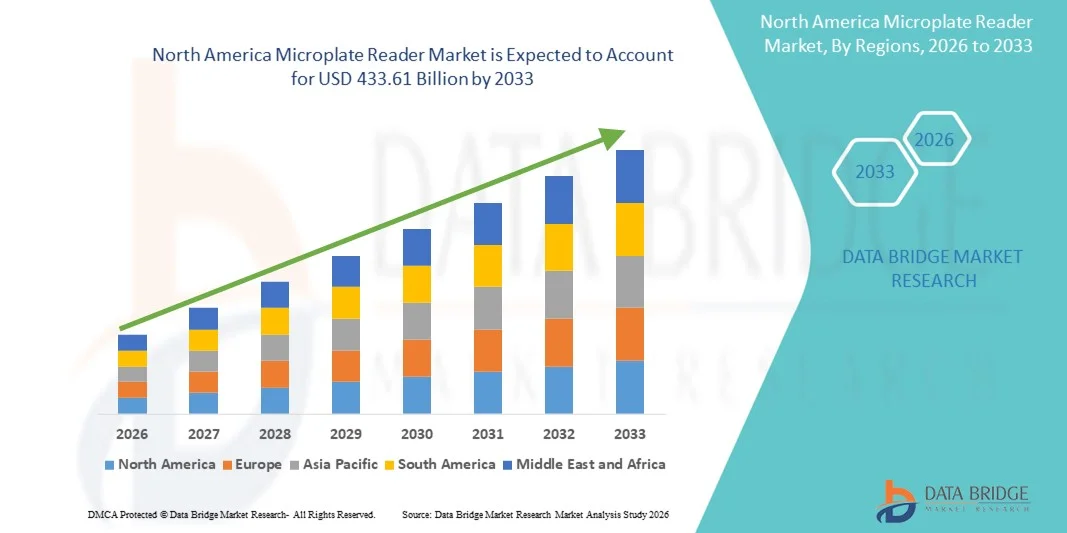
North America Microplate Reader Market Size
- The North America microplate reader market size was valued at USD 309.62 billion in 2025 and is expected to reach USD 433.61 billion by 2033, at a CAGR of 4.30% during the forecast period
- The market growth is largely driven by the increasing adoption of advanced laboratory automation and the continuous technological advancements in life sciences research, biotechnology, and clinical diagnostics, leading to higher efficiency and accuracy in experimental workflows across research institutes, pharmaceutical companies, and diagnostic laboratories
- Furthermore, the rising demand for high-throughput screening, precise quantitative analysis, and reliable data generation in drug discovery, genomics, proteomics, and immunoassays is positioning microplate readers as an essential analytical instrument. These converging factors are accelerating the uptake of Microplate Reader solutions, thereby significantly boosting the overall growth of the Microplate Reader market
North America Microplate Reader Market Analysis
- Microplate readers, which are analytical instruments used to detect biological, chemical, or physical events in samples arranged in microplates, have become essential tools across life sciences research, pharmaceutical development, and clinical diagnostics due to their high accuracy, automation compatibility, and ability to support high-throughput workflows in both research and diagnostic settings
- The growing demand for drug discovery, genomics, proteomics, immunoassays, and cell-based assays, along with increasing adoption of laboratory automation and data-driven research practices, is a key factor driving the expansion of the Microplate Reader market globally
- The U.S. dominated the microplate reader market, accounting for approximately 38.4% of the global revenue share in 2025, supported by strong federal and private funding for life sciences research, a highly developed pharmaceutical and biotechnology ecosystem, and widespread adoption of advanced laboratory automation technologies across academic institutions, contract research organizations, and diagnostic laboratories
- Canada is expected to be the fastest-growing country in the microplate reader market during the forecast period, with an estimated CAGR of 8.2%, driven by increasing investments in biomedical research, expanding biopharmaceutical manufacturing capabilities, growing government support for innovation, and rising demand for advanced diagnostic and research tools
- The 96-well segment dominated the largest market revenue share of 47.3% in 2025, driven by its extensive usage across pharmaceutical, biotechnology, clinical diagnostic, and academic research laboratories
Report Scope and Microplate Reader Market Segmentation
|
Attributes |
Microplate Reader Key Market Insights |
|
Segments Covered |
|
|
Countries Covered |
North America
|
|
Key Market Players |
• Thermo Fisher Scientific (U.S.) |
|
Market Opportunities |
|
|
Value Added Data Infosets |
In addition to the insights on market scenarios such as market value, growth rate, segmentation, geographical coverage, and major players, the market reports curated by the Data Bridge Market Research also include in-depth expert analysis, patient epidemiology, pipeline analysis, pricing analysis, and regulatory framework. |
North America Microplate Reader Market Trends
Technological Advancements and Automation in Microplate Readers
- A key and rapidly emerging trend in the global microplate reader market is the continuous advancement in automation, detection technologies, and data processing capabilities. Modern microplate readers are increasingly equipped with enhanced optical systems, multi-mode detection (absorbance, fluorescence, luminescence), and improved sensitivity to support high-throughput screening applications
- For instance, next-generation microplate readers offer faster read times, reduced sample volumes, and higher accuracy, making them highly suitable for applications in drug discovery, genomics, proteomics, and clinical diagnostics. These advancements are improving laboratory efficiency and enabling researchers to generate reliable results in shorter timeframes
- The integration of automated workflows and user-friendly software interfaces allows seamless data acquisition, analysis, and reporting. Advanced software platforms enable real-time data visualization, error reduction, and improved reproducibility, which are critical requirements in regulated laboratory environments
- Furthermore, compact and modular microplate reader designs are gaining traction, particularly in academic and small research laboratories, as they optimize laboratory space while maintaining high performance
- This trend toward technologically advanced, efficient, and versatile microplate readers is reshaping laboratory operations and setting higher performance expectations among end users, thereby driving product innovation and competitive differentiation across the market
- The growing preference for automated and high-performance microplate readers across pharmaceutical, biotechnology, and clinical research settings is significantly contributing to market expansion
North America Microplate Reader Market Dynamics
Driver
Rising Demand from Pharmaceutical, Biotechnology, and Clinical Research Activities
- The increasing volume of pharmaceutical research, biotechnology innovation, and clinical diagnostic testing is a major driver fueling the demand for microplate readers. These instruments play a critical role in enzyme assays, cell viability studies, immunoassays, and high-throughput screening workflows
- For instance, the growing focus on drug discovery, vaccine development, and personalized medicine has significantly increased the need for reliable and high-throughput laboratory instrumentation, including microplate readers
- Expanding investments in life sciences research, coupled with rising government and private funding for biomedical studies, are accelerating the adoption of microplate readers in research institutes and laboratories worldwide
- In addition, the increasing prevalence of chronic diseases has boosted diagnostic testing volumes, further driving demand for microplate-based assays in clinical laboratories
- The ability of microplate readers to deliver accurate, reproducible, and scalable results makes them indispensable tools in both research and diagnostic settings, thereby supporting sustained market growth
Restraint/Challenge
High Equipment Costs and Technical Complexity
- The relatively high initial cost of advanced microplate reader systems poses a significant challenge to market growth, particularly for small laboratories, academic institutions, and facilities operating under budget constraints
- For instance, multi-mode microplate readers offered by leading manufacturers such as Tecan and BMG LABTECH, which support absorbance, fluorescence, and luminescence detection in a single system, can involve substantial upfront investment, limiting their adoption among small-scale research laboratories and start-ups
- In addition , the technical complexity associated with operating sophisticated microplate readers and interpreting assay data often requires trained personnel and specialized expertise, increasing operational costs for end users
- Maintenance requirements, periodic calibration, and software upgrades further contribute to the total cost of ownership, making long-term affordability a concern for some laboratories
- Addressing these challenges through the introduction of cost-effective models, simplified software interfaces, and enhanced user training and support services will be critical for improving adoption and sustaining growth in the Microplate Reader market
North America Microplate Reader Market Scope
The market is segmented on the basis of well system, product type, application, end user, and distribution channel.
- By Well System
On the basis of well system, the Microplate Reader market is segmented into 96 wells, 384 wells, 1536 wells, and others. The 96-well segment dominated the largest market revenue share of 47.3% in 2025, driven by its extensive usage across pharmaceutical, biotechnology, clinical diagnostic, and academic research laboratories. This well format offers an optimal balance between throughput, assay flexibility, and operational simplicity, making it suitable for routine laboratory applications. Laboratories prefer 96-well plates due to their compatibility with a wide range of microplate readers and assay kits. The standardized format supports high reproducibility and ease of protocol validation. Additionally, lower capital investment and manageable reagent consumption make this format economically viable. Diagnostic laboratories widely use 96-well plates for ELISA and screening assays. Academic and government research institutions continue to rely on this format for teaching and research purposes. The availability of consumables and accessories further supports dominance. These factors collectively sustain the leadership of the 96-well segment.
The 384-well segment is expected to witness the fastest CAGR of 13.2% from 2026 to 2033, attributed to the rising demand for high-throughput screening in drug discovery and life sciences research. This format allows laboratories to process a larger number of samples simultaneously while significantly reducing reagent volumes. Pharmaceutical companies increasingly adopt 384-well systems to improve screening efficiency and lower per-assay costs. Advances in automation and assay miniaturization further enhance adoption. Improved reader sensitivity supports accurate detection even with smaller volumes. Contract research organizations also favor this format for large-scale studies. Growing R&D investments globally accelerate demand. The shift toward efficiency-driven laboratory workflows strongly supports rapid growth of this segment.
- By Product Type
On the basis of product type, the Microplate Reader market is segmented into multi-mode microplate readers, automated ELISA systems, automated nucleic acid purification systems, and single-mode microplate readers. The multi-mode microplate readers segment accounted for the largest market revenue share of 45.6% in 2025, owing to their ability to perform multiple detection modes such as absorbance, fluorescence, and luminescence within a single platform. These systems offer high flexibility, allowing laboratories to conduct diverse assays without investing in multiple instruments. Pharmaceutical and biotechnology companies extensively adopt multi-mode readers for drug screening and assay development. Research institutions benefit from their adaptability across varied experimental protocols. Advanced software integration improves data accuracy and workflow efficiency. Reduced instrument footprint optimizes laboratory space. The growing complexity of research activities further drives adoption. Strong demand across multiple end-use industries sustains segment dominance.
The automated ELISA systems segment is projected to grow at the fastest CAGR of 14.5% from 2026 to 2033, driven by the increasing demand for standardized and high-throughput immunoassays. Automation reduces manual errors and enhances reproducibility, which is critical in clinical diagnostics. Rising prevalence of infectious and chronic diseases increases ELISA testing volumes. Diagnostic laboratories are adopting automated platforms to manage growing workloads. Improved turnaround times and reduced labor requirements support adoption. Hospitals also increasingly rely on automated ELISA systems. Technological advancements improving assay precision further boost growth. These factors collectively drive rapid expansion of this segment.
- By Application
On the basis of application, the Microplate Reader market is segmented into protein and nucleic acid detection, enzyme-linked immunosorbent assay (ELISA), and others. The protein and nucleic acid detection segment dominated the market with a revenue share of 43.9% in 2025, supported by extensive use in genomics, proteomics, and molecular biology research. Microplate readers play a critical role in quantification and analysis of DNA, RNA, and proteins. Pharmaceutical and biotechnology companies rely heavily on these applications for drug discovery and biomarker research. Academic institutions widely use these assays for fundamental research. Increasing focus on personalized medicine further supports demand. High accuracy and reproducibility drive adoption. Expanding research funding globally strengthens market leadership. Broad applicability across industries sustains dominance.
The ELISA segment is expected to register the fastest CAGR of 14.9% from 2026 to 2033, driven by rising diagnostic testing for infectious diseases and chronic conditions. ELISA assays are widely preferred for their sensitivity, specificity, and cost-effectiveness. Increasing healthcare expenditures boost adoption in hospitals and diagnostic laboratories. Automation integration improves efficiency and throughput. Growing awareness of early disease detection further accelerates demand. Expanding diagnostic infrastructure in emerging markets supports growth. Regulatory approvals for ELISA-based tests enhance adoption. These factors collectively drive strong segment expansion.
- By End User
On the basis of end user, the Microplate Reader market is segmented into biotechnology and pharmaceutical companies, contract research organizations, diagnostic laboratories, hospitals, research and academic institutes, and others. The biotechnology and pharmaceutical companies segment held the largest market revenue share of 40.8% in 2025, driven by extensive R&D activities and increasing drug development pipelines. These organizations require high-throughput and precise analytical tools. Microplate readers support assay development, screening, and validation processes. Rising investments in biologics and biosimilars further boost demand. Advanced reader capabilities improve research efficiency. Integration with automated workflows supports large-scale studies. Global expansion of pharmaceutical research strengthens dominance. Continuous innovation sustains leadership of this segment.
The contract research organizations segment is anticipated to witness the fastest CAGR of 13.6% from 2026 to 2033, supported by the growing outsourcing of research and testing services. Pharmaceutical companies increasingly rely on CROs to reduce costs and accelerate timelines. CROs invest heavily in advanced laboratory instrumentation. Expansion of clinical trials globally drives demand. Increasing complexity of studies supports microplate reader adoption. Technological advancements enhance CRO capabilities. Growing presence in emerging markets further fuels growth. These trends drive rapid expansion of the CRO segment.
- By Distribution Channel
On the basis of distribution channel, the Microplate Reader market is segmented into direct tenders and retail sales. The direct tenders segment dominated the market with a revenue share of 59.4% in 2025, driven by large-scale procurement by hospitals, research institutions, and government laboratories. Bulk purchasing allows cost optimization and long-term service agreements. Public healthcare systems rely heavily on tender-based procurement. Research institutes prefer direct supplier relationships. Customized solutions further support adoption. Consistent funding cycles sustain demand. Strong institutional presence maintains dominance of this channel.
The retail sales segment is expected to grow at the fastest CAGR of 11.8% from 2026 to 2033, fueled by increasing purchases from small laboratories and private diagnostic centers. Growing availability of compact and affordable microplate readers supports retail expansion. Online distribution channels enhance accessibility. Start-ups and independent research facilities prefer retail procurement. Distributor networks strengthen regional reach. Rising laboratory setups in emerging economies boost demand. Improved after-sales support encourages adoption. These factors collectively drive rapid growth.
North America Microplate Reader Market Regional Analysis
- The North America microplate reader market is projected to expand at a robust CAGR over the forecast period, driven by strong regulatory frameworks, a high emphasis on research accuracy and compliance, and the growing demand for high-throughput, precise, and automated analytical instruments across life sciences and healthcare applications
- Rising investments in biomedical research, drug discovery, and clinical diagnostics, along with continuous modernization of laboratory infrastructure, are significantly accelerating the adoption of advanced microplate reader systems across the region
- The region is witnessing strong demand from academic and research institutes, pharmaceutical and biotechnology companies, contract research organizations (CROs), and diagnostic laboratories, with microplate readers being widely deployed in both newly established laboratories and facility upgrades
U.S. Microplate Reader Market Insight
The U.S. microplate reader market dominated the microplate reader market in 2025, accounting for approximately 38.4% of the global revenue share, supported by substantial federal and private funding for life sciences research and a highly developed pharmaceutical and biotechnology ecosystem. The widespread adoption of advanced laboratory automation technologies across academic institutions, CROs, and diagnostic laboratories has driven strong demand for high-performance and multi-mode microplate reader systems. Additionally, the country’s leadership in drug discovery, precision medicine, and translational research continues to fuel sustained market growth.
Canada Microplate Reader Market Insight
Canada microplate reader market is expected to be the fastest-growing country in the microplate reader market during the forecast period, registering an estimated CAGR of 8.2%. This growth is driven by increasing investments in biomedical research, expansion of biopharmaceutical manufacturing capabilities, and strong government support for innovation and life sciences. Furthermore, rising demand for advanced diagnostic solutions, growing research collaborations, and the modernization of laboratory facilities are expected to accelerate the adoption of microplate reader systems across the country.
North America Microplate Reader Market Share
The Microplate Reader industry is primarily led by well-established companies, including:
• Thermo Fisher Scientific (U.S.)
• Agilent Technologies (U.S.)
• PerkinElmer (U.S.)
• BMG LABTECH (Germany)
• Tecan Group (Switzerland)
• Bio-Rad Laboratories (U.S.)
• Berthold Technologies (Germany)
• Promega Corporation (U.S.)
• Awareness Technology (U.S.)
• Lonza Group (Switzerland)
• Rayto Life and Analytical Sciences (China)
• Mindray Bio-Medical Electronics (China)
• Erba Mannheim (Germany)
• Dynex Technologies (U.S.)
• Enzo Life Sciences (U.S.)
Latest Developments in North America Microplate Reader Market
- In February 2022, BMG LABTECH introduced the VANTAstar compact multimode microplate reader — a user-friendly, flexible reader with Enhanced Dynamic Range (EDR), rapid full-plate autofocus and automatic luminescence crosstalk reduction, officially introduced at SLAS2022
- In October 2022, Molecular Devices announced new SpectraMax iD series multi-mode microplate readers (iD3 / iD5 family refresh), positioning them as next-generation multimode readers with touchscreen/NFC features and expanded assay support
- In February 2023, PerkinElmer launched the EnVision Nexus — described as the company’s fastest and most sensitive multimode plate-reader platform to date, targeted at high-throughput screening and drug-discovery workflows
- In July 2023, Agilent (BioTek line) released the Gen6 data-analysis/control software for Agilent BioTek microplate readers, delivering walk-up usability, prebuilt experiment templates and automated optimization tools for multimode detection instruments
- In August 2024, Tecan reported (in its H1/2024 reporting material) the launch of Spark Cyto 3D (an extension of the Spark/Spark Cyto family) — a multimode/imaging system with tools for 3D cell model analysis and AI-based 3D analysis capabilities for spheroids/organoids and similar models

- Interactive Data Analysis Dashboard
- Company Analysis Dashboard for high growth potential opportunities
- Research Analyst Access for customization & queries
- Competitor Analysis with Interactive dashboard
- Latest News, Updates & Trend analysis
- Harness the Power of Benchmark Analysis for Comprehensive Competitor Tracking
Data collection and base year analysis are done using data collection modules with large sample sizes. The stage includes obtaining market information or related data through various sources and strategies. It includes examining and planning all the data acquired from the past in advance. It likewise envelops the examination of information inconsistencies seen across different information sources. The market data is analysed and estimated using market statistical and coherent models. Also, market share analysis and key trend analysis are the major success factors in the market report. To know more, please request an analyst call or drop down your inquiry.
The key research methodology used by DBMR research team is data triangulation which involves data mining, analysis of the impact of data variables on the market and primary (industry expert) validation. Data models include Vendor Positioning Grid, Market Time Line Analysis, Market Overview and Guide, Company Positioning Grid, Patent Analysis, Pricing Analysis, Company Market Share Analysis, Standards of Measurement, Global versus Regional and Vendor Share Analysis. To know more about the research methodology, drop in an inquiry to speak to our industry experts.
Data Bridge Market Research is a leader in advanced formative research. We take pride in servicing our existing and new customers with data and analysis that match and suits their goal. The report can be customized to include price trend analysis of target brands understanding the market for additional countries (ask for the list of countries), clinical trial results data, literature review, refurbished market and product base analysis. Market analysis of target competitors can be analyzed from technology-based analysis to market portfolio strategies. We can add as many competitors that you require data about in the format and data style you are looking for. Our team of analysts can also provide you data in crude raw excel files pivot tables (Fact book) or can assist you in creating presentations from the data sets available in the report.













