


North America Mobile Cardiac Telemetry (MCT) Market Size
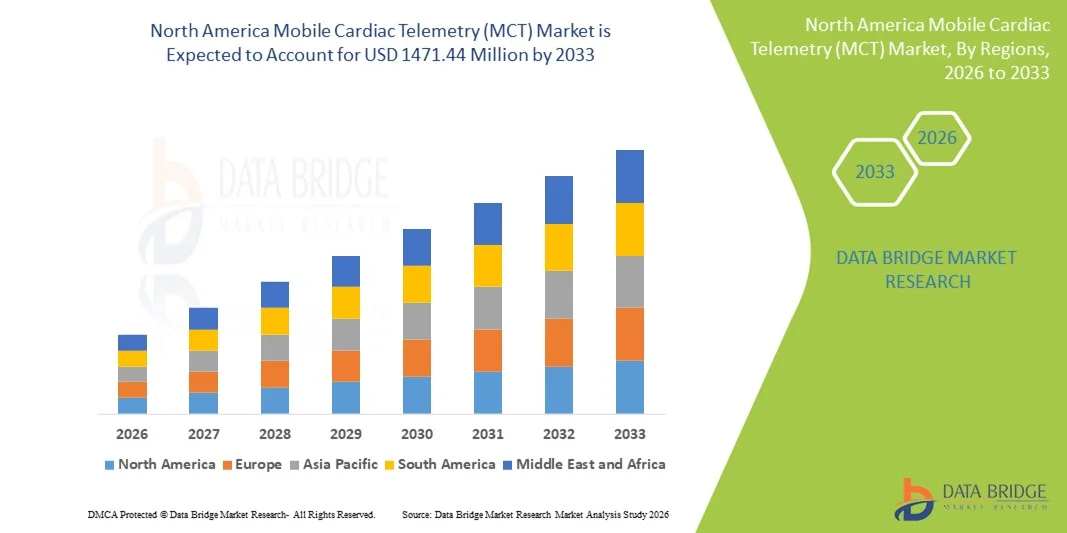
- The North America Mobile Cardiac Telemetry (MCT) market size was valued at USD 638.5 Million in 2025 and is expected to reach USD 1471.44 Million by 2033, at a CAGR of 11.00% during the forecast period
- The market growth is primarily driven by the increasing prevalence of cardiovascular diseases, the rising demand for continuous and remote cardiac monitoring, and rapid technological advancements in wearable and wireless ECG monitoring systems, which are accelerating the digitalization of cardiac care across hospitals, clinics, and homecare settings
- Furthermore, growing patient and physician preference for real-time, user-friendly, and clinically accurate cardiac monitoring solutions, combined with improved reimbursement policies and the integration of cloud-based data analytics and AI-enabled diagnostics, is positioning Mobile Cardiac Telemetry (MCT) as a preferred solution for long-term arrhythmia detection and management, thereby significantly boosting the overall growth of the MCT market
North America Mobile Cardiac Telemetry (MCT) Market Analysis
- Mobile Cardiac Telemetry (MCT), which enables continuous, real-time monitoring and wireless transmission of cardiac rhythm data, has become an essential tool in modern cardiovascular care across hospitals, ambulatory centers, and homecare settings due to its ability to detect transient and asymptomatic arrhythmias with high clinical accuracy
- The growing demand for MCT is primarily driven by the rising prevalence of cardiovascular diseases, increasing geriatric population, and the shift toward remote patient monitoring and value-based care models, as healthcare providers seek more efficient, patient-friendly, and data-driven diagnostic solutions
- The U.S. dominated the mobile cardiac telemetry (MCT) market in 2025, accounting for approximately 82% of the North American revenue share, driven by the country’s advanced healthcare infrastructure, high prevalence and diagnosis rates of cardiac arrhythmias, widespread adoption of remote patient monitoring technologies, and favorable reimbursement policies, along with strong investments in digital health, early acceptance of innovative MCT solutions by clinicians, and the presence of leading cardiac diagnostics and telecardiology companies supporting large-scale deployment across hospitals and outpatient settings
- Canada is expected to be the fastest-growing country in the North America Mobile Cardiac Telemetry (MCT) market during the forecast period, registering a CAGR of around 12.5% from 2026 to 2033, supported by increasing investments in digital health, expanding telecardiology programs, rising awareness of cardiovascular diseases, and strong government initiatives promoting remote patient monitoring across provinces
- The multi-channel segment held the largest market revenue share of approximately 61.3% in 2025, owing to its advanced ability to collect comprehensive cardiac rhythm data.
Report Scope and Mobile Cardiac Telemetry (MCT) Market Segmentation
|
Attributes |
Mobile Cardiac Telemetry (MCT) Key Market Insights |
|
Segments Covered |
|
|
Countries Covered |
North America
|
|
Key Market Players |
|
|
Market Opportunities |
|
|
Value Added Data Infosets |
In addition to the insights on market scenarios such as market value, growth rate, segmentation, geographical coverage, and major players, the market reports curated by the Data Bridge Market Research also include in-depth expert analysis, patient epidemiology, pipeline analysis, pricing analysis, and regulatory framework. |
North America Mobile Cardiac Telemetry (MCT) Market Trends
Advancements in Continuous Remote Cardiac Monitoring
- A significant and accelerating trend in the North America mobile cardiac telemetry (MCT) market is the growing adoption of continuous, real-time cardiac monitoring technologies that enable long-term detection of arrhythmias and other cardiac abnormalities outside hospital settings
- For instance, MCT systems from providers such as Philips Healthcare are widely used to continuously monitor ECG data in ambulatory patients, enabling early detection of intermittent arrhythmias that may be missed by short-duration Holter monitoring
- MCT systems are increasingly being used to provide uninterrupted ECG data transmission to clinicians, improving diagnostic accuracy for conditions such as atrial fibrillation, tachycardia, and unexplained syncope
- Technological advancements in sensor miniaturization, wireless data transmission, and wearable device design are enhancing patient comfort and compliance, thereby supporting wider adoption of MCT solutions
- The integration of advanced analytics within MCT platforms allows for faster interpretation of large ECG datasets and timely clinical decision-making, reducing delays in diagnosis and treatment
- Growing emphasis on outpatient care and home-based cardiac monitoring is further strengthening demand for MCT systems across both hospital-affiliated programs and independent diagnostic service providers
- This trend toward more accurate, patient-friendly, and continuously connected cardiac monitoring solutions is reshaping clinical approaches to long-term heart rhythm management
North America Mobile Cardiac Telemetry (MCT) Market Dynamics
Driver
Rising Burden of Cardiovascular Diseases and Demand for Remote Monitoring
- The increasing prevalence of cardiovascular diseases, including arrhythmias and atrial fibrillation, is a major driver for the growing demand for Mobile Cardiac Telemetry technologies
- For instance, according to clinical evidence, extended monitoring using MCT devices has demonstrated higher arrhythmia detection rates compared to traditional Holter monitors, particularly in patients with cryptogenic stroke and intermittent atrial fibrillation
- An aging population and a rise in lifestyle-related risk factors such as obesity, diabetes, and hypertension are significantly contributing to higher diagnosis rates of cardiac rhythm disorders
- MCT offers clinicians the ability to monitor patients continuously over extended periods, leading to higher diagnostic yield compared to traditional monitoring solution
- The shift toward value-based care and early intervention strategies is encouraging healthcare systems to adopt remote monitoring tools that reduce emergency admissions and overall treatment costs
- In addition, growing awareness among physicians about the clinical benefits of long-term ambulatory ECG monitoring is accelerating the use of MCT across cardiology practices and hospitals
- Expansion of reimbursement coverage for remote cardiac monitoring services in North America further supports widespread adoption of MCT solutions
Restraint/Challenge
High Cost and Data Management Complexity
- High initial costs associated with mobile cardiac telemetry systems, including devices, data management infrastructure, and professional monitoring services, present a barrier to adoption, particularly for smaller healthcare facilities
- For instance, smaller clinics and independent cardiology practices often face budget constraints due to recurring service fees and specialized staffing requirements linked to continuous ECG data analysis
- The large volume of continuous ECG data generated by MCT devices creates challenges related to data storage, interpretation, and workflow integration for healthcare providers
- Concerns regarding data privacy, secure transmission of patient health information, and compliance with regulatory standards can slow adoption among risk-averse organizations
- Limited patient awareness and discomfort with wearing monitoring devices for extended durations may also affect compliance and overall effectiveness of MCT solutions
- Addressing these challenges through cost optimization, improved data analytics, streamlined clinical workflows, and robust data security measures will be critical for sustained growth in the Mobile Cardiac Telemetry market
North America Mobile Cardiac Telemetry (MCT) Market Scope
The market is segmented on the basis of technology, type, cellular connection, and end user.
- By Technology
On the basis of technology, the Mobile Cardiac Telemetry (MCT) market is segmented into lead-based and patch-based systems. The lead-based segment dominated the obile Cardiac Telemetry (MCT) market with a revenue share of approximately 58.6% in 2025, primarily due to its long-standing clinical usage and high diagnostic accuracy in continuous ECG monitoring. Lead-based systems are capable of capturing multi-lead ECG data, allowing physicians to detect complex arrhythmias with greater precision. These systems are widely preferred for patients with high-risk cardiac conditions, post-stroke complications, and unexplained syncope. Lead-based MCT devices provide continuous real-time data transmission, enabling prompt clinical intervention when abnormal rhythms are detected. Their reliability and consistency make them the standard choice in hospital and IDTF settings. Additionally, strong physician familiarity and established clinical guidelines further support adoption. Higher reimbursement acceptance for lead-based monitoring also contributes to segment dominance. Despite slightly lower patient comfort compared to patches, their superior clinical validation sustains demand. Integration with advanced cardiac data analytics platforms enhances usability. Long monitoring durations with minimal data loss further strengthen adoption. Expansion of cardiac diagnostic infrastructure globally continues to support this segment’s leadership.
The patch-based segment is expected to witness the fastest growth at a CAGR of 18.9% from 2026 to 2033, driven by increasing demand for comfortable, discreet, and minimally invasive cardiac monitoring solutions. Patch-based systems eliminate the need for external wires, significantly improving patient compliance during extended monitoring periods. These devices are particularly suited for ambulatory patients and home healthcare environments. Rising preference for wearable medical devices is accelerating adoption. Continuous improvements in sensor accuracy, battery performance, and adhesive materials are enhancing clinical confidence. Patch-based MCT devices support seamless wireless connectivity, making them compatible with modern telehealth platforms. Growing awareness of early arrhythmia detection further boosts demand. Physicians increasingly prescribe patches for low- to moderate-risk patients. Cost-effectiveness relative to traditional systems also supports penetration. Aging populations and rising cardiovascular disease prevalence further drive growth. The shift toward remote patient monitoring strongly favors patch-based technologies.
- By Type
On the basis of type, the Mobile Cardiac Telemetry (MCT) market is segmented into multi-channel and single-channel systems. The multi-channel segment held the largest market revenue share of approximately 61.3% in 2025, owing to its advanced ability to collect comprehensive cardiac rhythm data. Multi-channel MCT systems provide multiple simultaneous ECG views, enabling accurate detection of complex and overlapping arrhythmias. These systems are extensively used in hospitals and specialized cardiac centers for diagnosing critical conditions. Their high sensitivity reduces the risk of false negatives. Multi-channel devices support long-term monitoring without compromising data quality. Clinicians prefer these systems for patients with known cardiac disorders and high arrhythmia burden. Integration with advanced ECG analysis software enhances workflow efficiency. Strong reimbursement policies further support adoption. The reliability of data transmission ensures clinical confidence. Availability of trained professionals also boosts utilization. Ongoing innovations in multi-channel systems improve patient usability. Increasing demand for precision diagnostics strongly sustains segment dominance.
The single-channel segment is projected to grow at the fastest CAGR of 17.4% from 2026 to 2033, supported by rising demand for simplified and cost-effective monitoring solutions. Single-channel MCT devices are easier to deploy and require minimal patient training. These systems are increasingly prescribed for screening intermittent or low-risk arrhythmias. Their compact design supports home healthcare and outpatient monitoring. Growing adoption in emerging economies is driven by affordability. Technological improvements have enhanced signal clarity despite limited channels. Single-channel devices support prolonged wear, aiding detection of sporadic cardiac events. Increased awareness of preventive cardiac care accelerates demand. Integration with mobile applications improves patient engagement. Physicians increasingly recommend single-channel solutions for initial diagnosis. Expanding telemedicine services further push adoption. Favorable reimbursement expansions also support market growth.
- By Cellular Connection
On the basis of cellular connection, the Mobile Cardiac Telemetry (MCT) market is segmented into wireless (Wi-Fi) and Bluetooth (BT). The wireless (Wi-Fi) segment dominated the market with a revenue share of around 55.8% in 2025, owing to its ability to support continuous long-range data transmission. Wi-Fi-enabled MCT systems ensure uninterrupted ECG data flow to centralized monitoring centers. These systems are commonly used in hospital-linked home monitoring programs. High bandwidth enables real-time alerts and analytics processing. Physicians benefit from immediate access to patient data. Wi-Fi connectivity integrates seamlessly with cloud-based cardiac platforms. Reliable network availability supports continuous monitoring. This technology is widely adopted in developed regions with strong digital infrastructure. Enhanced data security protocols further boost trust. Large-scale remote monitoring initiatives rely heavily on Wi-Fi. The segment benefits from the expansion of broadband connectivity. Increasing telehealth adoption strengthens long-term demand.
The Bluetooth segment is expected to register the fastest CAGR of 19.6% from 2026 to 2033, driven by its low power consumption and portability. Bluetooth-enabled MCT devices support local data transmission to smartphones or hubs. These systems are ideal for wearable and patch-based monitoring devices. Energy efficiency enables longer battery life. Ease of device pairing improves patient experience. Bluetooth supports compact and lightweight designs. Growing smartphone penetration boosts compatibility. These systems are widely used in ambulatory settings. Cost advantages also support adoption in price-sensitive markets. Continuous advancements in Bluetooth Low Energy (BLE) enhance reliability. Increased demand for mobile healthcare solutions accelerates growth. Integration with digital health apps further supports expansion.
- By End User
On the basis of end user, the Mobile Cardiac Telemetry (MCT) market is segmented into home healthcare, hospitals, IDTFs, cardiac centers, and ambulatory surgical centers. The hospital segment accounted for the largest market revenue share of approximately 36.9% in 2025, driven by high patient volumes and advanced diagnostic infrastructure. Hospitals serve as the primary centers for complex cardiac evaluations. Availability of trained cardiologists supports extensive MCT usage. Hospitals use MCT for inpatient, post-discharge, and emergency monitoring. Integrated IT systems improve data handling efficiency. Strong reimbursement frameworks support hospital-based monitoring. Adoption is reinforced by standardized diagnostic protocols. Continuous advancements in cardiac care improve MCT utilization. Hospitals also engage in large-scale cardiac screening programs. High trust in hospital-based diagnostics sustains dominance. Ongoing investments in cardiac departments further strengthen the segment.
The home healthcare segment is projected to witness the fastest CAGR of 20.3% from 2026 to 2033, driven by the shift toward remote patient monitoring. Growing elderly populations increase demand for home-based cardiac care. Patients prefer monitoring in familiar environments. MCT enables real-time physician oversight without hospital visits. Reduced healthcare costs support adoption. Technological advancements improve ease of use. Expanding telehealth reimbursement enhances accessibility. Increased awareness of early diagnosis drives demand. Home healthcare improves patient compliance. Chronic cardiac patients benefit from continuous monitoring. Rising adoption of wearable technologies further fuels growth. Healthcare system decentralization supports long-term expansion.
North America Mobile Cardiac Telemetry (MCT) Market Regional Analysis
- North America represents a mature and innovation-driven market for mobile cardiac telemetry (MCT)
- Supported by well-established healthcare systems, strong digital health adoption, and a high burden of cardiovascular diseases
- The region benefits from widespread acceptance of remote patient monitoring, increasing hospital-to-home care transitions, and supportive reimbursement frameworks that encourage the use of advanced cardiac monitoring technologies
U.S. Mobile Cardiac Telemetry (MCT) Market Insight
The U.S. mobile cardiac telemetry dominated the Mobile Cardiac Telemetry (MCT) market in 2025, accounting for approximately 82% of the North American revenue share, driven by the country’s advanced healthcare infrastructure and high prevalence and diagnosis rates of cardiac arrhythmias. Widespread adoption of remote patient monitoring technologies, favorable Medicare and private payer reimbursement policies, and strong investments in digital health have significantly supported market growth. In addition, early clinical acceptance of innovative MCT solutions, continuous technological advancements, and the strong presence of leading cardiac diagnostics and telecardiology companies enable large-scale deployment of MCT systems across hospitals, outpatient clinics, and home healthcare settings.
Canada Mobile Cardiac Telemetry (MCT) Market Insight
Canada mobile cardiac telemetry is expected to be the fastest-growing country in the North America Mobile Cardiac Telemetry (MCT) market during the forecast period, registering a CAGR of around 12.5% from 2026 to 2033. This growth is supported by increasing investments in digital health infrastructure, expansion of telecardiology and remote monitoring programs, and rising awareness of cardiovascular diseases. Moreover, strong government initiatives aimed at improving access to remote patient monitoring and reducing healthcare system burdens across provinces are accelerating the adoption of MCT solutions in Canada.
North America Mobile Cardiac Telemetry (MCT) Market Share
The Mobile Cardiac Telemetry (MCT) industry is primarily led by well-established companies, including:
• iRhythm Technologies, Inc. (U.S.)
• Philips Healthcare (Netherlands)
• GE HealthCare (U.S.)
• Medtronic (Ireland)
• Baxter International (U.S.)
• Boston Scientific Corporation (U.S.)
• AliveCor, Inc. (U.S.)
• ZOLL Medical Corporation (U.S.)
• VectraCor, Inc. (U.S.)
• ScottCare Cardiovascular Solutions (U.S.)
• Cardiac Insight, Inc. (U.S.)
• Spacelabs Healthcare (U.S.)
• ACS Diagnostics (U.S.)
Latest Developments in North America Mobile Cardiac Telemetry (MCT) Market
- In February 2021, Royal Philips completed the acquisition of BioTelemetry, a leading U.S. provider of remote cardiac diagnostics and monitoring, strengthening Philips’ position in ambulatory cardiac monitoring and MCT services across North America
- In May 2021, VitalConnect announced the addition of a Mobile Cardiac Telemetry offering to its cardiac monitoring platform, expanding wearable/patch-based MCT options for ambulatory and home monitoring programs
- In November 2021, Philips (via its Healthcare unit) signed an agreement to acquire Cardiologs, an AI/cloud-based cardiac diagnostics company, to boost Philips’ AI capabilities and cloud diagnostics for cardiac monitoring services including MCT
- In May 2023, the U.S. FDA posted a warning letter to iRhythm Technologies regarding certain regulatory issues for its Zio AT system, drawing attention to compliance and labeling matters for ambulatory ECG/MCT-classified solutions
- In October 2024, iRhythm announced it had received FDA 510(k) clearance for design modifications and labeling updates to its Zio AT device — a regulatory step that supported further deployment of its ambulatory/MCT-capable offering in 2025
- In January 2025, the U.S. FDA designated a Class I correction for Philips’ Monitoring Service Application used with its Mobile Cardiac Outpatient Telemetry (MCOT) service after finding that some ECG events from July 2022–July 2024 were not properly routed, prompting Philips to issue corrections and notifications to customers

- Interactive Data Analysis Dashboard
- Company Analysis Dashboard for high growth potential opportunities
- Research Analyst Access for customization & queries
- Competitor Analysis with Interactive dashboard
- Latest News, Updates & Trend analysis
- Harness the Power of Benchmark Analysis for Comprehensive Competitor Tracking
Data collection and base year analysis are done using data collection modules with large sample sizes. The stage includes obtaining market information or related data through various sources and strategies. It includes examining and planning all the data acquired from the past in advance. It likewise envelops the examination of information inconsistencies seen across different information sources. The market data is analysed and estimated using market statistical and coherent models. Also, market share analysis and key trend analysis are the major success factors in the market report. To know more, please request an analyst call or drop down your inquiry.
The key research methodology used by DBMR research team is data triangulation which involves data mining, analysis of the impact of data variables on the market and primary (industry expert) validation. Data models include Vendor Positioning Grid, Market Time Line Analysis, Market Overview and Guide, Company Positioning Grid, Patent Analysis, Pricing Analysis, Company Market Share Analysis, Standards of Measurement, Global versus Regional and Vendor Share Analysis. To know more about the research methodology, drop in an inquiry to speak to our industry experts.
Data Bridge Market Research is a leader in advanced formative research. We take pride in servicing our existing and new customers with data and analysis that match and suits their goal. The report can be customized to include price trend analysis of target brands understanding the market for additional countries (ask for the list of countries), clinical trial results data, literature review, refurbished market and product base analysis. Market analysis of target competitors can be analyzed from technology-based analysis to market portfolio strategies. We can add as many competitors that you require data about in the format and data style you are looking for. Our team of analysts can also provide you data in crude raw excel files pivot tables (Fact book) or can assist you in creating presentations from the data sets available in the report.













