


What is the North America Molecular Spectroscopy Market Size and Growth Rate?
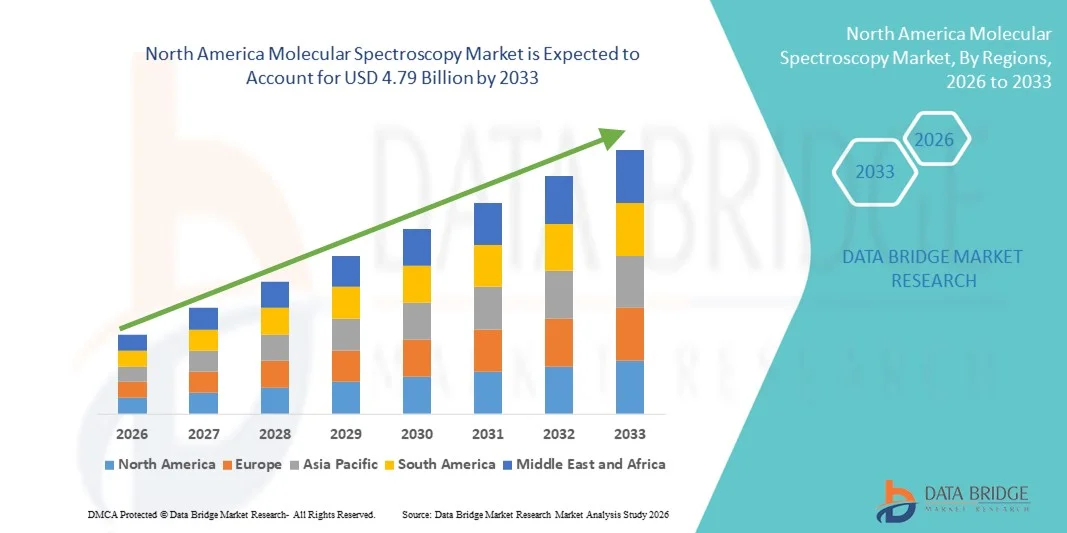
- As per Data Bridge Market Research Analysis the North America molecular spectroscopy market size was valued at USD 2.78 billion in 2025 and is expected to reach USD 4.79 billion by 2033, at a CAGR of 7.05% during the forecast period
- The market growth is largely fueled by the region’s strong pharmaceutical, biotechnology, and research infrastructure, substantial investments in R&D activities, and increasing adoption of advanced analytical techniques for drug development, quality control, and environmental testing
- Furthermore, rising demand for precise, high‑performance molecular characterization tools and the ongoing integration of spectroscopy in academic, industrial, and clinical applications are establishing molecular spectroscopy as a critical analytical solution across North American industries. These converging factors are accelerating the uptake of molecular spectroscopy technologies, thereby significantly boosting the market’s growth
Market Size & Forecast
- Market Value (2025): USD 2.78 billion
- Expected Market Value (2033): USD 4.79 billion
- Forecast CAGR (2026–2033): 7.05%
North America Molecular Spectroscopy Market Analysis
- Molecular spectroscopy, encompassing techniques such as infrared (IR), Raman, and nuclear magnetic resonance (NMR) spectroscopy, is increasingly vital for chemical, pharmaceutical, environmental, and materials research due to its ability to provide precise molecular characterization, structural analysis, and real-time monitoring in both academic and industrial settings
- The escalating demand for molecular spectroscopy is primarily fueled by increasing R&D activities in pharmaceuticals and biotechnology, stringent quality control requirements, and the growing adoption of advanced analytical techniques for drug development, material testing, and environmental monitoring
- The United States dominated the molecular spectroscopy market with the largest revenue share of 82% in 2025, characterized by well-established pharmaceutical and biotech industries, significant research funding, and a strong presence of key spectroscopy equipment manufacturers, with substantial growth in spectroscopy instrument installations across pharmaceutical labs, academic institutions, and contract research organizations, driven by innovations in automation and high-throughput spectroscopy systems
- Canada is expected to be the fastest-growing country in the molecular spectroscopy market during the forecast period due to rising industrial R&D activities, government initiatives supporting advanced analytical technologies, and growing adoption of spectroscopy in environmental and chemical testing
- Infrared (IR) spectroscopy segment dominated the molecular spectroscopy market with a market share of 35.9% in 2025, driven by its established applications in material characterization, non-destructive testing, and ease of integration into analytical workflows
Report Scope and North America Molecular Spectroscopy Market Segmentation
|
Attributes |
North America Molecular Spectroscopy Key Market Insights |
|
Segments Covered |
|
|
Countries Covered |
North America
|
|
Key Market Players |
|
|
Market Opportunities |
|
|
Value Added Data Infosets |
In addition to the insights on market scenarios such as market value, growth rate, segmentation, geographical coverage, and major players, the market reports curated by the Data Bridge Market Research also include in-depth expert analysis, patient epidemiology, pipeline analysis, pricing analysis, and regulatory framework |
What is the Key Trend in the North America Molecular Spectroscopy Market?
Integration of Automation and AI-Driven Data Analysis
- A significant and accelerating trend in the North America molecular spectroscopy market is the growing integration of automation and artificial intelligence (AI) into spectroscopy instruments, enhancing throughput, accuracy, and predictive analysis for chemical, pharmaceutical, and material research
- For instance, Thermo Fisher Scientific’s AI-enabled Raman spectrometers can automatically interpret complex spectra and suggest compound identification, reducing manual processing time and improving laboratory efficiency
- AI integration enables predictive modeling of molecular interactions, anomaly detection in spectral data, and automated reporting, while advanced software platforms allow researchers to visualize and analyze results with minimal human intervention
- The seamless incorporation of spectroscopy instruments with laboratory information management systems (LIMS) facilitates centralized control over multiple experiments, enabling unified data tracking, reproducibility, and compliance across research workflows
- This trend towards more intelligent, automated, and interconnected spectroscopy systems is fundamentally reshaping research efficiency and expectations in North America. Consequently, companies such as Bruker are developing AI-enabled spectroscopy solutions with automated sample handling and real-time data interpretation
- The demand for spectroscopy instruments with AI and automation capabilities is growing rapidly across pharmaceutical, chemical, and environmental sectors, as researchers increasingly prioritize speed, accuracy, and reproducible results
- The trend of coupling spectroscopy instruments with cloud-based platforms for remote monitoring and data sharing is gaining traction, allowing collaborative research and real-time decision-making across multiple sites
North America Molecular Spectroscopy Market Dynamics
Driver
Rising R&D Investment and Adoption in Pharmaceutical and Chemical Industries
- The increasing R&D activities in pharmaceutical, biotechnology, and chemical industries, coupled with stringent quality control regulations, are a major driver for the heightened demand for molecular spectroscopy instruments
- For instance, Agilent Technologies expanded its molecular spectroscopy solutions in 2025 to support high-throughput screening and analytical testing in U.S.-based pharmaceutical labs, boosting adoption across multiple research facilities
- As companies aim for faster drug development, precise material characterization, and regulatory compliance, spectroscopy provides critical analytical insights that traditional methods cannot match
- Furthermore, the growing need for real-time monitoring, non-destructive testing, and accurate molecular analysis in laboratories and contract research organizations is making spectroscopy instruments indispensable tools
- The ability to integrate spectroscopy data with advanced software platforms for reporting, visualization, and predictive modeling is propelling adoption in both academic and commercial research facilities, driving market growth
- For instance, Bruker’s expansion of high-resolution NMR solutions for U.S. pharmaceutical companies demonstrates the rising demand for precise structural analysis in drug discovery
- Increasing government funding and grants for analytical research in the U.S. and Canada further encourage laboratories to adopt advanced spectroscopy systems for innovative research projects
Restraint/Challenge
High Equipment Cost and Technical Complexity
- The high initial investment required for advanced molecular spectroscopy instruments poses a significant challenge to broader market adoption, particularly for smaller laboratories or startups
- For instance, the cost of high-end NMR or Raman spectroscopy systems can exceed hundreds of thousands of USD, making it inaccessible for budget-constrained research organizations
- In addition, the technical complexity of operating and maintaining spectroscopy instruments requires skilled personnel and ongoing training, which can deter potential users from adoption
- Furthermore, ensuring accurate calibration, data interpretation, and compliance with analytical standards adds operational challenges, particularly in multi-user laboratory environments
- Overcoming these challenges through development of user-friendly, compact, and lower-cost spectroscopy instruments, along with enhanced training programs and software support, will be vital for sustained growth in the North America market
- For instance, smaller laboratories may struggle to justify investments in high-end spectroscopy equipment without clear ROI, slowing adoption rates despite technological advantages
- In addition, regulatory compliance requirements and frequent software/hardware upgrades increase operational costs, posing further barriers for adoption in budget-sensitive research environments
North America Molecular Spectroscopy Market Scope
The market is segmented on the basis of technology and application.
- By Technology
On the basis of technology, the North America molecular spectroscopy market is segmented into Nuclear Magnetic Resonance (NMR) Spectroscopy, UV-Visible Spectroscopy, Infrared (IR) Spectroscopy, Near-Infrared (NIR) Spectroscopy, Color Measurement Spectroscopy, Raman Spectroscopy, and Other Technologies. Infrared (IR) Spectroscopy segment dominated the market in 2025 with a market share of 35.9%, driven by its widespread applications in material characterization, pharmaceutical quality control, environmental analysis, and non-destructive testing. IR spectroscopy is highly valued for its reliability, ease of integration into automated laboratory workflows, and ability to provide rapid, reproducible results across both academic and industrial research settings. Its compatibility with other analytical techniques, such as chromatography and mass spectrometry, enhances its adoption for regulatory-compliant studies. The segment benefits from strong investments in laboratory infrastructure and continuous technological improvements, including miniaturized and portable IR devices.
Near-Infrared (NIR) Spectroscopy segment is expected to witness the fastest growth from 2026 to 2033, fueled by its increasing adoption in food and beverage testing, pharmaceutical quality control, and agricultural applications. NIR spectroscopy allows rapid, non-destructive analysis of moisture content, chemical composition, and product quality without extensive sample preparation. The technology is especially attractive for on-line and in-line industrial process monitoring, which is critical in regulated industries. Portable and handheld NIR instruments facilitate field-based applications, expanding usage beyond laboratory environments. Companies are introducing AI-powered predictive analytics and cloud-enabled NIR platforms to improve accuracy, reduce human error, and enable real-time decision-making.
- By Application
On the basis of application, the North America molecular spectroscopy market is segmented into pharmaceutical applications, food and beverage testing, biotechnology and biopharmaceutical applications, environmental testing, academic research, and other applications. Pharmaceutical Applications segment dominated the market in 2025, supported by stringent regulatory requirements and the need for precise molecular characterization in drug discovery, formulation, and quality control. Spectroscopy instruments, particularly NMR and IR systems, are critical for identifying molecular structures, detecting impurities, and ensuring batch-to-batch consistency. Pharmaceutical companies increasingly integrate spectroscopy data with laboratory information management systems (LIMS) for traceability and compliance. High throughput capabilities of automated spectroscopy platforms are further boosting adoption in research and production labs. For instance, large U.S.-based pharmaceutical companies leverage spectroscopy solutions to accelerate clinical trials and formulation development.
Food and Beverage Testing segment is expected to witness the fastest growth from 2026 to 2033, driven by increasing consumer demand for food safety, quality control, and authenticity verification. NIR, UV-Visible, and Raman spectroscopy are widely adopted for rapid analysis of moisture content, contaminants, adulterants, and nutritional composition. Portable and handheld spectroscopy devices allow on-site testing, which is particularly advantageous for food processing plants and supply chains. Regulatory mandates and growing awareness of foodborne hazards are further accelerating market adoption. Companies are introducing integrated solutions with AI-powered predictive analytics to improve efficiency and reduce errors in food quality assessments. In addition, North America’s focus on organic and high-value foods is boosting demand for spectroscopy-based testing to ensure compliance and product differentiation. The convenience, speed, and non-destructive nature of these instruments make them increasingly popular in the sector.
North America Molecular Spectroscopy Market Regional Analysis
- The United States dominated the molecular spectroscopy market with the largest revenue share of 82% in 2025, characterized by well-established pharmaceutical and biotech industries, significant research funding, and a strong presence of key spectroscopy equipment manufacturers
- Laboratories and research institutions in the U.S. highly value the precision, reliability, and versatility offered by molecular spectroscopy instruments such as NMR, IR, and Raman systems for drug discovery, quality control, environmental analysis, and academic research
- This widespread adoption is further supported by substantial R&D investments, advanced laboratory infrastructure, skilled personnel, and the presence of leading spectroscopy equipment manufacturers, establishing the U.S. as the key hub for both high-end and portable spectroscopy solutions in North America
U.S. Molecular Spectroscopy Market Insight
The U.S. molecular spectroscopy market captured the largest revenue share of 82% in 2025 within North America, fueled by the presence of leading pharmaceutical, biotechnology, and academic research institutions. Laboratories are increasingly prioritizing advanced analytical solutions for drug discovery, quality control, and regulatory compliance. The growing adoption of automated and AI-enabled spectroscopy instruments, coupled with integration into laboratory information management systems (LIMS), further propels the market. Moreover, high R&D expenditure, a skilled workforce, and the presence of major spectroscopy instrument manufacturers such as Bruker and Agilent are significantly contributing to market expansion.
Canada Molecular Spectroscopy Market Insight
The Canada molecular spectroscopy market is projected to grow at a considerable CAGR during the forecast period, driven by rising investments in research and development, environmental testing, and industrial quality control. Canadian laboratories are adopting spectroscopy instruments for chemical analysis, food safety testing, and biotechnology research. The government’s focus on advanced analytical technologies, combined with the expansion of academic and industrial research facilities, fosters adoption. In addition, portable and user-friendly spectroscopy systems are facilitating broader accessibility, enhancing market growth across both public and private sectors.
Mexico Molecular Spectroscopy Market Insight
The Mexico molecular spectroscopy market is anticipated to expand steadily during the forecast period, fueled by growing pharmaceutical, chemical, and food testing industries. Increasing regulatory requirements for quality control and environmental monitoring are driving the adoption of spectroscopy technologies. Local manufacturers and distributors are supporting market growth by providing cost-effective and portable solutions suitable for small- and medium-sized laboratories. Furthermore, collaborations between research institutions and spectroscopy instrument suppliers are promoting knowledge transfer and boosting adoption in both academic and industrial applications.
North America Molecular Spectroscopy Market Share
The North America Molecular Spectroscopy industry is primarily led by well-established companies, including:
- Thermo Fisher Scientific Inc. (U.S.)
- Agilent Technologies, Inc. (U.S.)
- Bruker Corporation (U.S.)
- PerkinElmer Inc. (U.S.)
- Waters Corporation (U.S.)
- Shimadzu Scientific Instruments (Japan)
- JEOL Ltd. (Japan)
- ABB Ltd (Switzerland)
- FOSS A/S (Denmark)
- Metrohm AG (Switzerland)
- Kaiser Optical Systems, Inc. (U.S.)
- Block Engineering (U.S.)
- Avantes BV (Netherlands)
- Galaxy Scientific (U.S.)
- Gasera Ltd (Finland)
- Ibsen Photonics (Norway)
- Industrial Test Systems, Inc. (U.S.)
- Spectral Evolution, Inc. (U.S.)
- Viavi Solutions Inc. (U.S.)
- Magritek Ltd (New Zealand)
What are the Recent Developments in North America Molecular Spectroscopy Market?
- In March 2025, HORIBA announced the launch of its Veloci™ BioPharma Analyzer for biopharma and pharmaceutical applications, a novel A‑TEEM™ spectroscopy system that combines absorbance, transmittance, and fluorescence for fast, label‑free molecular fingerprinting of proteins, antibodies, and vaccine components, reducing sample prep and analysis time in QA/QC workflow
- In March 2025, BrightSpec unveiled the world’s first commercial Molecular Rotational Resonance (MRR) instrument suite at PittCon 2025, introducing spectraMRR, isoMRR, and nanoMRR platforms designed to provide highly specific molecular structural identification and volatile compound quantification without extensive sample preparation
- In March 2025, HORIBA released three new spectroscopy products, including an advanced molecular fingerprinting system and a high‑throughput Raman screening tool, designed to support accelerated analysis in drug discovery, vaccine characterization, and protein/media monitoring in life science research
- In February 2025, Bruker Corporation launched the VERTEX NEO Platform with its first product, the VERTEX NEO R vacuum FT‑IR spectrometer, designed to set new standards in high‑end Fourier‑transform infrared spectroscopy for academic and industrial research applications with enhanced detector technology and broader spectral coverage
- In May 2024, Exum Instruments partnered with Edge Scientific to expand distribution of its Massbox laser ablation laser ionization time‑of‑flight (LALI‑TOF‑MS) mass spectrometer technology in Canada, enabling trace‑level quantitative analysis and elemental mapping for research and industrial laboratories across North America

- Interactive Data Analysis Dashboard
- Company Analysis Dashboard for high growth potential opportunities
- Research Analyst Access for customization & queries
- Competitor Analysis with Interactive dashboard
- Latest News, Updates & Trend analysis
- Harness the Power of Benchmark Analysis for Comprehensive Competitor Tracking
Data collection and base year analysis are done using data collection modules with large sample sizes. The stage includes obtaining market information or related data through various sources and strategies. It includes examining and planning all the data acquired from the past in advance. It likewise envelops the examination of information inconsistencies seen across different information sources. The market data is analysed and estimated using market statistical and coherent models. Also, market share analysis and key trend analysis are the major success factors in the market report. To know more, please request an analyst call or drop down your inquiry.
The key research methodology used by DBMR research team is data triangulation which involves data mining, analysis of the impact of data variables on the market and primary (industry expert) validation. Data models include Vendor Positioning Grid, Market Time Line Analysis, Market Overview and Guide, Company Positioning Grid, Patent Analysis, Pricing Analysis, Company Market Share Analysis, Standards of Measurement, Global versus Regional and Vendor Share Analysis. To know more about the research methodology, drop in an inquiry to speak to our industry experts.
Data Bridge Market Research is a leader in advanced formative research. We take pride in servicing our existing and new customers with data and analysis that match and suits their goal. The report can be customized to include price trend analysis of target brands understanding the market for additional countries (ask for the list of countries), clinical trial results data, literature review, refurbished market and product base analysis. Market analysis of target competitors can be analyzed from technology-based analysis to market portfolio strategies. We can add as many competitors that you require data about in the format and data style you are looking for. Our team of analysts can also provide you data in crude raw excel files pivot tables (Fact book) or can assist you in creating presentations from the data sets available in the report.












