


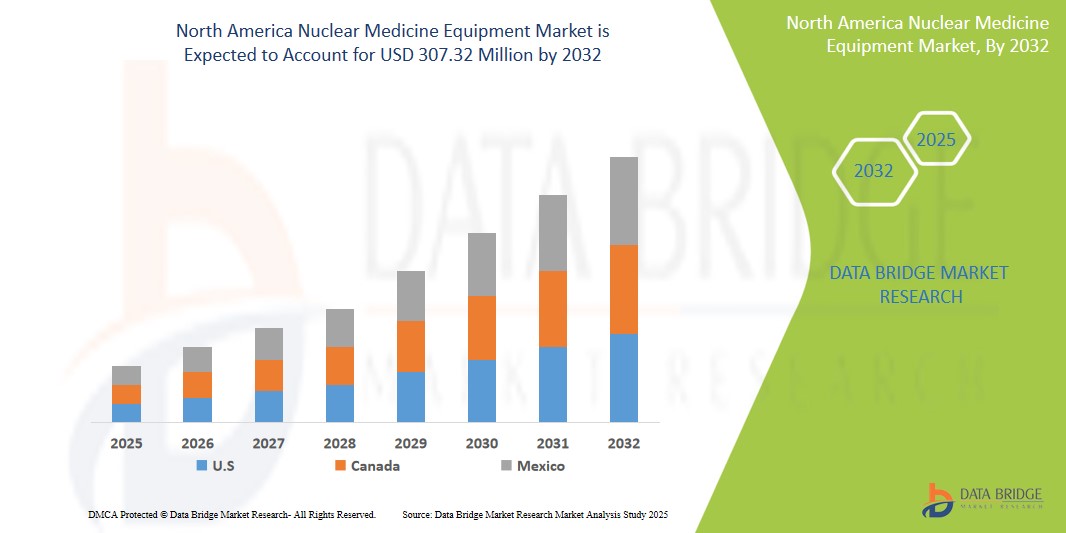
Nuclear Medicine Equipment Market Size
- The North America Nuclear Medicine Equipment Market size was valued at USD 154.34 Million in 2024 and is expected to reach USD 307.32 Million by 2032, at a CAGR of 9.0% during the forecast period.
- Market growth is primarily driven by the increasing prevalence of chronic diseases such as cancer and cardiovascular disorders, which necessitate advanced diagnostic and therapeutic procedures.
- Furthermore, the aging population in North America, coupled with technological advancements in nuclear medicine imaging and rising investments in healthcare infrastructure, are significantly contributing to market expansion. The growing adoption of hybrid imaging modalities like PET/CT and SPECT/CT is also fueling market growth by offering enhanced diagnostic accuracy and efficiency.
Nuclear Medicine Equipment Market Analysis
- Nuclear medicine equipment, including gamma cameras, PET scanners, and SPECT systems, plays a crucial role in the diagnosis and treatment of various diseases by utilizing radioactive tracers to visualize organ function and cellular activity. Their ability to provide functional information, unlike anatomical imaging techniques, makes them indispensable in oncology, cardiology, and neurology.
- The escalating demand for nuclear medicine equipment is primarily fueled by the increasing incidence of cancer, the growing geriatric population susceptible to chronic diseases, and the technological advancements leading to more sensitive and accurate imaging modalities. Additionally, the rising awareness of the benefits of early disease detection and personalized medicine is boosting the adoption of nuclear medicine procedures.
- U.S. holds a significant share of the Nuclear Medicine Equipment Market, characterized by a well-established healthcare system, high adoption rates of advanced medical technologies, and the presence of leading north america manufacturers. The U.S. is a major contributor to the North American market due to substantial healthcare expenditure, a large patient pool, and continuous technological innovation in the medical imaging sector.
- The Gamma Cameras segment is expected to dominate the Nuclear Medicine Equipment Market due to their wide range of clinical applications, established presence in hospitals and diagnostic centers, and ongoing technological improvements enhancing their performance and image quality.
Report Scope and Nuclear Medicine Equipment Market Segmentation
|
Attributes |
Nuclear Medicine Equipment Key Market Insights |
|
Segments Covered |
|
|
Countries Covered |
North America
|
|
Key Market Players |
|
|
Market Opportunities |
|
|
Value Added Data Infosets |
In addition to the insights on market scenarios such as market value, growth rate, segmentation, geographical coverage, and major players, the market reports curated by the Data Bridge Market Research also include in-depth expert analysis, pricing analysis, brand share analysis, consumer survey, demography analysis, supply chain analysis, value chain analysis, raw material/consumables overview, vendor selection criteria, PESTLE Analysis, Porter Analysis, and regulatory framework. |
Nuclear Medicine Equipment Market Trends
“Advancements in Hybrid Imaging Technologies”
- A significant and ongoing trend in the North America Nuclear Medicine Equipment Market is the continuous advancement and increasing adoption of hybrid imaging technologies, particularly PET-CT and SPECT-CT systems. These integrated systems combine the functional information provided by PET or SPECT with the detailed anatomical information from CT, offering clinicians a comprehensive view of disease processes.
- For instance, the latest PET-CT scanners feature improved detector sensitivity, faster scan times, and reduced radiation exposure, enhancing both diagnostic accuracy and patient safety. Similarly, advancements in SPECT-CT technology are leading to higher resolution images and more precise localization of radiopharmaceutical uptake.
- Furthermore, the integration of artificial intelligence (AI) and machine learning (ML) algorithms into these hybrid systems is enabling more sophisticated image analysis, lesion detection, and quantitative measurements, thereby improving diagnostic confidence and workflow efficiency.
- The trend towards more compact and mobile nuclear medicine systems is also gaining traction, allowing for point-of-care diagnostics and expanding the accessibility of these technologies to smaller hospitals and clinics.
- This focus on enhancing diagnostic capabilities through technological innovation is fundamentally reshaping the landscape of nuclear medicine imaging in North America, driving demand for advanced hybrid systems and associated software solutions.
- Consequently, major players in the market are heavily investing in research and development to introduce next-generation hybrid imaging systems with enhanced performance and clinical utility.
- The demand for nuclear medicine equipment with advanced hybrid imaging capabilities is expected to continue its upward trajectory across various clinical applications, including oncology, cardiology, and neurology, as healthcare providers recognize the significant benefits in terms of diagnostic accuracy and patient management.
Nuclear Medicine Equipment Market Dynamics
Driver
“Rising Prevalence of Chronic Diseases and Aging Population”
- The increasing prevalence of chronic diseases, such as cancer, cardiovascular diseases, and neurological disorders, coupled with the growing aging population in North America, is a significant driver for the heightened demand for nuclear medicine equipment.
- For instance, the American Cancer Society estimates that there will be over 2 million new cancer cases diagnosed in the U.S. in 2024. Nuclear medicine imaging, particularly PET-CT, plays a critical role in the diagnosis, staging, and monitoring of various cancers.
- As the population ages, the incidence of age-related chronic conditions also rises, leading to a greater need for advanced diagnostic tools like SPECT and PET to assess conditions such as Alzheimer's disease and coronary artery disease.
- Furthermore, the increasing emphasis on early disease detection and personalized medicine is driving the adoption of nuclear medicine techniques that can provide valuable functional and molecular insights, aiding in more targeted and effective treatment strategies.
- The growing awareness among healthcare professionals about the clinical utility of nuclear medicine in managing a wide range of diseases further contributes to the demand for sophisticated imaging equipment.
- This demographic shift and the increasing burden of chronic diseases are expected to continue fueling the growth of the nuclear medicine equipment market in North America.
Restraint/Challenge
“High Cost of Equipment and Reimbursement Issues”
- The high cost associated with the purchase, installation, and maintenance of advanced nuclear medicine equipment, such as PET-CT and SPECT-CT systems, poses a significant challenge to broader market adoption, particularly for smaller hospitals and diagnostic centers.
- For instance, the initial investment for a high-end PET-CT scanner can be substantial, requiring significant capital expenditure. Additionally, ongoing maintenance, including the cost of detectors and software upgrades, adds to the overall financial burden.
- Furthermore, uncertainties and complexities in reimbursement policies for nuclear medicine procedures can impact the financial viability of investing in new equipment. Inconsistent or inadequate reimbursement rates may discourage healthcare providers from adopting advanced imaging technologies, limiting market growth.
- Addressing these financial challenges through innovative financing models, cost-effective equipment designs, and favorable reimbursement policies is crucial for ensuring wider access to nuclear medicine services and sustaining market growth.
- While technological advancements are driving down the cost of some components, the overall expense of sophisticated nuclear medicine systems remains a considerable barrier for many healthcare institutions.
- Overcoming these economic hurdles will be essential for realizing the full potential of nuclear medicine in improving patient care across North America.
Nuclear Medicine Equipment Market Scope
The market is segmented on the basis of product type, application, and end user.
- By product type
On the basis of product type, the Nuclear Medicine Equipment Market is segmented into SPECT Systems, PET Systems, SPECT-CT Systems, PET-CT Systems, Gamma Cameras, Dose Calibrators, and Others. The PET-CT systems segment is expected to dominate the largest market revenue share due to their superior diagnostic capabilities, particularly in oncology. The ability of PET-CT to provide both functional and anatomical information in a single scan makes it an invaluable tool for cancer diagnosis, staging, and monitoring treatment response. The SPECT-CT systems segment is also expected to witness significant growth, driven by their increasing adoption in various clinical applications beyond oncology, including cardiology and neurology. The integration of SPECT with CT enhances the anatomical localization of functional abnormalities, improving diagnostic accuracy.
- By application
On the basis of application, the Nuclear Medicine Equipment Market is segmented into Oncology, Cardiology, Neurology, and Others. The oncology segment accounted for the largest market revenue share in 2024, driven by the widespread use of nuclear medicine imaging in the diagnosis and management of various cancers. PET-CT and SPECT-CT are essential tools for staging tumors, assessing treatment response, and detecting recurrence.
The cardiology segment is expected to witness the fastest CAGR during the forecast period, driven by the increasing application of PET and SPECT in assessing myocardial perfusion, viability, and cardiac function. The growing prevalence of cardiovascular diseases and the need for non-invasive diagnostic techniques are fueling this growth.
- By End User
On the basis of end user, the Nuclear Medicine Equipment Market is segmented into Hospitals & Clinics, Diagnostic Centers, Research Institutes, and Others. The hospitals & clinics segment held the largest market revenue share in 2024, owing to the high volume of nuclear medicine procedures performed in these settings. The presence of well-established nuclear medicine departments and the increasing demand for advanced diagnostic imaging contribute to this dominance.
The diagnostic centers segment is expected to witness significant growth, driven by the increasing trend of outsourcing diagnostic imaging services and the focus on providing specialized and accessible imaging services to a wider patient population.
Nuclear Medicine Equipment Market Regional Analysis
- U.S. dominates the Nuclear Medicine Equipment Market with the largest revenue share, driven by a well-established healthcare infrastructure, high healthcare expenditure, and the early adoption of advanced medical technologies. The increasing prevalence of chronic diseases and a growing aging population further contribute to the demand for nuclear medicine imaging.
- ·Consumers in the region benefit from favorable reimbursement policies for many nuclear medicine procedures and the presence of leading North America manufacturers who continuously introduce innovative imaging solutions.
- This strong market position is also supported by significant investments in research and development activities aimed at enhancing the capabilities and clinical applications of nuclear medicine equipment.
U.S. Nuclear Medicine Equipment Market Insight
The U.S. Nuclear Medicine Equipment Market captured the largest revenue share within North America, fueled by a high incidence of chronic diseases, a strong focus on early diagnosis, and the availability of advanced healthcare facilities. The presence of major market players and continuous technological advancements further propel market growth. The increasing adoption of hybrid imaging systems and the integration of AI in image analysis are key trends shaping the U.S. market.
Canada Nuclear Medicine Equipment Market Insight
The Canada Nuclear Medicine Equipment Market is projected to expand at a substantial CAGR throughout the forecast period, primarily driven by increasing healthcare spending, a growing aging population, and technological advancements in medical imaging. Stringent regulatory standards and a focus on high-quality healthcare contribute to the demand for advanced nuclear medicine equipment.
Mexico Nuclear Medicine Equipment Market Insight
The Mexico Nuclear Medicine Equipment Market is experiencing steady growth, driven by increasing investments in healthcare infrastructure and a rising awareness of the benefits of nuclear medicine in disease management. Government initiatives to improve access to advanced diagnostic imaging and a growing aging population are contributing to market expansion.
Nuclear Medicine Equipment Market Share
The Nuclear Medicine Equipment industry is primarily led by well-established companies, including:
- GE Healthcare (U.S.)
- Cardinal Health (U.S.)
- Lantheus (U.S.)
- Mirion Technologies (formerly Capintec) (U.S.)
- NorthStar Medical Radioisotopes (U.S.)
- Triad Isotopes (a subsidiary of Jubilant Pharma) (U.S.)
- Advanced Accelerator Applications (a Novartis company, with significant U.S. operations) (U.S.)
- Sotera Health (U.S.)
- BWX Technologies Inc. (U.S.)
- United Imaging Healthcare (U.S.)
Latest Developments in North america Nuclear Medicine Equipment Market
- In November 2024, United Imaging installed the world's first uMI Panvivo PET/CT at Pueblo Medical Imaging in Nevada, USA. This advanced platform expands upon United Imaging's fully digital PET/CT portfolio with industry-leading spatial resolution and digital AI-driven 3D camera technology for precision and care.
- In October 2023, Positrigo AG announced the launch of its dedicated PET system, NeuroLF, in the U.S. by incorporating its U.S. subsidiary. This signifies increased R&D for novel nuclear medicine products and aims to fuel market growth during the forecast period.
- In June 2022, Siemens Healthineers launched the Symbia Pro.specta, a SPECT/CT system with FDA clearance. This advanced system integrates state-of-the-art SPECT and CT imaging technologies, featuring a low-dose CT capable of capturing detailed images with up to 64 slices, enhancing diagnostic accuracy and patient care.
- In January 2021, BioTelemetry, Inc., a prominent provider of remote cardiac diagnosis and monitoring systems in the United States, was acquired by Koninklijke Philips N.V. This strategic acquisition enhances Philips' portfolio of patient care management solutions, offering healthcare providers enhanced convenience and control while ensuring robust diagnostic capabilities. (Note: While BioTelemetry itself isn't directly nuclear medicine, Philips' broader medical imaging portfolio includes nuclear medicine, and this acquisition strengthens their overall diagnostic capabilities in the U.S. market).

- Interactive Data Analysis Dashboard
- Company Analysis Dashboard for high growth potential opportunities
- Research Analyst Access for customization & queries
- Competitor Analysis with Interactive dashboard
- Latest News, Updates & Trend analysis
- Harness the Power of Benchmark Analysis for Comprehensive Competitor Tracking
Data collection and base year analysis are done using data collection modules with large sample sizes. The stage includes obtaining market information or related data through various sources and strategies. It includes examining and planning all the data acquired from the past in advance. It likewise envelops the examination of information inconsistencies seen across different information sources. The market data is analysed and estimated using market statistical and coherent models. Also, market share analysis and key trend analysis are the major success factors in the market report. To know more, please request an analyst call or drop down your inquiry.
The key research methodology used by DBMR research team is data triangulation which involves data mining, analysis of the impact of data variables on the market and primary (industry expert) validation. Data models include Vendor Positioning Grid, Market Time Line Analysis, Market Overview and Guide, Company Positioning Grid, Patent Analysis, Pricing Analysis, Company Market Share Analysis, Standards of Measurement, Global versus Regional and Vendor Share Analysis. To know more about the research methodology, drop in an inquiry to speak to our industry experts.
Data Bridge Market Research is a leader in advanced formative research. We take pride in servicing our existing and new customers with data and analysis that match and suits their goal. The report can be customized to include price trend analysis of target brands understanding the market for additional countries (ask for the list of countries), clinical trial results data, literature review, refurbished market and product base analysis. Market analysis of target competitors can be analyzed from technology-based analysis to market portfolio strategies. We can add as many competitors that you require data about in the format and data style you are looking for. Our team of analysts can also provide you data in crude raw excel files pivot tables (Fact book) or can assist you in creating presentations from the data sets available in the report.













