


North America Parasitology Identification Market Size
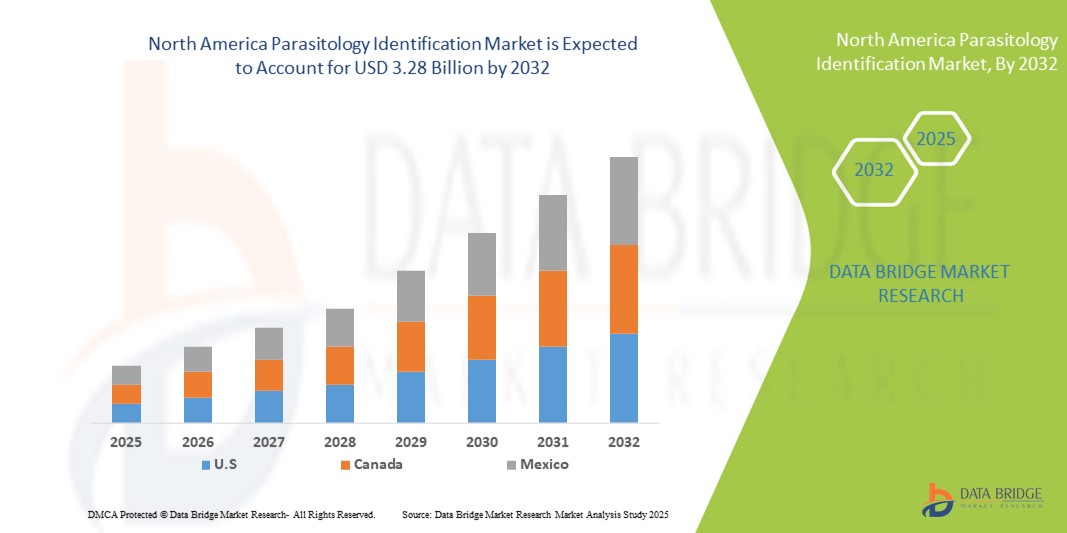
- The North America parasitology identification market size was valued at USD 2.17 billion in 2024 and is expected to reach USD 3.28 billion by 2032, at a CAGR of 5.30% during the forecast period
- The market growth is largely fueled by the increasing prevalence of parasitic infections across humans and animals, coupled with the rising need for rapid and accurate diagnostic methods in both clinical and research settings
- Furthermore, growing awareness among healthcare professionals and researchers about the importance of early detection and precise identification of parasites is establishing advanced Parasitology Identification solutions as the preferred choice. These converging factors are accelerating the adoption of Parasitology Identification technologies, thereby significantly boosting the industry's growth
North America Parasitology Identification Market Analysis
- Parasitology Identifications play a critical role in diagnosing and monitoring parasitic infections, providing accurate and timely results for both clinical and research applications across healthcare and laboratory settings
- The increasing prevalence of parasitic diseases, coupled with rising awareness about early detection and effective treatment, is driving the demand for advanced Parasitology Identification solutions. In addition, expanding healthcare infrastructure and investments in diagnostic technologies are further fueling market growth
- U.S. dominated the North America parasitology identification market with the largest revenue share of 75.05% in 2024, supported by its advanced healthcare infrastructure, strong presence of leading diagnostic companies, and high adoption of innovative testing technologies in hospitals, diagnostic centers, and research laboratories. Extensive clinical research activities, rapid implementation of molecular and immunological diagnostic methods, and strong awareness campaigns have further strengthened the U.S. market position. Favorable reimbursement policies and a well-established regulatory framework also play a critical role in sustaining its leadership in the regional market
- Canada is expected to be the fastest-growing country in the North America parasitology identification market during the forecast period, driven by increasing government investments in public health, expansion of laboratory networks, and rising adoption of advanced diagnostic tools for parasitology identification. Growing awareness of parasitic infections, rising collaborations between healthcare institutions and research organizations, and the country’s strategic focus on disease prevention and surveillance are further propelling market growth. The adoption of rapid diagnostic tests (RDTs) and molecular techniques in Canada is anticipated to accelerate its CAGR in the coming years
- The Devices segment dominated the North America parasitology identification market in 2024 with the largest revenue share of 60.7%, supported by the widespread use of automated diagnostic platforms, molecular systems, and MALDI-TOF MS instruments
Report Scope and Parasitology Identification Market Segmentation
|
Attributes |
Parasitology Identification Key Market Insights |
|
Segments Covered |
|
|
Countries Covered |
North America
|
|
Key Market Players |
|
|
Market Opportunities |
|
|
Value Added Data Infosets |
In addition to the insights on market scenarios such as market value, growth rate, segmentation, geographical coverage, and major players, the market reports curated by the Data Bridge Market Research also include in-depth expert analysis, pricing analysis, brand share analysis, consumer survey, demography analysis, supply chain analysis, value chain analysis, raw material/consumables overview, vendor selection criteria, PESTLE Analysis, Porter Analysis, and regulatory framework. |
North America Parasitology Identification Market Trends
Advancements in Diagnostic Accuracy and Rapid Detection
- A significant and accelerating trend in the North America parasitology identification market is the increasing adoption of advanced diagnostic technologies and rapid detection methods. These innovations are significantly enhancing the accuracy, speed, and reliability of parasitic disease diagnosis across clinical and research settings
- For instance, recent developments in molecular diagnostic platforms and immunoassays have enabled faster detection of parasitic infections such as malaria, giardiasis, and leishmaniasis, providing healthcare professionals with timely and actionable insights for treatment decisions. Similarly, point-of-care testing kits are increasingly being deployed in endemic regions to facilitate immediate diagnosis and improve patient outcomes
- Integration of multiplex testing and automated sample processing in Parasitology Identification enables laboratories to screen for multiple parasites simultaneously, reducing turnaround time and minimizing human error. High-throughput diagnostic platforms are supporting large-scale epidemiological studies and improving surveillance of parasitic infections in both urban and rural populations
- The seamless incorporation of Parasitology Identification solutions into broader laboratory workflows allows centralized management of testing, reporting, and data analysis. Through standardized protocols, laboratories can ensure consistent quality, enhance reproducibility, and streamline patient management for parasitic diseases
- This trend towards more precise, rapid, and integrated diagnostic solutions is fundamentally reshaping expectations for parasitology testing. Consequently, companies and research institutions are developing next-generation platforms with enhanced sensitivity, specificity, and ease of use, ensuring accurate detection across diverse clinical and field settings
- The demand for advanced Parasitology Identification solutions is growing rapidly across hospitals, research institutes, and diagnostic laboratories, as healthcare providers and public health agencies increasingly prioritize rapid, reliable, and scalable diagnostic capabilities to combat parasitic infections effectively
North America Parasitology Identification Market Dynamics
Driver
Growing Need Due to Rising Prevalence of Parasitic Infections and Advancements in Diagnostic Solutions
- The increasing prevalence of parasitic infections worldwide, combined with the growing demand for accurate and timely diagnostic solutions, is a significant driver for the heightened adoption of Parasitology Identifications
- For instance, in April 2024, leading diagnostic companies announced advancements in automated parasitology testing platforms, focusing on faster detection and higher accuracy for clinical and research laboratories. Such innovations are expected to drive growth in the Parasitology Identification industry during the forecast period
- As healthcare providers and researchers seek to improve patient outcomes and streamline laboratory workflows, Parasitology Identifications offer advanced capabilities, including rapid detection, high sensitivity, and reliable differentiation of parasitic species, providing a substantial upgrade over conventional microscopy-based methods
- Furthermore, the rising focus on disease surveillance, early detection programs, and laboratory automation is making Parasitology Identifications an integral part of clinical and research settings, supporting large-scale testing and epidemiological studies
- The growing availability of user-friendly diagnostic solutions, combined with the increasing emphasis on accurate and timely results in hospitals, diagnostic centers, and research institutions, is further contributing to market growth
Restraint/Challenge
Concerns Regarding High Costs and Technical Expertise Requirements
- The relatively high cost of advanced Parasitology Identification systems, along with the need for trained personnel to operate sophisticated instruments, poses a challenge to broader market adoption, particularly in developing regions or smaller laboratories
- In addition, ongoing maintenance and calibration requirements can increase the total cost of ownership, making some institutions hesitant to invest in state-of-the-art diagnostic equipment
- Addressing these challenges through the development of cost-effective, easy-to-use, and scalable diagnostic solutions is crucial for expanding market penetration. Companies are increasingly focusing on automation, integrated platforms, and simplified workflows to reduce the need for specialized expertise while maintaining high accuracy
- While equipment costs are gradually decreasing and more affordable options are becoming available, the perceived investment in high-end diagnostic systems can still hinder widespread adoption in resource-constrained settings
- Overcoming these barriers through affordable solutions, training programs for laboratory staff, and partnerships with healthcare institutions will be vital for sustained growth in the Parasitology Identification market
North America Parasitology Identification Market Scope
The market is segmented on the basis of products, methods, pathogen type, sample, stool concentration and preparation, and end-user.
- By Products
On the basis of products, the parasitology identification market is segmented into devices and consumables & accessories. The Devices segment dominated the market in 2024 with the largest revenue share of 60.7%, supported by the widespread use of automated diagnostic platforms, molecular systems, and MALDI-TOF MS instruments. Hospitals, diagnostic laboratories, and research institutes across North America rely heavily on devices for accurate and high-throughput parasitology testing. The ability of these instruments to deliver reproducible, sensitive, and species-specific results drives adoption. Increasing integration with laboratory information systems enhances workflow efficiency. Public and private funding for advanced diagnostic infrastructure further consolidates demand. The growing prevalence of parasitic infections in immunocompromised patients strengthens utilization in routine healthcare. Automation and multiplex detection continue to expand the appeal of device-based diagnostics.
The Consumables & Accessories segment is expected to register the fastest CAGR of 18.1% from 2025 to 2032, fueled by the recurring demand for reagents, assay kits, slides, and staining solutions. Laboratories require continuous supplies for daily parasitology testing, ensuring a steady revenue stream. The growth is further accelerated by public health surveillance programs, outbreak response initiatives, and NGO-supported screening campaigns. Field diagnostics and point-of-care testing increasingly depend on ready-to-use consumables for convenience. Innovations in rapid reagent formulations reduce turnaround times for results. Cost-effectiveness and scalability make consumables highly attractive in smaller labs. The segment benefits from growing awareness of standardized testing protocols in clinical practice.
- By Methods
On the basis of methods, the parasitology identification market is segmented into Fecal Identification, Morphological Identification, Molecular Techniques, MALDI-TOF MS, Immunological Techniques, Rapid Diagnostic Tests (RDTs), and Others. The Molecular Techniques segment dominated the market in 2024 with a revenue share of 53.4%, owing to their unmatched sensitivity and specificity for detecting parasites even in low concentrations. PCR and real-time PCR platforms are widely used in hospitals and reference laboratories across North America. Their ability to deliver accurate, species-level identification supports targeted treatment and epidemiological control. Multiplex PCR technologies enable simultaneous testing for multiple parasites, reducing time and costs. Molecular assays also minimize false negatives and detect asymptomatic infections. High adoption in outbreak management and surveillance further strengthens market share. Continuous improvements in automated molecular workflows enhance scalability and accuracy.
The Rapid Diagnostic Tests (RDTs) segment is projected to grow at the fastest CAGR of 19.6% from 2025 to 2032, driven by their portability and ability to deliver results within minutes. RDTs are particularly valuable for field testing, emergency situations, and low-resource settings. Their affordability and user-friendliness promote adoption among community health programs. Rising demand in travel clinics and urgent care centers contributes to market expansion. Multiplex RDT formats capable of detecting multiple pathogens simultaneously are gaining traction. Public health funding and government-backed initiatives to ensure widespread diagnostic access further support adoption. The cost-effectiveness and speed of RDTs make them a vital tool in large-scale screening programs.
- By Pathogen Type
On the basis of pathogen type, the parasitology identification market is segmented into Protozoan, Helminths, and Ectoparasites. The Protozoan segment dominated the market in 2024 with a revenue share of 57.2%, driven by the high incidence of protozoan infections such as giardiasis, cryptosporidiosis, and toxoplasmosis across North America. Hospitals and public health laboratories routinely screen for protozoan parasites using molecular and immunological assays. WHO- and CDC-led awareness programs and surveillance systems emphasize the importance of protozoan detection. The availability of advanced detection kits improves diagnostic speed and accuracy. Rising prevalence in immunocompromised populations further accelerates adoption. Research initiatives to combat waterborne protozoan infections also contribute to segment strength. Public health efforts for outbreak control and early treatment sustain segment leadership.
The Helminths segment is expected to record the fastest CAGR of 18.4% from 2025 to 2032, as soil-transmitted and zoonotic helminth infections remain a concern in certain regions. School deworming initiatives and epidemiological studies drive testing demand. Diagnostic kits for helminth detection are increasingly adopted due to their low cost and effectiveness. Advances in stool-based assays and molecular diagnostics enhance sensitivity and support early detection. Rising awareness of helminth-associated complications fuels public health campaigns. Diagnostic laboratories benefit from affordable, high-volume test kits. Expansion of surveillance programs by NGOs and government agencies further accelerates growth.
- By Sample
On the basis of sample, the parasitology identification market is segmented into feces, blood, urine, serum & plasma, and others. The Feces segment dominated the market in 2024 with a revenue share of 54.8%, as stool examination remains the gold standard for detecting gastrointestinal parasites. Hospitals, diagnostic centers, and research institutes routinely rely on fecal analysis to detect protozoan cysts and helminth eggs. Automated and semi-automated fecal examination platforms are increasingly used to improve accuracy. The prevalence of intestinal parasitic infections drives steady demand across North America. Mass screening programs in immigrant populations and high-risk communities reinforce adoption. Fecal testing remains cost-effective, scalable, and essential for both clinical and epidemiological applications. Its established role ensures strong utilization in both primary care and advanced research settings.
The Blood segment is projected to grow at the fastest CAGR of 18.2% from 2025 to 2032, supported by the growing reliance on serological and molecular assays for systemic parasitic infections like malaria and filariasis. Blood-based testing enables early diagnosis, improving treatment outcomes. Hospitals and diagnostic centers utilize automated blood analyzers and PCR assays for high throughput. Serological tests enhance sensitivity for latent and chronic infections. Point-of-care blood-based kits enable rapid field diagnostics, particularly in travel medicine and emergency settings. Epidemiological surveillance also depends on blood-based methods for parasite monitoring. Public health investments in improved serological platforms contribute to growth.
- By Stool Concentration and Preparation
On the basis of stool concentration and preparation, the parasitology identification market is segmented into concentration technique and un-concentration technique. The Concentration Technique segment dominated the market in 2024 with a revenue share of 52.1%, as these methods significantly improve detection of low-intensity infections. Techniques such as flotation and sedimentation enhance sensitivity in stool diagnostics. Hospitals and laboratories adopt these standardized methods to ensure reproducibility and accuracy. Concentration techniques minimize false negatives, providing clinicians with greater diagnostic confidence. They are widely used in both clinical practice and epidemiological surveys. Their ability to detect asymptomatic carriers supports outbreak control and disease prevention. Ongoing training programs and best-practice guidelines reinforce utilization across diagnostic centers.
The Un-Concentration Technique segment is expected to witness the fastest CAGR of 17.2% from 2025 to 2032, driven by the need for simple, rapid, and low-cost diagnostics in field settings. These methods are highly suitable for resource-limited laboratories and point-of-care applications. They reduce preparation time and eliminate the need for specialized equipment. Portable diagnostic kits often incorporate un-concentration techniques, supporting rapid deployment in outbreak scenarios. Public health campaigns in rural and underserved regions rely on these methods. Their ease of use facilitates large-scale community screening. Ongoing government and NGO initiatives targeting rapid diagnostics enhance growth potential.
- By End-User
On the basis of end-user, the parasitology identification market is segmented into diagnostic centers, hospitals, clinics, and others. The Hospitals segment dominated the market in 2024 with a revenue share of 58.7%, owing to their advanced laboratory infrastructure and high patient throughput. Hospitals provide comprehensive parasitology testing by combining molecular, immunological, and microscopic methods. Their critical role in patient diagnostics, outbreak management, and public health reporting strengthens segment leadership. Large-scale testing capabilities and specialized staff reinforce reliance on hospitals. Government and private healthcare investments ensure cutting-edge diagnostic technologies are adopted in hospital labs. Integration with research and surveillance programs further consolidates demand. The trust associated with hospital-based results makes them the preferred choice for patients and clinicians.
The Diagnostic Centers segment is projected to register the fastest CAGR of 19.8% from 2025 to 2032, as independent and chain laboratories expand across North America. Diagnostic centers are increasingly preferred for their cost-effective services, faster turnaround times, and convenience. Growing outsourcing of diagnostic services by hospitals supports demand. Public health surveillance often depends on diagnostic centers for community-level testing. Adoption of advanced platforms, including molecular and rapid diagnostic tests, enhances service quality. Rising demand in urban and suburban areas strengthens their role in population health management. Investments in high-throughput instruments enable reliable large-scale testing.
North America Parasitology Identification Market Regional Analysis
- North America dominated the parasitology identification market with the largest revenue share in 2024
- Supported by a well-established healthcare system, strong presence of key industry players, and high adoption of advanced diagnostic instruments in hospitals and laboratories
- The U.S. accounted for the majority of the regional revenue, driven by widespread clinical research initiatives, early adoption of innovative diagnostic techniques, and comprehensive awareness programs targeting healthcare professionals and patients
U.S. Parasitology Identification Market Insight
The U.S. parasitology identification market captured the largest revenue share of 75.05% within North America in 2024, fueled by extensive clinical research activities, growing focus on accurate and timely diagnosis of parasitic infections, and increasing awareness among healthcare professionals regarding advanced diagnostic solutions. The presence of leading diagnostic companies, along with ongoing initiatives for improving laboratory infrastructure and training personnel, further supports market expansion.
Canada Parasitology Identification Market Insight
The Canada parasitology identification market is expected to be the fastest-growing market in North America during the forecast period, driven by increasing government investments in public health, expansion of laboratory networks, and rising adoption of advanced diagnostic tools for parasitology identification. Growing awareness of parasitic infections among healthcare professionals and the general population is supporting demand for accurate and timely diagnostics. Collaborations between healthcare institutions, research organizations, and public health agencies are enhancing diagnostic capabilities and knowledge sharing. The country’s strategic focus on disease prevention, epidemiological surveillance, and early intervention further propels market growth. Adoption of rapid diagnostic tests (RDTs) and molecular techniques is accelerating, improving speed, accuracy, and efficiency of parasitic detection.
North America Parasitology Identification Market Share
The Parasitology Identification industry is primarily led by well-established companies, including:
- Abbott (U.S.)
- BD (U.S.)
- BIOMÉRIEUX (France)
- Bruker (U.S.)
- Quest Diagnostics (U.S.)
- Thermo Fisher Scientific Inc. (U.S.)
- Bio-Rad Laboratories, Inc. (U.S.)
- Meridian Bioscience, Inc. (U.S.)
- Danaher Corporation (U.S.)
- Labcorp (U.S.)
- Qiagen (Netherlands)
- Hardy Diagnostics (U.S.)
Latest Developments in North America Parasitology Identification Market
- In March 2025, ARUP Laboratories expanded its AI-augmented parasitology screening tool to include wet-mount slides, becoming the first laboratory to apply AI screening to the entire ova and parasite testing process. This advancement enhances diagnostic sensitivity and efficiency
- In August 2025, Researchers introduced the Parasite Genome Identification Platform (PGIP), a web server designed for the rapid taxonomic identification of parasite genomes. PGIP simplifies and accelerates genomic analysis and classification of parasitic organisms, facilitating quicker and more accurate diagnostics
- In June 2025, Kyoto University and Kyoto Prefectural University of Medicine developed a digital database utilizing existing slide specimens of parasite eggs, adult parasites, and arthropods. This resource supports international practical training and research, particularly within medical education programs
- In July 2025, Quest Diagnostics launched a new diagnostic laboratory test for the Oropouche virus, employing polymerase chain reaction (PCR) technology. Serology testing was also introduced later in the quarter, expanding diagnostic capabilities for this emerging infectious disease

- Interactive Data Analysis Dashboard
- Company Analysis Dashboard for high growth potential opportunities
- Research Analyst Access for customization & queries
- Competitor Analysis with Interactive dashboard
- Latest News, Updates & Trend analysis
- Harness the Power of Benchmark Analysis for Comprehensive Competitor Tracking
Data collection and base year analysis are done using data collection modules with large sample sizes. The stage includes obtaining market information or related data through various sources and strategies. It includes examining and planning all the data acquired from the past in advance. It likewise envelops the examination of information inconsistencies seen across different information sources. The market data is analysed and estimated using market statistical and coherent models. Also, market share analysis and key trend analysis are the major success factors in the market report. To know more, please request an analyst call or drop down your inquiry.
The key research methodology used by DBMR research team is data triangulation which involves data mining, analysis of the impact of data variables on the market and primary (industry expert) validation. Data models include Vendor Positioning Grid, Market Time Line Analysis, Market Overview and Guide, Company Positioning Grid, Patent Analysis, Pricing Analysis, Company Market Share Analysis, Standards of Measurement, Global versus Regional and Vendor Share Analysis. To know more about the research methodology, drop in an inquiry to speak to our industry experts.
Data Bridge Market Research is a leader in advanced formative research. We take pride in servicing our existing and new customers with data and analysis that match and suits their goal. The report can be customized to include price trend analysis of target brands understanding the market for additional countries (ask for the list of countries), clinical trial results data, literature review, refurbished market and product base analysis. Market analysis of target competitors can be analyzed from technology-based analysis to market portfolio strategies. We can add as many competitors that you require data about in the format and data style you are looking for. Our team of analysts can also provide you data in crude raw excel files pivot tables (Fact book) or can assist you in creating presentations from the data sets available in the report.













