


Pharmaceutical Packaging Market Size
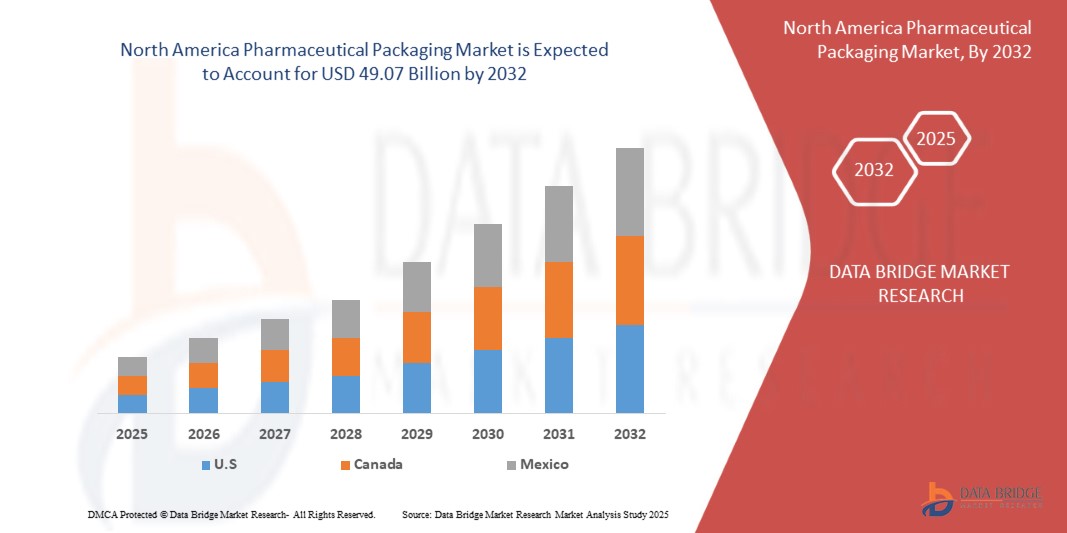
- The North America Pharmaceutical packaging market size was valued at USD 24.56 billion in 2024 and is projected to reach USD 49.07 billion by 2032, growing at a CAGR of 8.37% during the forecast period
- This growth is fueled by an aging population, rising prevalence of chronic diseases, and increasing regulatory focus on patient safety and drug traceability. The demand for advanced, sustainable, and smart packaging solutions is also expanding as pharmaceutical manufacturers adapt to stricter compliance standards and the need for product
Pharmaceutical Packaging Market Analysis
- Pharmaceutical packaging plays a significant role in the pharmaceutical industry for the safety of the drugs and medicine against all unfavourable external influences. These influences can change the properties of the drug or medicine and cause mechanical damage, physical damage, biological contamination and degradation and also counterfeiting
- The North America pharmaceutical packaging market is expected to rise in demand due to the high demand for drug delivery devices and blister packaging
- U.S. dominates the Europe pharmaceutical packaging market, accounting for the largest regional share of approximately 62.37% in 2024. This leadership is attributed to its strong pharmaceutical manufacturing base, high healthcare expenditure, and advanced packaging technology adoption. The presence of leading pharma companies and a robust regulatory environment further reinforces U.S. position as a key driver in the region's packaging evolution
- In 2025, the Plastics segment is expected to dominate the material type segment of the North America Pharmaceutical Packaging market, holding a market share of approximately 57.35%. This dominance is driven by plastics' versatility, lightweight nature, and cost-effectiveness, along with their suitability for a wide range of pharmaceutical products such as blister packs, bottles, syringes, and pouches
Report Scope and North America Pharmaceutical Packaging Market Segmentation
|
Attributes |
Pharmaceutical Packaging Key Market Insights |
|
Segments Covered |
|
|
Countries Covered |
North America
|
|
Key Market Players |
|
|
Market Opportunities |
|
|
Value Added Data Infosets |
In addition to the insights on market scenarios such as market value, growth rate, segmentation, geographical coverage, and major players, the market reports curated by the Data Bridge Market Research also include import export analysis, production capacity overview, production consumption analysis, price trend analysis, climate change scenario, supply chain analysis, value chain analysis, raw material/consumables overview, vendor selection criteria, PESTLE Analysis, Porter Analysis, and regulatory framework. |
North America Pharmaceutical Packaging Market Trends
“Sustainability Mandates Fuel the Rise of Eco-Friendly Pharmaceutical Packaging”
- A prominent trend in the Europe Pharmaceutical Packaging market is the accelerating shift towards sustainable and eco-friendly packaging solutions. With stringent EU regulations and increasing consumer awareness about environmental impact, pharmaceutical companies are adopting recyclable, biodegradable, and reusable packaging materials to reduce their carbon footprint
- Manufacturers are investing in green innovations, such as plant-based polymers, recyclable blister packs, and low-impact inks, to comply with environmental standards and appeal to eco-conscious stakeholders
- For instance, in February 2025, Gerresheimer AG introduced a new line of pharmaceutical containers made from 100% recyclable bio-based plastics, aligning with EU climate targets and customer expectations for greener products
- This trend not only supports environmental objectives but also enhances brand reputation, enables regulatory compliance, and positions companies to benefit from growing demand in sustainable healthcare packaging across North America
Pharmaceutical packaging Market Dynamics
Driver
“Stringent Regulatory Standards Promoting Advanced and Compliant Packaging Solutions”
- A major driver in the Europe Pharmaceutical Packaging market is the implementation of stringent regulatory frameworks aimed at ensuring drug safety, traceability, and patient compliance. European agencies such as the EMA and national authorities have introduced mandates around serialization, tamper-evidence, and material safety, compelling manufacturers to adopt advanced packaging technologies
- These regulations are particularly impactful in prescription and high-risk drug categories, where compliance with safety and anti-counterfeiting measures is critical, pushing pharmaceutical companies to invest in smart, trackable, and secure packaging formats
- As a result, there’s an increasing demand for serialized barcodes, RFID-enabled labels, and tamper-proof containers to meet EU Falsified Medicines Directive (FMD) requirements and enhance consumer trust
- For instance in January 2025, Schreiner MediPharm unveiled a new RFID-enabled label system designed to improve medication tracking and patient safety, helping pharmaceutical companies align with EU traceability guidelines.
- This regulatory-driven shift not only accelerates the adoption of innovative packaging solutions but also enhances product security, patient adherence, and overall pharmaceutical supply chain transparency across Europe
Restraint/Challenge
“High Cost of Advanced and Sustainable Packaging Solutions”
- The Pharmaceutical Packaging market faces a significant challenge due to the high cost associated with advanced and eco-friendly packaging materials. Incorporating technologies like tamper-evidence, serialization, and smart tracking—as well as transitioning to sustainable alternatives such as biodegradable plastics or recycled content—often results in higher production and operational expenses
- These elevated costs can be particularly burdensome for small and mid-sized pharmaceutical companies, limiting their ability to adopt innovative packaging at scale and potentially affecting overall profitability and pricing strategies
- For instance: in January 2025, a report by the European Federation of Pharmaceutical Industries and Associations (EFPIA) highlighted that over 40% of smaller firms in Europe cited packaging costs as a major barrier to implementing sustainable and compliant solutions
- This challenge underscores the need for scalable, cost-effective innovations in packaging technology and materials, as well as collaborative efforts across the supply chain to balance environmental responsibility with economic viability
North America Pharmaceutical Packaging Market Scope
The market is segmented on the basis of material type, type, and drug delivery mode.
- By Material Type
On the basis of material type, the North America pharmaceutical packaging market is segmented into plastics, paper and paperboard, glass, aluminum foil, and others. The plastics segment dominates the market, accounting for an estimated 36.8% share in 2024, driven by its cost-effectiveness, flexibility, and compatibility with a wide range of pharmaceutical products. Plastics are particularly favored for oral solid dosages and liquid packaging due to their lightweight nature and barrier properties. Innovations in recyclable and bio-based plastics further strengthen the segment's position amid growing sustainability concerns.
The glass segment is expected to witness the fastest growth rate of around 18.5% from 2025 to 2032, fueled by its inertness and suitability for high-value drugs, including vaccines and biologics. Increasing adoption of prefilled syringes and vials for injectable formulations has reinforced demand for pharmaceutical-grade glass across North America.
- By Type
On the basis of type, the pharmaceutical packaging market in North America is segmented into ampoules, blister packs, plastic bottles, canisters, cartridges, IV bags, mini-jars, pouches, syringes, tubes, vials, sachets, and others. The plastic bottles segment held the largest market revenue share in 2024, largely driven by its extensive use in over-the-counter (OTC) drugs and prescription liquids. Its tamper-evident designs, compatibility with child-resistant closures, and low cost contribute to sustained dominance.
The blister packs segment is anticipated to register the fastest CAGR from 2025 to 2032. The segment’s growth is supported by its ability to ensure accurate dosing, improve patient adherence, and provide robust protection against external contaminants. Blister packs are increasingly preferred in unit-dose packaging formats for both prescription and OTC solid dosage drugs.
- By Drug Delivery Mode
On the basis of drug delivery mode, the market is segmented into oral drug packaging, pulmonary drug packaging, transdermal drug packaging, injectable drug packaging, nasal drug packaging, and others. The oral drug packaging segment dominates the market, held the largest market revenue share in 2024, driven by the high volume consumption of tablets, capsules, and liquid formulations across the region. Demand is further reinforced by the prevalence of chronic diseases and aging populations reliant on oral therapies.
The injectable drug packaging segment is expected to record the fastest growth between 2025 and 2032, supported by the increasing deployment of biologics, vaccines, and biosimilars. The rise of self-injection therapies and home-based care models is also fueling the need for advanced packaging formats such as prefilled syringes, vials, and cartridges, which ensure sterility, precision, and safety.
Pharmaceutical packaging Market Regional Analysis
- U.S. dominates the Europe pharmaceutical packaging market, accounting for the largest regional share of approximately 62.37% in 2025. This leadership stems from its strong pharmaceutical industry, high R&D expenditure, and advanced packaging technology infrastructure
- U.S. position is reinforced by a robust regulatory framework, high export volumes of pharmaceuticals, and active investment in sustainable and smart packaging materials that meet global environmental standards
- Canada is experiencing a steady rise in pharmaceutical packaging demand due to the expansion of biotech and vaccine manufacturing, along with a push toward localized production and serialization compliance
- Canada and the Mexico are focusing on modernizing packaging operations, leveraging automation, serialization, and sustainable formats to cater to both domestic consumption and exports within the EU and beyond
United States Pharmaceutical Packaging Market Insight
U.S. packaging market accounted for the largest revenue share of approximately 62.37% in 2025 within the North America region. This leadership is attributed to the presence of a well-established pharmaceutical industry, advanced healthcare infrastructure, and strong regulatory frameworks that prioritize patient safety and product integrity. The high volume of drug production, coupled with increasing adoption of biologics, injectables, and specialty drugs, drives the demand for innovative and compliant packaging solutions. Moreover, the U.S. market is characterized by a strong push toward sustainable packaging practices and intelligent packaging technologies that enhance traceability, reduce counterfeiting, and support personalized medicine initiatives.
Canada Pharmaceutical packaging Market Insight
Canada is projected to witness the CAGR of around 6.8% from 2025 to 2032 in the North America pharmaceutical packaging market. The country’s focus on strengthening domestic pharmaceutical manufacturing, coupled with growing investments in biopharmaceutical R&D, is fueling demand for advanced and customized packaging solutions. Canadian regulatory authorities, such as Health Canada, are actively encouraging the use of tamper-evident, child-resistant, and environmentally sustainable packaging. Additionally, the expansion of generic drug production and government support for local manufacturing capacity—especially in provinces like Ontario and Québec—are further driving market growth. As personalized medicine and digital healthcare expand, Canada emerges as a high-growth market for next-generation pharmaceutical packaging.
North America Pharmaceutical Packaging Market Share
The Pharmaceutical packaging industry is primarily led by well-established companies, including:
- 3M (U.S.)
- BD - Becton, Dickinson and Company (U.S.)
- CCL Industries (Canada)
- McKesson Corporation (U.S.)
- WestRock Company (U.S.)
- AptarGroup Inc. (U.S.)
- Jabil Inc. (U.S.)
- Gerresheimer AG (Germany)
- West Pharmaceutical Services Inc. (U.S.)
- Klöckner Pentaplast (Germany)
- Origin Pharma Packaging (U.K.)
- SCHOTT (Germany)
- Amcor plc (Switzerland)
- Berry Global Inc. (U.S.)
- FlexiTuff Ventures International Ltd. (India)
- Nelipak Healthcare (U.S.)
- International Paper (U.S.)
- Stevanato Group (Italy)
- Origin Pharma Packaging (U.K.)
- Mondi (U.K.)
- Lonza (Switzerland)
- Robert Bosch GmbH (Germany)
- DuPont (U.S.)
- Thermo Fisher (U.S.)
Latest Developments in North America Pharmaceutical Packaging Market
- In February 2025, West Pharmaceutical Services launched its new EcoSmart vial sealing system, designed to reduce plastic use by 25% while maintaining superior drug protection, highlighting the push towards sustainability in pharmaceutical packaging.
- In March 2025, McKesson Corporation expanded its pharmaceutical distribution capabilities by acquiring a regional specialty logistics firm, aiming to improve cold chain packaging and delivery services across North America.
- In January 2025, Amcor announced plans to increase production capacity for its recyclable and biodegradable pharmaceutical packaging solutions, responding to growing demand for eco-friendly options in the healthcare industry.
- In November 2024, Berry Global introduced a next-generation child-resistant blister pack that enhances safety compliance and user convenience, addressing regulatory requirements and consumer needs.
- At the 2025 PACK EXPO conference, AptarGroup unveiled its innovative connected drug delivery packaging platform, integrating IoT technology to improve patient adherence and data tracking.

- Interactive Data Analysis Dashboard
- Company Analysis Dashboard for high growth potential opportunities
- Research Analyst Access for customization & queries
- Competitor Analysis with Interactive dashboard
- Latest News, Updates & Trend analysis
- Harness the Power of Benchmark Analysis for Comprehensive Competitor Tracking
North America Pharmaceutical Packaging Market, Supply Chain Analysis and Ecosystem Framework
To support market growth and help clients navigate the impact of geopolitical shifts, DBMR has integrated in-depth supply chain analysis into its North America Pharmaceutical Packaging Market research reports. This addition empowers clients to respond effectively to global changes affecting their industries. The supply chain analysis section includes detailed insights such as North America Pharmaceutical Packaging Market consumption and production by country, price trend analysis, the impact of tariffs and geopolitical developments, and import and export trends by country and HSN code. It also highlights major suppliers with data on production capacity and company profiles, as well as key importers and exporters. In addition to research, DBMR offers specialized supply chain consulting services backed by over a decade of experience, providing solutions like supplier discovery, supplier risk assessment, price trend analysis, impact evaluation of inflation and trade route changes, and comprehensive market trend analysis.
Data collection and base year analysis are done using data collection modules with large sample sizes. The stage includes obtaining market information or related data through various sources and strategies. It includes examining and planning all the data acquired from the past in advance. It likewise envelops the examination of information inconsistencies seen across different information sources. The market data is analysed and estimated using market statistical and coherent models. Also, market share analysis and key trend analysis are the major success factors in the market report. To know more, please request an analyst call or drop down your inquiry.
The key research methodology used by DBMR research team is data triangulation which involves data mining, analysis of the impact of data variables on the market and primary (industry expert) validation. Data models include Vendor Positioning Grid, Market Time Line Analysis, Market Overview and Guide, Company Positioning Grid, Patent Analysis, Pricing Analysis, Company Market Share Analysis, Standards of Measurement, Global versus Regional and Vendor Share Analysis. To know more about the research methodology, drop in an inquiry to speak to our industry experts.
Data Bridge Market Research is a leader in advanced formative research. We take pride in servicing our existing and new customers with data and analysis that match and suits their goal. The report can be customized to include price trend analysis of target brands understanding the market for additional countries (ask for the list of countries), clinical trial results data, literature review, refurbished market and product base analysis. Market analysis of target competitors can be analyzed from technology-based analysis to market portfolio strategies. We can add as many competitors that you require data about in the format and data style you are looking for. Our team of analysts can also provide you data in crude raw excel files pivot tables (Fact book) or can assist you in creating presentations from the data sets available in the report.













