


North America Propionic Acid and Derivatives Market Size
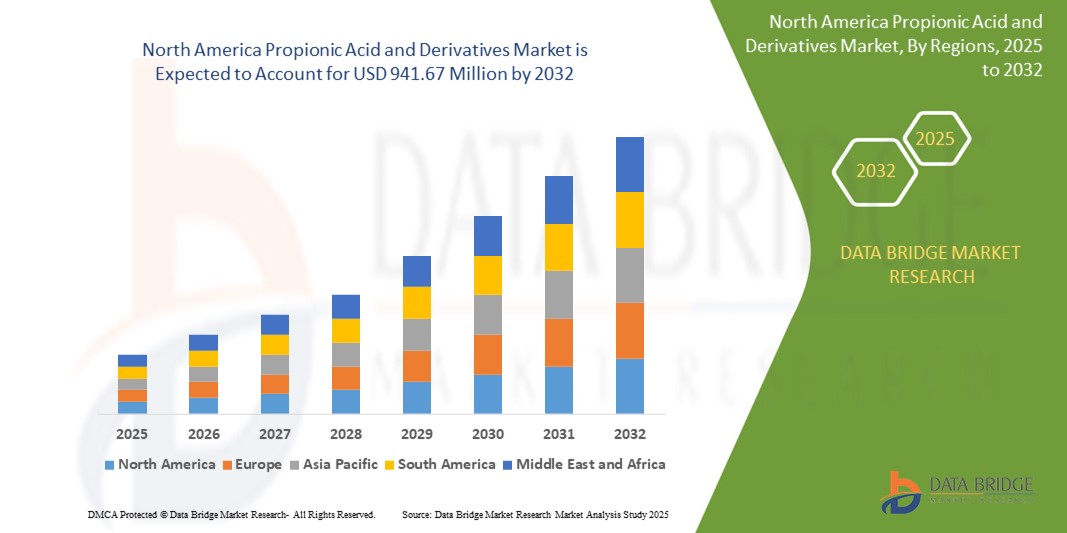
- The North America propionic acid and derivatives market size was valued at USD 577.61 million in 2024 and is expected to reach USD 941.67 million by 2032, at a CAGR of 6.30% during the forecast period
- The market growth is largely fuelled by the expanding food and feed industries, growing demand for preservatives due to rising food exports, and increasing use of propionic acid as a fungicide and antibacterial agent in agricultural applications
- Rising awareness about livestock health and the role of feed preservatives in improving feed shelf-life and reducing microbial contamination is further driving regional demand
North America Propionic Acid and Derivatives Market Analysis
- The growing focus on improving livestock health and feed efficiency, particularly in commercial poultry and dairy farming, is boosting the adoption of propionic acid derivatives such as calcium and sodium propionate across the region
- Expanding industrial applications, including use in herbicides, cellulose-based plastics, and pharmaceutical formulations, are further contributing to the market's steady growth in the region
- U.S. dominated the North America propionic acid and derivatives market in 2024, driven by its well-established food processing and livestock industries, widespread adoption of food-grade preservatives, and stringent regulatory standards that promote the use of safe and effective antimicrobial agents
- Canada is expected to witness the highest compound annual growth rate (CAGR) in the North America propionic acid and derivatives market due to increasing investments in sustainable agriculture, growing awareness of animal nutrition, and expanding demand for clean-label and shelf-stable food products
- The propionic acid segment held the largest market revenue share in 2024, driven by its extensive use as a preservative in food and feed applications across the region. The increasing demand for shelf-life enhancement, especially in bakery and dairy products, has significantly contributed to the segment’s growth. In the feed sector, propionic acid is widely adopted to prevent mold growth and maintain nutritional value
Report Scope and North America Propionic Acid and Derivatives Market Segmentation
|
Attributes |
North America Propionic Acid and Derivatives Key Market Insights |
|
Segments Covered |
|
|
Countries Covered |
North America
|
|
Key Market Players |
|
|
Market Opportunities |
|
|
Value Added Data Infosets |
In addition to the insights on market scenarios such as market value, growth rate, segmentation, geographical coverage, and major players, the market reports curated by the Data Bridge Market Research also include in-depth expert analysis, pricing analysis, brand share analysis, consumer survey, demography analysis, supply chain analysis, value chain analysis, raw material/consumables overview, vendor selection criteria, PESTLE Analysis, Porter Analysis, and regulatory framework. |
North America Propionic Acid and Derivatives Market Trends
“Rising Adoption of Propionic Acid in Livestock Feed to Improve Animal Health and Productivity”
- Increased demand for high-quality animal protein in North America has led to growing use of propionic acid in animal feed to prevent microbial spoilage and maintain nutritional integrity
- Propionic acid derivatives such as calcium and sodium propionate are widely used to inhibit mold and bacterial growth, thereby enhancing feed safety and storage life
- In the U.S., large commercial poultry and cattle operations are incorporating feed preservatives to ensure consistent growth performance and feed conversion efficiency
- Canada is experiencing increased investments in livestock nutrition, with feed manufacturers adopting propionate-based additives to meet health and safety standards
- This trend supports broader regional initiatives aimed at strengthening domestic meat supply, improving animal health, and reducing dependence on antibiotic-based solutions
- For instance, in the U.S., integrated livestock farms are using calcium propionate extensively to prevent feed spoilage during long-distance distribution and storage in high-humidity zones
North America Propionic Acid and Derivatives Market Dynamics
Driver
“Growing Processed Food Industry Fueling the Use of Propionic Acid as a Preservative”
- Rising consumption of packaged and convenience foods in North America is significantly increasing demand for propionic acid-based preservatives, especially in bakery, dairy, and ready-to-eat meals
- Propionic acid is widely used to inhibit microbial growth and extend shelf-life in high-moisture food products such as bread, cheese, and snack items
- The U.S. and Canada have well-established food manufacturing sectors, where food-grade propionic acid and its derivatives are critical for meeting safety and export standards
- Clean-label awareness is growing, but propionic acid remains favored for its low toxicity, efficiency at low dosages, and compatibility with regulatory frameworks such as FDA and CFIA
- Major food producers are increasingly focused on reducing food waste, making shelf-life extension a strategic priority across retail and export chains
- For instance, leading North American bakery brands continue to use calcium and sodium propionate to preserve bread and pastry products distributed through national retail networks
Restraint/Challenge
“Regulatory Constraints and Health Concerns Regarding Synthetic Preservatives”
• Consumer demand for natural and clean-label products is rising in North America, leading to scrutiny over the use of synthetic preservatives, including propionic acid derivatives
- Growing health awareness has prompted food producers to explore alternative natural preservatives, challenging the long-term market growth of synthetic propionates
- Regulatory agencies such as the FDA and Health Canada enforce strict labeling and concentration guidelines for chemical preservatives, which may limit flexibility for formulators
- Public perception associating synthetic preservatives with potential health risks is influencing reformulation trends, especially in premium food and organic product lines
- Small and mid-sized food brands are leading the shift toward additive-free and organic offerings, reducing reliance on traditional preservatives in niche segments
- For instance, several U.S.-based organic food manufacturers have started replacing synthetic propionates with natural mold inhibitors such as vinegar or fermented extracts to appeal to health-conscious consumers
North America Propionic Acid and Derivatives Market Scope
The market is segmented on the basis of product, grade, formulation type, form, type, source, application, production method, and distribution channel.
• By Product
On the basis of product, the North America propionic acid and derivatives market is segmented into propionic acid and derivatives. The propionic acid segment held the largest market revenue share in 2024, driven by its extensive use as a preservative in food and feed applications across the region. The increasing demand for shelf-life enhancement, especially in bakery and dairy products, has significantly contributed to the segment’s growth. In the feed sector, propionic acid is widely adopted to prevent mold growth and maintain nutritional value.
The derivatives segment is expected to witness the fastest growth rate from 2025 to 2032. This growth is fueled by rising demand in the animal feed industry due to increased livestock production. The segment also benefits from broad utility in food processing and pharmaceuticals, where regulatory approval and versatility in formulations enhance adoption.
• By Grade
On the basis of grade, the North America propionic acid and derivatives market is segmented into industrial grade/technical grade, food grade, feed grade, and pharma grade. The food grade segment dominated the market in 2024 owing to the rising consumption of packaged foods and the demand for effective preservatives in bakery, dairy, and ready-to-eat products. Its compliance with food safety regulations and effectiveness at low concentrations makes it the preferred option across food manufacturers in the region.
The feed grade segment is expected to witness the fastest growth rate from 2025 to 2032, driven by increased livestock farming and the push for feed quality improvements. Propionic acid-based feed preservatives are increasingly used by commercial farms to improve feed shelf-life, reduce spoilage, and ensure animal health.
• By Formulation Type
On the basis of formulation type, the North America propionic acid and derivatives market is segmented into sodium propionate, calcium propionate, and propionic acid. The calcium propionate segment held the largest share in 2024 due to its widespread use as a mold inhibitor in bread, pastries, and animal feed. Its high efficacy, low toxicity, and regulatory acceptance make it an essential ingredient for manufacturers in the region.
The sodium propionate segment is expected to witness the fastest growth rate from 2025 to 2032, supported by rising applications in cheese preservation, pharmaceuticals, and food safety compliance. Its growing preference in processed meat and dairy further enhances its regional demand.
• By Form
Based on form, the North America propionic acid and derivatives market is divided into dry and liquid. The dry form segment dominated the market in 2024, driven by its convenience in handling, storage stability, and compatibility with dry-mix food and feed applications. Dry forms are preferred by regional feed mills and food manufacturers for bulk processing and ease of transportation.
The liquid segment is expected to witness the fastest growth rate from 2025 to 2032, as demand rises for quick-acting, easy-to-blend formulations in industrial and agricultural uses. Liquid formulations offer superior solubility, making them ideal for direct spray or injection-based systems in modern farming operations.
• By Type
On the basis of type, the North America propionic acid and derivatives market is segmented into encapsulated and non-encapsulated. The non-encapsulated segment accounted for the highest share in 2024, due to its direct and cost-effective use in feed and food applications. Its high efficacy and immediate release mechanism make it suitable for standard preservative functions in conventional setups.
The encapsulated segment is expected to witness the fastest growth rate from 2025 to 2032, driven by increasing adoption in specialized feed formulations where targeted release and stability are prioritized. Innovations in encapsulation technologies are further enhancing performance in extreme storage conditions.
• By Source
On the basis of source, the North America propionic acid and derivatives market is segmented into natural and synthetic. The synthetic segment led the market in 2024 due to its established production infrastructure and consistent quality output, meeting the region's industrial and food-grade needs efficiently.
The natural segment is expected to witness the fastest growth rate from 2025 to 2032, driven by increasing consumer demand for clean-label products and growing interest in bio-based preservatives in food and personal care formulations.
• By Application
On the basis of application, the North America propionic acid and derivatives market is segmented into food and beverage, feed, pharmaceuticals, cosmetics, home and personal care, agriculture, industrial, and others. The feed segment dominated in 2024 owing to rising livestock production and the growing need for safe, long-lasting feed ingredients.
The food and beverage segment is expected to witness the fastest growth rate from 2025 to 2032, fueled by increased consumption of packaged foods and the rising demand for effective preservatives in bakery, dairy, and meat applications.
• By Production Method
On the basis of production method, the North America propionic acid and derivatives market is segmented into chemical synthesis and fermentation process. The chemical synthesis segment accounted for the largest market share in 2024 due to its cost-effectiveness, scalability, and widespread use across industrial applications.
The fermentation process segment is expected to witness the fastest growth rate from 2025 to 2032 owing to rising demand for sustainable and bio-based chemical production. Regulatory and consumer preference for naturally derived ingredients is further driving investments in fermentation technologies.
• By Distribution Channel
On the basis of distribution channel, the North America propionic acid and derivatives market is segmented into direct sales, distributors, and online retail. The distributors segment held the largest share in 2024, reflecting the regional dependency on established chemical and feed ingredient supply chains across countries.
The online retail segment is expected to witness the fastest growth rate from 2025 to 2032, driven by increasing digitalization, ease of procurement, and the rise of e-commerce platforms catering to specialty chemical and additive buyers.
North America Propionic Acid and Derivatives Market Regional Analysis
- U.S. dominated the North America propionic acid and derivatives market in 2024, driven by its well-established food processing and livestock industries, widespread adoption of food-grade preservatives, and stringent regulatory standards that promote the use of safe and effective antimicrobial agents
- The country’s advanced manufacturing infrastructure and high demand for processed and packaged foods continue to fuel the use of propionic acid and its derivatives across bakery, dairy, and animal feed applications
- In addition, large-scale livestock operations in states such as Texas and Iowa rely heavily on feed preservatives such as calcium and sodium propionate to maintain feed quality and reduce spoilage
Canada Propionic Acid and Derivatives Market Insight
The Canada is expected to witness the fastest growth rate from 2025 to 2032 due to increasing investments in sustainable agriculture, growing awareness of animal nutrition, and expanding demand for clean-label and shelf-stable food products. The Canadian food industry is embracing advanced preservation techniques to meet both domestic and export requirements, while the country’s growing livestock population and the expansion of commercial feed mills further support rising use of propionate-based additives in animal feed formulations.
North America Propionic Acid and Derivatives Market Share
The North America Propionic Acid and Derivatives industry is primarily led by well-established companies, including:
-
- Eastman Chemical Company (U.S.)
- Kemin Industries, Inc. (U.S.)
- Perstorp (Sweden)
- BASF SE (Germany)
- Biomin (Austria)
- Dow (U.S.)
- Impextraco NV (Belgium)
- Macco Organiques Inc. (Canada)
- Finoric LLC (U.S.)
- Spectrum Chemical Manufacturing Corp. (U.S.)
- Niacet (U.S.)
- Celanese Corporation (U.S.)
- Cayman Chemical (U.S.)
- NOVUS INTERNATIONAL (U.S.)
- Trouw Nutrition USA, LLC. (U.S.)
- Daicel Corporation (Japan)

- Interactive Data Analysis Dashboard
- Company Analysis Dashboard for high growth potential opportunities
- Research Analyst Access for customization & queries
- Competitor Analysis with Interactive dashboard
- Latest News, Updates & Trend analysis
- Harness the Power of Benchmark Analysis for Comprehensive Competitor Tracking
North America Propionic Acid And Derivatives Market, Supply Chain Analysis and Ecosystem Framework
To support market growth and help clients navigate the impact of geopolitical shifts, DBMR has integrated in-depth supply chain analysis into its North America Propionic Acid And Derivatives Market research reports. This addition empowers clients to respond effectively to global changes affecting their industries. The supply chain analysis section includes detailed insights such as North America Propionic Acid And Derivatives Market consumption and production by country, price trend analysis, the impact of tariffs and geopolitical developments, and import and export trends by country and HSN code. It also highlights major suppliers with data on production capacity and company profiles, as well as key importers and exporters. In addition to research, DBMR offers specialized supply chain consulting services backed by over a decade of experience, providing solutions like supplier discovery, supplier risk assessment, price trend analysis, impact evaluation of inflation and trade route changes, and comprehensive market trend analysis.
Data collection and base year analysis are done using data collection modules with large sample sizes. The stage includes obtaining market information or related data through various sources and strategies. It includes examining and planning all the data acquired from the past in advance. It likewise envelops the examination of information inconsistencies seen across different information sources. The market data is analysed and estimated using market statistical and coherent models. Also, market share analysis and key trend analysis are the major success factors in the market report. To know more, please request an analyst call or drop down your inquiry.
The key research methodology used by DBMR research team is data triangulation which involves data mining, analysis of the impact of data variables on the market and primary (industry expert) validation. Data models include Vendor Positioning Grid, Market Time Line Analysis, Market Overview and Guide, Company Positioning Grid, Patent Analysis, Pricing Analysis, Company Market Share Analysis, Standards of Measurement, Global versus Regional and Vendor Share Analysis. To know more about the research methodology, drop in an inquiry to speak to our industry experts.
Data Bridge Market Research is a leader in advanced formative research. We take pride in servicing our existing and new customers with data and analysis that match and suits their goal. The report can be customized to include price trend analysis of target brands understanding the market for additional countries (ask for the list of countries), clinical trial results data, literature review, refurbished market and product base analysis. Market analysis of target competitors can be analyzed from technology-based analysis to market portfolio strategies. We can add as many competitors that you require data about in the format and data style you are looking for. Our team of analysts can also provide you data in crude raw excel files pivot tables (Fact book) or can assist you in creating presentations from the data sets available in the report.













