


Refrigerant Market Size
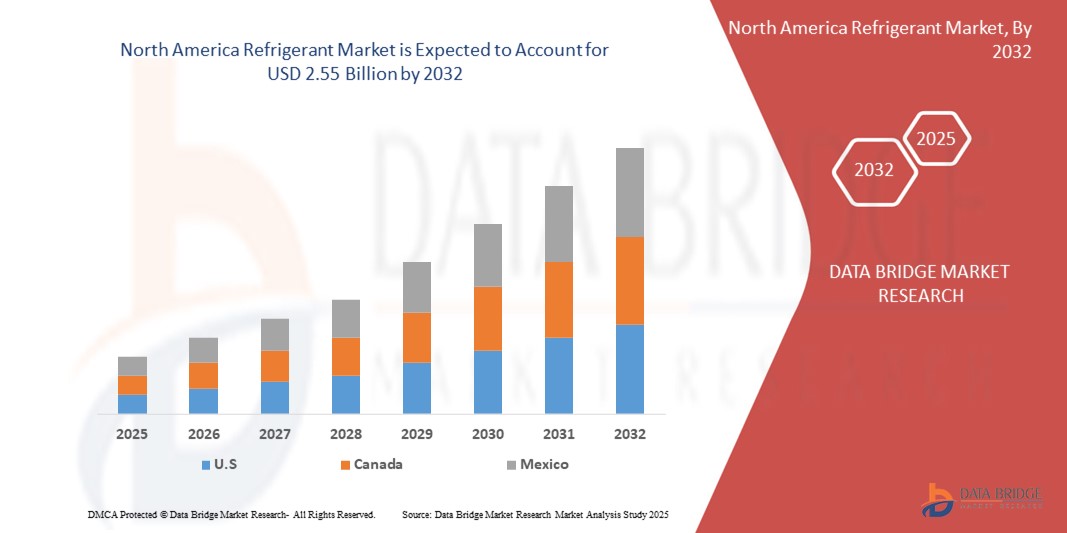
- The North America Refrigerant Market was valued at USD 1.62 billion in 2024 and is expected to reach USD 2.55 billion by 2032
- During the forecast period of 2025 to 2032 the market is likely to grow at a CAGR of 5.86%, primarily driven by the implementation of stringent environmental regulations
- This growth is driven by factors such as In response to these regulations, industries are increasingly adopting natural refrigerants such as carbon dioxide (CO₂), ammonia (NH₃), and hydrocarbons
Refrigerant Market Analysis
- Refrigerant is a chemical combination of fluids which operates in heat pumps and refrigeration cycling as cooling agents.
- They are extensively used in several applications such as residential, industrial, and commercial sectors and are also used in automotive industry.
- Major factors that are expected to boost the growth of the refrigerant market in the forecast period are the rise in the cold chain.
- Furthermore, the growing disposable income of the people is further anticipated to propel the growth of the refrigerant market.
- Moreover, the increase in the knowledge related to global warming and ozone depletion is further estimated to cushion the growth of the refrigerant market.
Report Scope and Refrigerant Market Segmentation
|
Attributes |
Refrigerant Key Market Insights |
|
Segments Covered |
|
|
Countries Covered |
North America
|
|
Key Market Players |
|
|
Market Opportunities |
|
|
Value Added Data Infosets |
In addition to the insights on market scenarios such as market value, growth rate, segmentation, geographical coverage, and major players, the market reports curated by the Data Bridge Market Research also include in-depth expert analysis, pricing analysis, brand share analysis, consumer survey, demography analysis, supply chain analysis, value chain analysis, raw material/consumables overview, vendor selection criteria, PESTLE Analysis, Porter Analysis, and regulatory framework. |
Refrigerant Market Trends
“Accelerating Shift Towards Natural Refrigerants”
- Industries like food processing and cold storage are increasingly implementing natural refrigerants to meet sustainability goals and reduce carbon footprints.
- Innovations such as transcritical CO₂ systems and microchannel heat exchangers have improved the efficiency and cost-effectiveness of natural refrigerant systems, making them viable even in warmer climates.
- Governments and industry bodies in North America are expanding incentives, rebates, and certification programs to support the adoption of natural refrigerants.
- For instance, California’s CARB offers financial incentives for businesses switching to low-GWP refrigerants, encouraging early adoption
- The North American refrigerant market is experiencing a paradigm shift towards natural refrigerants. This trend is expected to continue, aligning with global efforts to combat climate change and promote sustainable industrial practices.
Refrigerant Market Dynamics
Driver
“The Implementation of Stringent Environmental Regulations”
- The U.S. Environmental Protection Agency's (EPA) Significant New Alternatives Policy (SNAP) program promotes the transition to low-GWP refrigerants, phasing out substances like hydrofluorocarbons (HFCs).
- Similarly, Canada's commitment to the Kigali Amendment targets an 85% reduction in HFC consumption by 2036, aligning with global efforts to mitigate climate change.
- In response to these regulations, industries are increasingly adopting natural refrigerants such as carbon dioxide (CO₂), ammonia (NH₃), and hydrocarbons.
- These alternatives offer low GWP and are being utilized across various applications, including commercial refrigeration and industrial cooling systems.
For instance,
- Whole Foods Market implemented a commercial R290/CO₂ cascade refrigeration system in its Brooklyn, NY store, showcasing a commitment to sustainable practices.
- In summary, stringent environmental regulations are a pivotal driver in the North American refrigerant market, steering the industry towards sustainable practices. The collaborative efforts of regulatory agencies and industry stakeholders are fostering an environment conducive to innovation and environmental responsibility.
Opportunity
“Integration of Smart Technologies in Refrigeration Systems”
- The North American refrigerant market is witnessing a surge in the adoption of Internet of Things (IoT)-enabled refrigeration systems. These smart systems incorporate sensors and connectivity features that allow real-time monitoring of refrigerant levels, temperature, and system performance. Such capabilities enable predictive maintenance, reduce energy consumption, and extend the lifespan of refrigeration units.
- Smart refrigeration systems contribute to significant energy savings by optimizing cooling cycles and reducing unnecessary compressor usage. This not only lowers operational costs but also aligns with environmental regulations aimed at reducing greenhouse gas emissions.
- Industries such as food processing, pharmaceuticals, and data centers are increasingly adopting smart refrigeration solutions to ensure product quality and system reliability.
For instance,
- Data centers require efficient cooling systems to manage heat generated by servers, and smart refrigeration offers precise temperature control and fault detection, minimizing downtime and energy usage
- By enhancing energy efficiency, ensuring regulatory compliance, and meeting the growing demand in various sectors, smart refrigeration solutions are poised to drive market growth and innovation in the coming years.
Restraint/Challenge
“Transition to Low-Global Warming Potential (GWP) Refrigerants”
- Upgrading to eco-friendly refrigerants requires substantial financial investment. Retrofitting or replacing existing equipment can increase costs significantly, posing a significant burden, especially for small and medium-sized enterprises.
- Natural refrigerants like ammonia and hydrocarbons, while environmentally friendly, present operational challenges. Ammonia is toxic, hydrocarbons are flammable, and CO₂ systems operate at high pressures, necessitating specialized equipment and safety measures.
- The shortage of skilled technicians trained in handling new refrigerants hampers the transition. Many contractors lack familiarity with upcoming regulations and the technical know-how required for new systems.
- Addressing these challenges requires coordinated efforts, including financial incentives, standardized regulations, and comprehensive training programs, to facilitate a smoother transition to sustainable refrigerants in North America.
Refrigerant Market Scope
The market is segmented on the basis of type, product, and application.
|
Segmentation |
Sub-Segmentation |
|
By Type |
|
|
By Product |
|
|
By Application |
|
Refrigerant Market Regional Analysis
“U.S. is the Dominant Country in the Refrigerant Market”
- U.S. dominates the Refrigerant market due to its advanced industrial infrastructure, stringent environmental regulations, and substantial investments in HVAC technologies. The U.S. Environmental Protection Agency's Significant New Alternatives Policy (SNAP) program promotes the adoption of low-global-warming-potential refrigerants, accelerating the transition to eco-friendly alternatives. Additionally, the country's robust cold chain logistics network further supports the demand for advanced refrigeration systems, reinforcing its leading position in the market.
“U.S. is Projected to Register the Highest Growth Rate”
- U.S. is projected to register the highest compound annual growth rate (CAGR) in the North America Refrigerant Market. This growth is driven by the increasing need for energy-efficient cooling solutions in residential and commercial buildings supports the market expansion. The U.S. Department of Energy reports that residential and commercial cooling systems account for approximately 10% of total energy consumption, highlighting the importance of energy-efficient refrigerants.
Refrigerant Market Share
The market competitive landscape provides details by competitor. Details included are company overview, company financials, revenue generated, market potential, investment in research and development, new market initiatives, global presence, production sites and facilities, production capacities, company strengths and weaknesses, product launch, product width and breadth, application dominance. The above data points provided are only related to the companies' focus related to market.
The Major Market Leaders Operating in the Market Are:
- Honeywell International Inc. (U.S.)
- The Chemours Company (U.S.)
- Orbia (Mexico)
- Linde plc (U.K.)
- DuPont (U.S.)
- Airgas (U.S.)
Latest Developments in North America Refrigerant Market
- In April 2024, Honeywell International Inc. announced a partnership with Bosch, under which Bosch’s new heat pump range will incorporate Honeywell’s Solstice 454B refrigerant, known for its energy efficiency and low global warming potential (GWP).
- In May 2023, The Chemours Company signed an agreement with Zhejiang Juhua Co., Ltd. to expand production capacity for its ultra-low GWP HFO foaming agent, Opteon 1100, and specialty fluid Opteon SF33. This expansion will triple the output of HFO-1336MZZZ to address rising demand for sustainable, energy-efficient solutions. Production from this expansion is scheduled to start by late 2025, with full capacity expected in early 2026.
- In June 2023, Honeywell International Inc. announced the launch of Ireland’s first low-carbon district heating system in Tallaght, Dublin. This innovative network uses a heat pump powered by Honeywell’s Solstice ze (R-1234ze) refrigerant, celebrated for its very low GWP. The system is now operational and will contribute to Ireland’s 2030 and 2050 renewable energy targets as well as the European Union’s decarbonization plans under REPowerEU.
- In January 2022, Honeywell International Inc. introduced a new non-flammable, energy-efficient refrigerant, Solstice N71 (R-471A), developed to comply with stricter greenhouse gas emission reduction regulations.

- Interactive Data Analysis Dashboard
- Company Analysis Dashboard for high growth potential opportunities
- Research Analyst Access for customization & queries
- Competitor Analysis with Interactive dashboard
- Latest News, Updates & Trend analysis
- Harness the Power of Benchmark Analysis for Comprehensive Competitor Tracking
North America Refrigerant Market, Supply Chain Analysis and Ecosystem Framework
To support market growth and help clients navigate the impact of geopolitical shifts, DBMR has integrated in-depth supply chain analysis into its North America Refrigerant Market research reports. This addition empowers clients to respond effectively to global changes affecting their industries. The supply chain analysis section includes detailed insights such as North America Refrigerant Market consumption and production by country, price trend analysis, the impact of tariffs and geopolitical developments, and import and export trends by country and HSN code. It also highlights major suppliers with data on production capacity and company profiles, as well as key importers and exporters. In addition to research, DBMR offers specialized supply chain consulting services backed by over a decade of experience, providing solutions like supplier discovery, supplier risk assessment, price trend analysis, impact evaluation of inflation and trade route changes, and comprehensive market trend analysis.
Data collection and base year analysis are done using data collection modules with large sample sizes. The stage includes obtaining market information or related data through various sources and strategies. It includes examining and planning all the data acquired from the past in advance. It likewise envelops the examination of information inconsistencies seen across different information sources. The market data is analysed and estimated using market statistical and coherent models. Also, market share analysis and key trend analysis are the major success factors in the market report. To know more, please request an analyst call or drop down your inquiry.
The key research methodology used by DBMR research team is data triangulation which involves data mining, analysis of the impact of data variables on the market and primary (industry expert) validation. Data models include Vendor Positioning Grid, Market Time Line Analysis, Market Overview and Guide, Company Positioning Grid, Patent Analysis, Pricing Analysis, Company Market Share Analysis, Standards of Measurement, Global versus Regional and Vendor Share Analysis. To know more about the research methodology, drop in an inquiry to speak to our industry experts.
Data Bridge Market Research is a leader in advanced formative research. We take pride in servicing our existing and new customers with data and analysis that match and suits their goal. The report can be customized to include price trend analysis of target brands understanding the market for additional countries (ask for the list of countries), clinical trial results data, literature review, refurbished market and product base analysis. Market analysis of target competitors can be analyzed from technology-based analysis to market portfolio strategies. We can add as many competitors that you require data about in the format and data style you are looking for. Our team of analysts can also provide you data in crude raw excel files pivot tables (Fact book) or can assist you in creating presentations from the data sets available in the report.













