


North America Respiratory Masks Market Size
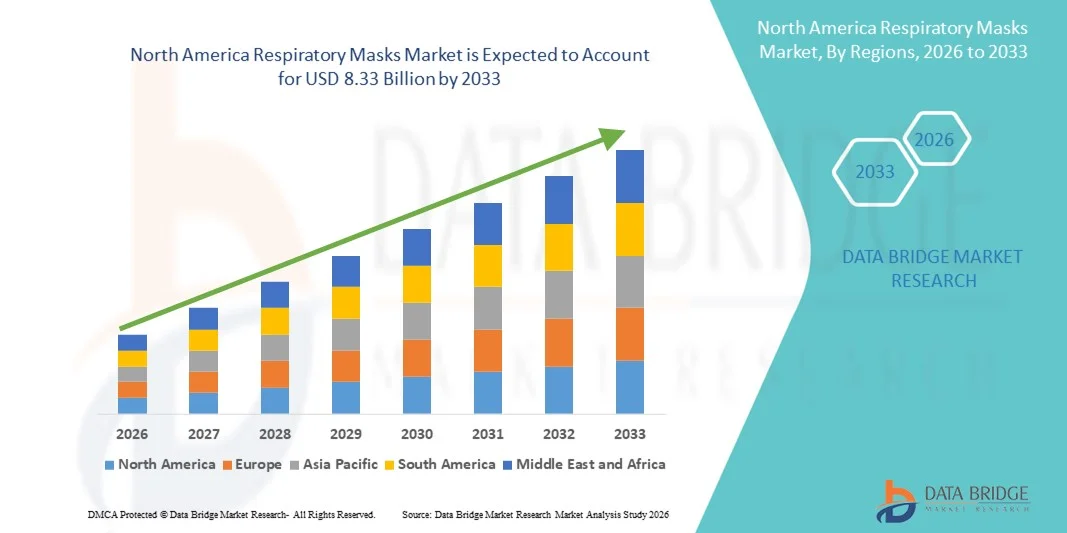
- The North America respiratory masks market size was valued at USD 4.34 billion in 2025 and is expected to reach USD 8.33 billion by 2033, at a CAGR of 8.5% during the forecast period
- The market growth is largely fueled by stringent occupational health and safety regulations, heightened awareness of respiratory hazards across industrial, healthcare, and construction sectors, and advancements in protective equipment technology that improve comfort, effectiveness, and compliance with safety standards
- Furthermore, rising demand for reliable respiratory protection in both commercial and institutional applications driven by post‑pandemic emphasis on worker and patient safety, expanding healthcare infrastructure, and growth in high‑risk industries such as oil & gas and manufacturing is establishing respiratory masks and related protective gear as essential safety solutions. These converging factors are accelerating the uptake of respiratory protective equipment across North America, thereby significantly boosting the industry’s growth
North America Respiratory Masks Market Analysis
- Respiratory masks, providing protective filtration against airborne particles, pathogens, and pollutants, are increasingly essential in both occupational and healthcare settings due to their critical role in safeguarding workers, patients, and the general public. Their importance spans industries such as healthcare, construction, manufacturing, and emergency response
- The escalating demand for respiratory masks is primarily fueled by stringent occupational health and safety regulations, heightened awareness of respiratory hazards, ongoing public health concerns, and a rising preference for high-efficiency, comfortable, and reusable protective equipment
- The United States dominated the North America respiratory masks market with the largest revenue share of 81.2% in 2025, characterized by advanced healthcare infrastructure, strict regulatory standards, high industrial safety compliance, and a strong presence of leading mask manufacturers
- Canada is expected to be the fastest growing country in the North America respiratory masks market during the forecast period due to rising industrial activities, growing awareness of occupational safety, and increasing healthcare investments
- FFP segment dominated the North America respiratory masks market in 2025 with a market share of 46.5%, driven by their high filtration efficiency, compliance with international safety standards, and widespread use in industrial, medical, and public safety applications
Report Scope and North America Respiratory Masks Market Segmentation
|
Attributes |
North America Respiratory Masks Key Market Insights |
|
Segments Covered |
|
|
Countries Covered |
North America
|
|
Key Market Players |
|
|
Market Opportunities |
|
|
Value Added Data Infosets |
In addition to the insights on market scenarios such as market value, growth rate, segmentation, geographical coverage, and major players, the market reports curated by the Data Bridge Market Research also include in-depth expert analysis, patient epidemiology, pipeline analysis, pricing analysis, and regulatory framework |
North America Respiratory Masks Market Trends
Enhanced Protection Through Advanced Filtration and Comfort
- A significant and accelerating trend in the North America respiratory masks market is the development of advanced filtration technologies combined with ergonomic designs, enhancing both protection and user comfort. This includes multi-layer filters, anti-fog features, and adjustable straps for extended wear
- For instance, 3M’s Aura 9300+ N95 masks feature high-efficiency filtration with breathable materials and a unique valve system, reducing heat and moisture buildup during prolonged use. Similarly, Honeywell’s H910 respirator series integrates soft sealing materials for improved comfort without compromising filtration
- Advanced materials and design improvements allow respiratory masks to maintain high filtration efficiency while reducing user fatigue, making them suitable for healthcare professionals, industrial workers, and the general public. For instance, Moldex models incorporate lightweight polypropylene layers and cushioned nose bridges for all-day wearability
- The integration of reusable components and adjustable features facilitates personalized fit and extended usability, helping users adhere to safety guidelines effectively. Through these innovations, users can achieve consistent protection in both medical and industrial environments
- Integration of antimicrobial coatings and odor-reducing layers in certain masks is also gaining traction, enhancing hygiene and user comfort over extended usage. For instance, Honeywell’s N95 masks with antimicrobial layers provide additional protection for healthcare workers during long shifts
- This trend towards more protective, comfortable, and user-friendly masks is fundamentally reshaping expectations for respiratory safety. Consequently, companies such as Kimberly-Clark are developing masks with improved fit, hypoallergenic materials, and adjustable straps to meet diverse user needs
- The demand for respiratory masks offering superior filtration, comfort, and durability is growing rapidly across healthcare, industrial, and public safety sectors, as consumers and organizations increasingly prioritize both safety and usability
North America Respiratory Masks Market Dynamics
Driver
Rising Awareness and Regulatory Enforcement for Workplace Safety
- The increasing awareness of airborne hazards in industrial, healthcare, and public settings, coupled with strict regulatory enforcement by OSHA and NIOSH, is a significant driver for heightened demand for respiratory masks
- For instance, in March 2025, 3M announced an expansion of its N95 respirator line for healthcare and industrial use, incorporating enhanced filtration to comply with updated safety standards. Such initiatives by key companies are expected to drive market growth in the forecast period
- As organizations implement stricter workplace safety protocols and individuals seek reliable protection from pollutants and pathogens, respiratory masks provide advanced filtration and certified safety levels, offering a clear upgrade over conventional face coverings
- Furthermore, ongoing public health awareness campaigns and post-pandemic hygiene measures are making masks an essential component of occupational and everyday safety, integrating seamlessly into both professional and personal protective equipment routines
- Convenience features such as adjustable straps, reusable options, and compatibility with protective eyewear are key factors propelling adoption in healthcare, industrial, and public safety sectors. The increasing availability of certified, easy-to-use masks further contributes to market growth
- Rising industrialization in the U.S. and Canada, particularly in manufacturing, oil & gas, and construction sectors, is boosting demand for protective respiratory equipment. For instance, large construction firms are mandating high-grade FFP masks for workers exposed to dust and airborne particles
- Increased government funding for public health preparedness, including stockpiling of high-efficiency respiratory masks, is supporting consistent demand. For instance, Canada’s public health agencies have invested in reserve supplies of N95 and surgical masks for emergency situations
Restraint/Challenge
Supply Chain Constraints and Cost Barriers
- Supply chain disruptions, fluctuating raw material costs, and dependency on specialized filtration media pose significant challenges to market expansion, potentially affecting availability and affordability
- For instance, shortages of melt-blown polypropylene during peak demand periods have delayed production and distribution of N95 and FFP masks, causing temporary supply gaps
- High-quality respiratory masks, particularly those meeting NIOSH or FDA standards, often come at a premium price, which can be a barrier for small businesses, budget-conscious healthcare providers, or individuals. For instance, premium reusable elastomeric respirators with replaceable filters carry higher upfront costs compared to standard disposable masks
- While companies are investing in local manufacturing and innovative materials to reduce dependency on imports, cost pressures and production challenges remain critical hurdles for widespread adoption, especially in smaller enterprises or rural markets
- Overcoming these challenges through improved supply chain management, cost-efficient manufacturing, and wider distribution of certified masks will be vital for sustained market growth in North America
- Environmental concerns regarding disposable masks and proper disposal practices are emerging as challenges, as increased usage generates significant waste. For instance, hospitals and industrial sites are seeking eco-friendly alternatives or recycling programs for used masks
- Regulatory compliance and frequent updates in standards for industrial and medical respiratory masks require manufacturers to adapt continuously. For instance, frequent revisions by NIOSH and FDA necessitate product redesigns to maintain certification, affecting production timelines and costs
North America Respiratory Masks Market Scope
The market is segmented on the basis of type, usability, age, material, application, end user, and distribution channel.
- By Type
On the basis of type, the North America respiratory masks market is segmented into FFP, common grade surgical masks, non-medical grade respiratory masks, and other. The FFP masks segment dominated the market with the largest market revenue share of 46.5% in 2025, driven by their superior filtration efficiency, certified compliance with NIOSH and EN standards, and wide adoption across healthcare, industrial, and public safety sectors. Hospitals, manufacturing plants, and oil & gas companies prefer FFP masks for their ability to protect against fine airborne particles and pathogens. The segment’s dominance is reinforced by innovations such as adjustable straps, valve-equipped designs for breathability, and reusable models that reduce long-term costs. FFP masks are also preferred by first responders and emergency personnel due to their consistent protection during extended operations. Consumer awareness about the effectiveness of FFP masks further strengthens their market share.
The Common Grade Surgical Masks segment is expected to witness the fastest growth at a CAGR of 9.5% from 2026 to 2033, fueled by rising adoption in outpatient healthcare facilities, homecare settings, and public use. Surgical masks are perceived as convenient, affordable, and easy-to-use solutions for routine protection against airborne particles and droplets. The increasing awareness of respiratory hygiene post-pandemic and growing adoption in schools, offices, and commercial spaces are driving this growth. Manufacturers are also producing lighter, more breathable surgical masks with enhanced moisture control. Easy availability and bulk supply options make surgical masks attractive for everyday use. Product designs with improved fit and comfort are further enhancing consumer adoption.
- By Usability
On the basis of usability, the market is segmented into reusable and disposable. The Disposable masks segment dominated the market with a revenue share of 55% in 2025, owing to their convenience, ease of distribution, and minimal maintenance requirements. Disposable masks, including N95/FFP2 and surgical masks, are widely used in healthcare, public safety, and industrial sectors, especially for short-term or high-traffic applications. Hospitals, clinics, and industrial sites prefer disposable masks to reduce cross-contamination risks and maintain hygiene standards. Bulk availability and affordable pricing further drive adoption in medical and industrial applications. Consumer preference for single-use masks in public settings also supports dominance. Continuous regulatory compliance reinforces the market share of disposable masks.
The Reusable masks segment is expected to witness the fastest growth at a CAGR of 10.2% from 2026 to 2033, driven by rising environmental concerns, increasing preference for cost-effective long-term solutions, and development of high-efficiency reusable respirators. Reusable masks with replaceable filters are gaining traction in industrial and healthcare applications. They offer sustained protection while reducing waste. Enhanced comfort features, such as adjustable straps and cushioning, make them suitable for long shifts. Growing awareness of sustainable alternatives is supporting adoption among individual consumers. Manufacturers are also innovating with antimicrobial coatings to enhance safety and hygiene.
- By Age
On the basis of age, the market is segmented into pediatric and adult. The Adult segment dominated the market with a revenue share of 82% in 2025, due to higher occupational exposure, industrial use, and healthcare requirements among adults. Adult masks are widely deployed in hospitals, construction sites, manufacturing plants, and public safety organizations where prolonged wear and higher filtration are essential. Availability of various designs, including FFP, surgical, and non-medical masks, tailored for adult face sizes, reinforces the dominance of this segment. Professionals in high-risk environments rely heavily on adult masks. Government and regulatory guidelines prioritize adult mask use in workplaces. Continuous innovation in adult mask design also maintains market leadership.
The Pediatric segment is expected to witness the fastest growth at a CAGR of 11% from 2026 to 2033, fueled by rising awareness of respiratory safety among children in schools, daycare centers, and public spaces. Child-friendly designs with adjustable straps, colorful prints, and comfortable materials improve compliance. Manufacturers are introducing multi-layered masks with filter pockets for enhanced protection. Increased concern about seasonal respiratory illnesses and air pollution is driving adoption. Public health campaigns emphasize pediatric mask use in crowded environments. Pediatric masks are also increasingly incorporated in homecare settings for family protection.
- By Material
On the basis of material, the market is segmented into Polypropylene (PP), polyurethane, polyester, cotton, and others. The Polypropylene (PP) segment dominated the market with a revenue share of 50% in 2025, owing to its widespread use in high-efficiency masks such as N95, FFP2, and surgical masks. PP offers excellent filtration efficiency, durability, and affordability, making it ideal for healthcare, industrial, and public safety applications. Its non-woven structure ensures consistent performance against airborne particles while maintaining comfort. The availability of PP masks in disposable and reusable formats further strengthens adoption. Industrial, healthcare, and emergency services heavily rely on PP masks. Continuous R&D improves filtration and breathability in PP-based masks.
The Cotton segment is expected to witness the fastest growth at a CAGR of 12% from 2026 to 2033, driven by consumer preference for breathable, hypoallergenic, and reusable masks for everyday use. Cotton masks are gaining popularity in public, homecare, and office settings, especially among individuals seeking sustainable and washable alternatives. Innovations such as multi-layer cotton masks with filter pockets enhance their protective performance. Comfortable and soft fabric increases compliance among all age groups. Growing focus on eco-friendly and reusable masks supports this segment. Cotton masks are also increasingly used in schools and offices for prolonged use.
- By Application
On the basis of application, the market is segmented into military, industrial, public, medical, and others. The Medical segment dominated the market with a revenue share of 48% in 2025, due to the critical need for high-protection masks in hospitals, clinics, and healthcare facilities. Medical professionals rely on N95/FFP2 and surgical masks for protection against airborne pathogens and infections. Continuous innovations in fit, comfort, and filtration efficiency further drive adoption. Regulatory compliance and government mandates also reinforce dominance. Hospitals and healthcare providers prioritize certified masks for patient and staff safety. Medical mask usage is supported by increasing awareness of infection control.
The Industrial segment is expected to witness the fastest growth at a CAGR of 10.8% from 2026 to 2033, fueled by increased safety regulations in construction, manufacturing, oil & gas, and chemical industries. Industrial workers require high-efficiency masks with features such as valve-based breathability, adjustable straps, and long-duration wear comfort. Rising awareness of occupational hazards and mandatory use of protective equipment accelerate adoption. Companies are investing in ergonomic designs to reduce fatigue. Growth in infrastructure and heavy industries further drives demand. Industrial masks are increasingly integrated into employee safety programs.
- By End User
On the basis of end user, the market is segmented into hospitals and clinics, homecare setting, public safety service organizations, oil & gas companies, manufacturing companies, construction companies, and others. The Hospitals and Clinics segment dominated the market with a revenue share of 44% in 2025, driven by the high demand for protective respiratory masks among healthcare professionals and patients. Continuous use in surgeries, patient care, and high-risk procedures necessitates high-efficiency masks. Hospitals prefer certified masks with proven filtration and comfort for prolonged wear. Bulk procurement and adherence to regulatory guidelines reinforce dominance. Medical staff compliance programs increase usage. Hospitals also invest in reusable and high-quality masks to reduce operational costs.
The Construction Companies segment is expected to witness the fastest growth at a CAGR of 11.5% from 2026 to 2033, due to rising industrialization, stringent workplace safety standards, and the need to protect workers from dust, particulate matter, and chemical exposure. Adoption is accelerated by the introduction of ergonomically designed, reusable, and high-filtration masks suitable for long-duration outdoor use. Construction sites increasingly mandate certified FFP masks for compliance. Rising awareness of occupational health is driving enforcement. Companies are training workers for proper mask usage. Growth in large-scale infrastructure projects further supports segment expansion.
- By Distribution Channel
On the basis of distribution channel, the market is segmented into direct tenders, retail, online pharmacies, and others. The Direct Tenders segment dominated the market with a revenue share of 41% in 2025, driven by bulk procurement by hospitals, industrial organizations, and government agencies. Direct tendering ensures supply continuity, cost efficiency, and compliance with regulatory standards. Large-scale buyers prefer direct contracts for long-term supply and quality assurance. Hospitals, manufacturing plants, and oil & gas companies rely on tenders for consistency. Government initiatives and emergency stockpiling also reinforce dominance. The ease of managing large orders and warranties attracts buyers.
The Online Pharmacies segment is expected to witness the fastest growth at a CAGR of 13% from 2026 to 2033, fueled by increasing e-commerce adoption, convenience of doorstep delivery, and growing consumer preference for purchasing certified masks online. Online platforms offer wider product variety, reviews, and subscription services, enhancing accessibility. Individuals and small businesses find online channels convenient for bulk or recurring purchases. Ease of comparison and access to certified products supports rapid adoption. Growing digital literacy and urban internet penetration accelerate growth. Manufacturers are also promoting direct-to-consumer online sales.
North America Respiratory Masks Market Regional Analysis
- The United States dominated the North America respiratory masks market with the largest revenue share of 81.2% in 2025, characterized by advanced healthcare infrastructure, strict regulatory standards, high industrial safety compliance, and a strong presence of leading mask manufacturers
- Consumers and organizations in the region prioritize respiratory safety, valuing high-efficiency filtration, comfort, and compliance with standards such as NIOSH and FDA. The demand for masks that provide reliable protection against airborne particles, pathogens, and pollutants is especially high in hospitals, manufacturing plants, and public safety operations
- This widespread adoption is further supported by advanced healthcare infrastructure, stringent workplace safety regulations, high industrial compliance, and a strong presence of leading mask manufacturers. Growing awareness of air quality, post-pandemic hygiene practices, and the need for protection in high-risk environments are establishing respiratory masks as essential safety solutions for both professional and personal use
U.S. Respiratory Masks Market Insight
The U.S. respiratory masks market captured the largest revenue share of 81.2% in 2025 within North America, driven by high awareness of occupational and public health safety, stringent regulatory enforcement, and widespread adoption of certified protective masks across healthcare, industrial, and construction sectors. Consumers and organizations increasingly prioritize respiratory safety, favoring high-efficiency filtration masks that protect against airborne pathogens, pollutants, and fine dust. The growing adoption of reusable and disposable masks, coupled with advanced designs offering comfort and durability, further propels market growth. Moreover, the integration of masks in workplace safety programs and public health initiatives significantly supports the expansion of the U.S. market.
Canada Respiratory Masks Market Insight
The Canada respiratory masks market is expected to grow at a robust CAGR during the forecast period, primarily driven by increasing awareness of air quality, rising industrialization, and stricter workplace safety regulations. The country is witnessing growing adoption in healthcare facilities, industrial sites, and public safety organizations, where high-efficiency masks are essential for protecting staff and workers. Canadian consumers are also prioritizing comfort and reusable mask options for everyday use. Government initiatives supporting public health preparedness and emergency stockpiling are further boosting market growth. The rising focus on sustainable and eco-friendly mask solutions is expected to accelerate adoption across residential and commercial applications.
Mexico Respiratory Masks Market Insight
The Mexico respiratory masks market is projected to expand steadily at a notable CAGR during the forecast period, driven by rising industrialization, urban air pollution, and growing awareness of occupational health and safety standards. Industrial and construction sectors are increasingly enforcing mask usage among workers to mitigate exposure to dust, chemicals, and airborne particles. Healthcare facilities and public institutions are adopting certified surgical and FFP masks to prevent the spread of infectious diseases. Consumers are also seeking comfortable, easy-to-use masks for public and household use. Government campaigns promoting respiratory safety and partnerships with local mask manufacturers are supporting market growth.
North America Respiratory Masks Market Share
The North America Respiratory Masks industry is primarily led by well-established companies, including:
- 3M (U.S.)
- Honeywell International Inc. (U.S.)
- Kimberly‑Clark Corporation (U.S.)
- MSA Safety Incorporated (U.S.)
- Alpha Pro Tech Ltd (Canada)
- Avon Protection PLC (U.K.)
- Bullard (U.S.)
- Gentex Corporation (U.S.)
- Prestige Ameritech (U.S.)
- Gateway Safety (U.S.)
- Moldex‑Metric, Inc. (U.S.)
- Radians Inc (U.S.)
- DuPont de Nemours, Inc. (U.S.)
- Ansell Limited (Australia)
- Protective Industrial Products, Inc. (U.S.)
- Lakeland Industries, Inc. (U.S.)
- Gerson Companies, Inc. (U.S.)
- RPB Safety LLC (U.S.)
- Intech Safety (U.S.)
What are the Recent Developments in North America Respiratory Masks Market?
- In October 2025, the National Institute for Occupational Safety and Health (NIOSH) announced the latest voluntary rescissions of respirator approvals, affecting hundreds of respirator models from major manufacturers such as 3M and others. This affects products that can legally be sold or used in occupational settings, and requires organizations to update their PPE inventories accordingly
- In October 2025, NIOSH released an updated Chemical, Biological, Radiological, and Nuclear (CBRN) Respiratory Protection Handbook, announcing that over 500 respirators with CBRN protections are approved, enhancing guidance for emergency responders and safety professionals
- In September 2025, public health authorities in New Brunswick, Canada reinstated mandatory masking policies in certain healthcare settings due to a rise in respiratory illnesses, reflecting renewed operational use of medical and surgical masks in clinical environments
- In March 2025, the CDC’s NIOSH Respirator Approval Program updates its Approved® list and guidance materials, including updates to how employers and users identify compliant respirators and watch for fraudulent products, improving workplace respiratory safety compliance across the U.S.
- In March 2023, Canadian PPE manufacturers publicly expressed frustration with federal contracts favoring U.S. suppliers, highlighting ongoing supply chain and industry structure issues impacting domestic mask and respirator production capacity in Canada

- Interactive Data Analysis Dashboard
- Company Analysis Dashboard for high growth potential opportunities
- Research Analyst Access for customization & queries
- Competitor Analysis with Interactive dashboard
- Latest News, Updates & Trend analysis
- Harness the Power of Benchmark Analysis for Comprehensive Competitor Tracking
Data collection and base year analysis are done using data collection modules with large sample sizes. The stage includes obtaining market information or related data through various sources and strategies. It includes examining and planning all the data acquired from the past in advance. It likewise envelops the examination of information inconsistencies seen across different information sources. The market data is analysed and estimated using market statistical and coherent models. Also, market share analysis and key trend analysis are the major success factors in the market report. To know more, please request an analyst call or drop down your inquiry.
The key research methodology used by DBMR research team is data triangulation which involves data mining, analysis of the impact of data variables on the market and primary (industry expert) validation. Data models include Vendor Positioning Grid, Market Time Line Analysis, Market Overview and Guide, Company Positioning Grid, Patent Analysis, Pricing Analysis, Company Market Share Analysis, Standards of Measurement, Global versus Regional and Vendor Share Analysis. To know more about the research methodology, drop in an inquiry to speak to our industry experts.
Data Bridge Market Research is a leader in advanced formative research. We take pride in servicing our existing and new customers with data and analysis that match and suits their goal. The report can be customized to include price trend analysis of target brands understanding the market for additional countries (ask for the list of countries), clinical trial results data, literature review, refurbished market and product base analysis. Market analysis of target competitors can be analyzed from technology-based analysis to market portfolio strategies. We can add as many competitors that you require data about in the format and data style you are looking for. Our team of analysts can also provide you data in crude raw excel files pivot tables (Fact book) or can assist you in creating presentations from the data sets available in the report.













